

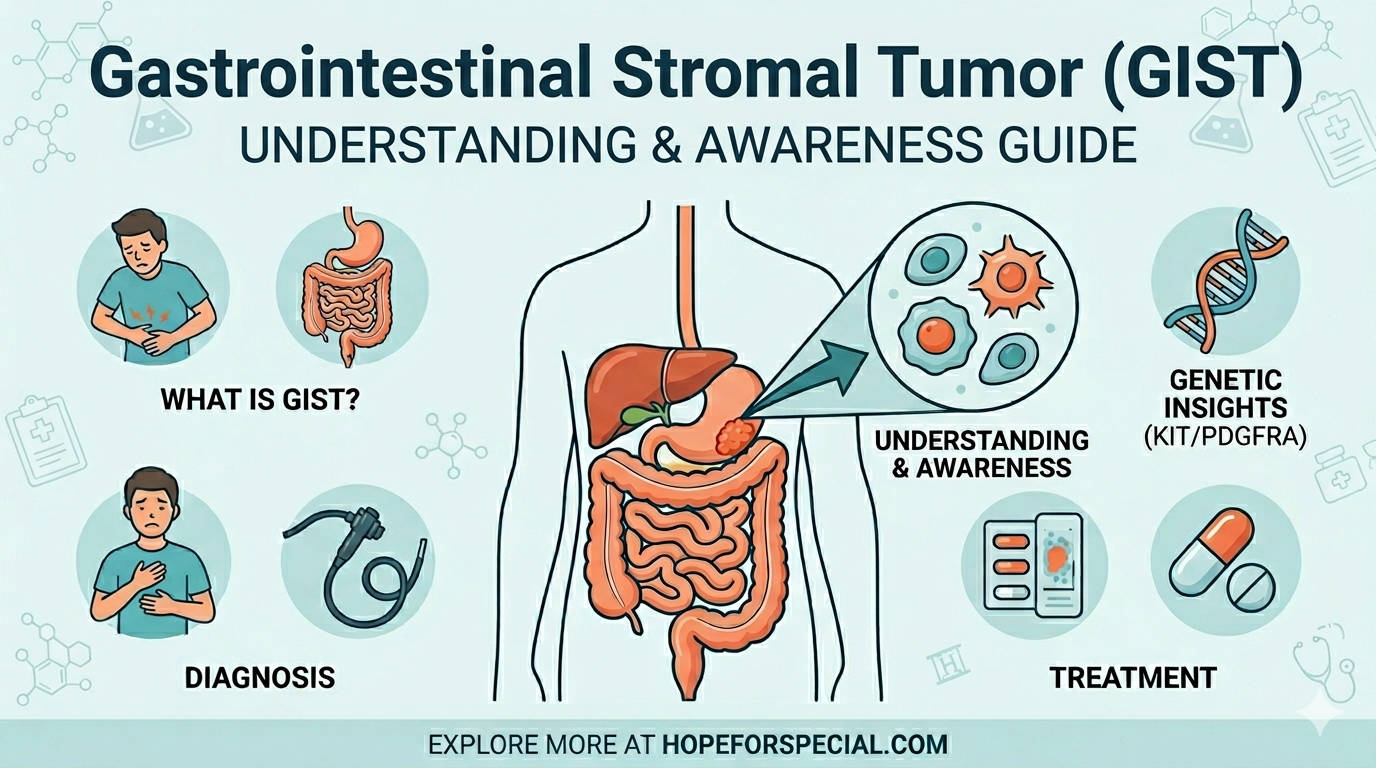
🎗️ Gastrointestinal Stromal Tumor (GIST) 2026: The Devastating Cancer Most Families Have Never Heard Of
For families in the special needs community, understanding Gastrointestinal Stromal Tumor (GIST) matters deeply. Children can develop GIST. Its symptoms overlap with many common digestive complaints. And because it is rare, it is frequently misdiagnosed — sometimes for months.
Early knowledge saves lives.

- 🔬 What Is a Gastrointestinal Stromal Tumor (GIST) — and Why Should Every Parent Know About It?
- 📊 GIST Statistics 2026: The Numbers Behind This Rare Cancer
- 🧬 What Causes GIST? The Biology Every Parent Deserves to Understand
- 🚨 GIST Symptoms: What Families Should Never Dismiss
- 👶 Paediatric GIST
- How Common Is GIST in Children?
- A Story That Shows Why Awareness Matters
- Key Differences Between Adult and Paediatric GIST
- 🩺 How Is GIST Diagnosed? The Step-by-Step Process
- 💊 GIST Treatment 2026: What Is Available — and What Has Changed
- 🏥 Surgery: Still the Gold Standard for Localised GIST
- 💊 FDA-Approved Targeted Therapies for GIST: The Complete 2026 Guide
- 🌟 Breakthrough 1: Avapritinib — A Game-Changer for PDGFRA D842V Mutation
- 🌟 Breakthrough 2: Ripretinib — For the Hardest-to-Treat GIST
- 💊 What About Imatinib? Still the Foundation of GIST Treatment
- 🧬 Emerging Treatments for Paediatric Wild-Type GIST
- 📈 GIST Survival Rates 2026: The Encouraging Truth
- 💔 GIST and the Family: The Hidden Emotional Burden
- 🧩 About GIST
- 🛡️ How to Advocate for Your Child: The GIST Parent’s Action Guide
- 🔗 Trusted GIST Resources for Families
- ❓ FAQs: Gastrointestinal Stromal Tumor (GIST)
- Q: What is a Gastrointestinal Stromal Tumor (GIST) in simple terms?
- Q: Can children get a Gastrointestinal Stromal Tumor (GIST)?
- Q: What are the first signs of GIST?
- Q: What is the survival rate for GIST?
- Q: How is GIST treated?
- Q: What is the difference between adult and paediatric GIST?
- Q: Is GIST hereditary?
- Q: Are there clinical trials for GIST?
- 💙 A Final Word — Because Rare Doesn’t Mean Unimportant
🔬 What Is a Gastrointestinal Stromal Tumor (GIST) — and Why Should Every Parent Know About It?
A Gastrointestinal Stromal Tumor (GIST) is a rare type of cancer that starts in the walls of the gastrointestinal (GI) tract — the digestive system that runs from the mouth to the anus. In simple words: it is a tumour that grows in the specialized cells lining the gut, most commonly in the stomach or small intestine.
Current estimates for the total number of GIST cases diagnosed each year in the United States range from about 4,000 to about 6,000.
These tumors can start anywhere in the GI tract, but they occur most often in the stomach (about 60%) or the small intestine (about 35%). (Source: American Cancer Society)
📊 GIST Statistics 2026: The Numbers Behind This Rare Cancer
Gastrointestinal stromal tumors (GISTs) are the most common subtype of sarcoma, with an incidence of approximately 1.2 cases per 100,000 individuals per year. (Source: Pathology & Oncology Research, 2025)
| Statistic | Figure | Source |
|---|---|---|
| US GIST cases diagnosed annually | 4,000 – 6,000 | American Cancer Society |
| Global incidence (per 100,000/year) | ~1.2 cases | PMC / Pathology & Oncology Research, 2025 |
| Most common GIST location | Stomach (~60%) | ACS |
| Second most common location | Small intestine (~35%) | ACS |
| Overall 5-year cancer-specific survival rate | ~81.3% | PMC / SEER Database |
| 5-year survival — metastatic GIST | Exceeds 50% | PMC / SEER Database |
| Annual incidence increase (2010–2019) | +2.4% per year | PMC / SEER Database |
| Pediatric GIST (under age 18) | 1–2% of all GIST cases | PMC / Life Raft Group |
| Median age of diagnosis (early-onset cases) | 43 years | PMC, 2025 |
| Median age of diagnosis (standard onset) | 60 years | PMC |
| Patients potentially undertreated | ~7% | PMC / SEER |
| KIT or PDGFRA mutations driving adult GIST | ~85–90% of cases | PMC / Life Raft Group |
From 2010 to 2019, the age-standardised incidence rate of GIST increased from 0.79 to 1.02 per 100,000 person-years, with an increase of 2.4% annually. The increase was across age and sex subgroups. (Source: PMC / SEER Database)
These numbers tell a clear story. Gastrointestinal Stromal Tumor (GIST) is becoming more common. Detection is improving. And when caught early, outcomes are genuinely encouraging.
🧬 What Causes GIST? The Biology Every Parent Deserves to Understand
Gastrointestinal Stromal Tumor (GIST) begins in very specific cells in the wall of the digestive tract — the interstitial cells of Cajal (ICCs). These are sometimes called the “pacemaker cells” of the gut because they regulate the rhythmic muscle movements that move food through the digestive system.
Gastrointestinal stromal tumors (GISTs) are rare mesenchymal neoplasms arising from the interstitial cells of Cajal. Pediatric GISTs differ significantly from adult cases in their clinical and molecular characteristics. (Source: PMC — Pediatric GIST Case Report)
When the DNA inside these cells develops an error — a mutation — the cells begin to grow uncontrollably. In the majority of adult GIST cases, this mutation happens in one of two genes:
| Gene | % of Adult GIST Cases | What It Does |
|---|---|---|
| KIT gene (c-KIT) | ~75–80% | Produces a protein that normally helps regulate cell growth |
| PDGFRA gene | ~10% | Another growth-signalling protein; certain mutations (like D842V) are especially important |
| Wild-type GIST (no KIT/PDGFRA mutation) | ~10–15% | More common in children; may involve SDH, NF1, or other pathways |
This distinction matters enormously. Because most paediatric GISTs are wild-type — meaning they do not have the KIT or PDGFRA mutations common in adults. This fundamentally changes how they are treated.
The etiologies of adult and pediatric GIST appear to be different, with adult GISTs being primarily driven by KIT or PDGFRα mutations. (Source: PMC / Life Raft Group Observational Registry)
GIST and Genetic Syndromes: What Special Needs Parents Must Know 🔴
For families in the special needs community, this is one of the most critical connections.
Certain genetic conditions significantly increase the risk of developing Gastrointestinal Stromal Tumor (GIST):
| Genetic Condition | Connection to GIST |
|---|---|
| Neurofibromatosis Type 1 (NF1) | Associated with wild-type GIST; increased lifetime risk |
| Carney Triad | GIST + paraganglioma + pulmonary chondroma occurring together |
| Carney-Stratakis Syndrome | Hereditary GIST + paraganglioma via SDH gene mutations |
| SDH (Succinate Dehydrogenase) Deficiency | Associated with pediatric and young adult wild-type GIST |
In addition to GIST, pediatric patients often develop paragangliomas and/or chondromas. When any two of these three are present, it supports a diagnosis of Carney’s Triad. (Source: PMC / Life Raft Group)
If your child has NF1, a known SDH mutation, or a family history of any of the above conditions, ask your specialist specifically whether GIST monitoring is recommended. This conversation could matter more than you know.
🚨 GIST Symptoms: What Families Should Never Dismiss
One of the most dangerous aspects of Gastrointestinal Stromal Tumor (GIST) is that its early symptoms are often subtle, non-specific, and easy to attribute to other causes — especially in children who already have complex health profiles.
Early Warning Signs of GIST
- 🔴 Abdominal pain or discomfort — persistent, often without an obvious cause
- 🔴 Nausea and vomiting — especially when accompanied by blood (haematemesis)
- 🔴 Tarry or dark stools — a sign of bleeding in the upper GI tract
- 🔴 A palpable abdominal mass — a lump that can sometimes be felt through the abdomen
- 🔴 Loss of appetite and unexplained weight loss
- 🔴 A feeling of fullness after eating very little
- 🔴 Difficulty swallowing — if the tumour is in the oesophagus
Symptoms of GIST in children include hematemesis (vomiting blood), anemia accompanied by fatigue, and tarry stools. (Source: GIST Support International)
Why GIST Symptoms Get Missed — Especially in Special Needs Children ⚠️
For families already navigating a child’s disability, special health needs, or complex medical history, GIST warning signs can be particularly easy to miss:
- Children with autism or communication difficulties may not be able to articulate internal pain clearly
- Children with gastrointestinal issues as a known feature of their condition (common in Down syndrome, autism, and other conditions) may have abdominal symptoms routinely attributed to their existing diagnosis
- Anaemia and fatigue are common in many special needs conditions and may not immediately trigger alarm
- Non-verbal children showing signs of pain through behavioural changes may be misread
The key question to ask:
Is this symptom new?
Is it getting worse over time?
Is there any unexplained weight loss or blood in the stool or vomit?
If the answer to any of these is yes — push for investigation beyond the existing diagnosis.
👶 Paediatric GIST
GIST does occur in children — and when it does, it behaves differently, requires different treatment, and has different outcomes. This is the section the HopeForSpecial community needs most.
How Common Is GIST in Children?
GIST in children is rare and patients under the age 18 account for 1–2% of cases. (Source: PMC / Life Raft Group Observational Registry) That is small in percentage terms — but given that 4,000–6,000 cases are diagnosed in the US each year, it still means dozens of children are affected annually.

A Story That Shows Why Awareness Matters
In a 2025 published case report, a 12-year-old child was brought to hospital with abdominal pain, vomiting, and unexplained weight loss.
The true diagnostic challenge in this case lay in the nonspecific initial symptoms — abdominal pain, vomiting, and weight loss without a palpable mass — and the extreme rarity of pediatric GIST, which can mimic more common conditions and delay clinical suspicion.
Initial treatment with imatinib was followed by emergent surgical intervention due to tumor bleeding. Histopathology confirmed an epithelioid-type GIST, necessitating continued imatinib therapy. (Source: PMC — Pediatric GIST Case Report, 2025)
The same case report concluded: Pediatric GISTs demonstrate an indolent but unpredictable course, requiring a multidisciplinary approach.
Despite their aggressive nature, pediatric cases show better survival outcomes than adults. This case underscores the importance of timely intervention, individualized therapy, and long-term follow-up to improve prognosis in children with GISTs. (Source: PMC)
Key Differences Between Adult and Paediatric GIST
| Feature | Adult GIST | Paediatric GIST |
|---|---|---|
| Most common mutation | KIT or PDGFRA (~85–90%) | Wild-type (no KIT/PDGFRA) — majority |
| Response to imatinib (Gleevec) | Very good (ORR >80% in KIT+) | Often poor (wild-type resistance) |
| Associated syndromes | Rare | Carney Triad, Carney-Stratakis, SDH deficiency common |
| Location | Stomach (most common) | Stomach (most common) but can be multifocal |
| Tumour spread to lymph nodes | Rare | More common |
| Long-term prognosis | Depends on stage | Often surprisingly good despite aggressive appearance |
| Gender predominance | Slight male predominance | Slight female predominance in children |
As most pediatric GISTs are wild-type, non-standard kinase inhibitors — such as larotrectinib and entrectinib — could be applied in such cases.
Nevertheless, there is still limited data regarding their administration, especially in pediatric patients. (Source: MDPI / Cancers, 2022)
🩺 How Is GIST Diagnosed? The Step-by-Step Process
Diagnosing a Gastrointestinal Stromal Tumor (GIST) requires several tests working together. No single test confirms GIST alone.
Here is what the diagnostic journey typically looks like:
| Diagnostic Step | What It Does |
|---|---|
| CT scan (abdomen/pelvis) | Identifies the location, size, and extent of the mass |
| MRI scan | Detailed soft tissue imaging; preferred for rectal GIST |
| PET scan | Assesses tumour activity; especially useful for monitoring treatment response |
| Endoscopy / EUS (endoscopic ultrasound) | Views and samples tumours in the stomach or intestine directly |
| Biopsy (CT-guided or surgical) | Tissue sample for pathological confirmation |
| Immunohistochemistry (IHC) | Tests tissue for CD117 (KIT protein) and DOG-1 markers — both typically positive in GIST |
| Molecular / genetic testing | Identifies specific mutations (KIT exon 9, 11, 13, 17; PDGFRA exon 18; SDH deficiency) to guide treatment |
The CD117 (c-KIT) and DOG-1 immunohistochemistry markers are the diagnostic cornerstones of GIST. Most GISTs test positive for CD117 — this is what distinguishes GIST from other soft tissue tumours.
⚠️ Critical for paediatric cases: Molecular testing is especially important in children because wild-type GISTs (which lack KIT/PDGFRA mutations) require completely different treatment strategies.
Always insist that the biopsy includes full molecular profiling at a specialist sarcoma centre.
💊 GIST Treatment 2026: What Is Available — and What Has Changed
The treatment landscape for Gastrointestinal Stromal Tumor (GIST) has transformed more dramatically than almost any other cancer in the past 25 years.
The introduction of targeted therapy has turned GIST from a largely untreatable disease into one with genuinely encouraging long-term outcomes for many patients.
🏥 Surgery: Still the Gold Standard for Localised GIST
Surgery should remain the mainstay of treatment in GIST and EGIST patients. The neoplasm appears to be resistant to radiotherapy, and its side effects may worsen patient survival. (Source: PMC / NCBI — SEER analysis, 2026)
For localised (non-metastatic) GIST, complete surgical removal of the tumour is the primary goal.
In children, laparoscopic surgery with lymph node excision is proposed as the method of choice, with MRI, ultrasound, and PET imaging for ongoing monitoring control. (Source: MDPI / Cancers)
💊 FDA-Approved Targeted Therapies for GIST: The Complete 2026 Guide
The revolution in GIST treatment began with imatinib (Gleevec) — and has continued to expand with each new approval.
Here is the full picture of today’s treatment options:
| Drug (Brand Name) | FDA Approval | Line of Treatment | Best For |
|---|---|---|---|
| Imatinib (Gleevec) | 2002 | 1st line | KIT/PDGFRA-mutant GIST; most adult cases |
| Sunitinib (Sutent) | 2006 | 2nd line | After imatinib resistance or intolerance |
| Regorafenib (Stivarga) | 2013 | 3rd line | After imatinib + sunitinib failure |
| Avapritinib (Ayvakit) | 2020 | 1st line (specific mutation) | PDGFRA exon 18 D842V-mutant GIST |
| Ripretinib (Qinlock) | 2020 | 4th line | Multi-resistant GIST after ≥3 prior TKIs |
Not only did clinical trials lead to Gleevec as the first treatment for GIST, but they have also helped to find other drugs that can be used if Gleevec doesn’t work or if its effectiveness declines.
Drugs like Sutent, Stivarga, Ayvakit (avapritinib), and Qinlock (ripretinib) are all FDA-approved drugs for GIST because of successful clinical trials. (Source: The Life Raft Group)
🌟 Breakthrough 1: Avapritinib — A Game-Changer for PDGFRA D842V Mutation
In January 2020, the FDA approved avapritinib with Breakthrough Therapy designation for patients with GISTs harboring PDGFRA exon 18 mutations including D842V following the NAVIGATOR trial.
For patients harboring the PDGFRA D842V mutation, the overall response rate was 88%. The median duration of response was not yet reached with a median follow-up of 15.9 months. (Source: PMC / Avapritinib Case Series India)
An 88% response rate is extraordinary for any cancer treatment. For patients with PDGFRA D842V mutations — a subgroup previously almost impossible to treat effectively — avapritinib represents a transformation in outcomes.
🌟 Breakthrough 2: Ripretinib — For the Hardest-to-Treat GIST
The ripretinib arm had a median progression-free survival of 6.3 months compared with 1 month in the placebo arm, significantly reducing the risk of disease progression or death by 85% (hazard ratio of 0.15).
Median overall survival was also superior in the ripretinib arm: 15.1 months compared with the placebo arm. (Source: PMC / Avapritinib and Ripretinib Review)
Ripretinib has emerged as a new standard of care for advanced, multi-resistant GIST patients. The Food and Drug Administration granted approval of ripretinib for GIST patients after progression to imatinib, sunitinib, and regorafenib.
This constitutes a major breakthrough in sarcoma drug development, as there had not been new treatment approvals in GIST for nearly a decade. (Source: PMC / Ripretinib Review)
💊 What About Imatinib? Still the Foundation of GIST Treatment
Imatinib (Gleevec) remains the single most important drug in GIST history. Treatment with imatinib has led to significant improvements in survival, with overall response rates in excess of 80%.
Side effects are common, but usually manageable. The success of this drug has led to further trials investigating its use in the pre- and postoperative situation. (Source: PMC / Imatinib GIST Review)
For most adult GIST patients, imatinib is the first treatment given — either to shrink the tumour before surgery, or after surgery to reduce the risk of recurrence.
🧬 Emerging Treatments for Paediatric Wild-Type GIST
Medications of higher generation such as sunitinib and regorafenib are important in overcoming imatinib resistance. In the future, other targeted therapies such as sorafenib, ponatinib, and avapritinib may play a significant role in the treatment of adult-type GISTs in children.
Non-standard kinase inhibitors such as larotrectinib and entrectinib could be applied in wild-type pediatric cases. (Source: MDPI / Cancers)
Additionally, for SDH-deficient GIST in children, new research is investigating PARP inhibitors and epigenetic therapies. (Source: NCI — Childhood GIST Treatment PDQ)
📈 GIST Survival Rates 2026: The Encouraging Truth
The survival story for Gastrointestinal Stromal Tumor (GIST) is one of the most dramatic in cancer medicine. In the era before targeted therapy (before 2001), GIST had very poor outcomes. Today, the picture is fundamentally different.
Survival outcomes for GIST patients significantly improved in the 2000–2009 period — the period coinciding with the introduction of imatinib. The turning point for lower risk of GIST-specific mortality was 2005. (Source: PMC / Pathology & Oncology Research, 2025)
| Stage at Diagnosis | 5-Year Survival Rate | Source |
|---|---|---|
| Localised (confined to primary site) | ~83–84% | ACS / SEER |
| Regional (spread to nearby lymph nodes/tissue) | ~59–60% | ACS / SEER |
| Distant (metastatic) | Exceeds 50% (with treatment) | PMC / SEER Database |
| Overall 5-year cancer-specific survival | ~81.3% | PMC / SEER Database |
Importantly, early-onset GIST (diagnosed before age 50) has better survival outcomes than later-onset GIST. Median survival for early-onset cases was 70 months, compared with 48 months for later-onset cases. (Source: PMC — Early-Onset GIST Study, 2025)
And for children specifically: pediatric cases show better survival outcomes than adults. (Source: PMC) That is hopeful, important news for every family navigating a paediatric GIST diagnosis.
💔 GIST and the Family: The Hidden Emotional Burden
A Gastrointestinal Stromal Tumor (GIST) diagnosis does not arrive alone. It arrives with fear, confusion, financial pressure, and often — months of delayed answers.
For families in the special needs community who are already carrying a heavy caregiving load, the emotional weight of a GIST diagnosis can feel impossible.
A Story That Resonates Deeply
Meet Priya. She is the mother of two children — one of whom has autism.
When her husband Rajan began losing weight and complaining of stomach pain, she initially attributed it to work stress and his IBS history. Three GP visits later, still no answers. Finally, a CT scan revealed a large gastric mass.
The diagnosis: Gastrointestinal Stromal Tumor (GIST), stomach, localised.
“The hardest part wasn’t the diagnosis,” Priya says. “The hardest part was the months before it — when something felt wrong and nobody listened.”
After surgery and imatinib therapy, Rajan’s tumour responded dramatically. Two years later, he is stable, monitored, and present for his family.
But Priya still thinks about those lost months. “Earlier would have been easier,” she says simply.
The Caregiver Challenge with GIST Treatment
Encouraging family members, friends, and caregivers to attend medical visits may help with identification of cognitive effects not reported or not recognized by the patient, or subtle changes in the patient’s cognitive state — for example, the patient starting to ask the same question repeatedly. (Source: PMC — Avapritinib Treatment Strategies)
This guidance is particularly relevant for families of children with special needs, where communication of subtle cognitive or physical changes may already be complex.
Being present at appointments, keeping detailed symptom diaries, and advocating clearly for your child’s needs are not just helpful — they are essential to optimal GIST management.
🧩 About GIST
Here is what your family deserves to know.
🔸 Wild-type GIST in children is a completely different disease from adult GIST.
It does not respond the same way to standard imatinib treatment. Most GIST articles describe imatinib as the cornerstone of all GIST treatment — but for children with wild-type (SDH-deficient) GIST, this is often not the case. Families need to know this distinction before accepting a “standard” treatment plan.
🔸 Carney Triad and Carney-Stratakis Syndrome are almost never discussed in mainstream GIST articles.
If your child has unexplained paraganglioma (a nerve tumour), pulmonary chondroma, and a gastric mass — that combination has a name, and it has implications for the whole family’s genetic health.
🔸 Non-verbal children cannot reliably report internal bleeding symptoms.
Tarry stools, abdominal pain, and fatigue — the classic early warning signs of GIST — require a child to communicate discomfort.
For non-verbal children with autism, cerebral palsy, or other communication difficulties, these symptoms may manifest only through behavioural changes. Regular stool monitoring and awareness of unexplained pallor or fatigue are especially important in this population.
🔸 The GIST diagnostic process requires molecular testing — not just biopsy.
A GIST diagnosis that does not include full mutation profiling (KIT, PDGFRA, SDH) is an incomplete diagnosis for children. The specific mutation drives the treatment. Without knowing the mutation, the treatment plan is guesswork.
🔸 Approximately 7.0% of GIST patients may be undertreated, which is more pronounced among patients with distant and unknown stages. (Source: PMC / SEER Database)
For families managing complex care needs, being in the undertreated group is a real risk. Advocating for specialist review and full treatment options is not optional — it is essential.
🔸 Early-onset GIST is rising.
The incidence of gastrointestinal stromal tumors has risen, but early-onset GISTs in people under 50 remain underexplored. Early-onset patients had larger tumour diameters but longer median survival. (Source: PMC — Early-Onset GIST Study, 2025)
The special needs community — which includes parents, carers, and family members of all ages — should be aware that GIST is not only a disease of old age.
🛡️ How to Advocate for Your Child: The GIST Parent’s Action Guide
Navigating a rare cancer diagnosis in the special needs community requires a specific kind of advocacy. Here is a practical framework.
The GIST Advocacy Framework 💙
| Letter | Action | What It Looks Like |
|---|---|---|
| G | Get molecular testing | “Can we have full mutation profiling — KIT, PDGFRA, and SDH?” |
| I | Insist on specialist review | Ask for a referral to a sarcoma centre with GIST experience |
| S | Support the whole family | Connect with a GIST patient community; get emotional support early |
| T | Track symptoms carefully | Keep a dated diary of symptoms, behavioural changes, and medical visits |
🔗 Trusted GIST Resources for Families
- 🌐 American Cancer Society — GIST — Diagnosis, staging, survival rates, treatment overview
- 🌐 GIST Support International — Patient community, paediatric GIST resources, expert guidance
- 🌐 The Life Raft Group — Patient advocacy, clinical trial resources, treatment impact data
- 🌐 NORD — GIST — Rare disease medical reference for families
- 🌐 ClinicalTrials.gov — GIST — Current open clinical trials for GIST patients
- 🌐 MDPI — Pediatric GIST Management Review — Latest medical review on paediatric GIST treatment advances
❓ FAQs: Gastrointestinal Stromal Tumor (GIST)
Q: What is a Gastrointestinal Stromal Tumor (GIST) in simple terms?
A Gastrointestinal Stromal Tumor (GIST) is a rare type of cancer that grows in the walls of the digestive tract — most commonly the stomach or small intestine. It begins in the interstitial cells of Cajal, the specialized cells that regulate gut movement.
Current estimates for the total number of GIST cases diagnosed each year in the United States range from about 4,000 to about 6,000, occurring most often in the stomach (about 60%) or the small intestine (about 35%). (Source: American Cancer Society)
Q: Can children get a Gastrointestinal Stromal Tumor (GIST)?
Yes. GIST in children is rare and patients under the age of 18 account for 1–2% of cases. (Source: PMC / Life Raft Group) Paediatric GIST is biologically different from adult GIST — most cases in children are “wild-type,” meaning they lack the KIT and PDGFRA mutations common in adults, and require different treatment strategies.
Q: What are the first signs of GIST?
Early signs of Gastrointestinal Stromal Tumor (GIST) include persistent abdominal pain or discomfort, unexplained anaemia and fatigue, nausea, dark or tarry stools (indicating internal bleeding), vomiting blood, and unexplained weight loss.
Symptoms of GIST in children specifically include hematemesis (vomiting blood), anemia accompanied by fatigue, and tarry stools. (Source: GIST Support International)
Q: What is the survival rate for GIST?
The overall 5-year cancer-specific survival rate of GIST is approximately 81.3%. Even for metastatic GIST, the rate exceeded 50%. (Source: PMC / SEER Database) Localised GIST has survival rates over 83%. Survival has improved dramatically since the introduction of imatinib.
Q: How is GIST treated?
The primary treatment for localised GIST is surgery. For advanced or metastatic GIST, targeted drug therapy — particularly imatinib (Gleevec) — is the standard first-line treatment.
Drugs like Sutent (sunitinib), Stivarga (regorafenib), Ayvakit (avapritinib), and Qinlock (ripretinib) are all FDA-approved for GIST patients who progress on earlier therapies. (Source: The Life Raft Group)
Q: What is the difference between adult and paediatric GIST?
Adult GIST is driven primarily by KIT or PDGFRA mutations and responds well to imatinib. Paediatric GIST is most often wild-type — lacking these mutations — and therefore does not respond reliably to standard imatinib therapy.
Pediatric GISTs differ significantly from adult cases in their clinical and molecular characteristics, and despite their aggressive nature, pediatric cases show better survival outcomes than adults. (Source: PMC)
Q: Is GIST hereditary?
Most GISTs are not inherited. However, some familial forms exist. In addition to GIST, pediatric patients often develop paragangliomas and/or chondromas. When any two of these three are present, it supports a diagnosis of Carney’s Triad. (Source: PMC / Life Raft Group)
Carney-Stratakis Syndrome and SDH gene mutations are also associated with hereditary GIST. If your child has GIST, genetic counselling for the family is strongly recommended.
Q: Are there clinical trials for GIST?
Yes — and they are actively enrolling patients in 2025 and 2026, including paediatric patients. Visit ClinicalTrials.gov to search current open trials by location, age group, and mutation type.
The NCI’s PDQ summary for childhood GIST also lists trial information specifically for paediatric cases. (Source: NCI — Childhood GIST Treatment PDQ)
💙 A Final Word — Because Rare Doesn’t Mean Unimportant
Gastrointestinal Stromal Tumor (GIST) is rare. But rare does not mean uncommon enough to ignore. For the child whose abdominal pain gets dismissed as “growing pains.” For the parent whose instinct says something is wrong but the test results keep coming back “normal.” For the family navigating a diagnosis nobody warned them about — this article is for you.
The good news is real. The treatment revolution that began with imatinib in 2001 has continued — with four FDA-approved targeted therapies now available, and a robust clinical trial pipeline offering even more hope. Children with GIST, when diagnosed and treated at specialist centres, show survival outcomes that are genuinely encouraging.
The key is knowing what to look for. Trusting your instincts. Pushing for the right tests. Asking for the specialist referral. And refusing to stop until you have answers.
Because for your child — every week matters. And knowledge is the most powerful tool you have. 💙
📌 For GIST information and support, visit GIST Support International, The Life Raft Group, or search open clinical trials at ClinicalTrials.gov.


