
How to Find Special Needs Schools in India (City Guide): Every Parent Deserves Real Answers in 2026 🎗️
⚡ Direct Answer — What You Need to Know First
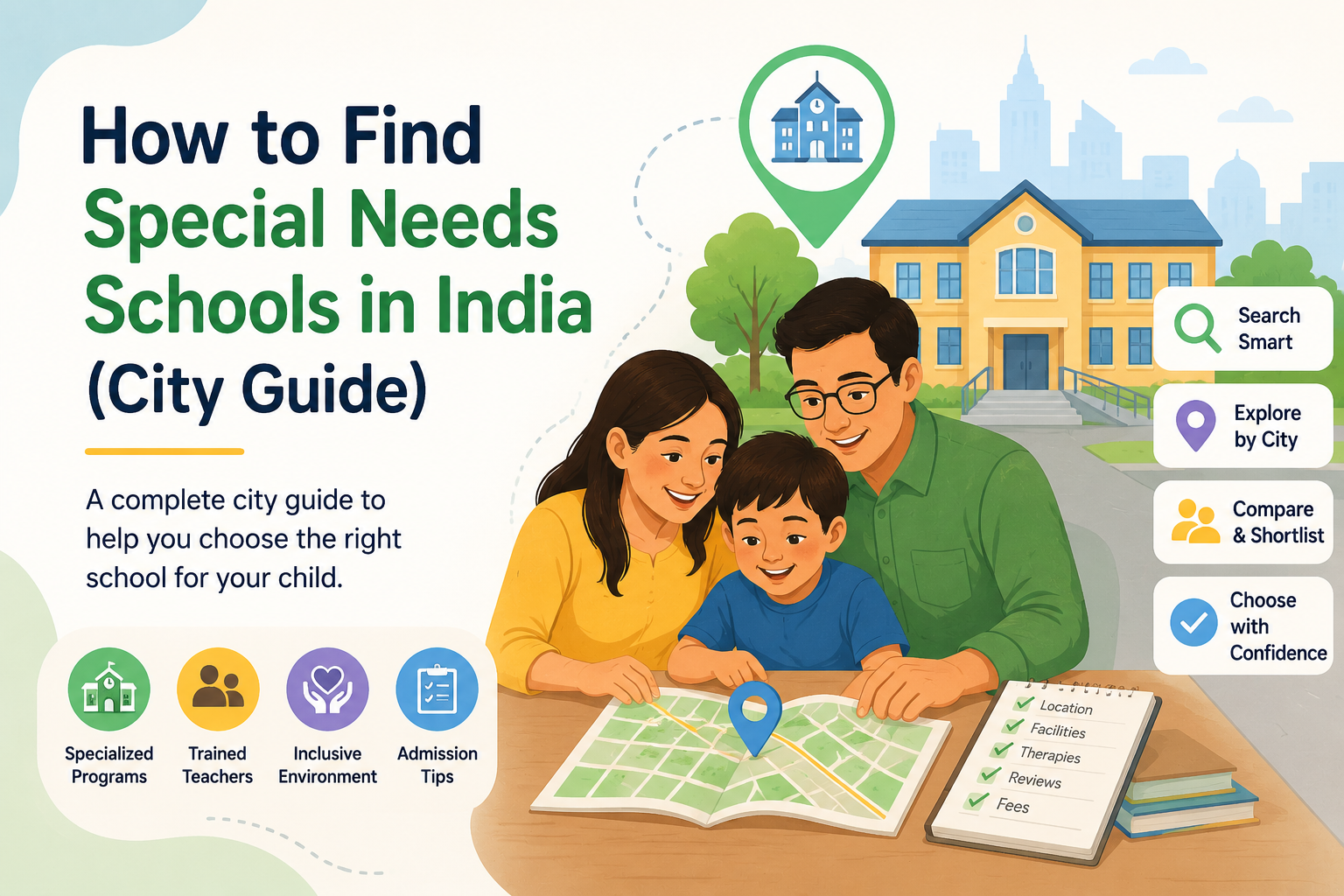
Finding a special needs school near me India is one of the most emotionally charged searches a parent can make. India has over 600 government-recognized special schools and thousands of NGO-run inclusive centers across its major cities. The right school depends on your child’s specific diagnosis, age, location, language, and budget. This guide shows you exactly how to find one — city by city.
If you are reading this at midnight, heart heavy, not knowing where to start — this guide is written for you. 💙
You are not alone. Millions of Indian families are on this same journey — searching, hoping, and advocating fiercely for a child whose needs the mainstream system was simply not built to serve.
This is not just a list of schools. This is a complete, honest, deeply researched guide to understanding the special education landscape in India — what works, what does not, what parents wish they had known earlier, and exactly what steps to take next.

- ⚡ Direct Answer — What You Need to Know First
- 🏫 Understanding Special Education in India
- 🧩 Types of Special Needs Schools in India
- Special Schools by Disability Focus
- Inclusive vs. Segregated Education — Which Is Right for Your Child?
- ⚖️ Key Laws Every Parent Must Know
- Rights of Persons with Disabilities Act 2016 (RPWD Act)
- Right to Education Act 2009 (RTE)
- National Policy for Persons with Disabilities 2006
- 🗺️ How to Search for a Special Needs School Near Me India — Step by Step
- Step 1 — Define Your Child’s Needs Precisely
- Step 2 — Contact These National Organizations First
- Step 3 — Search State-Level Directories
- Step 4 — Use Parent Networks
- Step 5 — Visit Shortlisted Schools in Person
- Step 6 — Request a Trial Period
- 🏙️ City-by-City Guide — Finding Special Needs Schools Near Me in India
- 🔵 Delhi & NCR
- 🔵 Mumbai & Maharashtra
- 🔵 Bangalore (Bengaluru) & Karnataka
- 🔵 Chennai & Tamil Nadu
- 🔵 Hyderabad & Telangana / Andhra Pradesh
- 🔵 Kolkata & West Bengal
- 🔵 Pune & Western Maharashtra
- 🔵 Other Major Cities — Quick Reference
- 📈 Key Statistics — Special Education in India With Source Links
- 🔍 What to Look for When Visiting a Special Needs School
- 🚩 Red Flags — Warning Signs to Walk Away From
- 💰 Funding, Fees & Financial Support
- Government & Free Education Options
- Financial Assistance Programs
- Typical Fee Ranges (Private Special Schools India 2026)
- 💛 A Parent’s Real Story: “We Drove 47 km Every Day. Then Found Answers 3 km Away.”
- 🔍 What You Must Not Miss About Special Schools in India
- 1. 🌐 The Rural Attrition Crisis
- 2. 📱 The Digital Invisibility of Great Schools
- 3. 🕐 The Transition Cliff After Age 18
- 4. 💊 The Therapy-School Integration Gap
- 5. 🧠 Assessment Before Admission Is Non-Negotiable
- 6. 🏆 The Shadow Teacher Quality Problem
- ❓ FAQs — Long-Tail Questions Answered
- How do I find a special needs school near me in India?
- Are special schools in India free?
- What is the best city in India for special education?
- At what age should I enroll my child in a special school?
- What is the difference between an inclusive school and a special school in India?
- How do I get my child assessed for special education needs in India?
- What rights do parents of special needs children have in Indian schools?
- Are there special schools for autism in smaller Indian cities?
- How do I know if a special school in India is genuine and qualified?
- What financial support is available for families who cannot afford special school fees?
- 🔗 Trusted Resources for Indian Special Needs Families
- ✨ Final Thoughts: The Right School Exists — You Just Have to Find It
🏫 Understanding Special Education in India
The search for a special needs school near me India begins with understanding what special education in India actually looks like — because it is far more varied, complex, and geographically unequal than most parents realize.
India’s special education system sits at the intersection of government policy, NGO leadership, private enterprise, and community advocacy. It ranges from world-class inclusive schools in metropolitan areas to barely resourced government special schools in rural districts.
The foundational principle, enshrined in Indian law since the Rights of Persons with Disabilities Act 2016, is this: every child with a disability has the right to free, appropriate education in an inclusive environment. The reality on the ground, however, varies enormously depending on your city, your child’s diagnosis, your income, and your access to information.
Understanding this landscape is the first and most important step every parent must take before beginning their school search.
The Three Tiers of Special Education in India
Tier 1 — Government Special Schools
Run by state governments and central government bodies. Free or heavily subsidized. Variable quality — excellent in some states, severely under-resourced in others. Often the only accessible option in smaller cities and rural areas.
Tier 2 — NGO-Run Special Schools
The backbone of quality special education in India. Organizations like Asha for Education, Vidya Sagar, ADAPT, and hundreds of smaller local NGOs run some of India’s finest special education programs. Fees are typically subsidized. Admission can be competitive.
Tier 3 — Private Special Schools & Inclusive Schools
Fee-charging institutions with professional staff, therapists, and specialized resources. Quality varies significantly. The best private special schools in India rival international standards. The worst are little more than custodial settings.
🧩 Types of Special Needs Schools in India
Not every special school serves every disability. Understanding the categories helps you search more effectively for a special needs school near me India that truly fits your child.
Special Schools by Disability Focus
| School Type | Primary Diagnosis Served | Key Features |
|---|---|---|
| Schools for Intellectual Disabilities | Intellectual disability, Down syndrome | Life skills focus; vocational training |
| Schools for Autism Spectrum Disorder | Autism (all levels) | ABA, TEACCH, sensory integration therapy |
| Schools for Hearing Impairment | Deaf and hard of hearing | Sign language; oral communication programs |
| Schools for Visual Impairment | Blind and low vision | Braille; orientation & mobility training |
| Schools for Cerebral Palsy | CP and physical disabilities | Physiotherapy; AAC; adapted curriculum |
| Schools for Learning Disabilities | Dyslexia, dyscalculia, ADHD | Resource rooms; remedial teaching |
| Inclusive Schools | Multiple/all disabilities | Mixed classrooms with specialist support |
| Multi-disability Schools | Multiple and complex needs | Individualized education programs (IEPs) |
Inclusive vs. Segregated Education — Which Is Right for Your Child?
Inclusive Schools (Mainstream + Support)
- ✅ Higher academic expectations
- ✅ Better preparation for mainstream adult life
- ⚠️ Requires trained shadow teachers and strong school commitment
- ⚠️ Not always appropriate for children with severe or complex needs
Special Schools (Segregated)
- ✅ Staff trained specifically for the disability
- ✅ Peer group of children with similar needs
- ✅ Specialized therapies integrated into the school day
- ✅ Often better for children with severe or multiple disabilities
💡 Voice Search Answer — What type of special school is best for my child in India? The best type of special needs school depends on your child’s diagnosis, severity, and communication level. Children with mild to moderate disabilities often thrive in inclusive schools. Children with severe or complex disabilities typically benefit more from specialized special schools with trained staff and integrated therapy.
⚖️ Key Laws Every Parent Must Know
Every parent searching for a special needs school near me India needs to understand their legal rights. These laws give you real power — use them.
Rights of Persons with Disabilities Act 2016 (RPWD Act)
- Section 16 — Every government-aided institution must ensure inclusive education for persons with disabilities
- Section 17 — Appropriate government must ensure children with disabilities are not discriminated against in admissions
- Section 31 — Right to free and appropriate education in an inclusive environment up to age 18
- Section 32 — Government must ensure home-based education for children with severe disabilities who cannot attend school
Right to Education Act 2009 (RTE)
- Section 3(2) extends free and compulsory education to children with disabilities up to age 18
- Requires mainstream schools to make reasonable accommodations for children with disabilities
National Policy for Persons with Disabilities 2006
Mandates that special education must be available within 3 km of a child’s home at primary level and 5 km at secondary level.
⚠️ If a school refuses your child: File a complaint with the District Education Officer (DEO), approach the State Commissioner for Persons with Disabilities, or contact the Rehabilitation Council of India at www.rehabcouncil.nic.in.
🗺️ How to Search for a Special Needs School Near Me India — Step by Step
This is the practical system that works. Follow these steps in order.

Step 1 — Define Your Child’s Needs Precisely
Before searching for a special needs school near me India, get clarity on:
- ✅ Primary diagnosis (autism, intellectual disability, hearing impairment, etc.)
- ✅ Severity level (mild, moderate, severe, profound)
- ✅ Communication level (verbal, non-verbal, AAC user)
- ✅ Therapy needs (OT, speech therapy, physiotherapy, ABA)
- ✅ Academic level and learning style
Step 2 — Contact These National Organizations First
These bodies maintain school directories and give location-specific referrals:
- 🔵 NIEPID — www.niepid.nic.in
- 🔵 Rehabilitation Council of India (RCI) — www.rehabcouncil.nic.in
- 🔵 National Trust — www.thenationaltrust.gov.in
- 🔵 NIMHANS — www.nimhans.ac.in
- 🔵 Asha for Education — www.ashanet.org
Step 3 — Search State-Level Directories
Every state’s Social Welfare or Education Department maintains a list of recognized special schools. Search: “[Your State] Social Welfare Department special schools list” for the official government directory.
Step 4 — Use Parent Networks
The most current, honest information comes from other parents. Join:
- Facebook groups: “Special Needs Parents India,” “Autism Parents India,” “Down Syndrome India Parents”
- WhatsApp communities through your child’s diagnosis-specific organization
- Parent forums through Milaap and iCare platforms
Step 5 — Visit Shortlisted Schools in Person
Never enroll a child based on a website or phone call alone. A minimum of two in-person visits is essential before making any decision.
Step 6 — Request a Trial Period
Most good special schools in India offer a 2–4 week trial period before formal admission. Always insist on this. It protects your child and gives you real-world evidence of fit.
🏙️ City-by-City Guide — Finding Special Needs Schools Near Me in India
🔵 Delhi & NCR
Delhi has one of India’s most developed special education ecosystems — combining government institutions, NGO-run schools, and private inclusive schools.
Key Organizations & Schools:
- Action for Autism (AFA) — Sector 5, Dwarka. India’s leading autism advocacy and school organization. Runs the National Centre for Autism. (Contact: www.autism-india.org)
- AADI (Action for Ability Development and Inclusion) — Hauz Khas. Excellent for cerebral palsy and multiple disabilities. Integrated therapies, vocational training.
- Tamana School — Saket. Highly regarded for intellectual disabilities and autism. Strong parent community.
- Vidya Sagar (Delhi chapter) — Multiple branches across Delhi NCR.
- NIPUN (National Institute for the Physically Handicapped) — New Delhi. (Contact: www.nipundelhi.ac.in)
Delhi NCR Tips: The Delhi government’s Samagra Shiksha scheme funds shadow teachers in select government schools. Inquire at your local DEO office about eligibility.
🔵 Mumbai & Maharashtra
Mumbai has a rich tradition of NGO-led special education. Maharashtra was one of India’s first states to establish a disability rights framework.
Key Organizations & Schools:
- ADAPT (Spastics Society of India) — Colaba and Bandra. India’s oldest and most respected organization for cerebral palsy. World-class physiotherapy, speech therapy, AAC services. (Contact: www.adaptindia.org)
- Ummeed Child Development Centre — Byculla. Excellent early intervention and school readiness programs. (Contact: www.ummeed.org)
- ALERT Centre — Santacruz. Running since 1978. Intellectual disabilities and multiple disabilities.
- National Institute for Hearing Handicapped (NIHH) — Bandra. Government institution. (Contact: www.nihh.gov.in)
Mumbai Tips: Transport is a significant challenge in Mumbai. Prioritize schools within 30 minutes of your home. Several NGOs provide subsidized transport for enrolled students.
🔵 Bangalore (Bengaluru) & Karnataka
Bangalore’s progressive culture has attracted significant investment in assistive technology and modern special education approaches.
Key Organizations & Schools:
- Vidya Sagar (Bangalore) — One of India’s finest inclusive education organizations. Strong community-based rehabilitation program. (Contact: www.vidyasagar.net)
- Association for People with Disability (APD) — Strong vocational and educational programs. (Contact: www.apdindia.org)
- NIMHANS Child and Adolescent Psychiatry — Hosur Road. Assessment and early intervention services. (Contact: www.nimhans.ac.in)
- Samarthanam Trust for the Disabled — Excellent for visual impairment and multiple disabilities.
- Manovikas Charitable Society — Intellectual disabilities and autism.
Bangalore Tips: Several mainstream international schools in Indiranagar and Koramangala have strong inclusion programs worth investigating for higher-functioning children.
🔵 Chennai & Tamil Nadu
Tamil Nadu has historically had one of India’s strongest state-level special education commitments.
Key Organizations & Schools:
- Vidya Sagar Chennai (formerly Spastics Society of Tamil Nadu) — T. Nagar. Landmark institution for cerebral palsy and multiple disabilities. (Contact: www.vidyasagar.net)
- NIEPID (National Institute for Empowerment of Persons with Intellectual Disabilities) — Government institute. (Contact: www.niepid.nic.in)
- The Banyan — Mental health and disability inclusion. (Contact: www.thebanyan.org)
- Amar Seva Sangam — Physically disabled children. Rural outreach. (Contact: www.amarseva.org)
Chennai Tips: Tamil Nadu’s Samagra Shiksha implementation is among India’s strongest. Ask specifically about “model inclusive schools” — Tamil Nadu has designated these across all districts.
🔵 Hyderabad & Telangana / Andhra Pradesh
Hyderabad is emerging as a significant center for autism therapy and early intervention services.
Key Organizations & Schools:
- NIEPID — Manovikasnagar. Central government institution. Residential and day programs. (Contact: www.niepid.nic.in)
- Little Star School for Autism — Banjara Hills. Well-regarded autism-specific school with ABA programming.
- Ali Yavar Jung National Institute for Hearing Handicapped — (Contact: www.ayjnihh.nic.in)
- Manovikasa — Intellectual disabilities, day school and residential programs.
🔵 Kolkata & West Bengal
Kolkata has a strong tradition of disability advocacy rooted in its social reform heritage.
Key Organizations & Schools:
- Autism Society West Bengal (ASWB) — Autism-specific school and parent support.
- Anandamela — Recognized for its innovative arts-based approach to intellectual disability education.
- Institute for Cerebral Palsy (ICP) — Established 1973. Strong physiotherapy and education integration.
- Behala Blind School — One of Kolkata’s oldest visual impairment institutions.
🔵 Pune & Western Maharashtra
Pune’s large student population and progressive civic culture have produced a relatively strong inclusion ecosystem.
Key Organizations & Schools:
- Poona School and Home for the Blind — Koregaon Park. Established and respected.
- Muktangan Inclusive School — Wanowrie. Among Pune’s strongest inclusive education models.
- Pune Zilla Parishad Special Schools — Multiple locations; government-run; free.
🔵 Other Major Cities — Quick Reference
| City | Key Organization | Website/Contact |
|---|---|---|
| Ahmedabad | Blind People’s Association | www.bpaindia.org |
| Jaipur | Jaipur Foot (BMVSS) | www.jaipurfoot.org |
| Lucknow | NIEPID Northern Regional Centre | www.niepid.nic.in |
| Chandigarh | PGIMER Child Development | www.pgimer.edu.in |
| Kochi | Spastic Society of Kerala | Kerala Social Justice Dept |
| Coimbatore | Amar Seva Sangam (satellite) | www.amarseva.org |
📈 Key Statistics — Special Education in India With Source Links
| Statistic | Figure | Source |
|---|---|---|
| Children with disabilities in India under age 19 | 78 lakh (7.8 million) | Census of India 2011 |
| Children with disabilities enrolled in school | ~61% | UDISE+ Report 2022–23 |
| Government-recognized special schools in India | 600+ | Rehabilitation Council of India |
| Children with disabilities in mainstream schools | ~29 lakh | UDISE+ Report 2022–23 |
| States with highest special school enrollment | Tamil Nadu, Maharashtra, Karnataka | Ministry of Education 2023 |
| Samagra Shiksha disability budget (2023–24) | ₹4,000+ crore | Ministry of Education |
| Special educators registered with RCI | ~80,000+ | Rehabilitation Council of India |
| Children with autism in India (estimated) | 1 in 68 | INCLEN Study, Indian Pediatrics |
| Average distance families travel for special school | 12–25 km (urban) | National Trust Survey 2022 |
| Special schools urban vs. rural distribution | 78% urban, 22% rural | RCI Annual Report 2022 |
🔍 What to Look for When Visiting a Special Needs School
When you visit a potential special needs school near me India, bring this checklist. Trust your instincts. Watch the children — not just the staff.
🏫 Physical Environment
- ✅ Wheelchair accessible (ramps, wide doorways, accessible bathrooms)
- ✅ Sensory-friendly spaces (low-stimulation areas, quiet rooms)
- ✅ Safe outdoor play areas with appropriate equipment
- ✅ Clean, well-lit, adequately ventilated classrooms
- ✅ Secure premises with controlled entry and exit
👩🏫 Staff & Qualifications
- ✅ Teachers hold RCI-recognized special education qualifications
- ✅ Therapists (OT, speech, physio) are on-site or visit regularly
- ✅ Staff-to-student ratio of 1:3 to 1:6 for most disability types
- ✅ Low staff turnover — consistency is critical for children with special needs
- ✅ Staff interact with children warmly, patiently, and with genuine affection
📚 Curriculum & Programs
- ✅ Individualized Education Programs (IEPs) for every child
- ✅ Clear communication of learning goals to parents
- ✅ Life skills and vocational training components
- ✅ Therapy integrated into the school day — not pulled out separately
- ✅ Transition planning for adolescents approaching adulthood
👨👩👧 Parent Involvement
- ✅ Regular parent-teacher meetings (at least monthly)
- ✅ Home program support — activities parents can continue at home
- ✅ Active parent association or community
- ✅ Open-door policy for parent observation visits
🚩 Red Flags — Warning Signs to Walk Away From
Not every school calling itself a “special needs school” in India deserves your child. Watch for these serious red flags:
⛔ No RCI-qualified staff — Teachers without recognized certification
⛔ No IEPs — No individualized education programs means no appropriate education
⛔ Any restraint practices — Physical restraint, isolation rooms, or punishment-based management
⛔ Overcrowding — More than 8–10 children per teacher in a special school setting
⛔ No therapy integration — Therapy available only once weekly or entirely separate from school
⛔ Restricted parent access — Any school discouraging unannounced parent visits
⛔ No written progress records — Inability to show documented child progress over time
⛔ High staff turnover — New faces every few months will harm your child’s attachment and routine
⛔ Custodial atmosphere — Children sitting passively for long periods with no structured activity
⛔ Pressure for immediate enrollment — Good schools never need to rush families
💰 Funding, Fees & Financial Support
Cost is a genuine barrier for many Indian families. Here is what you need to know.
Government & Free Education Options
Under the RTE Act and RPWD Act, children with disabilities are entitled to free education up to age 18 in any government-aided institution. The Samagra Shiksha Abhiyan funds resource teachers, assistive devices, and therapy support in mainstream schools nationwide.
Financial Assistance Programs
| Scheme | Benefit | Contact |
|---|---|---|
| ADIP Scheme | Free assistive devices | www.alimco.in |
| NHFDC Education Loans | Subsidized education loans | www.nhfdc.nic.in |
| National Trust — Niramaya | Health insurance ₹250–₹500/year | www.thenationaltrust.gov.in |
| National Trust — Samarth | Caregiver support programs | www.thenationaltrust.gov.in |
| State disability scholarships | Monthly student stipends | State Social Welfare Departments |
| PM-DAKSH | Free vocational skill training | www.pmdaksh.dosje.gov.in |
Typical Fee Ranges (Private Special Schools India 2026)
| City | Monthly Fee Range | Notes |
|---|---|---|
| Delhi NCR | ₹8,000 – ₹35,000 | NGO schools significantly lower |
| Mumbai | ₹10,000 – ₹45,000 | ADAPT and Ummeed offer sliding scale |
| Bangalore | ₹6,000 – ₹30,000 | Some NGO schools as low as ₹2,000/month |
| Chennai | ₹5,000 – ₹25,000 | Government-aided schools often ₹0–₹2,000 |
| Hyderabad | ₹5,000 – ₹22,000 | NIEPID government programs free |
| Pune | ₹4,000 – ₹20,000 | Zilla Parishad schools free |
💡 Always ask about internal scholarship programs. Most reputable NGO-run special schools in India will never turn away a child due to inability to pay if approached honestly and directly.
💛 A Parent’s Real Story: “We Drove 47 km Every Day. Then Found Answers 3 km Away.”
“My son Arjun was diagnosed with moderate autism at age three. We lived in Whitefield, Bangalore. For two years, we drove to a therapy center in Jayanagar — 47 km each way, three days a week. Arjun was exhausted. We were exhausted. We were spending ₹28,000 a month just on transport and therapy.
Then I found an NIMHANS parent forum online. Another mother told me about a school just 3 km from our home. It was an NGO-run inclusive school I had never heard of. It had an on-site speech therapist, occupational therapist, and an RCI-certified special educator. The fees were ₹6,500 a month. They had proper IEPs. The teachers knew Arjun’s name on day two.
Why did no one tell me about this school when Arjun was diagnosed? Why did the developmental pediatrician, the DM&HO office, and the government disability officer all fail to mention it?
The answer is that the information system for special education in India is completely broken. The schools exist. The resources often exist. But the pathways to finding them are invisible.
This is why I tell every new parent: talk to other parents first. They know things the system will never tell you.”
— Meera R., mother of Arjun (autism), Bangalore, parent advocate since 2022 💙
🔍 What You Must Not Miss About Special Schools in India
1. 🌐 The Rural Attrition Crisis
Most online content about special needs school near me India focuses exclusively on metro cities. In states like Bihar, Uttar Pradesh, and Rajasthan, specialized special schools may be 50–100 km from a child’s home. The National Trust’s community-based rehabilitation programs and mobile therapy units are among the few services attempting to address this severe rural gap.
2. 📱 The Digital Invisibility of Great Schools
Many outstanding special schools in India have no website, no Google listing, and no social media presence. A school serving children with disabilities for 30 years in Coimbatore may be completely invisible online. Always ask at government hospitals, NIMHANS, NIEPID regional centers, and local pediatric neurologists — the best school near you may not appear in any search.
3. 🕐 The Transition Cliff After Age 18
Almost every online special education resource stops at school age. But after 18, most Indian special schools cannot continue enrollment. Vocational training centers, supported employment, and group homes are severely limited. If your child is 14–15, begin researching post-school options immediately — waiting lists for good adult programs are often 3–5 years long.
4. 💊 The Therapy-School Integration Gap
Many Indian families juggle three separate institutions: a special school, a private therapy center, and a government assessment facility — each operating in complete isolation. This fragmentation wastes time, money, and misses the integration that produces the best outcomes. Insist on schools where therapy is delivered within the school day and where therapists and teachers write the IEP together.
5. 🧠 Assessment Before Admission Is Non-Negotiable
Many parents enroll children based solely on a diagnostic label. A diagnosis tells you the category. It does not tell you where your child is academically or what type of school environment they need. Always request a multi-disciplinary educational assessment before enrollment. NIMHANS, NIEPID, and most reputable NGO schools offer these assessments.
6. 🏆 The Shadow Teacher Quality Problem
In inclusive mainstream schools, shadow teachers are often the critical factor determining whether inclusion works. In India, shadow teacher training and qualifications are largely unregulated. When evaluating an inclusive school, ask specifically about the shadow teacher’s RCI qualifications, who supervises them, and whether they receive ongoing professional development.
❓ FAQs — Long-Tail Questions Answered
How do I find a special needs school near me in India?
Contact the Rehabilitation Council of India (rehabcouncil.nic.in) and National Trust (thenationaltrust.gov.in) for school directories. Ask NIMHANS or NIEPID for your region. Join diagnosis-specific parent WhatsApp groups. Other parents consistently provide the most accurate, current school information.
Are special schools in India free?
Yes. Government special schools are free. Under the RPWD Act 2016 and RTE Act, all children with disabilities are entitled to free education up to age 18 in government-aided institutions. Most NGO-run schools offer subsidized fees and internal scholarships, ensuring cost rarely prevents admission.
What is the best city in India for special education?
Mumbai, Bangalore, and Chennai consistently offer the strongest special education ecosystems. Delhi leads for autism services. Tamil Nadu has the most consistent state-level inclusive education infrastructure. However, quality schools exist in every major Indian city — finding them requires local parent network connections.
At what age should I enroll my child in a special school?
Early intervention by age 2–3 produces dramatically better outcomes. Many Indian special schools accept children from 18 months. Research confirms that intervention in the first five years of life creates the greatest long-term developmental gains. Never wait for a complete diagnosis before seeking assessment.
What is the difference between an inclusive school and a special school in India?
Inclusive schools admit children with disabilities into mainstream classrooms with support staff. Special schools serve only children with disabilities using specialized curriculum and integrated therapy. Inclusive schools suit mild-to-moderate disabilities. Special schools better serve children with severe or complex needs.
How do I get my child assessed for special education needs in India?
Assessments are available at NIMHANS (Bangalore), NIEPID (Hyderabad), Ali Yavar Jung Institute (Mumbai), and most government hospitals with child development units. A Disability Certificate from a government hospital is required for accessing government benefits, reservations, and financial assistance schemes.
What rights do parents of special needs children have in Indian schools?
Under the RPWD Act 2016, parents have rights to free appropriate education, reasonable school accommodations, free assistive devices, protection from admissions discrimination, and home-based education for severe disabilities. Violations can be reported to the District Education Officer or National Commission for Child Rights at ncpcr.gov.in.
Are there special schools for autism in smaller Indian cities?
Yes. Most district headquarters have at least one autism-specific or multi-disability NGO-run school. The National Trust’s district offices provide local referrals. The Samagra Shiksha Abhiyan mandates resource rooms in all district government schools. Home-based programs exist where specialist schools are unavailable.
How do I know if a special school in India is genuine and qualified?
Verify state government recognition through the Social Welfare or Education Department. Confirm teacher RCI certification at rehabcouncil.nic.in. Check that every child has a written IEP. Visit in person twice. Ask current school parents for honest feedback — this is always the most reliable verification method.
What financial support is available for families who cannot afford special school fees?
Access ADIP scheme for free assistive devices, NHFDC subsidized education loans, National Trust Niramaya health insurance (₹250–₹500/year), state disability scholarships, and NGO school internal scholarships. Contact your district Social Welfare Officer to apply for all applicable schemes simultaneously.
🔗 Trusted Resources for Indian Special Needs Families
🏥 Government Bodies
- Rehabilitation Council of India — School directory; RCI-certified teacher verification
- National Trust for Persons with Disabilities — Schemes, local board contacts, school listings
- NIEPID — Assessments, training, school referrals
- Ministry of Education — Samagra Shiksha — Inclusive education policy
- NIMHANS — Assessment and referral, Bangalore
- NCPCR — Child Rights Complaints — Rights violations reporting
💛 Leading NGOs & Schools
- Action for Autism India — Delhi; national autism resources
- ADAPT India — Mumbai; cerebral palsy
- Vidya Sagar — Chennai & Bangalore; inclusive education
- Ummeed Child Development Centre — Mumbai; early intervention
- Blind People’s Association India — Ahmedabad; visual impairment
- The Banyan — Chennai; mental health & disability
🔬 Research & Data
- UDISE+ Education Data — National school statistics
- Indian Pediatrics Journal — Disability prevalence research
- ALIMCO — Assistive Devices — ADIP scheme applications
✨ Final Thoughts: The Right School Exists — You Just Have to Find It
Searching for a special needs school near me India is not just a Google search. It is one of the most important things you will ever do for your child. 💙
The information system is imperfect. The geography is unequal. The bureaucracy can be exhausting. And the emotional weight of navigating all of this while caring for a child with complex needs is something only other special needs parents truly understand.
But here is what is also true: India has thousands of dedicated teachers, therapists, and school leaders who have given their working lives to children with disabilities. Schools of extraordinary warmth and skill exist in every major city. NGOs that will fight alongside you exist in every state. And a parent community that will share information, hold your hand, and celebrate every milestone — that community is waiting for you too.
So take this guide. Use these resources. Visit those schools. Trust your instincts about which classroom feels right when you walk in.
The right school for your child exists. Your job — and it is a worthy, beautiful, demanding job — is simply to find it. 🎗️
⚠️ Disclaimer: This article is written for informational purposes only. School information, fees, and program details change frequently. Always verify current details directly with schools and organizations before making enrollment decisions.


