

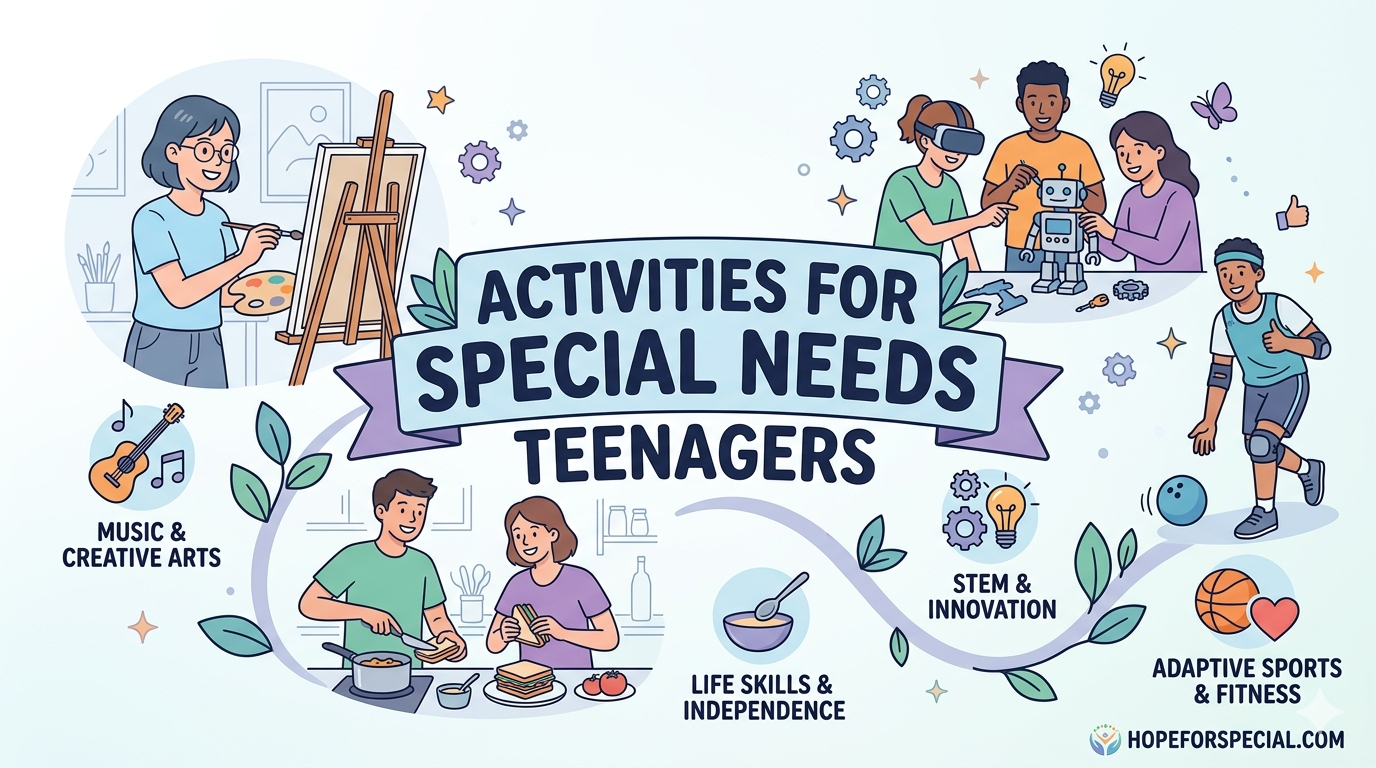
Activities for Special Needs Teenagers by Age, Disability Type, Summer Camps & Vocational Skills
Find the best activities for special needs teenagers — including age-specific guides (13–14, 15–18), activities for intellectual disabilities, vocational skills, summer camps 2026, homebound teens, and tips for reluctant teens.

- Why Activities Matter for Special Needs Teenagers: The Research Behind the Benefits
- Activities for Special Needs Teenagers by Age Group: A Stage-by-Stage Guide
- 🎒 Ages 13–14: Building Confidence and Exploring Interests
- 🌱 Ages 15–16: Deepening Skills and Building Social Connection
- 🎓 Ages 17–18: Vocational and Transition-Focused Activities
- Activities Specifically for Teenagers with Intellectual and Developmental Disabilities
- Vocational Activities for Special Needs Teenagers: Why Starting Early Changes Everything
- Summer Camps for Special Needs Teenagers 2026: A Complete Parent Guide
- Types of Summer Programmes Available
- What Makes a Good Summer Camp for Special Needs Teens
- Finding and Funding Summer Camps
- Online and Virtual Activities for Special Needs Teenagers
- Activities for Nonverbal and Minimally Verbal Special Needs Teenagers
- Activities for Homebound Special Needs Teenagers: When Getting Out Is Not Possible
- How to Choose the Right Activity for Your Special Needs Teenager
- Step 1: Start with Your Teen’s Interests, Not Your Goals
- Step 2: Match Activity Structure to Your Teen’s Tolerance
- Step 3: Think in Seasons
- Step 4: Give Every New Activity 6–8 Weeks Before Evaluating
- Tips for Motivating a Reluctant Special Needs Teenager
- Frequently Asked Questions: Activities for Special Needs Teenagers
Why Activities Matter for Special Needs Teenagers: The Research Behind the Benefits
Before exploring specific activities for special needs teens, it is worth understanding why structured activities during the teenage years are so important — because the benefits go far beyond fun. Research consistently shows that meaningful participation in activities produces measurable, lasting improvements for special needs teenagers across multiple areas of development.
Here is what the evidence shows:
| Benefit | What Research Shows |
|---|---|
| Social skill development | Teens with disabilities who participate in group activities show significantly faster social skills development than those without structured peer interaction (Source: Special Olympics Research) |
| Mental health and self-esteem | Regular participation in recreational activities reduces anxiety and depression in teens with developmental disabilities (Source: NIH/PMC — Physical Activity and Mental Health) |
| Employment outcomes | Research shows that paid work experience during the high school years is the strongest single predictor of adult employment for youth with disabilities — stronger than any classroom-based intervention (Source: Preprints.org — Vocational Programs and Transition Readiness, 2025) |
| Physical health | A clinical trial programme found that adaptive sports participation significantly improved strength, coordination, posture, and life satisfaction in teenagers with physical disabilities (Source: ClinicalTrials.gov — Physical Activity for Special Needs, 2023) |
| Independence in adulthood | Teens who regularly participate in life skills activities during their teenage years achieve significantly greater independence in housing and daily living as adults (Source: Your Therapy Source — Life Skills Activities) |
| Cognitive development | Structured activities — particularly music, drama, and visual arts — stimulate cognitive development and working memory in teenagers with learning disabilities (Source: NIH/PMC) |
Furthermore, it is important to understand that activity participation is not just a leisure concern — it is a legal one. Under IDEA, IEP transition plans must address recreational and community participation alongside academic and vocational goals. Meaningful activity during the teen years is part of your child’s educational and transition rights. (Source: IDEA.gov — Transition Services)
Activities for Special Needs Teenagers by Age Group: A Stage-by-Stage Guide
One of the most important things parents need to understand is that a 13-year-old and a 17-year-old with special needs have very different developmental needs, social priorities, and preparation goals. Most activity lists treat “teenagers” as a single group — but the teenage years span huge developmental territory.

Here is an age-specific guide so you can match the right activities to where your teen is right now:
🎒 Ages 13–14: Building Confidence and Exploring Interests
At this stage, the most important goal is exploration — trying a wide range of activities to discover what genuinely sparks interest, and beginning to build confidence in social settings outside the family.
| Activity Category | Specific Examples | Primary Benefit |
|---|---|---|
| Creative arts | Drawing, painting, simple pottery, collage making | Self-expression, fine motor skills, pride in output |
| Cooking basics | Following visual recipes, making simple meals and snacks | Sequencing, independence, practical daily skill |
| Adapted sports | Swimming, bocce ball, bowling, cycling | Cardiovascular health, coordination, team participation |
| Technology exploration | Photography on a tablet, digital art, music apps | Modern skills, creative confidence |
| Community involvement | Library visits, nature walks, local events | Community awareness, social exposure |
(Source: NIH/PMC — Adolescent Participation and Development)
Parent tip for this stage: Do not worry about skill mastery. The goal is exposure and positive experience. A 13-year-old who discovers they love cooking or photography has found an identity anchor that will serve them throughout their teenage years.
🌱 Ages 15–16: Deepening Skills and Building Social Connection
At this stage, social connection becomes increasingly important. Teens at this age need activities that put them alongside peers — not just family or therapists — in settings where they can practise real-world social skills.
| Activity Category | Specific Examples | Primary Benefit |
|---|---|---|
| Unified sports teams | Special Olympics Unified Sports — mixed teams of athletes with and without disabilities | Peer connection, teamwork, competitive achievement |
| Performing arts groups | Drama clubs, inclusive choirs, dance classes | Social performance skills, confidence, belonging |
| Volunteering | Animal shelters, food banks, community gardens | Real-world work skills, self-worth, social exposure |
| Adaptive fitness | Yoga, swimming, cycling, gym programmes | Physical health, body awareness, stress management |
| Cooking and food skills | Planning and cooking a family meal, baking for others | Sequencing, maths, practical daily independence |
(Source: Special Olympics — Unified Sports)
Parent tip for this stage: This is the ideal time to transition from parent-supervised activities to group and peer-led settings. Look for inclusive clubs at school, Special Olympics programmes, or community recreation centres that offer disability-inclusive groups.
🎓 Ages 17–18: Vocational and Transition-Focused Activities
At this stage, every activity should have at least one eye on adult life preparation. The goal is not just enjoyment — it is the development of real-world skills that translate directly to employment, independent living, and community participation.
| Activity Category | Specific Examples | Primary Benefit |
|---|---|---|
| Work experience | Part-time job, supported employment, school-to-work placement | Employment skills, confidence, earning income |
| Independent travel training | Learning a bus or train route, practising navigation | Community independence, safety skills |
| Financial skills activities | Budgeting a shopping trip, managing a personal allowance | Money management, adult life readiness |
| Home management practice | Laundry, cleaning, grocery shopping with support | Daily independence, adult functioning |
| Self-advocacy activities | Role-playing requesting accommodations, practising IEP participation | Lifelong advocacy skills |
(Source: IDEA.gov — Transition Planning) (Source: Preprints.org — Vocational Transition Readiness, 2025)
Activities Specifically for Teenagers with Intellectual and Developmental Disabilities
Teenagers with intellectual and developmental disabilities — including Down syndrome, moderate intellectual disability, and global developmental delay — need activities that are cognitively accessible without being childish. Finding age-appropriate activities that match developmental ability is one of the most common challenges parents face.
Here is a practical guide organised by activity type:
Physical Activities That Work
- Swimming — one of the most recommended activities for teens with intellectual disabilities. The sensory input is regulating, there is no complex equipment to manage, and progress is easily visible. Many YMCAs offer adaptive swim programmes.
- Adapted cycling and tricycling — for teens who cannot manage a two-wheel bike, an adult tricycle provides the freedom and cardiovascular benefit of cycling without the balance challenge. See our complete guide to tricycles for special needs teenagers.
Creative Activities That Work
- Simple cooking and baking — following a visual recipe, measuring ingredients, and serving the result to family are all highly meaningful and motivating activities for teens with intellectual disabilities. The practical life skill value is unmatched. (Source: Your Therapy Source)
- Collage and mixed media art — no fine motor precision required. Tearing, sticking, and arranging images creates satisfying visual results that produce genuine pride.
- Music participation — drumming circles, adaptive music groups, and choir participation are powerful activities for teens with intellectual disabilities. The rhythm and repetition are neurologically engaging regardless of cognitive level.
- Gardening — planting, watering, and harvesting are routine-based, sensory-rich, and deeply satisfying activities. Many communities have accessible garden plots specifically for disability groups.
Social Activities That Work
| Activity | Why It Works for Intellectual Disabilities |
|---|---|
| Special Olympics Unified Sports | Peer partnership model removes competitive pressure while maintaining real sport participation (Source: Special Olympics) |
| Drama and role play groups | Script-based social interaction reduces unpredictability — predictable scripts are much less anxiety-inducing |
| Board game groups | Clear rules, turn-taking structure, and social interaction — without the complexity of open-ended socialising |
| Volunteer work with animals | Animal shelters and pet rescue groups welcome volunteers with intellectual disabilities — non-verbal connection with animals is deeply rewarding |
| Community cooking groups | Cooking alongside peers in a structured setting combines life skills with social connection |
Vocational Activities for Special Needs Teenagers: Why Starting Early Changes Everything
Here is a fact every parent of a special needs teenager should know: paid work experience during the high school years is the single strongest predictor of adult employment for youth with disabilities — stronger than academic achievement, IQ scores, or any classroom-based training. (Source: Preprints.org — Vocational Programs and Transition Readiness, 2025)
In one large study examining vocational programmes for high school students with disabilities across multiple disability types, students who had paid work experience during school reported the most beneficial experiences (87.4%) — significantly higher than those who only had academic classes (67.1%). (Source: Preprints.org)
This means that for your 16 or 17-year-old with special needs, a Saturday morning at a local animal shelter, a greenhouse, or a bakery is not just a nice activity — it is potentially the most valuable investment in their adult future you can make right now.
Vocational Activity Ideas by Ability Level
For teens with higher support needs:
| Vocational Activity | Skills Practised |
|---|---|
| Sorting and organising tasks at home | Categorisation, sequencing, following instructions |
| Packing bags or boxes (simulated) | Fine motor, counting, task completion |
| Feeding and caring for a family pet | Responsibility, routine, empathy |
| Watering plants in a community garden | Routine, physical care, outdoor engagement |
| Sorting recyclables | Environmental awareness, categorisation, physical activity |
For teens with lower support needs:
| Vocational Activity | Skills Practised |
|---|---|
| Animal shelter volunteer | Following staff instructions, animal care, punctuality |
| Grocery store stocking (supported employment) | Inventory management, physical work, customer proximity |
| Library assistant | Organising books, helping patrons, quiet focused work |
| Community garden participant | Teamwork, outdoor skills, produce knowledge |
| Cafe or restaurant assistant | Food handling, customer service, time management |
(Source: Your Therapy Source — Life Skills Activities)
How to find vocational opportunities:
- Ask your teen’s IEP case manager about school-to-work transition programmes — many schools have partnerships with local businesses for supported employment placements
- Contact your state’s Vocational Rehabilitation (VR) agency — VR services are free and available to teens with disabilities, often starting at age 16
- Reach out to local branches of national disability employment organisations such as APSE (Association of People Supporting Employment First) (Source: APSE)
Summer Camps for Special Needs Teenagers 2026: A Complete Parent Guide
Summer is simultaneously the best and most challenging time for special needs teens — more free time means more opportunity, but also more risk of isolation, regression, and boredom. A well-chosen summer programme can be genuinely transformative.
Here is what parents need to know when searching for the right summer camp in 2026:
Types of Summer Programmes Available
| Programme Type | What It Offers | Best For |
|---|---|---|
| Inclusive day camp | Mainstream camp with disability support built in — your teen attends alongside typically developing peers | Teens who are socially motivated and benefit from inclusive peer modelling |
| Disability-specific camp | Camp designed specifically for teens with a particular disability or disability group — deep understanding of needs | Teens who are overwhelmed in mainstream settings and benefit from specialist staff |
| Therapeutic summer programme | Overseen by therapists — may be partially covered by insurance or Medicaid waiver | Teens with higher medical or therapeutic support needs |
| Day programme (not residential) | Attends daily, comes home each night — less overwhelming for teens with significant separation anxiety | Teens not yet ready for overnight experiences |
| Overnight camp | Residential experience — builds independence, self-management, and peer relationships | Teens with good self-care skills who are ready for increased independence |
| Vocational summer programme | Combines skill-building with work experience during summer months | Teens aged 16–18 preparing for post-school employment |
What Makes a Good Summer Camp for Special Needs Teens
When evaluating any summer programme, ask these specific questions:
- What is the staff-to-camper ratio? For teens with significant support needs, 1:3 or better is recommended
- What disability training do staff receive before the programme starts?
- Is there a therapist on site or on call?
- How do you handle behavioural or emotional crises?
- Are activities genuinely adapted or just mainstream activities with a special needs label?
- Can we do a site visit before enrolment?
Finding and Funding Summer Camps
- Very Special Camps (veryspecialcamps.com) — the most comprehensive directory of summer camps for children and teens with disabilities in the United States, searchable by state and disability type (Source: Very Special Camps)
- Rehabilitation Institute of Chicago (RIC) Lifecenter — publishes a free annual directory of summer camps for children and teens with disabilities (Source: RIC Lifecenter)
- Medicaid waiver funding — in many states, summer camp for teens with disabilities is a fundable service under Medicaid home and community-based waivers — ask your case manager
- State developmental disability agencies — many states have summer programme funding specifically for teens with developmental disabilities — contact your state’s DD agency directly
Online and Virtual Activities for Special Needs Teenagers
Not every special needs teenager can easily access community activities. Mobility limitations, anxiety, transport challenges, rural location, or a lack of local inclusive programmes mean that for many families, online and virtual activities are not a fallback — they are the primary option.
Here are the best online and virtual activity categories for special needs teenagers:
Virtual Social Connection
- Online Unified Sports events — Special Olympics offers virtual game events and interactive challenges for athletes who cannot attend in person (Source: Special Olympics)
Virtual Creative Activities
| Activity | Platform / Resource | Skill Built |
|---|---|---|
| Digital art and drawing | Procreate, Adobe Fresco, Google Canvas | Fine motor, creative expression |
| Online music making | Chrome Music Lab (free), GarageBand | Music, sequencing, creativity |
| Photography editing | Snapseed (free), Canva | Technology, visual art, self-expression |
| Virtual cooking classes | YouTube cooking channels with closed captions | Life skills, independence, following instructions |
| Creative writing / storytelling | Google Docs, Book Creator app | Language, sequencing, imagination |
Virtual Life Skills Practice
- Virtual shopping activities — practising shopping skills using real supermarket websites (selecting items, calculating costs) develops maths and planning skills without leaving home
- Online budgeting games — websites and apps that simulate managing a budget teach financial skills in an engaging, low-stakes environment
- Video-call communication practice — scheduling and running their own video calls with family members or support workers builds communication confidence and technology independence
Activities for Nonverbal and Minimally Verbal Special Needs Teenagers
Nonverbal and minimally verbal teenagers are one of the most underserved groups when it comes to activity suggestions. Most lists assume the teen can communicate verbally — but many autistic teens, teens with severe intellectual disabilities, and teens with cerebral palsy communicate primarily through AAC devices, sign language, or gestures.
Here is a focused guide to activities that work brilliantly for nonverbal and minimally verbal special needs teens:
Physical Activities
- Swimming and water play — water is universally regulating regardless of communication level. Aquatic activities require no verbal communication and provide powerful sensory input. Adaptive swimming programmes are widely available. (Source: NIH/PMC — Aquatic Therapy Benefits)
- Hippotherapy and horse riding — the movement of a horse activates motor pathways regardless of verbal communication. The bond between a teen and a horse does not require words. Many hippotherapy centres specifically welcome nonverbal participants.
- Dance and movement — rhythm-based movement activities are deeply engaging for nonverbal teens. Sensory-friendly dance sessions use music and physical cues rather than verbal instruction.
- Trampoline / rebound therapy — provides vestibular and proprioceptive input that is deeply regulating for many nonverbal autistic teens.
Creative Activities
- Sensory art — painting with hands, feet, sponges, and rollers produces beautiful results without fine motor precision or verbal instruction
- Music exploration — simple percussion instruments, music-making apps, and drumming circles are fully accessible without verbal communication
- Photography — a teen who cannot speak can still compose a beautiful photograph. A simple camera or tablet gives nonverbal teens a powerful expressive voice
- Sensory bins and exploration stations — tactile exploration of textures, temperatures, and materials is engaging, self-directed, and requires no communication
Communication-Building Activities
The right activities can also build communication for nonverbal teens — by creating contexts where communication becomes motivated and meaningful:
| Activity | How It Builds Communication |
|---|---|
| Cooking a preferred food | Creates a real motivation to request ingredients and express preferences via AAC |
| Choosing music for a playlist | Provides a meaningful context for expressing preferences through pointing, eye gaze, or AAC |
| Shopping for a desired item | Motivates use of communication to request what they want |
| Photography and sharing photos | Creates content the teen wants to share with others — a natural communication motivation |
(Source: IRIS Center — AAC and Communication Development)
Activities for Homebound Special Needs Teenagers: When Getting Out Is Not Possible
Many special needs teenagers go through periods — sometimes extended ones — when leaving home is not feasible. Medical fragility, severe anxiety, recovery from surgery, or extreme sensory sensitivity can all create situations where the teen is primarily or entirely homebound. This section is specifically for those families.
Here is a practical guide to meaningful at-home activities that keep homebound teens engaged, developing, and connected:
At-Home Creative Activities
| Activity | Materials Needed | Skill Built |
|---|---|---|
| Baking bread or simple recipes | Basic kitchen supplies | Life skills, maths, sequencing |
| Journaling with prompts | Notebook, pens, or a tablet | Language, emotional expression |
| Scrapbooking | Old photos, magazines, glue, scissors | Fine motor, creativity, memory |
| Jewellery making | Beads, string (kits available) | Fine motor, sequencing, creativity |
| Growing plants from seed | Pots, seeds, soil | Responsibility, patience, science |
| Stop-motion animation | Tablet or phone, small figures | Technology, creativity, storytelling |
At-Home Life Skills Activities
- Organising and sorting — organising a wardrobe, a bookshelf, or a collection by category or colour is cognitively engaging and produces a satisfying result
- Learning to do laundry step by step — one of the most valuable independence skills, and completely achievable at home
Maintaining Social Connection from Home
The biggest risk for homebound teens is social isolation, which accelerates mental health decline. Even from home, social connection is possible:
- Schedule regular video calls with peers, family members, or pen pals
- Participate in Friendship Circle Online’s virtual weekly programmes (Source: Friendship Circle)
- Join online special needs teen communities through disability organisations
How to Choose the Right Activity for Your Special Needs Teenager
With so many activity options available, the challenge for parents is often not finding activities — it is choosing the right ones for their specific teenager. Here is a practical decision framework:
Step 1: Start with Your Teen’s Interests, Not Your Goals
The single most important predictor of whether an activity will stick is whether your teenager is genuinely interested in it. A therapist-recommended activity that your teen hates will not produce the therapeutic benefits the therapist intended. An activity your teen loves — even if it does not look educational — will.
Start by observing what your teen gravitates toward naturally:
- Do they gravitate toward screens and technology? → Digital art, photography, gaming communities
- Do they gravitate toward movement? → Adaptive sports, dance, cycling
- Do they gravitate toward animals? → Volunteer at a shelter, horse riding, pet care
- Do they gravitate toward food? → Cooking, baking, community food events
- Do they gravitate toward music? → Music groups, drumming, singing, music apps
Step 2: Match Activity Structure to Your Teen’s Tolerance
| If your teen… | Choose activities that are… |
|---|---|
| Thrives on routine and predictability | Highly structured, same time, same place, same steps |
| Needs sensory input to regulate | Physically active, tactile, movement-based |
| Gets overwhelmed by groups | 1:1 or very small group activities (2–4 people maximum) |
| Craves peer connection | Group activities, clubs, team sports, volunteer groups |
| Has low frustration tolerance | Activities with visible, immediate results |
| Has high creative intelligence | Open-ended creative activities with minimal instruction |
Step 3: Think in Seasons
Not every activity needs to be year-round. Seasonal thinking reduces pressure and keeps things fresh:
- Autumn/Winter — indoor arts, cooking, board games, online programmes, music
- Spring/Summer — adaptive sports, cycling, gardening, community events, summer camps
- All-year — Special Olympics programmes, volunteering, life skills practice
Step 4: Give Every New Activity 6–8 Weeks Before Evaluating
Autistic and special needs teenagers frequently show initial resistance to new activities — not because they do not enjoy them, but because novelty is inherently uncomfortable. Research-backed occupational therapy programmes use a model where a new activity is tried for 8 weeks with support before evaluation. (Source: ClinicalTrials.gov — PREP Intervention) Do not give up after two sessions.
Tips for Motivating a Reluctant Special Needs Teenager
One of the most common and most frustrating challenges parents face is a teenager who refuses to engage with any activity at all. This is extremely common in special needs teens — and it is almost always about anxiety and past negative experience, not laziness.
Here is how to approach a truly reluctant teenager:
1. Remove all pressure from the first exposure. The first visit to any new activity should have zero expectation of participation. “We are just going to look” removes the threat of failure. Many teens who refuse to participate in session one are enthusiastically participating by session three.
2. Let them bring their safe person. Many special needs teens will try something new if their preferred person (a parent, a sibling, a support worker) participates alongside them for the first few sessions. The safe person gradually reduces involvement as the teen becomes more comfortable.
3. Connect the activity to something they already love. A teen who loves animals might be willing to try a dog-walking volunteer role even if they resist all other social activities. A teen who loves cooking videos might try a cooking class. Lead with the passion.
4. Honour autonomy. Giving your teen genuine choice between two or three pre-selected options — rather than presenting a single “you are doing this” mandate — reduces resistance dramatically. Even the illusion of control matters enormously to teenagers with special needs.
5. Celebrate attendance, not achievement. For the first several weeks, praise simply getting there. Do not focus on what was produced, achieved, or learned — focus entirely on the courage it took to show up.
6. Do not force it. If after 8 genuine, low-pressure weeks your teen still finds an activity distressing — not just uncomfortable but genuinely distressing — it is the wrong activity. Move on without guilt. There are hundreds of options. (Source: NIH/PMC — Self-Determination and Disability)
Frequently Asked Questions: Activities for Special Needs Teenagers
What activities are good for special needs teenagers?
Engaging options include sensory-friendly sports like swimming or martial arts, creative outlets like digital arts and music therapy, and outdoor activities such as guided nature hikes. These foster both physical coordination and social confidence in a structured environment.
What summer camps exist for teens with disabilities?
There are specialized programs like Victory Junction (medically safe overnight camps) and Talisman Summer Camps for neurodivergent youth. Many organizations also offer inclusive day camps focused on adaptive sports, social skills, and traditional recreation.
What vocational activities help special needs teens?
Practical skills like basic computer literacy, gardening, and culinary arts provide a strong foundation for independence. Hands-on tasks such as assembling electronic parts or office administration (filing and data entry) are also excellent for building workplace readiness.
How do you motivate a special needs teenager to try new activities?
Use positive reinforcement through reward charts or “token systems” where they earn points toward a favorite activity. Breaking new tasks into small, achievable steps and maintaining a predictable routine can also help reduce the anxiety of trying something new.
What activities work for nonverbal teenagers?
Visual and tactile experiences like sensory bins, finger painting, and photography allow for self-expression without the need for words. Activities involving animal therapy or swimming also provide calming, rhythmic sensory input that promotes emotional well-being.


