

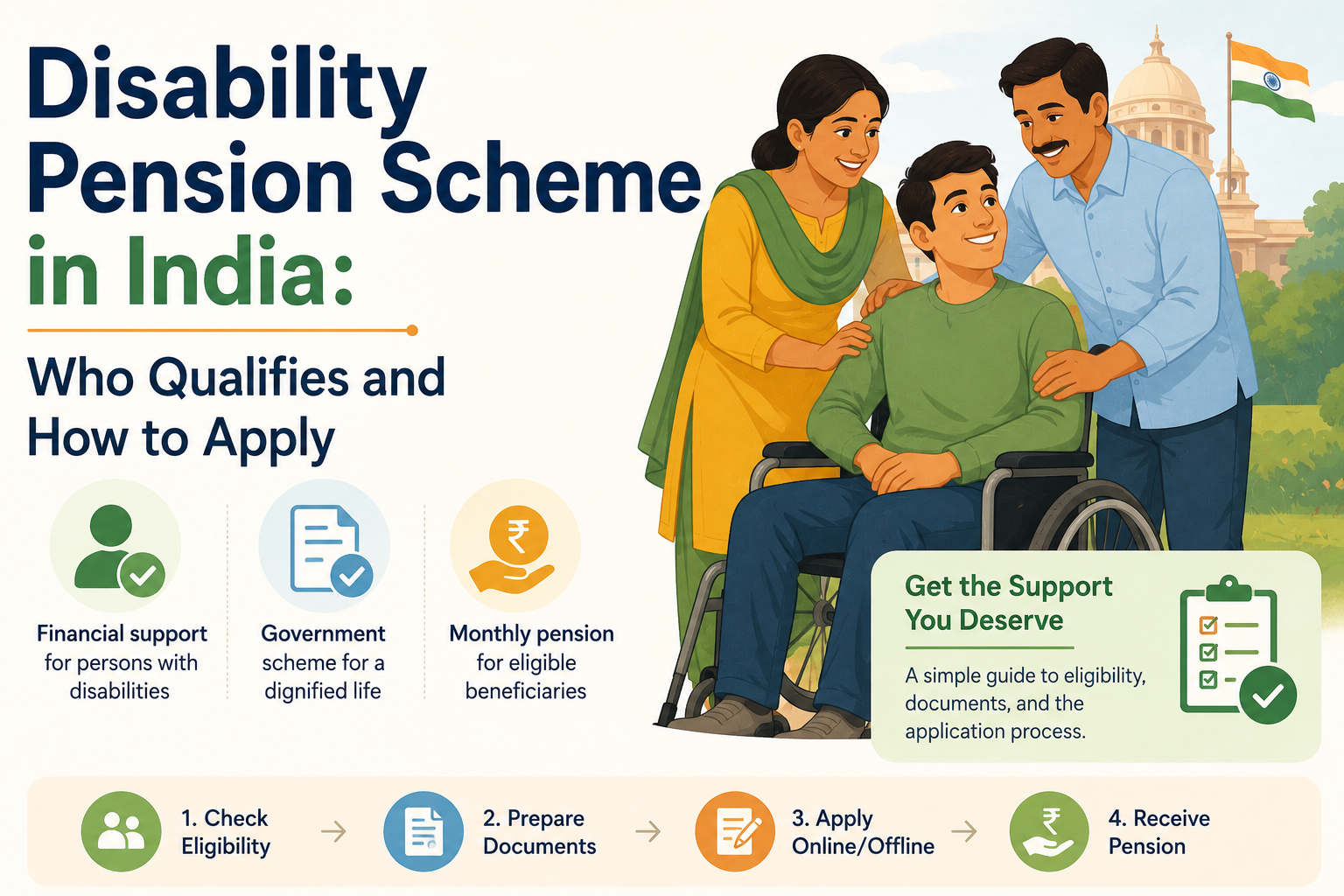
Disability Pension Scheme in India: Who Qualifies and How to Apply (2026 Guide)
⚡ Direct Answer — What You Need to Know First
The disability pension scheme India apply process covers multiple central and state government schemes providing monthly financial support to persons with disabilities. To qualify, you generally need a minimum 40% certified disability, a valid Disability Certificate from a government hospital, and income below state-specified limits. Applications go through your local District Social Welfare Office or online state portals. 💙
If you are a parent of a child with special needs — or a person with a disability yourself — and you have been told by neighbors, relatives, or even government offices that “you probably do not qualify” or “the process is too complicated” — please read every word of this guide.
Thousands of eligible Indian families are not receiving disability pension benefits simply because they do not know they qualify, do not know which scheme applies to them, or gave up after a confusing first attempt.
This guide changes that. Completely. Clearly. With real steps, real stories, and real clarity.

- ⚡ Direct Answer — What You Need to Know First
- 🏛️ What Is the Disability Pension Scheme in India?
- 📋 Types of Disability Pension Schemes in India
- 1. Indira Gandhi National Disability Pension Scheme (IGNDPS) — Central Government
- 2. State Disability Pension Schemes
- 3. Schemes for Children With Disabilities
- 4. Ex-Servicemen Disability Pension
- ✅ Who Qualifies — Eligibility Criteria Explained
- Core Eligibility Criteria (IGNDPS — Central Scheme)
- State Scheme Eligibility (Broader — Often More Accessible)
- The 21 Specified Disabilities Under RPWD Act 2016
- Who Does NOT Qualify
- 📄 The Disability Certificate — Your Most Important Document
- What Is a Disability Certificate?
- How to Get a Disability Certificate
- Disability Percentage — What It Means for Benefits
- 🪜 Step-by-Step Application Process — Disability Pension Scheme India Apply
- Phase 1 — Preparation (Before You Apply)
- Phase 2 — Application Submission
- Phase 3 — Verification and Approval
- 💰 State-Wise Disability Pension Amounts — India 2026
- 📊 Key Statistics — Disability Pension in India With Source Links
- 📁 Documents Required — Complete Checklist
- For All Applicants
- Additional Documents for Children (Parent Applying on Behalf)
- Additional Documents for Specific Disability Types
- 💻 Online vs. Offline Application — What Works Better in India 2026
- 🚫 Common Reasons for Rejection — And How to Avoid Them
- Rejection Reason 1: Disability Certificate Not From Recognized Hospital
- Rejection Reason 2: Disability Percentage Below Threshold
- Rejection Reason 3: Bank Account Not in Applicant’s Name
- Rejection Reason 4: Already Receiving Another Pension
- Rejection Reason 5: Incomplete or Inconsistent Documents
- Rejection Reason 6: Income Certificate Too Old
- Rejection Reason 7: Missing Photograph or Wrong Photo Format
- 🎁 Additional Benefits Linked to Disability Pension
- 💛 A Parent’s Real Story: “We Did Not Know This Money Existed for Four Years.”
- 🔍 What You Must Not Miss About Disability Pension in India
- 1. 🧒 Children Are Also Eligible — But Most Parents Do Not Know
- 2. 💳 The UDID Card Unlocks a Wider Benefits Ecosystem Than Any Single Pension
- 3. 🏦 DBT Failures Are Silently Ending Pension Payments for Many Families
- 4. 📋 The Annual Life Certificate — The Most Commonly Missed Renewal
- 5. 🔄 Portability — What Happens When You Move States
- 6. ⚖️ The Grievance Mechanism — Your Right When Things Go Wrong
- ❓ FAQs — Long-Tail Questions Answered
- What is the disability pension amount in India in 2026?
- What is the minimum disability percentage for disability pension in India?
- Can a child with disability get pension in India?
- How long does it take to get disability pension approved in India?
- Can I get disability pension and old age pension together in India?
- What documents are needed for disability pension in India?
- Where do I apply for disability pension in India online?
- Is autism eligible for disability pension in India?
- What is UDID card and how does it help in getting disability pension?
- What happens if my disability pension application is rejected?
- 🔗 Trusted Resources for Disability Pension in India
- ✨ Final Thoughts: You Are Entitled. Apply Today.
🏛️ What Is the Disability Pension Scheme in India?
The disability pension scheme India apply process begins with understanding that there is not one single national disability pension — there are several overlapping schemes at the central and state levels, each with different eligibility criteria, benefit amounts, and application processes.
At the central government level, the primary scheme is the Indira Gandhi National Disability Pension Scheme (IGNDPS) — part of the National Social Assistance Programme (NSAP). This provides a monthly pension to persons with severe disabilities who are below the poverty line.
At the state level, nearly every Indian state runs its own disability pension scheme — often with higher monthly amounts, broader eligibility, and sometimes different disability percentage thresholds than the central scheme.
Understanding which scheme applies to you — or whether you qualify for multiple schemes simultaneously — is the first and most important step in the disability pension scheme India apply journey.
Why This Matters More Than You Think
Financial support through disability pension does three things simultaneously:
✅ Reduces financial burden on families who often spend significantly more than average households on therapy, equipment, healthcare, and specialized education
✅ Provides legal recognition of disability that opens doors to other benefits, reservations, and concessions
✅ Restores dignity — acknowledging that disability creates genuine additional costs and reducing the family’s dependence on informal charity
💡 Voice Search Answer — What is disability pension in India?
📋 Types of Disability Pension Schemes in India
Before starting the disability pension scheme India apply process, you must identify which schemes apply to you. Here is a complete overview.
1. Indira Gandhi National Disability Pension Scheme (IGNDPS) — Central Government
Administered by: Ministry of Rural Development through state governments
Key Features:
- Targets persons aged 18–79 with severe or multiple disabilities
- Must be below the poverty line (BPL)
- Monthly benefit: ₹300 per month from central government (states add their own top-up, bringing total to ₹500–₹1,500+ depending on state)
- Benefit transferred directly to bank account (DBT — Direct Benefit Transfer)
Reference: Ministry of Rural Development — NSAP
2. State Disability Pension Schemes
Every state runs its own scheme, often with more generous criteria than IGNDPS. Examples:
| State | Scheme Name | Monthly Amount (2026) | Min. Disability % |
|---|---|---|---|
| Maharashtra | Sanjay Gandhi Niradhar Anudan Yojana | ₹1,500 | 40% |
| Tamil Nadu | Chief Minister’s Differently Abled Persons Welfare Scheme | ₹1,500 | 40% |
| Karnataka | Manaswini / Disability Pension | ₹1,000 | 40% |
| Delhi | Delhi Disability Pension Scheme | ₹2,500 | 40% |
| Rajasthan | Rajasthan Disability Pension Yojana | ₹750–₹1,500 | 40% |
| West Bengal | Disability Pension Scheme | ₹1,000 | 40% |
| Andhra Pradesh | YSRCP Pension Kanuka | ₹3,000 | 40% |
| Kerala | Disability Pension | ₹1,600 | 40% |
| Uttar Pradesh | Divyang Pension Yojana | ₹500 | 40% |
| Gujarat | Divyang Sahay Yojana | ₹600 | 40% |
Note: Amounts change periodically. Verify current rates with your State Social Welfare Department.
3. Schemes for Children With Disabilities
Many parents searching the disability pension scheme India apply process are specifically looking for support for their child. Key child-specific schemes include:
National Trust Schemes:
- Samarth — Caregiver support and day care support
- Gharaunda — Residential care and group home support for adults
ADIP Scheme (Assistance to Disabled Persons for Purchase of Aids/Appliances): Provides free assistive devices — wheelchairs, hearing aids, braille kits, crutches, artificial limbs — through ALIMCO.
Reference: ALIMCO — Artificial Limbs Manufacturing Corporation of India
4. Ex-Servicemen Disability Pension
A separate, higher-value disability pension exists for military veterans disabled in service. This is administered by the Department of Ex-Servicemen Welfare and is entirely separate from civilian disability pension schemes.
Reference: Department of Ex-Servicemen Welfare
✅ Who Qualifies — Eligibility Criteria Explained
The eligibility criteria for the disability pension scheme India apply process vary by scheme but share common core requirements.
Core Eligibility Criteria (IGNDPS — Central Scheme)
| Criterion | Requirement |
|---|---|
| Age | 18 to 79 years |
| Disability Type | Severe disability (80%+) OR multiple disabilities |
| BPL Status | Must be below poverty line (BPL card holder OR assessed as BPL by gram panchayat/urban local body) |
| Disability Certificate | Valid certificate from government hospital stating disability percentage |
| Residency | Must be a resident of the state where applying |
| Bank Account | Must have a bank or post office account for DBT |
| Existing Pension | Must not be receiving any other government pension |
State Scheme Eligibility (Broader — Often More Accessible)
Most state schemes are more accessible than the central IGNDPS:
- ✅ Lower disability threshold — Most states require only 40% disability (not 80%)
- ✅ No strict BPL requirement — Many states use an income ceiling instead (typically annual family income below ₹1–₹2 lakh)
- ✅ Wider age range — Some states cover from birth/childhood
- ✅ Broader disability types — All 21 specified disabilities under RPWD Act 2016
The 21 Specified Disabilities Under RPWD Act 2016
The Rights of Persons with Disabilities Act 2016 expanded India’s official list of recognized disabilities from 7 to 21. All 21 are now eligible for disability certification and associated benefits:
- Blindness
- Low Vision
- Leprosy Cured Persons
- Hearing Impairment (Deaf and Hard of Hearing)
- Locomotor Disability
- Dwarfism
- Intellectual Disability
- Mental Illness
- Autism Spectrum Disorder
- Cerebral Palsy
- Muscular Dystrophy
- Chronic Neurological Conditions
- Specific Learning Disabilities
- Multiple Sclerosis
- Speech and Language Disability
- Thalassemia
- Haemophilia
- Sickle Cell Disease
- Multiple Disabilities including Deaf-Blindness
- Acid Attack Victims
- Parkinson’s Disease
Source: Rights of Persons with Disabilities Act 2016
Who Does NOT Qualify
❌ Persons already receiving another government pension (old age pension, widow pension) — though some states allow dual benefits; verify locally
❌ Persons with disability below the state minimum threshold (usually 40%)
❌ Persons without a valid Disability Certificate from a recognized government hospital
❌ Persons with annual family income above the state ceiling
❌ Persons without Indian citizenship or valid state residency
📄 The Disability Certificate — Your Most Important Document
Before you can disability pension scheme India apply, you must obtain a Disability Certificate. This single document unlocks virtually every disability benefit in India — pension, concessions, reservations, free assistive devices, and more.
What Is a Disability Certificate?
A Disability Certificate is an official government document issued by a medical board at a government hospital, certifying:
- The nature and type of disability
- The percentage of disability (e.g., 45%, 75%, 80%)
- Whether the disability is permanent or temporary
How to Get a Disability Certificate
Step 1 — Visit a Government Hospital Go to the nearest government district hospital or medical college. Private hospitals cannot issue Disability Certificates.
Step 2 — Request a Medical Board Assessment Ask for the Medical Board assessment counter. In most hospitals, specific days are designated for disability assessments. Call ahead to confirm the schedule.
Step 3 — Bring Required Documents
- Photographs
- Identity proof (Aadhaar)
- Address proof
- For children: birth certificate and parents’ ID
Step 4 — Medical Board Assessment A medical board — comprising two or more doctors — examines you and reviews your medical records. They assess the disability type and percentage.
Step 5 — Certificate Issuance The certificate is typically issued within 7–30 days. In cases of complex assessment (e.g., intellectual disability), it may take longer.
Step 6 — UDID Card (Unique Disability ID) Always apply for the UDID Card (Unique Disability Identification Card) alongside your Disability Certificate. The UDID is a smart card that serves as the single national proof of disability for all benefit claims.
Apply online: UDID Portal — www.swavlambancard.gov.in
Disability Percentage — What It Means for Benefits
| Disability % | Benefit Access |
|---|---|
| 40–49% | State pension schemes; most concessions |
| 50–74% | Additional reservations; higher concessions |
| 75–99% | IGNDPS central scheme; maximum benefits |
| 80%+ or Multiple | Highest support tier; all central schemes |
🪜 Step-by-Step Application Process — Disability Pension Scheme India Apply
Here is the complete, step-by-step guide to the disability pension scheme India apply process.

Phase 1 — Preparation (Before You Apply)
Step 1 — Get Your Disability Certificate As described above. This is non-negotiable. Without it, no application proceeds.
Step 2 — Apply for UDID Card Apply at swavlambancard.gov.in simultaneously. Many states now require UDID during pension application.
Step 3 — Open a Bank Account in Your Name The pension is transferred via Direct Benefit Transfer (DBT) to a bank or post office account. The account must be in the applicant’s name — not a parent or guardian’s name (for adults). For minor children, a joint account with a parent/guardian is acceptable.
Step 4 — Obtain BPL Card or Income Certificate For IGNDPS, you need a BPL ration card. For state schemes, an income certificate from the Tehsildar/Mamlatdar/Talathee is usually sufficient.
Step 5 — Gather All Required Documents See the complete document checklist in the next section.
Phase 2 — Application Submission
Step 6 — Identify the Correct Scheme
Ask yourself:
- Am I / is my child below 18? → Look for child-specific state schemes or National Trust schemes
- Is the disability 80%+ or multiple? → Apply for IGNDPS + state scheme
- Is the disability 40–79%? → Apply for state scheme only (most cases)
- Am I a veteran? → Apply through Ex-Servicemen Welfare
Step 7 — Get the Application Form
Option A — Online (Recommended): Most states now have online portals. Key portals:
- National: NSAP Portal
- Maharashtra: Aaple Sarkar
- Delhi: Delhi e-District
- Karnataka: Karnataka Seva Sindhu
- Tamil Nadu: TN e-Seva
- Rajasthan: Jan Soochna Portal
- UP: UP Divyang Pension
- Andhra Pradesh: AP Nadu-Nedu Portal
Option B — Offline: Visit your local District Social Welfare Office (urban) or Block Development Office / Gram Panchayat (rural). Collect Form No. varies by state — ask specifically for the “Disability Pension Application Form.”
Step 8 — Fill the Application Form
Fill carefully in BLOCK LETTERS. Common fields include:
- Applicant name, age, address, Aadhaar number
- Disability type and percentage (from certificate)
- Family income details
- Bank account details (IFSC, account number)
- Names and income of family members
Step 9 — Submit With All Documents
Online: Upload scanned copies of all documents. Offline: Submit self-attested photocopies + originals for verification at the office counter.
Step 10 — Get Acknowledgment Receipt
Always insist on a written acknowledgment receipt with an application reference number. This is essential for tracking and follow-up.
Phase 3 — Verification and Approval
Step 11 — Field Verification
A government officer may visit your home to verify the information provided. This is standard procedure — particularly in rural areas. Be present and cooperative.
Step 12 — Sanction Order
If approved, a sanction order is issued. This may take 30–90 days depending on state and volume of applications.
Step 13 — First Pension Credit
The first pension installment is credited to your bank account. In some states, pensions are credited monthly. In others, quarterly. Confirm the schedule with your district office.
Step 14 — Annual Renewal/Verification
Most disability pension schemes require annual life certificate submission and periodic re-verification. Set a calendar reminder.
💰 State-Wise Disability Pension Amounts — India 2026
| State | Monthly Amount | Additional Benefits | Apply At |
|---|---|---|---|
| Andhra Pradesh | ₹3,000 | Rice at ₹1/kg | navasakam.ap.gov.in |
| Delhi | ₹2,500 | Travel concessions | edistrict.delhigovt.nic.in |
| Kerala | ₹1,600 | Medical support | State Social Welfare Dept |
| Maharashtra | ₹1,500 | Ration card benefits | aaplesarkar.mahaonline.gov.in |
| Tamil Nadu | ₹1,500 | Free bus pass | tn.gov.in |
| Karnataka | ₹1,000 | Free health card | sevasindhu.karnataka.gov.in |
| West Bengal | ₹1,000 | Ration benefits | State Social Welfare Dept |
| Rajasthan | ₹750–₹1,500 | Varies by severity | jansoochna.rajasthan.gov.in |
| Gujarat | ₹600 | Assistive devices | State Social Welfare Dept |
| Uttar Pradesh | ₹500 | Free travel | sspy-up.gov.in |
| IGNDPS (Central) | ₹300 + state top-up | BPL only | nsap.nic.in |
Note: Amounts are indicative for 2026. Verify current rates at your State Social Welfare Department website.
📊 Key Statistics — Disability Pension in India With Source Links
| Statistic | Figure | Source |
|---|---|---|
| Total NSAP beneficiaries (all categories) | ~3.5 crore (35 million) | Ministry of Rural Development — NSAP |
| IGNDPS disability pension beneficiaries | ~10 lakh (1 million) | NSAP Annual Report 2023 |
| Persons with disabilities in India (Census 2011) | 2.68 crore (26.8 million) | Census of India 2011 |
| Estimated actual disability prevalence (WHO-adjusted) | 7–8 crore (70–80 million) | WHO India Country Profile |
| UDID cards issued (as of 2024) | ~1 crore (10 million) | UDID Portal |
| Percentage of persons with disabilities receiving any pension | ~25–30% (estimated) | Disability Affairs Division — MOSJE |
| States with highest disability pension coverage | Tamil Nadu, AP, Kerala | NSAP State Reports |
| Annual ADIP scheme budget | ₹230+ crore | Ministry of Social Justice & Empowerment |
| Niramaya health insurance beneficiaries | ~7 lakh | National Trust Annual Report |
| Families unaware of disability entitlements | ~60% (estimated) | NCPEDP Survey 2022 |
📁 Documents Required — Complete Checklist
Print this checklist before starting the disability pension scheme India apply process.
For All Applicants
- ✅ Disability Certificate (original + self-attested photocopy)
- ✅ UDID Card (if already issued) or UDID application receipt
- ✅ Aadhaar Card (original + photocopy)
- ✅ Passport-size photographs (usually 2–4 copies)
- ✅ Bank passbook first page (showing name, account number, IFSC)
- ✅ Address proof (Aadhaar / Voter ID / Ration Card / Electricity Bill)
- ✅ Income Certificate (from Tehsildar/Mamlatdar — usually for income below state ceiling)
- ✅ BPL Ration Card (for IGNDPS central scheme — if applicable)
- ✅ Caste Certificate (if applicable — SC/ST/OBC may have separate schemes)
Additional Documents for Children (Parent Applying on Behalf)
- ✅ Child’s Birth Certificate
- ✅ Parent/Guardian Aadhaar Card
- ✅ Parent/Guardian Bank Account details (for joint account)
- ✅ School enrollment certificate (if applicable)
- ✅ Medical reports supporting the disability diagnosis
Additional Documents for Specific Disability Types
- 🦯 Visual Impairment: Ophthalmologist report + Disability Certificate
- 🦻 Hearing Impairment: Audiologist report + Disability Certificate
- 🧠 Intellectual Disability/Autism/Cerebral Palsy: Psychologist/neurologist report + Disability Certificate from Medical Board
- 🦽 Locomotor Disability: Orthopedic specialist report + Disability Certificate
- 🧬 Genetic Conditions (Thalassemia, Haemophilia, SCD): Specialist reports + Disability Certificate
💻 Online vs. Offline Application — What Works Better in India 2026
| Factor | Online Application | Offline Application |
|---|---|---|
| Convenience | High — apply from home | Requires office visit |
| Speed | Generally faster | Can be slower |
| Document submission | Scanned uploads | Physical copies |
| Tracking | Online status tracking | Requires follow-up visits |
| Technical barriers | Internet/digital literacy needed | No technical barrier |
| Best for | Urban applicants; tech-comfortable | Rural; elderly; first-timers |
| Common issue | Portal errors; document size limits | Queue times; officer availability |
| Recommendation | Use online where available | Use offline as backup |
Pro Tip 💡
Even when applying online, visit the district office in person once after online submission to confirm receipt and get a physical acknowledgment. This protects you if the online submission has any technical issue.
🚫 Common Reasons for Rejection — And How to Avoid Them
The disability pension scheme India apply process fails for many families not because they are ineligible — but because of avoidable errors. Here are the most common rejection reasons and how to prevent each one.
Rejection Reason 1: Disability Certificate Not From Recognized Hospital
❌ Problem: Certificate issued by a private doctor or non-designated hospital
✅ Solution: Always obtain your Disability Certificate from the Medical Board of a government district hospital or government medical college
Rejection Reason 2: Disability Percentage Below Threshold
❌ Problem: Certificate shows 35% disability; state requires 40% minimum
✅ Solution: If you believe the assessment underestimates your disability, you can request a re-assessment or appeal to the Chief Medical Officer
Rejection Reason 3: Bank Account Not in Applicant’s Name
❌ Problem: Bank account in parent’s name only (for adult applicants)
✅ Solution: Ensure the pension bank account is in the applicant’s name. For adults with intellectual disability, a joint account with guardian is acceptable in most states
Rejection Reason 4: Already Receiving Another Pension
❌ Problem: Applicant is registered for old age pension, widow pension, or another state scheme
✅ Solution: In many states, disability pension and old age pension cannot be combined. Check state rules. Some states allow switching to the higher-value pension.
Rejection Reason 5: Incomplete or Inconsistent Documents
❌ Problem: Name spelling differs across documents; date of birth mismatch
✅ Solution: Ensure all documents show identical name spelling and date of birth before submitting. Use Aadhaar as the master identity document.
Rejection Reason 6: Income Certificate Too Old
❌ Problem: Income certificate is more than 6 months old
✅ Solution: Obtain a fresh income certificate from Tehsildar within 3 months of application
Rejection Reason 7: Missing Photograph or Wrong Photo Format
❌ Problem: Photograph is too large in file size for online upload; or wrong background color
✅ Solution: Use a white-background, recent passport photo. For online upload, compress to under 100KB JPEG.
🎁 Additional Benefits Linked to Disability Pension
The disability pension scheme India apply process unlocks far more than just the monthly pension amount. A valid Disability Certificate and UDID Card open access to a comprehensive ecosystem of benefits.
Financial Benefits
| Benefit | Description | Authority |
|---|---|---|
| Income Tax Deduction | ₹75,000–₹1,25,000 deduction under Section 80U | Income Tax Act |
| GST Exemption | Assistive devices exempt from GST | Finance Ministry |
| Bank Loan Concessions | Priority lending; lower interest rates | RBI Guidelines |
| NHFDC Loans | Subsidized loans for self-employment | NHFDC |
Education Benefits
| Benefit | Description |
|---|---|
| Scholarship Schemes | Pre-matric and post-matric scholarships for students with disabilities |
| Reservation in Admission | 5% horizontal reservation in all government educational institutions |
| Special Coaching | Free coaching for competitive exams through NIMHANS, NIEPID |
| Free Special Education | Under RTE Act and RPWD Act up to age 18 |
Reference: National Scholarship Portal
Employment Benefits
| Benefit | Description |
|---|---|
| Government Job Reservation | 4% reservation in all central government jobs (1% each for blindness/low vision, hearing impairment, locomotor disability, intellectual disability/autism/CP/MD) |
| EPFO Benefits | Enhanced employer contribution; special provisions |
| Supported Employment | Vocational training through NIEPID, NILD, AYJNIHH |
| Self-Employment Support | PM-DAKSH; NHFDC loans; MSME benefits |
Travel Concessions
| Mode | Concession |
|---|---|
| Indian Railways | 75% concession (Sleeper class) for persons with disabilities and escort |
| Air Travel | 50% concession on select airlines |
| State Road Transport | Free or heavily subsidized bus travel (state-specific) |
| Metro Rail | 50% concession in most metro systems |
Reference: Indian Railways — Concessions for Persons with Disabilities
Healthcare Benefits
- Ayushman Bharat PM-JAY — Disability is a priority category for health insurance coverage
- ADIP Scheme — Free assistive devices through ALIMCO camps
Reference: Ayushman Bharat PM-JAY
💛 A Parent’s Real Story: “We Did Not Know This Money Existed for Four Years.”
“My daughter Kavya has cerebral palsy. She is nine years old now. She has been receiving therapy since she was eight months old — physiotherapy three times a week, speech therapy twice a week. Every month we were spending between ₹12,000 and ₹18,000 on therapy alone.
We are a middle-class family in Nagpur. My husband works in a factory. I stopped working to care for Kavya. Every month we calculated what we could cut — food, clothing, our own medical visits — to keep Kavya’s therapy going.
We did not know there was a disability pension. We did not know about the Sanjay Gandhi Niradhar Yojana in Maharashtra. We did not know about the National Trust Niramaya health insurance. We did not know about the ADIP scheme that provides Kavya’s ankle-foot orthoses free of charge.
Within four months, ₹1,500 was coming to our account every month. Kavya’s orthoses were covered. Our annual health insurance was ₹250. We cannot get back the four years we did not know. But we tell every parent we meet — do not wait. Apply now.
The money is not much. But it is ours. And it is a recognition that what we do for Kavya has value. That recognition matters.”
— Rekha D., mother of Kavya (cerebral palsy), Nagpur, Maharashtra 💙
🔍 What You Must Not Miss About Disability Pension in India
1. 🧒 Children Are Also Eligible — But Most Parents Do Not Know
The vast majority of online guidance about the disability pension scheme India apply process is written as if only adults are eligible. This is incorrect and misleading. Many state disability pension schemes have no minimum age requirement — meaning a child with a qualifying disability and Disability Certificate is eligible from birth or infancy.
Parents can apply as legal guardians. The pension is deposited in a joint account. For children with severe disabilities requiring round-the-clock care, this monthly support can be a meaningful contribution to therapy costs. Always apply — even for young children.
2. 💳 The UDID Card Unlocks a Wider Benefits Ecosystem Than Any Single Pension
Most websites describe disability pension as a standalone benefit. The reality is that the Disability Certificate and UDID Card are master keys to a comprehensive benefits ecosystem — tax deductions, travel concessions, job reservations, educational scholarships, free assistive devices, health insurance, and more. The combined monetary value of all accessed benefits typically far exceeds the monthly pension amount alone. Apply for the UDID Card simultaneously with every other application.
3. 🏦 DBT Failures Are Silently Ending Pension Payments for Many Families
Direct Benefit Transfer (DBT) system failures — mismatched Aadhaar-bank account linking, inactive bank accounts, incorrect IFSC codes — are causing pension payments to fail silently for thousands of beneficiaries.
Many families assume the pension has been discontinued or they have been removed from the rolls — when in reality a simple correction at the bank or district office would restore payments. Check your bank statement every month. If the pension does not arrive, act within that same month.
4. 📋 The Annual Life Certificate — The Most Commonly Missed Renewal
Most disability pension schemes require an annual life certificate submission — proof that the beneficiary is alive and still resident. Missing this deadline causes automatic suspension of pension payments. In many states, life certificates can now be submitted at any Common Service Centre (CSC), through the Jeevan Pramaan app, or at any bank branch.
Set an annual reminder for November — the standard deadline for most central and state schemes. Missing this simple step has caused thousands of families to lose months of pension payments.
5. 🔄 Portability — What Happens When You Move States
If a family moves from one state to another, the disability pension from the previous state typically stops. Many families do not know they need to re-apply in their new state of residence. Additionally, the Disability Certificate from the previous state may need to be re-assessed and re-issued by a medical board in the new state. Plan this in advance if you are relocating. The UDID Card, however, is nationally portable and does not need to be re-issued.
6. ⚖️ The Grievance Mechanism — Your Right When Things Go Wrong
When pension applications are wrongly rejected, when payments stop without explanation, or when officers are unhelpful or demand bribes, most families simply give up. This is exactly what should not happen. Every disability pension scheme has a formal grievance mechanism:
- Online complaints: Centralised Public Grievance Redress and Monitoring System (CPGRAMS)
- State-level: State Disability Commissioner office
- Anti-corruption complaints: State Lokayukta / Central Vigilance Commission
You have the right to a pension you are eligible for. Use the grievance system.
❓ FAQs — Long-Tail Questions Answered
What is the disability pension amount in India in 2026?
The central IGNDPS scheme pays ₹300/month. States add top-ups bringing totals to ₹500–₹3,000/month. Andhra Pradesh (₹3,000) and Delhi (₹2,500) offer the highest amounts. Verify your state’s current rate at your State Social Welfare Department website.
What is the minimum disability percentage for disability pension in India?
Most state disability pension schemes require a minimum of 40% disability certified by a government medical board. The central IGNDPS scheme requires 80% or multiple disabilities. Always check your specific state’s threshold before applying.
Can a child with disability get pension in India?
Yes. Many state disability pension schemes have no minimum age. Parents apply as legal guardians. A valid Disability Certificate is required. The pension is deposited in a joint parent-child bank account. Apply regardless of your child’s age.
How long does it take to get disability pension approved in India?
Approval typically takes 30–90 days after complete application submission. Online applications are generally faster. Delays occur due to verification backlogs. Follow up with your District Social Welfare Office monthly using your acknowledgment receipt number.
Can I get disability pension and old age pension together in India?
Usually no — most states allow only one government pension at a time. However, some states permit switching to the higher-value pension. Verify your specific state’s rules with the District Social Welfare Officer before applying for both.
What documents are needed for disability pension in India?
You need: Disability Certificate, Aadhaar card, passport photos, bank passbook, income certificate, address proof, and BPL card (for central IGNDPS). For children, add birth certificate and parent’s ID. Complete checklist is in this article’s document section.
Where do I apply for disability pension in India online?
Apply at your state’s e-governance portal. Key portals: Delhi (edistrict.delhigovt.nic.in), Maharashtra (aaplesarkar.mahaonline.gov.in), Karnataka (sevasindhu.karnataka.gov.in), UP (sspy-up.gov.in), and central NSAP at nsap.nic.in.
Is autism eligible for disability pension in India?
Yes. Autism Spectrum Disorder is one of the 21 specified disabilities under the RPWD Act 2016. A Disability Certificate confirming autism with 40%+ disability from a government hospital medical board makes a person eligible for state disability pension schemes and National Trust benefits.
What is UDID card and how does it help in getting disability pension?
UDID (Unique Disability ID) is a national smart card issued through swavlambancard.gov.in. It serves as the single proof of disability for all benefit claims nationally, including pension applications, travel concessions, job reservations, and educational benefits. Many states now require UDID during pension applications.
What happens if my disability pension application is rejected?
File a grievance at pgportal.gov.in or contact your State Disability Commissioner. Request the written reason for rejection. If the rejection is due to a correctable error, reapply with correct documents. If you believe the rejection is unjust, approach the District Legal Services Authority for free legal aid.
🔗 Trusted Resources for Disability Pension in India
🏛️ Government Portals
- UDID Portal — Swavlamban Card — UDID card application
- National Trust — Niramaya, Samarth, Gharaunda schemes
- ALIMCO — Assistive Devices — ADIP scheme applications
- National Scholarship Portal — Disability scholarships
- CPGRAMS — Grievance Portal — Complaints and grievances
- NHFDC — Loans for Disabled — Subsidized loans
💛 Advocacy & Support Organizations
- National Centre for Promotion of Employment for Disabled People (NCPEDP) — Rights advocacy
- Disability Rights India Foundation (DRIF) — Legal support
- Rehabilitation Council of India — Special educator certification; school directory
- Action for Autism India — Autism-specific guidance
📚 Legal References
- Rights of Persons with Disabilities Act 2016 — Full Text
- Indian Railways Disability Concessions
- Income Tax — Section 80U
✨ Final Thoughts: You Are Entitled. Apply Today.
The disability pension scheme India apply process can feel overwhelming. The forms, the offices, the certificates, the waiting — it is genuinely exhausting, especially when you are already giving everything you have to care for a child or family member with a disability.
But here is the truth that this entire guide has been building toward: 💙
You are not asking for charity. You are claiming what the law says is yours.
The Rights of Persons with Disabilities Act 2016. The National Social Assistance Programme. The National Trust schemes. The ADIP scheme. The income tax deductions. The travel concessions. The job reservations. These are not favors. They are legal entitlements — paid for by taxpayers and established by Parliament specifically because disability creates additional costs, additional challenges, and additional needs that deserve additional support.
Thousands of families like Rekha and Kavya spent years struggling without support they were entitled to — simply because no one told them clearly enough, simply enough, what to do.
Now you know.
So take this guide. Print the document checklist. Get the Disability Certificate if you do not have one already. Download your state’s application form. And apply — not next month, not after the next assessment — today.
Because the money is not just money. It is recognition. It is dignity. It is the government of India acknowledging that your journey matters and that you deserve support.
You deserve it. Your child deserves it. Apply now. 🎗️
⚠️ Disclaimer: This article is written for informational purposes only. Scheme details, eligibility criteria, and benefit amounts change periodically. Always verify current information with your State Social Welfare Department or District Social Welfare Office before applying.


