

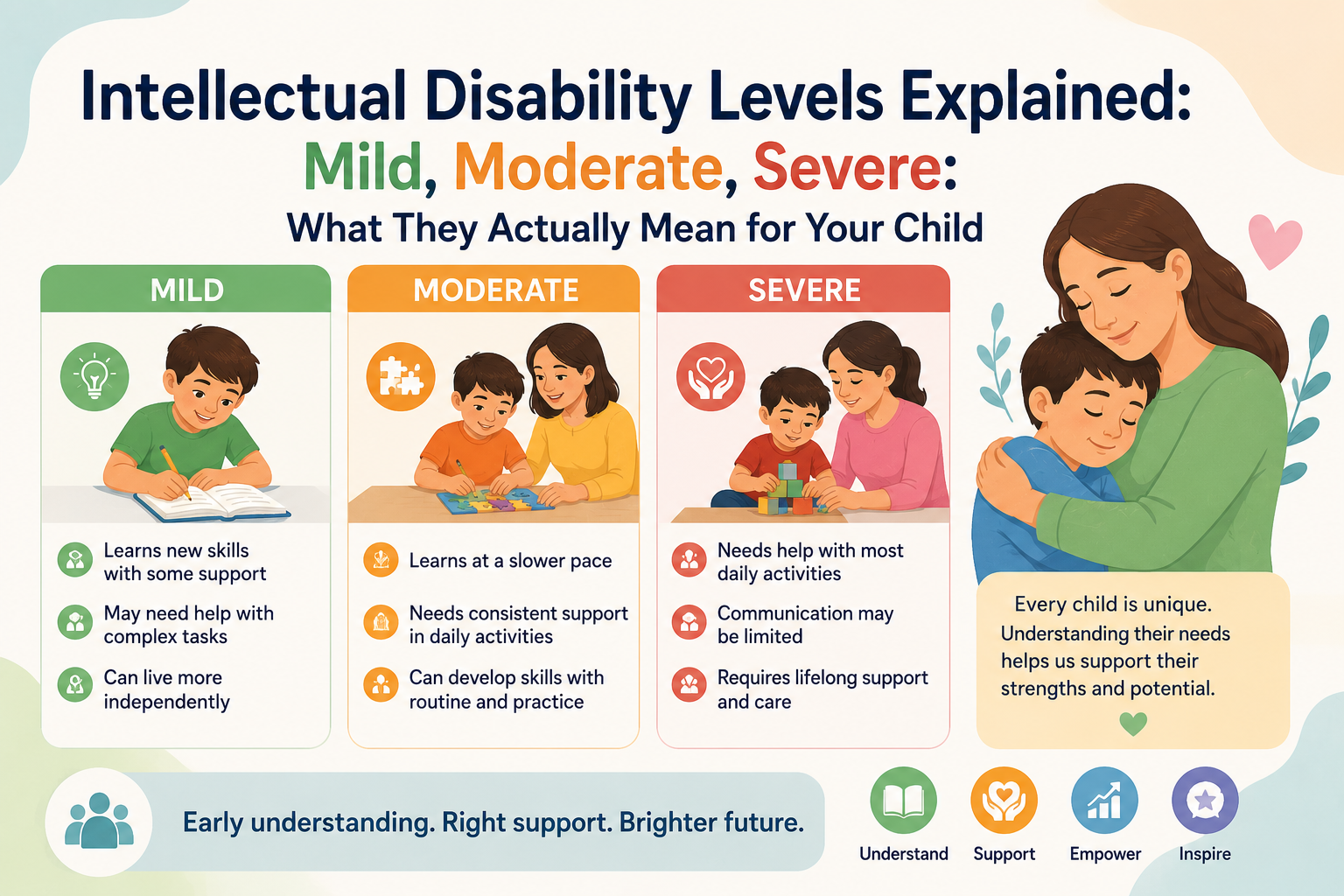
Intellectual Disability Levels Explained: Mild, Moderate, Severe: What They Actually Mean for Your Child in 2026 🎗️
⚡ Direct Answer — What You Need to Know First
Intellectual disability levels explained simply: intellectual disability (ID) is classified into mild, moderate, severe, and profound levels based on IQ scores and adaptive functioning — not labels that define a child’s worth or potential. Mild ID affects about 85% of all cases. Each level describes support needs, not limitations. With the right help, every child can grow. 💙
If a doctor just handed you a report with words like “moderate intellectual disability” or “severe cognitive impairment” — and you are sitting there not knowing what that actually means for your child’s daily life, their future, their education, or your family — this guide is written specifically for you.
These labels can feel devastating in the moment. But they are tools — imperfect, clinical tools — designed to help educators, therapists, and support workers understand your child’s needs. They are not ceilings. They are not destinies. And they absolutely do not tell the full story of who your child is or who they will become.
Let us take this apart clearly, honestly, and with the depth you deserve.

🧠 What Is Intellectual Disability?
Intellectual disability levels explained start here: intellectual disability is a neurodevelopmental condition characterized by significant limitations in both intellectual functioning and adaptive behavior. It originates before age 18. It affects how a person learns, reasons, solves problems, and navigates daily life.
The term “intellectual disability” replaced earlier terminology — including “mental retardation” — which is now considered offensive and outdated. This language shift matters. It reflects a deeper shift in how society understands these conditions: not as fixed deficits, but as profiles of strengths and support needs.
Intellectual disability is not:
- ❌ A mental illness
- ❌ A single, uniform condition
- ❌ A life sentence of dependency
- ❌ Something caused by bad parenting
- ❌ A measure of a person’s value or potential
Intellectual disability is:
- ✅ A neurodevelopmental difference present from birth or early childhood
- ✅ A spectrum — ranging from very mild to very complex
- ✅ A profile that changes over time with support and development
- ✅ Something that affects approximately 1–3% of the global population
- ✅ A condition that millions of people live full, meaningful, connected lives with
💡 Voice Search Answer — What is intellectual disability? Intellectual disability is a condition where a person has significant limits in intellectual functioning (thinking, learning, reasoning) and adaptive behavior (daily life skills). It begins before age 18. It ranges from mild to profound. About 1–3% of people worldwide have an intellectual disability. With appropriate support, people with intellectual disability can live meaningful, productive lives.
📏 How Are Intellectual Disability Levels Determined?
Understanding intellectual disability levels explained requires understanding how levels are actually assessed — because this process is more nuanced than most people realize.

Two Core Criteria (Both Must Be Present)
Criterion 1 — Significant Limitation in Intellectual Functioning
Intellectual functioning is measured through standardized IQ tests administered by a qualified psychologist. The average IQ score is 100. A score of approximately 70 or below — roughly two standard deviations below the mean — is considered a significant limitation in intellectual functioning.
However — and this is critical — IQ score alone does not diagnose intellectual disability. It is one part of a two-part assessment.
Criterion 2 — Significant Limitation in Adaptive Behavior
Adaptive behavior refers to the collection of conceptual, social, and practical skills that people use in everyday life. This includes:
- Conceptual skills — Language, reading, writing, money concepts, time management
- Social skills — Interpersonal skills, social responsibility, following rules, problem-solving in social situations
- Practical skills — Personal care, occupational skills, healthcare, travel, daily schedules, safety
Both criteria must be significantly limited, and both must have been present during the developmental period (before age 18).
The IQ Classification System
| IQ Range | Classification |
|---|---|
| 85–115 | Average range |
| 70–84 | Borderline intellectual functioning |
| 55–69 | Mild intellectual disability |
| 40–54 | Moderate intellectual disability |
| 25–39 | Severe intellectual disability |
| Below 25 | Profound intellectual disability |
Source: American Association on Intellectual and Developmental Disabilities (AAIDD)
The Modern Shift — DSM-5 and Support Levels
The DSM-5 (Diagnostic and Statistical Manual of Mental Disorders, 5th Edition) made a significant change in how intellectual disability is classified. Rather than relying primarily on IQ scores, DSM-5 emphasizes adaptive functioning across three domains and the intensity of supports needed.
This shift is enormously important. It means that a child’s intellectual disability level is increasingly defined not by a number on a test — but by what they need to thrive in their specific environment.
Source: American Psychiatric Association — DSM-5
🟢 Mild Intellectual Disability — What It Really Means
Mild intellectual disability is the most common level. It accounts for approximately 85% of all intellectual disability cases. It is the level most likely to go undetected until school age — and it is the level most frequently misunderstood by families who hear the word “mild” and assume it means insignificant.
“Mild” does not mean easy. It means this person’s support needs, while real, are generally less intensive than at other levels.
IQ Range
Approximately 55–69
What Mild ID Looks Like in Real Life
In Early Childhood:
- Development may appear slightly slower than peers but often within a range that does not trigger immediate concern
- Language development is typically delayed but progresses
- Play skills develop, though imaginative or abstract play may emerge later
- May not be identified until formal schooling begins
In School Age:
- Academic learning progresses more slowly than peers
- Reading and mathematics are typically below grade level
- With appropriate support and specialized teaching, most children with mild ID learn to read and perform basic mathematical operations
- Social relationships with peers are generally possible, though social nuance may be more challenging
- Most children with mild ID attend mainstream schools with additional support
In Adolescence and Adulthood:
- Most adults with mild ID develop sufficient communication and social skills to live semi-independently or independently
- Many hold paid employment — particularly in structured, supportive work environments
- Many form meaningful romantic relationships and some marry and parent with appropriate support
- Most adults with mild ID manage their personal care independently
What Parents Often Wish They Had Known
The biggest challenge many parents of children with mild ID describe is the “gap of invisibility” — their child looks and often acts like their peers in many ways, making it harder to access support services. Schools may underestimate their needs. Communities may not recognize their challenges. And the child themselves may be acutely aware of the difference between themselves and their peers — increasing vulnerability to anxiety, depression, and low self-esteem.
Early identification and ongoing emotional support are as important as academic intervention in mild intellectual disability.
🟡 Moderate Intellectual Disability — What It Really Means
Moderate intellectual disability accounts for approximately 10% of all intellectual disability cases. It is the level where the gap between a child’s development and their peers becomes clearly visible during the preschool years.
IQ Range
Approximately 40–54
What Moderate ID Looks Like in Real Life
In Early Childhood:
- Developmental delays are typically noticeable in the first 1–3 years of life
- Language development is significantly delayed — many children speak in simple sentences by school age
- Self-care skills (toilet training, dressing, feeding) develop but later than typical peers
- Early intervention services make a significant difference at this stage
In School Age:
- Most children with moderate ID attend special education programs or special schools
- Academic learning focuses on functional literacy and numeracy — reading common words, managing money at a basic level, understanding basic time concepts
- Social relationships are typically meaningful and important — children with moderate ID often form genuine friendships, particularly with peers of similar needs
- Structured routines are particularly important — predictability supports learning and reduces anxiety
In Adolescence and Adulthood:
- Most adults with moderate ID require supported living — either with family, in group homes, or in supported housing arrangements
- Supported or sheltered employment is achievable for many
- Self-care is largely independent with varying degrees of support for more complex tasks
- Meaningful community participation — social groups, recreational activities, faith communities — is not only possible but vital for wellbeing
A Closer Look at What Moderate ID Is Not
A common misconception is that moderate intellectual disability means a person cannot have preferences, relationships, humor, or meaningful communication. This is profoundly wrong. Adults with moderate ID consistently demonstrate:
- 💬 Rich emotional lives and genuine relational bonds
- 😄 Humor and playfulness
- 🎨 Artistic and creative expression
- ❤️ Deep loyalty and capacity for love
- 🌟 Specific talents and areas of strength that may surprise and delight their families
The label describes a level of intellectual and adaptive functioning. It says nothing about the fullness of a person’s humanity.
🔴 Severe Intellectual Disability — What It Really Means
Severe intellectual disability accounts for approximately 3–4% of all intellectual disability cases. It is associated with more significant support needs across all areas of daily life — and it is also the level most associated with co-occurring physical and medical conditions.
IQ Range
Approximately 25–39
What Severe ID Looks Like in Real Life
In Early Childhood:
- Significant developmental delays are typically apparent in infancy
- Motor development — sitting, crawling, walking — is often delayed
- Communication development is significantly affected — many children develop some functional communication, though for some this will be through Augmentative and Alternative Communication (AAC) devices, signing, or picture-based systems rather than speech
- Medical conditions — seizure disorders, sensory impairments, motor difficulties — frequently co-occur
In School Age:
- Education focuses on functional skills — basic communication, self-care routines, cause-and-effect understanding, social engagement
- Structured, consistent, sensory-supported learning environments are essential
- One-to-one and small group work is the norm
- Technology-supported learning (AAC devices, switches, eye-gaze technology) can dramatically expand participation
In Adolescence and Adulthood:
- Adults with severe ID typically require significant daily support across most areas of life — personal care, communication, community access, safety
- Supported living — with family or in residential care with appropriate staffing ratios — is the typical living arrangement
- Quality of life research consistently shows that adults with severe ID who have stable, caring relationships and meaningful daily activities report positive wellbeing
- Person-centered planning — driven by the individual’s preferences, not just their care needs — is the gold standard of support
The Communication Imperative
One of the most consistently underserved needs in severe intellectual disability is communication access. When a person cannot reliably communicate their needs, preferences, pain, and desires, the consequences for wellbeing are severe. Every person with severe ID deserves a robust communication assessment and access to the most appropriate AAC tools available. This is not a luxury — it is a fundamental right.
Resource: ISAAC — International Society for Augmentative and Alternative Communication
🟣 Profound Intellectual Disability — What It Really Means
Profound intellectual disability is the least common and most complex level. It accounts for approximately 1–2% of all intellectual disability cases. It is almost always associated with significant physical and medical complexities.
IQ Range
Below approximately 25 (standardized IQ testing is often unreliable or impossible at this level — functional assessment is used)
What Profound ID Looks Like in Real Life
Communication and Interaction:
- Communication is typically pre-symbolic or early symbolic — facial expressions, body movements, vocalization, eye contact
- With skilled, consistent partners and appropriate AAC tools, meaningful communication is possible
- The importance of familiar, attuned communication partners cannot be overstated
Daily Living:
- Pervasive support is needed for all aspects of daily life — personal care, mobility, eating, safety
- Many individuals have associated motor impairments (wheelchair use, limited voluntary movement)
- Seizure disorders, sensory impairments, feeding difficulties, and complex health needs are common co-occurrences
Quality of Life:
- This is where the research and the clinical literature are absolutely clear: quality of life for people with profound ID is determined primarily by the quality of their relationships and the responsiveness of their care environment — not by their IQ score or their level of independence
- People with profound ID respond to love, music, familiar voices, warmth, and human connection in ways that are visible and real, even when standardized measurement cannot capture them.
⚠️ Critical Point for Parents: The shift in best practice for profound intellectual disability is toward Intensive Interaction — a communication approach based on responding to the individual’s own signals and building genuine two-way communication from their starting point. Ask your child’s school or therapy team about Intensive Interaction training.
🔄 The Shift From IQ to Adaptive Functioning — Why This Matters for Your Child
This is one of the most important sections of intellectual disability levels explained — and one of the most poorly understood by families and many professionals.
The traditional classification of intellectual disability by IQ score alone is increasingly recognized as insufficient. Here is why the shift to adaptive functioning assessment matters so much:
IQ tests have known limitations:
- They measure performance on a specific test on a specific day under specific conditions
- They are heavily influenced by language, cultural context, and prior educational experience
- They do not measure motivation, creativity, emotional intelligence, or the ability to learn with support
- They can systematically underestimate the abilities of children with sensory impairments, autism, or limited language
Adaptive functioning tells a richer story:
- It measures what a person actually does in their real environment
- It identifies specific areas of strength and specific areas needing support
- It guides intervention planning more practically than IQ alone
- It can change significantly with effective support and education
What this means for your child: A child labeled “moderate intellectual disability” based on IQ may have adaptive functioning in some domains that is closer to the mild range — particularly with good early intervention. Conversely, a child with a “mild” IQ label may have adaptive behavior challenges that require more intensive support than the label suggests.
Always ask for the full adaptive behavior assessment — not just the IQ score.
Source: AAIDD — Intellectual Disability: Definition, Classification, and Systems of Supports
📊 Comparison Table — All Four Intellectual Disability Levels
| Feature | Mild ID | Moderate ID | Severe ID | Profound ID |
|---|---|---|---|---|
| IQ Range | 55–69 | 40–54 | 25–39 | Below 25 |
| Prevalence | ~85% of ID cases | ~10% of ID cases | ~3–4% of ID cases | ~1–2% of ID cases |
| Age of Identification | Often school age | Preschool years | Infancy/toddler | Birth/infancy |
| Communication | Full speech; may lag | Simple sentences; AAC helpful | Limited speech; AAC often essential | Pre-symbolic; AAC/Intensive Interaction |
| Academic Learning | Functional literacy achievable | Functional literacy with support | Pre-academic functional skills | Sensory/cause-effect learning |
| Self-Care | Largely independent | Largely independent with prompts | Significant support needed | Full support needed |
| Adult Living | Semi/fully independent | Supported living | Supported residential | Full residential support |
| Employment | Competitive with support | Supported/sheltered | Day programs | Day programs/home-based |
| Typical Causes | Often unknown; genetic, prenatal | Down syndrome, FASD, genetic | Genetic, chromosomal, brain injury | Multiple; chromosomal; severe brain injury |
| Co-occurring Conditions | Mental health challenges common | Physical & health conditions more common | Seizures, motor, sensory common | Complex medical needs very common |
Sources: AAIDD · American Psychiatric Association DSM-5 · CDC — Intellectual Disability
📈 Key Statistics — Intellectual Disability With Source Links
| Statistic | Figure | Source |
|---|---|---|
| Global prevalence of intellectual disability | 1–3% of world population | WHO — Disabilities |
| US prevalence of intellectual disability | ~6.5 million people | CDC — Developmental Disabilities |
| Percentage of ID cases classified as mild | ~85% | AAIDD |
| Percentage of ID cases with unknown cause | ~30–50% | American Academy of Pediatrics |
| Down syndrome prevalence (leading identifiable ID cause) | 1 in 700 births | CDC — Down Syndrome |
| Prevalence of co-occurring mental health conditions in ID | 30–40% | Journal of Intellectual Disability Research |
| Children with ID receiving special education services (US) | ~7.5% of all special education students | IDEA Data — US Dept of Education |
| Employment rate for adults with ID | ~19% (vs 66% general population) | Disability Statistics Annual Report |
| Percentage of adults with mild ID living independently or semi-independently | ~60–70% | AAIDD |
| Age of ID diagnosis (median) | 3–5 years for moderate-profound; later for mild | CDC — Developmental Monitoring |
🔍 Causes of Intellectual Disability
Understanding intellectual disability levels explained also means understanding where ID comes from. Causes vary enormously — and in many cases, no clear cause is ever identified.
Prenatal Causes (Before Birth)
- 🧬 Chromosomal conditions — Down syndrome (Trisomy 21), fragile X syndrome, Prader-Willi syndrome, Angelman syndrome
- 🧪 Genetic mutations — Single gene disorders; de novo (new) mutations increasingly identified through genetic testing
- 🍷 Fetal Alcohol Spectrum Disorder (FASD) — Leading preventable cause of ID worldwide
- 🦠 Prenatal infections — Rubella, cytomegalovirus, toxoplasmosis
- ☢️ Teratogen exposure — Certain medications, environmental toxins during pregnancy
- 🧠 Brain malformations — Conditions affecting brain development in utero
Perinatal Causes (During Birth)
- 🫁 Hypoxia — Oxygen deprivation during labor or delivery
- 🦠 Neonatal infections — Meningitis, encephalitis in the newborn period
- ⚖️ Extreme prematurity — Significant risk for neurodevelopmental difficulties
Postnatal Causes (After Birth, Before Age 18)
- 🤕 Traumatic brain injury — Accidents, abuse (shaken baby syndrome)
- 🦠 Meningitis/encephalitis — Infections affecting brain tissue
- ☠️ Severe malnutrition — Particularly in early childhood
- ☢️ Lead poisoning — Environmental exposure
- 🧠 Neurodegenerative conditions — Rare conditions causing regression
Unknown Causes
Despite advanced genetic testing, 30–50% of intellectual disability cases have no clearly identified cause. This “diagnostic odyssey” is one of the most emotionally exhausting aspects of parenting a child with ID — and families deserve acknowledgment of this uncertainty, not dismissal.
Source: American Academy of Pediatrics
🌱 Early Signs & When to Seek Assessment
One of the most evidence-based principles in intellectual disability levels explained is this: earlier identification leads to better outcomes. Every month of appropriate early intervention during the preschool years has measurable long-term impact.
Developmental Red Flags by Age
By 6 months:
- Not smiling or responding to familiar faces
- Limited eye contact
- Not reaching for objects
By 12 months:
- Not babbling
- Not pointing or waving
- Not responding to their name
By 18 months:
- Not using any single words
- Not walking independently
- Limited imitation of others’ actions
By 24 months:
- Not using two-word phrases
- Significant regression in previously acquired skills
- Limited pretend play
By 36 months:
- Not using three-word sentences
- Unable to follow simple two-step instructions
- Very limited peer interaction
⚠️ Trust Your Instincts
Research consistently shows that parents who express concern about their child’s development are right far more often than they are wrong. If something feels different — pursue it. Request a developmental pediatrician referral. Early assessment is always better than waiting.
💡 Voice Search Answer — What are early signs of intellectual disability in children? Early signs of intellectual disability include delayed milestones such as late sitting, walking, or talking; limited eye contact; not responding to their name; limited play skills; and difficulty following simple instructions. If you notice these signs, request a developmental assessment from your pediatrician. Early intervention significantly improves long-term outcomes.
Resource: CDC — Act Early Campaign
🏫 Education, Support & What Actually Helps
Understanding intellectual disability levels explained is most useful when it leads directly to knowing what actually helps children at each level thrive.
For Mild Intellectual Disability
✅ Inclusive education with targeted support — Resource rooms, learning support assistants, differentiated curriculum
✅ Literacy and numeracy intervention — Structured, evidence-based reading programs (phonics-based approaches work well)
✅ Social skills support — Social stories, structured peer interaction, friendship programs
✅ Mental health awareness — High rates of anxiety and depression; emotional wellbeing support is essential
✅ Self-advocacy training — Teaching children with mild ID to understand and communicate their own needs
For Moderate Intellectual Disability
✅ Functional academic skills — Reading common signs, managing money, understanding schedules
✅ Communication development — Speech therapy; augmentative communication as needed
✅ Life skills curriculum — Personal care, cooking basics, community navigation, safety awareness
✅ Structured routines — Predictability and visual schedules reduce anxiety and support learning
✅ Transition planning from age 14 — Post-school employment, housing, community participation planning
For Severe Intellectual Disability
✅ AAC (Augmentative and Alternative Communication) — PECS, speech-generating devices, signing systems
✅ Sensory integration — Occupational therapy addressing sensory processing
✅ Intensive Interaction — Communication-focused approach building on the individual’s signals
✅ Physiotherapy — Motor development, positioning, mobility
✅ Positive Behaviour Support (PBS) — Understanding and supporting behaviour through environmental and communication strategies
For Profound Intellectual Disability
✅ Intensive Interaction — The most evidence-supported approach for building communication
✅ Multisensory environments — Snoezelen rooms; sensory storytelling; music therapy
✅ High-quality personal care — Positioning, skin care, nutrition management, seizure management
✅ Relationship-centered care — Consistent, attuned caregivers who know the individual deeply
✅ Person-centered active support — Maximizing meaningful participation in daily activities at every level
Resource: Intensive Interaction Institute
💛 A Parent’s Real Story: “The Label Scared Me. My Son Amazed Me.”
“When the psychologist handed me the report that said ‘moderate intellectual disability’ — IQ 47 — I remember staring at those words and feeling the future I had imagined for my son collapse.
Rohan was four. He had just learned to say ‘Mama’ clearly for the first time three months earlier. He loved trains with a passion that lit up his whole face. He could identify every Thomas the Tank Engine character by sight and sound. He had the most genuine, full-body laugh I have ever seen in a child.
The report said ‘significant limitations in intellectual functioning and adaptive behavior.’ It said ‘expected to require supported living as an adult.’ It said ‘prognosis for independent living is poor.’
What it did not say was that Rohan would, by age seven, learn to read 80 sight words using a specialized program. That he would form a deep friendship with a boy named Aarav that still exists at age twelve. That he would learn to use the subway with a support worker, remember every stop, and tell the support worker when they got on the wrong train.
That report described his limitations on a test taken on a Tuesday in a small room with a stranger.
It did not describe my son.
The label gave us access to services. It opened doors to his school, to his therapies, to his disability allowance. For that, I am grateful. But I refused to let it become the ceiling. And it has not.
If you just got a report like ours — please hear this: the label is a starting point, not a finishing line.”
— Sunita P., mother of Rohan (moderate intellectual disability), Pune, India 💙
🔍 What You Must Not Miss About Intellectual Disability Levels
1. 🧠 The IQ Score Is the Least Important Number in the Report
Most online resources lead with IQ ranges and spend paragraphs explaining what IQ scores mean. But as the DSM-5 and AAIDD explicitly state — the level of intellectual disability should be determined primarily by adaptive functioning, not IQ score.
A child with an IQ of 58 who has excellent practical and social adaptive skills needs a fundamentally different support plan than a child with an IQ of 62 who has very limited self-care and communication. Always ask: “What does the adaptive behavior assessment show?” — not just “What is the IQ score?”
2. 💪 Strengths Profiles Are Absent From Most Classification Descriptions
Every clinical description of intellectual disability levels focuses almost entirely on limitations. Yet neurodevelopmental research consistently shows that intellectual disability — like all neurodevelopmental profiles — includes areas of relative strength alongside areas of challenge.
Children with Down syndrome frequently have strong social and visual learning skills. Children with Williams syndrome often have exceptional verbal memory and musical ability. Children with Angelman syndrome typically have warm, sociable personalities and strong non-verbal communication. The strengths profile matters as much as the limitations profile for educational and support planning.
3. 🔄 Levels Are Not Fixed — They Change With Support
One of the most damaging misconceptions about intellectual disability levels explained is that they are permanent and fixed. They are not. Adaptive functioning — the core of modern ID classification — responds to environment, education, and support. Children who receive high-quality early intervention, rich educational environments, and skilled support consistently show improvements in adaptive functioning over time.
The IQ score changes less — but the adaptive functioning level, which is what actually determines support needs in daily life, is genuinely responsive to intervention. This is not a promise of a cure. It is a recognition that people grow.
4. 😰 Mental Health in Intellectual Disability Is Critically Underdiagnosed
Research shows that 30–40% of people with intellectual disability have co-occurring mental health conditions — anxiety, depression, OCD, ADHD, and psychosis at significantly higher rates than the general population. Yet mental health conditions in people with ID are consistently underdiagnosed because:
- Symptoms present differently (“diagnostic overshadowing” — behaviours attributed to the ID rather than to mental illness)
- Communication limitations make self-reporting of mental symptoms difficult
- Many mental health professionals lack training in intellectual disability
If your child has an intellectual disability and is showing increased behavioural difficulties, sleep disturbance, withdrawal, or appetite changes — consider a mental health evaluation, not just a behavioral intervention.
Source: Journal of Intellectual Disability Research
5. 👴 Adults With Intellectual Disability Are Invisible in the Literature
The vast majority of content about intellectual disability levels focuses on children. But people with intellectual disability become adults. And adult ID services, aging with ID, healthcare access for adults with ID, and end-of-life care for people with profound ID are dramatically underserved topics. Parents need to think about transition planning — from school to adult services — far earlier than most guidance suggests. Begin at age 14 at the latest.
6. 🌍 The Global Disparity in ID Diagnosis and Support
In high-income countries, intellectual disability is diagnosed through multi-disciplinary teams using standardized assessments. In low- and middle-income countries — where the majority of the world’s population with ID lives — diagnosis is often absent or severely delayed, services are minimal, and social stigma is profound. The global burden of ID is heavily concentrated in contexts where causes like FASD, iodine deficiency, and perinatal hypoxia are preventable but not yet prevented.
❓ FAQs — Long-Tail Questions Answered
What is the difference between mild, moderate, and severe intellectual disability?
Mild ID (IQ 55–69) affects ~85% of cases; most adults live semi-independently. Moderate ID (IQ 40–54) requires supported living; most develop basic communication. Severe ID (IQ 25–39) needs significant daily support; AAC communication is often essential. Each level describes support needs, not potential.
Can intellectual disability be cured?
Intellectual disability cannot be cured. However, adaptive functioning — daily life skills — improves significantly with early intervention, quality education, and appropriate support. The goal is not cure but maximizing independence, wellbeing, and quality of life. Many people with ID live fulfilling, meaningful lives with the right support systems.
At what age is intellectual disability usually diagnosed?
Moderate-to-profound ID is typically identified between ages 1–3 through developmental monitoring. Mild ID is often not identified until school age (5–7 years) when academic demands reveal learning differences. Early developmental concerns should always prompt immediate pediatric referral — earlier diagnosis means earlier support.
Is intellectual disability the same as autism?
No. Intellectual disability and autism are separate conditions that frequently co-occur. Approximately 30–40% of autistic people also have an intellectual disability. A person can have autism without intellectual disability (and vice versa). Autism affects social communication and sensory processing; intellectual disability affects cognitive functioning and adaptive behavior.
What causes mild intellectual disability?
Mild intellectual disability often has no single clearly identified cause. Contributing factors include genetic variants, prenatal exposures (alcohol, infections, toxins), complications during birth, and environmental factors including severe early deprivation. In 30–50% of mild ID cases, no specific cause is ever identified despite thorough investigation.
Can a child with intellectual disability go to mainstream school?
Yes — particularly children with mild intellectual disability often attend mainstream schools with learning support. Children with moderate-to-profound ID may attend special schools or special classes within mainstream schools depending on their needs. The right placement depends on the individual child’s profile, not the label alone.
What is the life expectancy of a person with intellectual disability?
Life expectancy varies by cause and severity. People with mild ID have near-typical life expectancy. Those with Down syndrome now live into their 60s on average — dramatically improved from previous generations. People with profound ID and complex medical needs have shorter life expectancy, though highly variable by individual health profile and quality of care.
How do I know which level of intellectual disability my child has?
Level is determined by a qualified psychologist through standardized IQ testing combined with adaptive behavior assessments (such as the Vineland Adaptive Behavior Scales). Request a full psycho-educational assessment from your pediatrician. Both intellectual functioning and adaptive functioning across conceptual, social, and practical domains must be assessed.
What support services are available for children with intellectual disability?
Services vary by country but typically include: early intervention programs, special education, speech and language therapy, occupational therapy, physiotherapy, behavioral support (PBS), respite care for families, disability allowances, and transition-to-adulthood planning. Contact your national disability organization for country-specific guidance.
Does intellectual disability get worse over time?
Most forms of intellectual disability are not degenerative — the condition itself does not worsen. However, without adequate support and stimulation, adaptive skills may plateau or decline. With appropriate support, most people with ID continue developing skills throughout their lives. Some rare genetic conditions associated with ID do involve progressive neurological decline.
🔗 Trusted Resources for Parents & Professionals
🏥 Clinical & Research Authorities
- American Association on Intellectual and Developmental Disabilities (AAIDD) — Definition, classification, support systems
- American Psychiatric Association — DSM-5 — Diagnostic criteria
- CDC — Intellectual and Developmental Disabilities — Prevalence, causes, monitoring
- World Health Organization — Disability — Global perspective
- Journal of Intellectual Disability Research — Peer-reviewed research
💛 Patient & Family Support
- The Arc — Intellectual and Developmental Disabilities — US-based advocacy and support
- Mencap — UK — UK-based; extensive family resources
- Down Syndrome International — Global Down syndrome resources
- Fragile X Society — Fragile X specific resources
- Intensive Interaction Institute — Communication approach for severe/profound ID
🔬 Assessment & Early Intervention
- CDC — Act Early — Developmental monitoring milestones
- Vineland Adaptive Behavior Scales — Gold standard adaptive behavior assessment
- ISAAC — Augmentative & Alternative Communication — AAC resources and advocacy
✨ Final Thoughts: The Label Is a Starting Point, Not a Ceiling
Intellectual disability levels explained — mild, moderate, severe, profound — are clinical classifications designed to describe support needs. They are useful tools. They open doors to services, guide educational planning, and help families understand what kind of support their child needs.
But they are not — and have never been — the full story of who your child is. 💙
The research on what actually determines quality of life for people with intellectual disability at every level is remarkably consistent: it is not the IQ score. It is the quality of relationships, the responsiveness of the support environment, the presence of meaningful activity, and the degree to which the person is seen, heard, and valued.
Every child — at every level of intellectual disability — has the capacity to grow, to connect, to surprise, and to contribute to the lives of the people around them.
The label gives you a starting point. What you build from there — the relationships, the advocacy, the education, the therapy, the love — that is what actually shapes a life.
Your child is more than a level. And with the right support in 2026 and beyond, they have more potential than any report will ever fully capture. 🎗️
⚠️ Disclaimer: This article is written for informational and educational purposes only. It does not constitute medical or psychological advice. Always consult a qualified developmental pediatrician, clinical psychologist, or relevant specialist for assessment and support planning for your child.


