
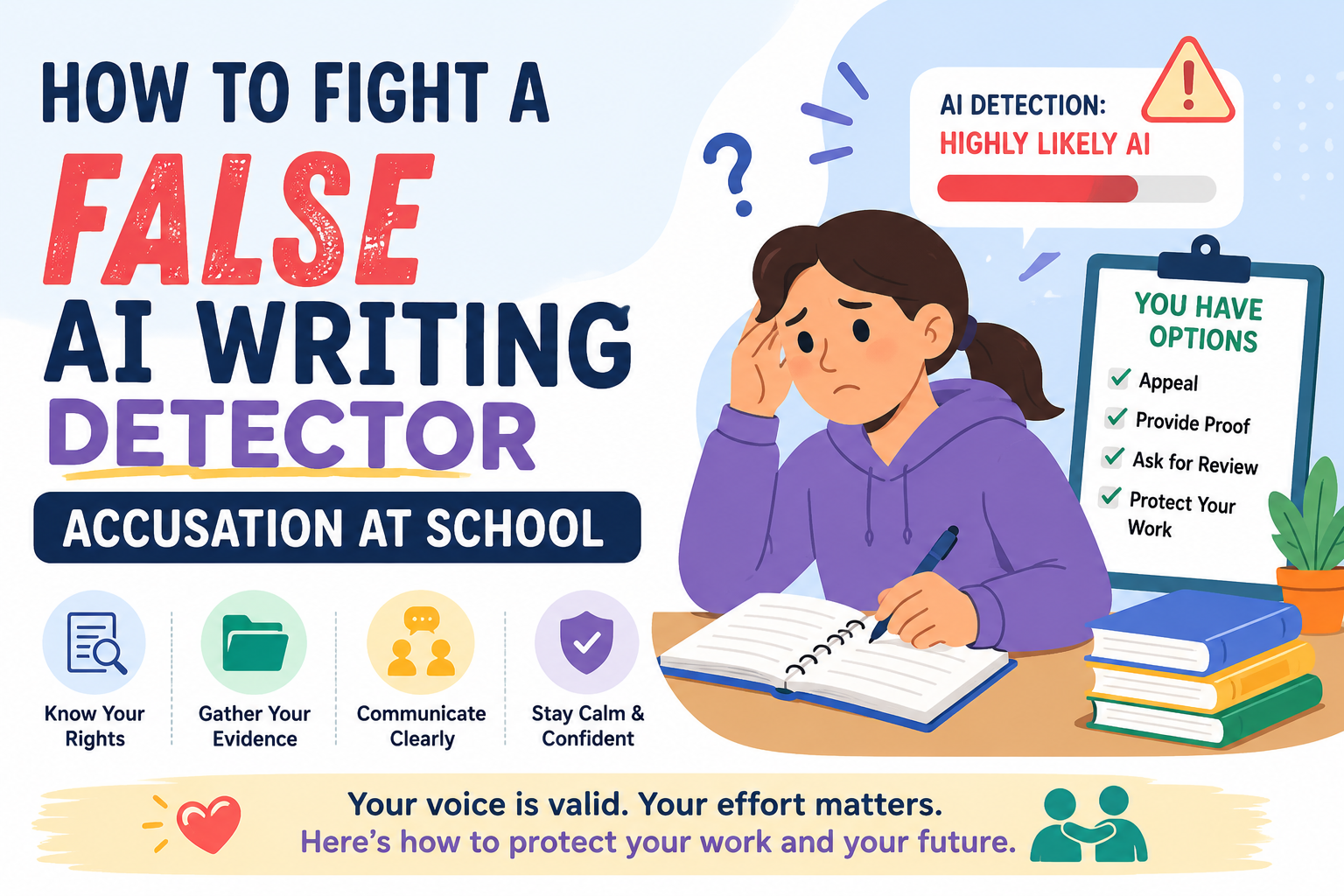
How to Fight a False AI Writing Detector Accusation at School: 2026 Complete Guide for Students, Parents, and Families 💛
😤 Your child wrote every word — yet the AI writing detector says otherwise? You’re not alone. In 2026, 61% of neurodivergent and ESL students are falsely flagged. This guide shows you exactly how to fight back and win. 👇

- 🌟 When an AI Writing Detector Gets It Dangerously Wrong
- 📊 The AI Writing Detector False Positive Crisis — The Data Every Parent and Student Must See
- 🧠 Why AI Writing Detectors Systematically Fail Specific Students
- ⚖️ Your Legal Rights When Facing an AI Writing Detector Accusation
- FERPA Rights — What You Can Demand
- Key Legal Principle — AI Scores Are Not Proof
- The Newby Precedent — Why 2026 Changed Everything
- Disability Rights Protections — Especially Important for Special Needs Families
- 🛠️ The 7-Step Action Plan — Fight a False AI Writing Detector Accusation
- Step 1: Breathe — Then Document Immediately ⏰
- Step 2: Gather Your Evidence — The Writing Audit 🗂️
- Step 3: Run the Document Through Multiple AI Detectors 🔍
- Step 4: Write Your Formal Appeal — The Framework 📝
- Step 5: Request a Viva or Oral Examination 🗣️
- Step 6: Escalate If the First Appeal Fails 📣
- Step 7: Protect the Future — Proactive Documentation 🛡️
- 💡 What Schools and Teachers Should Know — The Ethical Responsibility
- 🌐 Building Your Defence — Specific Guidance for Special Needs Families
- Documentation to Gather Alongside Your Academic Evidence
- The Key Argument for Neurodivergent Students
- ❓ FAQs — AI Writing Detector False Accusations 2026
- Q1: Can an AI writing detector really be wrong about human-written text?
- Q2: Are students with autism at higher risk of being falsely flagged by AI writing detectors?
- Q3: Can a school expel a student based solely on an AI writing detector score?
- Q4: What is the best evidence to fight an AI writing detector accusation?
- Q5: Are ESL students disproportionately accused by AI writing detectors?
- Q6: How do I know if an AI writing detector score is unreliable?
- Q7: What FERPA rights do students have when accused based on an AI writing detector?
- Q8: Can I request an oral exam instead of facing an AI accusation penalty?
- Q9: Which AI writing detectors have the lowest false positive rates?
- Q10: Should my child’s school be using AI writing detectors at all?
- 💛 Final Words: You Are Not Powerless
🌟 When an AI Writing Detector Gets It Dangerously Wrong
An AI writing detector — software designed to identify machine-generated text — is increasingly being used in schools and universities worldwide. But here is the critical truth: these tools are not reliable enough to determine guilt, carry well-documented bias against specific student populations, and have already destroyed academic records and mental health of students who wrote every single word themselves.
If your child or student has been falsely flagged, you are not powerless. This guide gives you the exact, step-by-step framework to challenge the accusation, clear their name, and protect their future.
This is especially urgent for families of children with special needs. Neurodivergent students — those with autism, ADHD, dyslexia, or other learning differences — are among the populations most frequently and unfairly flagged by AI writing detectors, simply because their genuine writing style can resemble patterns these tools associate with AI-generated text.
📊 The AI Writing Detector False Positive Crisis — The Data Every Parent and Student Must See
Before we walk through the defence strategy, you need to understand exactly how unreliable these tools are. Because this data is your most powerful argument.
| Statistic | Data | Source |
|---|---|---|
| False positive rate for non-native English writers | AI detectors misclassified over 61.3% of essays written by non-native English speakers as AI-generated — vs. 5.1% for US students | Stanford Study via Thesify, 2026 |
| Overall accuracy of leading AI detection tools | Most detectors hover between 65% and 90% accuracy — leaving massive room for error | WalterWrites AI, April 2026 |
| False positive rate at sentence level (Turnitin) | Turnitin’s sentence-level false positive rate is approximately 4% — flagging thousands of genuine student sentences | GradPilot, May 2026 |
| Racial disparity in AI accusation rates | 20% of Black teens reported being falsely accused of using AI, vs. 7% of white teens and 10% of Latino teens | Common Sense Media Report via Cook Law Firm, April 2026 |
| Non-native unanimous false positives | On 20% of flagged non-native papers, the false positive result was unanimous across all detectors tested | Cook Law Firm, April 2026 |
| Neurodivergent students elevated risk | Recent studies indicate neurodivergent students (autism, ADHD, dyslexia) are flagged at higher rates due to reliance on repeated phrases, terms, and words | University of San Diego Legal Research Center |
| Accuracy on hybrid human-AI texts | Performance on hybrid human–AI texts dropping to nearly 0% — tools cannot reliably detect texts that combine human and AI elements | Arab World Books — Sultan Qaboos University Study, 2026 |
| AI detection accuracy for scientific texts | Accuracy for scientific texts was 28–38 percentage points lower than for humanities texts — structured academic writing is systematically flagged | Sultan Qaboos University, 2026 via Arab World Books |
| First student to win federal lawsuit over AI false accusation | In February 2026, Orion Newby became the first student to win a federal lawsuit over a false AI plagiarism accusation — a judge ruled the finding was “without merit” | Detection Drama, April 2026 |
| Universities that have stopped using AI detectors | A growing number including Vanderbilt University and Michigan State University have discontinued use of AI detection tools | Kaltman Law, June 2025 |
🧠 Why AI Writing Detectors Systematically Fail Specific Students
Understanding why your student was flagged is the first step toward mounting an effective defence. AI writing detectors do not read text the way humans do. They analyse statistical patterns in language — things like predictability of word choices, sentence structure regularity, and “perplexity” (a measure of how surprising the next word is in a sequence).
The problem is that these patterns — low perplexity, structured sentences, predictable vocabulary — appear in many types of legitimate human writing, for entirely legitimate reasons.
🔴 The Five Groups Most Unfairly Targeted by AI Writing Detectors
1. Students with Autism Spectrum Disorder (ASD)
This is the most documented and most unjust failure of AI writing detectors.
Students on the autism spectrum often exhibit structured, literal, or repetitive writing styles that may resemble AI-generated text. The case of Moira Olmsted, a college student with autism, was falsely accused of cheating based solely on AI detector output. Despite explaining her communication style, which is shaped by her neurodivergence, she received a zero and a disciplinary warning. (Source: Kaltman Law, June 2025)
Similarly, in a landmark 2025 case, Orion Newby — a student with autism at Adelphi University — was accused after Turnitin flagged his paper as 100% AI-generated. Newby alleges the university failed to follow its own student rights policies, denied him the right to an advisor, and dismissed the impact of his autism on his writing style. (Source: AOL News via Detection Drama)
Why autism is specifically vulnerable to AI detector bias:
- Autistic writers often use clear, direct, structured sentence patterns
- Repetition of key vocabulary is a common communication trait
- Low linguistic “perplexity” is common — autistic writers often choose predictable, precise words
- These are exactly the patterns AI detectors associate with machine-generated text
2. Students with Dyslexia
Students with dyslexia frequently:
- Use shorter, simpler sentence structures
- Rely on familiar vocabulary rather than varied word choice
- Write in patterns that are more uniform across a piece
- Use grammar-checking and spell-checking tools extensively, which can make text appear more polished and “uniform” — another AI trigger
All of these legitimate accommodations for a genuine learning difference can produce false positive results on AI writing detectors.
3. Students with ADHD
Students with ADHD sometimes write in highly structured ways as a coping strategy — using formulas and templates to manage executive function challenges. This structured, formulaic approach to writing — which is entirely self-developed and human — can trigger AI detectors that associate structure with machine generation.
4. English as a Second Language (ESL) Students
The Stanford ESL bias study data is devastating: seven major AI detectors flagged writing by non-native English speakers as AI-generated 61% of the time. The reason is the same: non-native writers tend to use simpler vocabulary, predictable sentence patterns, and more standardised structures — exactly what these tools are trained to flag. (Source: Cook Law Firm, April 2026)
5. Students Who Use Assistive Technology
Students who use grammar-checking tools (Grammarly, ProWritingAid), text-to-speech software, AAC devices, or speech-to-text software as disability accommodations may produce text that appears more polished or uniform than their “natural” writing — again triggering AI detectors.
💬 A Real Case — A Family’s Experience
“My son Arjun has autism and is in his first year of university. He has always written in a very clear, structured way — it is part of how his brain works. He got an academic misconduct notification saying his philosophy essay had been flagged as 80% AI-generated by Turnitin.
He wrote every word over three sessions in the library. I watched him. He has drafts on his laptop, dated. His notes are in his notebook. The university investigation took four weeks. Four weeks of my son convinced he was about to be expelled for something he didn’t do. We provided everything — drafts, timestamps, his autism diagnosis, information about how autism affects writing style.
The university ultimately dropped the case. But the damage to his confidence — that was real. We were lucky we had evidence. I am writing this so other parents know: document everything, from the very first assignment.” — Smita A., mother of a university student with autism, Bengaluru, India
⚖️ Your Legal Rights When Facing an AI Writing Detector Accusation
This is the section that is critically important for families of students with special needs.
FERPA Rights — What You Can Demand
The Family Educational Rights and Privacy Act (FERPA) guarantees students and their families significant rights in any academic misconduct process:
- ✅ The right to see the evidence — Universities cannot punish you without showing you the specific evidence. Demand the full AI detector report, including the exact score, the tool used, and the passages flagged
- ✅ The right to respond — You have the right to formally respond to any accusation before any penalty is imposed
- ✅ The right to an appeal — Every institution is required to have an appeals process; make sure you use it
- ✅ The right to have someone present — You can typically bring a parent, advisor, or advocate to any hearing
Key Legal Principle — AI Scores Are Not Proof
Many universities explicitly prohibit discipline based on AI detectors alone due to their unreliability. Vanderbilt University explicitly states AI detectors cannot be used as sole evidence. The burden of proof is on the institution — they need to prove cheating occurred, not on the student to prove innocence. (Source: Paper Checker Hub, April 2026)
The Newby Precedent — Why 2026 Changed Everything
In February 2026, Orion Newby became the first student to win a federal lawsuit over a false AI plagiarism accusation. A judge ruled the finding was “without merit” after Turnitin flagged his World Civilizations paper as fully AI-written, despite two independent detectors clearing the same paper as human-written. (Source: Detection Drama, April 2026)
Former U.S. attorney Andrew Lelling called the court’s opinion “groundbreaking,” noting it established that students deserve due process before AI detection evidence is used to impose academic penalties.
This ruling matters for your case. You can cite the Newby precedent in any appeal to establish that:
- AI detector output is not proof of misconduct
- Conflicting results across different detectors undermine any single tool’s reliability
- Students are entitled to due process before penalties are imposed
Disability Rights Protections — Especially Important for Special Needs Families
For students with documented disabilities, additional protections apply:
- Section 504 of the Rehabilitation Act — Prohibits disability discrimination in any programme receiving federal funding. Using an AI writing detector that systematically produces higher false positive rates for students with autism, dyslexia, or ADHD and then imposing academic penalties raises serious Section 504 concerns.
- Americans with Disabilities Act (ADA) — Provides additional protections against discriminatory enforcement of academic integrity policies.
- UK SEND Code of Practice — For UK families, SEND provisions include the right to reasonable adjustments in assessment processes; using tools known to flag neurodivergent writing patterns raises compliance issues.
🛠️ The 7-Step Action Plan — Fight a False AI Writing Detector Accusation
This is the practical, sequential guide for students and families from the moment the accusation arrives.

Step 1: Breathe — Then Document Immediately ⏰
The moment you receive an accusation, before you respond to anyone, do three things:
- Screenshot and save everything — the notification, the email, the AI detector report, the exact score, the date and time
- Open your device and start gathering — every draft, every version, every timestamp showing your writing process
- Do not delete anything — even old, messy early drafts are evidence of your process
Critical: Many file deletion events happen innocently in the days after an accusation — routine device cleanups, syncing, app updates. Stop all of these until your case is resolved.
Step 2: Gather Your Evidence — The Writing Audit 🗂️
Build a comprehensive file of everything that proves human authorship. This is called your “authorship evidence package.”
Digital Evidence:
- [ ] All saved drafts — every version of the document, with timestamps
- [ ] Cloud storage version history — Google Docs, OneDrive, Dropbox all show edit-by-edit history
- [ ] Browser history from research sessions — shows the sources you consulted
- [ ] Notes app entries or handwritten notes photographed
- [ ] Any emails or messages discussing the assignment — to teachers, classmates, tutors
- [ ] Academic library account history — databases, articles, books accessed
Process Evidence:
- [ ] Handwritten notes or outline — physical evidence of planning
- [ ] Photographs or screenshots taken at the library or workspace
- [ ] Any peer review drafts with classmates’ comments
- [ ] Tutoring session records — dates, discussions, what was reviewed
Character and Context Evidence:
- [ ] Previous work showing consistent writing style
- [ ] Evidence of similar writing patterns in past assignments (to show style is consistent)
- [ ] For students with disabilities: your formal diagnosis documentation and any notes about how your disability affects your writing style
Step 3: Run the Document Through Multiple AI Detectors 🔍
Before submitting your appeal, run the flagged document through at least three different AI detectors yourself. This is powerful evidence because:
- Different tools often produce dramatically different results for the same text
- Conflicting results demonstrate that the accusation is based on an unreliable methodology
- You can cite the Sultan Qaboos University 2026 study, which found leading tools achieved accuracy rates of only 69% and 61%
AI detectors to test:
- Copyleaks — Industry-grade; often used by institutions themselves
- GPTZero — Widely referenced; generates probability scores
- Originality.ai — Popular with educators
- Pangram — Has the lowest false positive rate in independent University of Chicago Booth research
Keep screenshots of every result. If three out of four detectors clear the work as human-written, that contradicts the original accusation powerfully.
Step 4: Write Your Formal Appeal — The Framework 📝
Your appeal letter should follow this structure:
Opening (1 paragraph): State clearly that you are appealing a false AI detection accusation. State your name, student ID, course, assignment, and the date you received the accusation.
The Evidence Section (2–3 paragraphs): Walk through your evidence methodically. Present your drafts and their timestamps. Describe your research process. Cite specific elements of the writing — references you found, word choices you made, arguments you formed — that demonstrate genuine engagement with the material.
The Scientific Challenge (1–2 paragraphs): This is where you cite the research:
- Most AI detectors hover between 65% and 90% accuracy — leaving significant room for error (WalterWrites AI, 2026)
- The Sultan Qaboos University 2026 study found that leading tools achieved accuracy rates of only 69% and 61%
- A 2025 University of Maryland study found that AI-text detectors exhibit “alarmingly high false positive rates”
The Alternative Detector Results (1 paragraph): Present the results you obtained by running the document through multiple other tools, showing conflicting or contradictory outputs.
The Disability/Context Section (if applicable): If your student has a documented disability that affects their writing style, include this clearly. Cite that neurodivergent students with autism, ADHD, and dyslexia tend to use repeated phrases, predictable vocabulary, and formulaic structure — patterns that AI detectors interpret as machine-generated text. (University of San Diego Legal Research Center)
The Requested Resolution: State clearly what you are asking for — dismissal of the accusation, a fresh assessment, an oral examination, or a meeting with a human reviewer.
Step 5: Request a Viva or Oral Examination 🗣️
An oral examination — also called a viva — is one of the most effective ways to demonstrate genuine authorship. If you wrote the work yourself, you can discuss it. You know the ideas, the decisions, the arguments you made and why.
This request is increasingly being granted by institutions as AI detection controversies grow. Ask specifically:
“I request an oral examination or in-person discussion of the work in question to demonstrate my genuine understanding and authorship of the material.”
If you truly wrote it, this is your strongest card. No AI-generated work can be defended in real-time discussion the way a student’s own thinking can.
Step 6: Escalate If the First Appeal Fails 📣
If your internal appeal is denied, escalation options include:
- Department head or Dean — Request a meeting at the highest academic level
- Student ombudsman or ombudsperson — An independent advocate within the institution
- Student union or student government — Legal advice and advocacy support
- External legal counsel — As AI false accusation cases become more common, student defence attorneys are developing specific expertise in this area
- Media and institutional reputation — Institutions are increasingly sensitive to public cases of false AI accusation; the Newby case generated national coverage and university policy changes
Step 7: Protect the Future — Proactive Documentation 🛡️
Once this case is resolved, build a documentation habit for every future assignment:
- Save a new version of every document at every meaningful draft stage
- Send email updates to yourself describing your progress — creates timestamped evidence
- Keep a brief “writing journal” — even a few sentences after each work session noting what you worked on
💡 What Schools and Teachers Should Know — The Ethical Responsibility
This section is written for educators reading this guide — because the solution to the AI writing detector false accusation crisis starts with how institutions use these tools.
Major AI detector providers themselves acknowledge limitations. Turnitin, GPTZero, and other major tools include disclaimers stating their results should not be used as the sole basis for academic misconduct decisions. An AI detection score alone is not sufficient evidence.
The burden of proof is on the institution. Given the documented unreliability of AI detectors — especially for ESL writers — a detection score is weak evidence at best. (Source: SupWriter, April 2026)
The Institutional Policy Checklist — What Good Practice Looks Like
Schools that handle AI detection responsibly in 2026 follow these principles:
| Good Practice | What It Means | Example Institution |
|---|---|---|
| AI detection is a conversation starter, not a verdict | Scores trigger a conversation — not an accusation | Vanderbilt University |
| No sole reliance on AI detectors | Academic misconduct requires corroborating evidence | Michigan State University |
| Disability-adjusted thresholds | Higher false positive rates for neurodivergent and ESL students are acknowledged in policy | Growing number of institutions |
| Student due process guaranteed | Students see the evidence and have meaningful appeal opportunity | Required by FERPA |
| Human review before any penalty | A qualified educator reviews flagged work — not just software output | Best practice across sector |
🌐 Building Your Defence — Specific Guidance for Special Needs Families
For parents of children with autism, dyslexia, ADHD, or other neurodevelopmental conditions, the advocacy challenge is layered. You are simultaneously fighting the AI writing detector accusation AND educating the institution about how disability affects writing style.
Documentation to Gather Alongside Your Academic Evidence
- ✅ Formal diagnosis documentation — from a licensed psychologist, neurologist, or other qualified clinician
- ✅ IEP or 504 Plan — which may already document how your child’s disability affects their writing
- ✅ Previous teachers’ written observations of your child’s writing style
- ✅ Previous assignments — from earlier grades or courses — showing the same writing style existed long before any AI tools were used
- ✅ Statement from your child’s specialist — a psychologist or speech-language pathologist who can explain how the disability specifically affects written output
The Key Argument for Neurodivergent Students
Frame the argument this way in your appeal:
“My child’s writing style — including the characteristics that triggered this AI writing detector — directly reflects their neurodevelopmental profile as documented by [clinician name] on [date]. The characteristics flagged by the detector [list specific characteristics] are consistent with and expected from a writer with [diagnosis]. Using an AI writing detector as evidence of misconduct against a student whose disability produces these exact characteristics constitutes disability discrimination under [relevant law].”
❓ FAQs — AI Writing Detector False Accusations 2026
Q1: Can an AI writing detector really be wrong about human-written text?
Yes — significantly and often. Most detectors hover between 65% and 90% accuracy, leaving massive room for error. A 2026 Sultan Qaboos University study found leading tools achieved overall accuracy rates of only 69% and 61%, with performance on hybrid human–AI texts dropping to nearly 0%. (Source: WalterWrites AI, 2026)
Q2: Are students with autism at higher risk of being falsely flagged by AI writing detectors?
Yes — significantly. Recent studies confirm that neurodivergent students with autism, ADHD, and dyslexia tend to use repeated phrases, predictable vocabulary, and formulaic structure — patterns that AI detectors interpret as machine-generated text. The case of Moira Olmsted — a student with autism falsely accused — has been widely documented as a warning about this systematic bias. (Source: University of San Diego Legal Research Center)
Q3: Can a school expel a student based solely on an AI writing detector score?
No institution should impose penalties based solely on an AI detector score — and growing legal precedent supports this. In February 2026, Orion Newby became the first student to win a federal lawsuit over a false AI plagiarism accusation. Vanderbilt University explicitly states AI detectors cannot be used as sole evidence of misconduct. Always demand to know what corroborating evidence exists beyond the detector score. (Source: Detection Drama, April 2026)
Q4: What is the best evidence to fight an AI writing detector accusation?
The most powerful evidence includes: timestamped draft versions of the document showing revision history; cloud storage edit history (Google Docs is particularly useful); browser history from research sessions; handwritten notes or outlines; results from multiple independent AI detectors showing conflicting or human results; and for neurodivergent students, a clinician’s statement explaining how the disability affects writing style.
Q5: Are ESL students disproportionately accused by AI writing detectors?
Yes — dramatically so. A Stanford study found that AI detectors misclassified over 61.3% of essays written by non-native English speakers as AI-generated, compared with just 5.1% for US native speakers. This false positive rate for ESL students is extraordinarily high and represents one of the clearest documented failures of current AI detection technology. (Source: Thesify, 2026)
Q6: How do I know if an AI writing detector score is unreliable?
Run the same document through at least three different reputable AI detectors. Conflicting results — where one tool says AI and another says human — are strong evidence that no single tool should be trusted. Also note: AI detection scores are probabilities, not certainties. They are “conversation starters” per major providers, not definitive proof of misconduct. (Source: Paper Checker Hub, 2026)
Q7: What FERPA rights do students have when accused based on an AI writing detector?
FERPA guarantees the right to see all evidence against you, the right to formally respond before any penalty, the right to an appeal process, and the right to have someone present at any hearing. Schools cannot punish students without showing them the specific evidence — including the full AI detector report, score, and flagged passages.
Q8: Can I request an oral exam instead of facing an AI accusation penalty?
Yes — and this is one of the most effective strategies available. An oral examination (viva) allows you to demonstrate genuine understanding and authorship of your work through real-time discussion. If you wrote it yourself, you know it. This request is increasingly being granted as AI detection controversies grow. Frame it as: “I request an in-person discussion of the flagged work to demonstrate genuine authorship through direct engagement with the material.”
Q9: Which AI writing detectors have the lowest false positive rates?
In independent 2025 University of Chicago Booth research, Pangram had the lowest false-positive rate — essentially zero across passage lengths. GPTZero and Originality.ai sit near 1%. Turnitin’s sentence-level rate is approximately 4%, and its second-language rate is near 1.4%. Tools like ZeroGPT and Sapling have lower reliability and higher false positive rates. (Source: GradPilot, May 2026)
Q10: Should my child’s school be using AI writing detectors at all?
This is a legitimate question. Several major universities — including Vanderbilt University and Michigan State University — have discontinued use of AI detection tools, recognising that the technology is not reliable enough to stake students’ academic careers on. If your child’s school is using these tools, you can advocate at the school board or parent council level for a policy requiring human review before any accusation is made and prohibiting sole reliance on AI detector scores.
💛 Final Words: You Are Not Powerless
Being falsely accused by an AI writing detector is one of the most distressing experiences a student can face. It attacks something fundamental — the integrity of their work, their identity as a learner, and their trust in the institution that is supposed to support them.
For families of children with special needs, this injustice cuts even deeper. A tool that systematically produces higher false positive rates for autistic students, students with dyslexia, and students with ADHD — and is then used to impose academic penalties — is not a neutral tool. It is a discriminatory one.
But the tide is turning. The Newby ruling. The universities dropping these tools. The research mounting against them. The parents and students who fought back and won.
You have evidence on your side. You have legal rights on your side. And if you follow the steps in this guide — document, appeal, challenge the science, and escalate where needed — you have a real chance of justice.
HopeForSpecial stands with every family navigating this. 💛
🔗 Essential Resources
- 🌐 Paper Checker Hub — How to Appeal AI False Positives
- 🌐 Kaltman Law — AI Detectors and Academic Integrity Bias
- 🌐 Detection Drama — AI Detection Lawsuits 2026
- 🌐 University of San Diego — AI Detector Problems Guide
- 🌐 Cook Law Firm — Student Rights Against AI Accusations
- 🌐 Arab World Books — False Positive Epidemic Research Review
- 🌐 GradPilot — AI Detector False Positive Rates Compared
This article is written for educational and informational purposes only. It does not constitute legal advice. For cases involving formal academic misconduct proceedings, please consult a qualified student rights attorney in your jurisdiction.


