

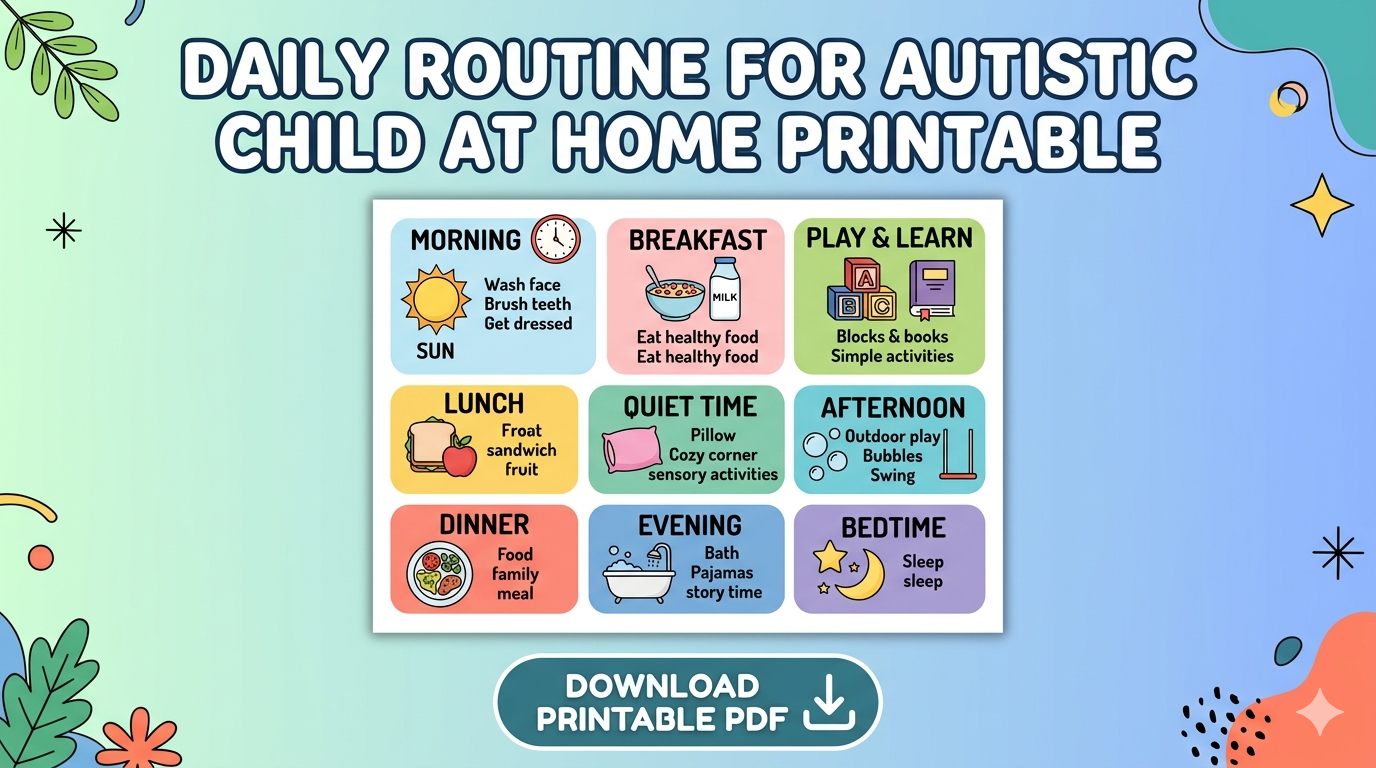
Daily Routine for Autistic Child at Home Printable (2026 Parent Guide)
Creating a daily routine for a child with autism can feel challenging at first. However, once you set a simple structure, daily life becomes much easier.
Children with autism often feel safe when they know what will happen next. That is why a daily routine for autistic child at home printable can be a powerful tool.
In this guide, you will learn:
- Why routines matter
- A complete daily schedule example
- A printable routine template
- Tips to make routines work

- Why a Daily Routine Is Important for Autistic Children
- What Is a Daily Routine for an Autistic Child?
- Key Elements of an Effective Autism Routine
- 🌅 Morning Routine (6:30 AM – 9:00 AM)
- 📚 Mid-Morning (9:00 AM – 12:00 PM)
- 🍽️ Afternoon Routine (12:00 PM – 3:00 PM)
- 🎨 Evening Routine (3:00 PM – 7:00 PM)
- 🌙 Night Routine (7:00 PM – 9:00 PM)
- 📋 Daily Routine Checklist
- Step 1: List Daily Activities
- Step 2: Arrange in Order
- Step 3: Add Pictures
- Step 4: Print and Display
- Step 5: Practice Daily
Why a Daily Routine Is Important for Autistic Children
Children with autism thrive on predictability.
A structured routine helps:
- Reduce anxiety
- Improve behavior
- Build independence
According to the Centers for Disease Control and Prevention (CDC), consistent routines help children develop emotional and behavioral control.
https://www.cdc.gov/parents/essentials/structure/index.html
Also, routines improve communication and learning outcomes over time.

What Is a Daily Routine for an Autistic Child?
A daily routine is a planned schedule of activities throughout the day.
It includes:
- Morning tasks
- Learning time
- Therapy sessions
- Play and rest
- Bedtime
👉 In simple words: it is a step-by-step plan for the day.
Key Elements of an Effective Autism Routine
Before creating a routine, understand these key points.
1. Consistency
Keep activities at the same time each day.
2. Visual Support
Use pictures or charts.
Experts recommend visual schedules to improve understanding.
https://www.autismspeaks.org/tool-kit-excerpt/visual-supports-and-autism
3. Flexibility
Even the best plan may need changes.
4. Balance
Include:
- Learning
- Play
- Rest
Daily Routine for Autistic Child at Home (Step-by-Step Example)
Here is a simple and practical daily schedule.
🌅 Morning Routine (6:30 AM – 9:00 AM)
6:30 AM – Wake Up
- Gentle wake-up
- Calm environment
7:00 AM – Personal Care
- Brush teeth
- Get dressed
7:30 AM – Breakfast
- Healthy meal
- Medication if needed
8:00 AM – Visual Schedule Review
- Show daily plan
8:30 AM – Start Learning Activities
👉 Tip: Avoid rushing. Keep mornings calm.
📚 Mid-Morning (9:00 AM – 12:00 PM)
9:00 AM – Learning Time
- Reading
- Writing
- Math
10:30 AM – Break
- Snack
- Sensory activity
11:00 AM – Therapy Time
- Speech therapy
- Occupational therapy
According to experts, structured learning improves focus.
https://www.understood.org/en/articles/learning-routines
🍽️ Afternoon Routine (12:00 PM – 3:00 PM)
12:00 PM – Lunch
1:00 PM – Rest / Quiet Time
2:00 PM – Skill Building
- Life skills
- Communication practice
🎨 Evening Routine (3:00 PM – 7:00 PM)
3:00 PM – Play Time
- Outdoor play
- Sensory play
4:30 PM – Practice Skills
- Homework
- Communication
5:30 PM – Family Time
🌙 Night Routine (7:00 PM – 9:00 PM)
7:00 PM – Dinner
8:00 PM – Calm Activities
- Reading
- Quiet play
8:30 PM – Bedtime Routine
- Bath
- Story
- Sleep
👉 Consistent bedtime improves sleep and behavior.
Printable Daily Routine for Autistic Child (Download Format)
Here is a simple printable routine template you can use:
📋 Daily Routine Checklist
✔ Wake up
✔ Brush teeth
✔ Get dressed
✔ Breakfast
✔ Learning time
✔ Break / snack
✔ Therapy
✔ Lunch
✔ Rest
✔ Play time
✔ Practice skills
✔ Dinner
✔ Bath
✔ Sleep
👉 You can:
- Print this list
- Use pictures for each step
- Stick it on a wall
Visual Schedule Example (Very Important)
Visual schedules are highly effective.
They use:
- Pictures
- Icons
- Symbols
Benefits:
- Improve understanding
- Reduce frustration
- Increase independence
Experts strongly recommend visual supports for autism.
https://www.autismspeaks.org/tool-kit-excerpt/visual-supports-and-autism
How to Create Your Own Printable Routine
Follow these steps:
Step 1: List Daily Activities
Write all tasks.
Step 2: Arrange in Order
Start from morning to night.
Step 3: Add Pictures
Use simple images.
Step 4: Print and Display
Place it where your child can see it.
Step 5: Practice Daily
Repeat every day.
Tips to Make the Routine Work
✔ Start Small
Do not include too many tasks.
✔ Use Rewards
Praise or reward small achievements.
✔ Stay Consistent
Follow the same routine daily.
✔ Be Flexible
Adjust when needed.
✔ Involve Your Child
Let them choose activities.
Common Mistakes to Avoid
Avoid these mistakes:
❌ Overloading the schedule
❌ Changing routine too often
❌ Ignoring breaks
❌ Not using visuals
Instead:
✔ Keep it simple
✔ Keep it consistent
Benefits of a Printable Routine
A printable routine helps:
- Reduce stress
- Improve behavior
- Build independence
- Support learning
Parents also feel more organized.
Real-Life Example
Priya, a parent of a child with autism, struggled daily.
There was:
- No routine
- Frequent meltdowns
Then she created a printable schedule.
She:
- Used pictures
- Set fixed times
- Added breaks
Result?
✔ Fewer meltdowns
✔ Better communication
✔ More independence
Expert Insights
Experts agree:
👉 Structured routines improve emotional stability and daily functioning.
Research shows that consistent routines support better behavior and learning outcomes in children with autism.
https://www.ncbi.nlm.nih.gov/pmc/articles/PMC4910503/
FAQs: Daily Routine for Autistic Child at Home Printable
1. How strict should the routine be?
It should be consistent but flexible.
2. What if my child refuses the routine?
Start slowly. Use rewards and visuals.
3. Can I change the routine?
Yes. Adjust based on your child’s needs.
4. How long should activities be?
Keep them short. 20–40 minutes works well.
5. Is a printable routine necessary?
Yes. It improves understanding and consistency.
Final Thoughts
Creating a daily routine for autistic child at home printable is one of the best steps you can take.
It helps:
- Your child feel safe
- Improve behavior
- Build independence
- Show daily plan


