

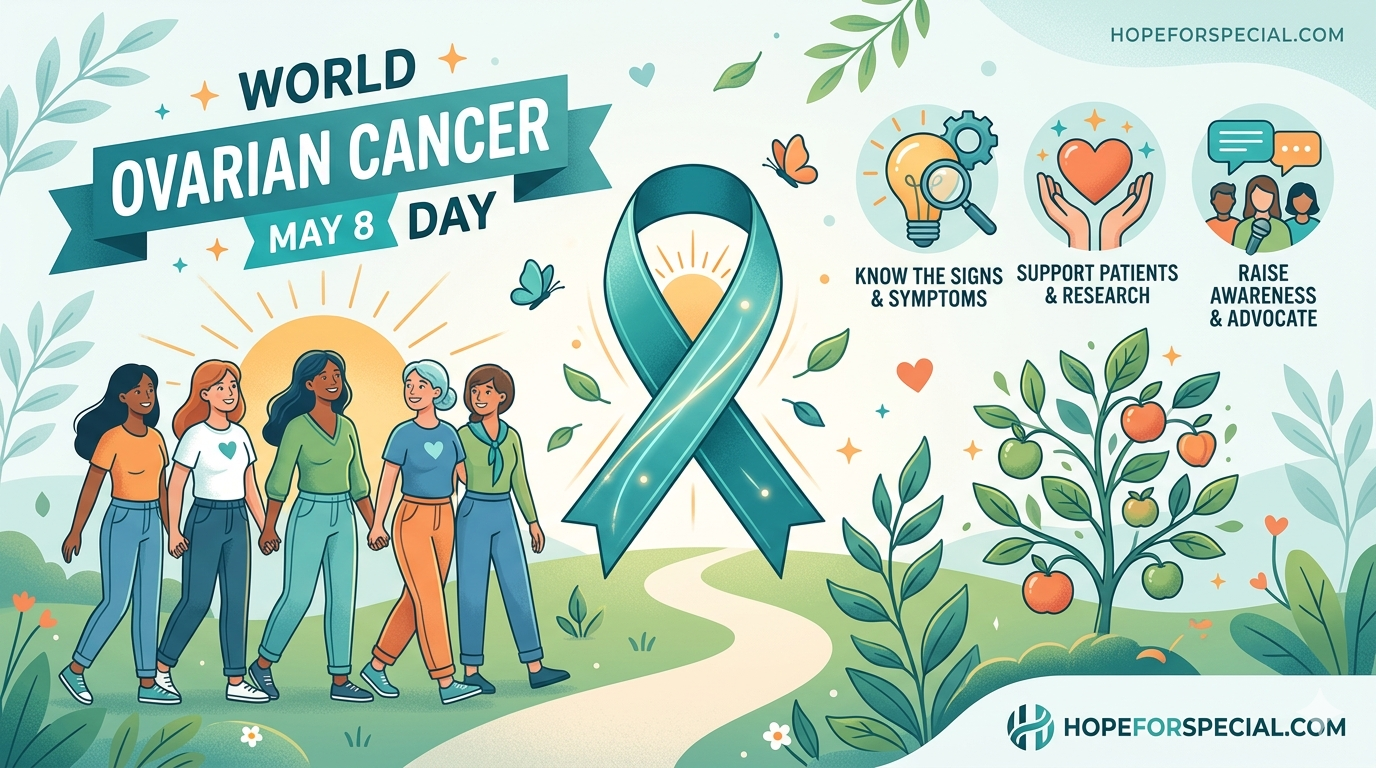
🎗️ World Ovarian Cancer Day 2026: Know the Heartbreaking Truth & How to Fight Back
World Ovarian Cancer Day, observed every year on May 8, is one of the most important health awareness days on the global calendar — and one of the most personal for families in the special needs community.
In simple terms, ovarian cancer is a silent, aggressive cancer of the female reproductive system that is often caught too late because its early symptoms are easily dismissed. It is the 8th most common cancer in women worldwide and the deadliest gynecological cancer — responsible for approximately 140,000 deaths globally every year. (Source: Days of the Year)

- 📅 When Is World Ovarian Cancer Day 2026?
- 🌍 The History of World Ovarian Cancer Day: How a Movement Was Born
- 📊 World Ovarian Cancer Day 2026: Statistics That Will Stop You in Your Tracks
- ⚠️ Why Ovarian Cancer Is Called the “Silent Killer”
- 💔 When a Special Needs Child’s Mother Has Ovarian Cancer
- 👩👧 A Real Story: “My Son’s World Fell Apart When I Got My Diagnosis”
- 🧬 Ovarian Cancer Risk Factors: Who Is Most Vulnerable?
- 🏥 Ovarian Cancer Diagnosis: What Happens and How Long It Takes
- 💊 Ovarian Cancer Treatment Options in 2026
- 👦 Ovarian Cancer in Children: What Every Special Needs Parent Should Know
- 🎗️ How to Observe World Ovarian Cancer Day 2026 as a Special Needs Family
- 🧬 BRCA Genes, Genetic Testing, and What It Means for Your Family
- 💙 Support Resources for Ovarian Cancer Patients, Survivors, and Caregivers
- 🏫 Helping Your Special Needs Child Understand When a Parent Has Cancer
- 🚫 Myths About Ovarian Cancer: Busted on World Ovarian Cancer Day
- Voice Search
- ❓ FAQs: World Ovarian Cancer Day
- Q: What is World Ovarian Cancer Day and when is it observed?
- Q: What colour represents ovarian cancer awareness?
- Q: What are the early warning signs of ovarian cancer?
- Q: What is the survival rate for ovarian cancer?
- Q: Can children get ovarian cancer?
- Q: Is there a screening test for ovarian cancer?
- Q: What is the BRCA gene and does it affect ovarian cancer risk?
- Q: How does a mother’s ovarian cancer diagnosis affect a child with special needs?
- Q: How can I participate in World Ovarian Cancer Day 2026?
- Q: What organisations support ovarian cancer patients?
- 💜 A Final Word From the HopeforSpecial Community
📅 When Is World Ovarian Cancer Day 2026?
World Ovarian Cancer Day 2026 falls on Friday, May 8, 2026.
World Ovarian Cancer Day is observed annually throughout the world on May 8. This observance aims to raise awareness as advocacy organizations, families, and patients come together to raise their voices against ovarian cancer. (Source: National Today)
This date is more than a number on a calendar. It is a lifeline for thousands of women who are still waiting for a diagnosis — and for the children and families who desperately need them to be found in time.
🌍 The History of World Ovarian Cancer Day: How a Movement Was Born
World Ovarian Cancer Day, observed annually on May 8th, was first launched in 2013 by a global coalition of ovarian cancer charity and advocacy organizations. What began as a grassroots movement has evolved into a global phenomenon, now uniting over 200 organizations worldwide in a coordinated effort to create a single, powerful voice for ovarian cancer awareness and action. (Source: Not These Ovaries)
Here is a quick timeline of how this day grew into a global force:
| Year | Milestone |
|---|---|
| 1809 | First recorded ovarian tumor removal surgery by Dr. Ephraim McDowell on Christmas Day |
| 1970s | Dr. Robert Bast discovers the CA-125 blood protein biomarker for ovarian cancer detection |
| 1987 | American Medical Association begins formal recognition of ovarian cancer treatment protocols |
| 2013 | World Ovarian Cancer Day officially launched by a global coalition of advocacy organizations |
| 2018 | World Ovarian Cancer Coalition estimates nearly 300,000 global cases and 185,000 deaths annually |
| 2025 | Estimated 20,890 new US cases diagnosed; rates of new diagnoses and deaths are slowly declining |
| 2026 | World Ovarian Cancer Day observed May 8 — with campaigns in Times Square and Piccadilly Circus |
(Source: National Today | Source: LGSOC Initiative)
📊 World Ovarian Cancer Day 2026: Statistics That Will Stop You in Your Tracks
These numbers are not just data. Each one represents a mother, a daughter, a sister — and in many cases, the primary caregiver of a special needs child.
| Statistic | Data | Source |
|---|---|---|
| New US ovarian cancer diagnoses (2025) | ~20,890 women | OCRA / NCI SEER 2025 |
| US ovarian cancer deaths (2025) | ~12,730 women | American Cancer Society 2025 |
| A woman’s lifetime risk of ovarian cancer | 1 in 91 | OCRA |
| 5-year relative survival rate (all stages) | 51.6% | AACR / NCI SEER |
| 5-year survival rate when caught at local (early) stage | 91.9% | NCI SEER Stat Facts |
| Women diagnosed in advanced (late) stage globally | ~70% | JCO Global Oncology |
| Ovarian cancer’s rank as cancer killer in women | 8th most common; deadliest gynecological cancer | Days of the Year |
| Annual global deaths from ovarian cancer | ~140,000 | Days of the Year |
| Rate of new cases declining annually in the US | 1.4% per year (2014–2023) | NCI SEER |
| Death rates declining annually in the US | 2.9% per year (2015–2024) | NCI SEER |
| Organizations participating in World Ovarian Cancer Day globally | 200+ | Not These Ovaries |
| Estimated global lives lost to ovarian cancer 2022–2050 | 8 million | JCO Global Oncology Study |
| Reduction in ovarian cancer risk with daily 30-min exercise | 20% | National Day Calendar |
💡 The most important number: When caught early — at the local stage — the 5-year survival rate jumps to 91.9%. That is why World Ovarian Cancer Day exists. Awareness saves lives. Early detection saves lives. Knowing the symptoms saves lives.
⚠️ Why Ovarian Cancer Is Called the “Silent Killer”
Ovarian cancer earned its devastating nickname because its early symptoms are so ordinary that most women dismiss them — for months, sometimes for years.
Symptoms like bloating or abdominal pain are often vague, delaying diagnosis. Many women mistake these signs for digestive issues. (Source: Days of the Year)
Here is the full symptom picture. Notice how “normal” each symptom sounds on its own:
🔴 Primary Symptoms (Do Not Ignore If Persistent):
- Bloating that does not go away after a few days
- Pelvic or lower abdominal pain
- Difficulty eating or feeling full very quickly
- Needing to urinate more often or more urgently
🟠 Secondary Symptoms (Often Dismissed as Other Conditions):
- Unexplained fatigue that is severe and persistent
- Unexpected weight loss or gain
- Changes in bowel habits — constipation or diarrhea without explanation
- Pain during sex
- Lower back pain with no clear cause
- Irregular periods or unusual vaginal bleeding (especially after menopause)
💡 The “Persistent” Rule:
The key word is persistent. Most women experience bloating or fatigue sometimes. The red flag is when these symptoms occur more than 12 times per month and cannot be explained by diet, exercise, or another known condition.
🗣️ If you have had ANY combination of these symptoms for more than 2–3 weeks consistently, speak to your doctor and specifically mention ovarian cancer. Do not wait.
(Source: National Ovarian Cancer Coalition – NOCC)
💔 When a Special Needs Child’s Mother Has Ovarian Cancer
When a mother is diagnosed with ovarian cancer, the entire family is diagnosed. Routines collapse. Fear fills every room. But when that mother is also the primary caregiver of a child with autism, cerebral palsy, a chromosomal condition, or any other special need — the crisis is multiplied in ways.
Here is what actually happens in a special needs household when a parent gets an ovarian cancer diagnosis:
| Challenge | Impact on the Special Needs Child |
|---|---|
| Disrupted daily routine | Massive anxiety, behavioural regression, meltdowns |
| Mother’s fatigue from chemotherapy | Reduced availability for therapy, communication, and care |
| Hospitalisation periods | Child may need emergency placement — devastating for bonded relationships |
| Caregiver burnout in the surviving parent | Two people needing intensive care, only one caregiver |
| Grief and uncertainty | Children with limited communication cannot express their fear or confusion |
| School communication breakdown | IEP meetings, therapy appointments missed during crisis |
| Financial pressure | Cancer treatment + special needs costs simultaneously |
The research confirms this burden is real:
Globally, more than 900,000 women have been diagnosed with ovarian cancer in the last 5 years, with approximately seven of every 10 women diagnosed in advanced stages. Many of these women are mothers. Many are the primary caregiver in a household that depends entirely on them. (Source: JCO Global Oncology)
👩👧 A Real Story: “My Son’s World Fell Apart When I Got My Diagnosis”
Priya, 44, is the mother of a 9-year-old son with Down syndrome and a 12-year-old daughter. She was diagnosed with Stage III ovarian cancer in 2024 after dismissing her symptoms for eight months as “stress from caregiving.”
“The first thing I thought about wasn’t dying,” Priya says quietly. “It was: who will do the 6am speech therapy warm-ups with Rohan? Who will read the same three books he needs every night in exactly the right order? Who will know that he needs his applesauce warm but not hot?”
“My husband is wonderful. But he didn’t know these things. And Rohan couldn’t tell him. For the first two weeks of chemo, Rohan refused to eat. He cried at the school drop-off every day. His teacher called me from my hospital bed.”
“We got through it. But I want every mother in our community to know: the symptoms I ignored for eight months — the bloating, the back pain, the feeling full too fast — those were the cancer. If I had gone to the doctor at month two instead of month eight, my stage would have been different. My fear would have been different. Please don’t wait.”
🧬 Ovarian Cancer Risk Factors: Who Is Most Vulnerable?
Understanding risk helps families take action before a crisis occurs. On World Ovarian Cancer Day, knowing your personal risk profile is one of the most empowering things you can do.
Highest-Risk Factors:
| Risk Factor | How Much It Increases Risk |
|---|---|
| BRCA1 gene mutation | 39–46% lifetime risk (vs 1.2% general population) |
| BRCA2 gene mutation | 10–27% lifetime risk |
| Strong family history of ovarian cancer | 2–3x higher risk |
| Lynch syndrome (hereditary colon cancer) | 10–12% lifetime risk |
| Never having been pregnant | Moderately higher risk |
| Starting menstruation before age 12 | Slightly higher risk |
| Late menopause (after 52) | Slightly higher risk |
| Endometriosis | 2x higher risk |
Factors That REDUCE Risk:
- ✅ Using oral contraceptives (the pill) for 5+ years — reduces risk by up to 50%
- ✅ Having children and breastfeeding
- ✅ Tubal ligation or removal of the ovaries (for very high-risk women)
- ✅ Exercise — 30+ minutes per day reduces risk by 20% (Source: National Day Calendar)
- ✅ Diet high in Vitamin D and Vitamin A (Source: National Day Calendar)
💡 Special note for special needs families: If you have a BRCA mutation AND are the primary caregiver for a child with special needs, please discuss your risk management options with a genetic counsellor specifically in the context of your caregiving role. Your survival is part of your child’s care plan.
🏥 Ovarian Cancer Diagnosis: What Happens and How Long It Takes
One of the most frustrating realities of ovarian cancer is that there is no routine screening test. Unlike breast cancer (mammogram) or cervical cancer (Pap smear), there is no equivalent standard screening for ovarian cancer.
Ovarian cancer is often diagnosed at a later stage. Awareness helps individuals recognize symptoms earlier and seek care. (Source: NOCC)
The typical diagnostic journey:
- Patient notices persistent symptoms and consults GP
- GP rules out digestive, urinary, or hormonal conditions first
- Blood test for CA-125 protein marker (elevated in many ovarian cancer cases, but not all)
- Pelvic ultrasound or transvaginal ultrasound
- CT scan or MRI to check for spread
- Laparoscopy or biopsy for definitive confirmation
- Staging of cancer (I through IV based on spread)
The stages of ovarian cancer and what they mean:
| Stage | What It Means | 5-Year Survival Rate |
|---|---|---|
| Stage I | Cancer confined to one or both ovaries | ~92% |
| Stage II | Cancer spread to other pelvic organs | ~71% |
| Stage III | Cancer spread to abdominal cavity or lymph nodes | ~30–41% |
| Stage IV | Cancer spread to distant organs (liver, lungs) | ~20–24% |
(Source: NCI SEER | Source: Moffitt Cancer Center)
The problem: Most women (approximately 70% globally) are diagnosed at Stage III or IV — when survival rates drop dramatically. This is exactly why World Ovarian Cancer Day is so urgent. Every year this day goes unheard, more women are diagnosed too late.
💊 Ovarian Cancer Treatment Options in 2026
Treatment for ovarian cancer has advanced significantly. While there is still no cure, the right treatment plan can extend life dramatically and maintain quality of life for years.
Main Treatment Options:
| Treatment | How It Works | When It Is Used |
|---|---|---|
| Surgery (debulking) | Removes the tumour and affected tissue | Primary treatment for most stages |
| Platinum-based chemotherapy | Kills cancer cells throughout the body | After surgery — most common combination |
| PARP inhibitors (e.g., Olaparib) | Targets cancer cells with BRCA mutations | Maintenance therapy for BRCA+ patients |
| Bevacizumab (Avastin) | Anti-angiogenic — cuts off cancer’s blood supply | Advanced ovarian cancer |
| Immunotherapy | Activates the immune system to fight cancer | Emerging; under clinical trials |
| Hormone therapy | Reduces oestrogen to slow hormone-sensitive cancers | Some specific ovarian cancer types |
| Radiation therapy | Targets specific areas of spread | Less common; used for palliative care |
For special needs families: If you or a partner is undergoing ovarian cancer treatment, it is essential to communicate with your child’s school team immediately. Request an IEP review to add flexibility for medical appointments, caregiver absences, and potential emotional regression in your child. Many schools have policies to support children during family medical crises — but only if they are told.
👦 Ovarian Cancer in Children: What Every Special Needs Parent Should Know
Most people do not realise that children can be diagnosed with ovarian cancer. While it is rare, it is critically important for parents — especially those who are medically vigilant about their children — to understand this.
In a series of female patients younger than 19 years with borderline or malignant epithelial ovarian tumors in the SEER Program database, the 10-year overall survival rate was 97.3% for borderline tumors. Among patients with stage I tumors, 100% survival rate was documented in specific well-differentiated groups. (Source: NCI – Childhood Ovarian Cancer Treatment PDQ)
Types of childhood ovarian cancer:
- Germ cell tumors — the most common type in children and young people; usually diagnosed in girls aged 10–19
- Epithelial ovarian tumors — more common in adults but can occur in teenage girls
- Stromal cell tumors — rare; account for about 5% of childhood ovarian tumors
Symptoms to watch for in girls with special needs:
Many children with special needs — particularly those who are nonverbal or have high pain thresholds — cannot communicate abdominal pain or pelvic discomfort. As a parent, watch for:
- ⚠️ Unexplained abdominal swelling or visible abdominal enlargement
- ⚠️ Changes in toileting behaviour — new resistance or regression
- ⚠️ Increased distress that cannot be attributed to sensory or behavioural triggers
- ⚠️ Unexplained fatigue or loss of energy even with adequate sleep
- ⚠️ Noticeable weight changes without dietary explanation
If your daughter with special needs has any of these unexplained physical changes, request a paediatric gynaecology referral. Early investigation can genuinely be life-saving.
🎗️ How to Observe World Ovarian Cancer Day 2026 as a Special Needs Family
You do not need a medical degree. You do not need to run a marathon. Here is a practical, family-friendly guide to marking World Ovarian Cancer Day on May 8, 2026.
| Action | How the Special Needs Community Can Join | Why It Matters |
|---|---|---|
| 🩵 Wear teal | Choose a teal top or accessory for the whole family | Starts conversations that save lives |
| 📱 Post on social media | Use #WorldOvarianCancerDay #TealRibbon #May8 | Reaches people who may not yet know the symptoms |
| 💰 Donate | Support NOCC at ovarian.org or OCRA at ocrahope.org | Funds better treatments and support systems |
| 📚 Share the symptoms | Print the symptom list and give it to 3 women you know | Most women diagnosed late say nobody told them the signs |
| 🕯️ Teal candle vigil | Light a teal candle at home in the evening | Honours those living with and lost to ovarian cancer |
| 🏫 Tell your child’s school | Share a simple ovarian cancer awareness card with teachers | Schools can share information with the wider parent community |
| 🧬 Know your family history | Check if ovarian or breast cancer runs in your family | BRCA gene testing could save your life |
World Ovarian Cancer Day was first launched in 2013 by a coalition of ovarian cancer advocacy organizations from around the world. The initiative was created to provide a unified voice for ovarian cancer awareness and to connect people globally in the fight against this disease. (Source: Awareness Days)

🧬 BRCA Genes, Genetic Testing, and What It Means for Your Family
For families in the special needs community, this section holds particular weight. If you carry a BRCA mutation, your children — including your children with disabilities — have a 50% chance of inheriting it.
What is a BRCA gene mutation?
BRCA1 and BRCA2 are tumour-suppressor genes. When functioning normally, they help protect the body from cancer. When mutated, they significantly increase the risk of ovarian AND breast cancer.
Should you get tested?
Genetic testing is recommended if you have:
- A first-degree relative (mother, sister, daughter) with ovarian or breast cancer
- Ashkenazi Jewish heritage (higher BRCA mutation prevalence)
- A personal history of breast cancer before age 50
- Two or more close relatives with breast, ovarian, pancreatic, or prostate cancer
What happens if you test positive?
A genetic counsellor will walk you through your options, which may include:
- Increased surveillance (more frequent ultrasounds and CA-125 tests)
- Preventive medications (chemoprevention)
- Risk-reducing surgery (oophorectomy — removal of ovaries)
- Family planning decisions
For mothers of children with special needs who test positive, this conversation should explicitly include your caregiving responsibilities. Your oncologist and genetic counsellor need to understand that your health decision directly impacts a child who depends entirely on you.
(Source: Ovarian Cancer Research Alliance – OCRA)
💙 Support Resources for Ovarian Cancer Patients, Survivors, and Caregivers
You do not have to face this alone. These organisations exist specifically to help you.
| Organisation | What They Offer | Website |
|---|---|---|
| National Ovarian Cancer Coalition (NOCC) | Patient support, peer mentoring, awareness events | ovarian.org |
| Ovarian Cancer Research Alliance (OCRA) | Research funding, patient resources, Women to Women support | ocrahope.org |
| World Ovarian Cancer Coalition | Global advocacy, international awareness campaigns | worldovariancancercoalition.org |
| Target Ovarian Cancer (UK) | UK-specific support, nurse helpline, research | targetovariancancer.org.uk |
| American Cancer Society | 24/7 helpline, treatment navigation, caregiver support | cancer.org |
| LGSOC Initiative | Specific support for low-grade serous ovarian cancer | lgsoc.org |
| NCI – National Cancer Institute | Research-based patient information | cancer.gov |
🏫 Helping Your Special Needs Child Understand When a Parent Has Cancer
This is perhaps the most difficult conversation a family will ever have. And for a child with autism, intellectual disability, or another special need, the communication challenge is compounded.
Here is an age-appropriate, ability-appropriate framework:
For nonverbal or low-verbal children: Use visual supports — a simple picture board showing “Mummy is sick,” “Mummy is at the hospital,” “Mummy will come back,” and “You are safe.” Keep the core message consistent and simple: you are loved, you are safe, your routine will stay as normal as possible.
For children with mild to moderate intellectual disability (ages 7–15): Use concrete, literal language: “I have a sickness inside my tummy. Doctors are giving me medicine to fight it. The medicine makes me tired. I still love you the same amount every single day. Nothing you did caused this.”
For teenagers with autism or learning differences: Be honest and specific in a way that matches their processing style. Many autistic teenagers respond better to factual, ordered information than to emotional conversations. “I have been diagnosed with Stage II ovarian cancer. This is my treatment plan. These are the expected side effects. Here is how our family routine will change and here is what will stay the same.”
Signs your child is struggling emotionally:
- New sleep disturbances or nightmares
- Increased stimming or self-regulatory behaviours
- Regression in previously mastered skills (toileting, feeding, communication)
- Refusal of food or favourite activities
- Increased aggression or emotional outbursts without clear sensory trigger
If you notice these signs, contact your child’s therapist, psychologist, or school support team immediately. Do not wait. Children process grief differently — but they do grieve, even without the words to say so.
🚫 Myths About Ovarian Cancer: Busted on World Ovarian Cancer Day
One myth claims ovarian cancer only affects older women, but it can occur at any age. Another misconception is that a hysterectomy guarantees protection, though cancer can still develop elsewhere in the reproductive system. (Source: Days of the Year)
Let us bust the most dangerous myths clearly:
| Myth ❌ | Truth ✅ |
|---|---|
| “A Pap smear detects ovarian cancer” | No — Pap smears detect cervical cancer only. There is NO routine screening test for ovarian cancer. |
| “Only older women get it” | The median diagnosis age is 63, but women in their 20s, 30s, and 40s are diagnosed every day |
| “Removing the uterus (hysterectomy) prevents ovarian cancer” | No — unless the ovaries are also removed, cancer risk remains |
| “No symptoms means no cancer” | Early-stage ovarian cancer may have very subtle symptoms — or none at all |
| “It runs in families, so if my mother didn’t have it, I’m safe” | 90% of ovarian cancer cases have NO family history |
| “Ovarian cancer is always fatal” | Early-stage ovarian cancer has a 91.9% 5-year survival rate when caught early |
| “Chemotherapy always causes hair loss” | Some ovarian cancer regimens do not cause hair loss |
Voice Search
When is World Ovarian Cancer Day?
World Ovarian Cancer Day is observed annually on May 8th to raise global awareness and support for those affected by the disease.
What colour is ovarian cancer?
The official awareness color for ovarian cancer is teal, which is used in ribbons and campaigns to represent the cause.
Ovarian cancer survival rate?
The overall five-year relative survival rate is approximately 50%, though this varies significantly depending on the stage at diagnosis and the specific subtype of the cancer.
Can children get ovarian cancer?
Yes, although it is extremely rare, children and adolescents can develop ovarian cancer, most commonly in the form of germ cell tumors.
❓ FAQs: World Ovarian Cancer Day
Q: What is World Ovarian Cancer Day and when is it observed?
A: World Ovarian Cancer Day is a global health awareness day observed every year on May 8. In 2026, it falls on Friday, May 8, 2026. It was first launched in 2013 by a global coalition of ovarian cancer charity and advocacy organizations and has grown to unite over 200 organizations worldwide. (Source: Not These Ovaries)
Q: What colour represents ovarian cancer awareness?
A: The official awareness colour for ovarian cancer is teal. On World Ovarian Cancer Day, people around the world wear teal ribbons, clothing, and accessories to show solidarity with those affected by ovarian cancer. (Source: NOCC)
Q: What are the early warning signs of ovarian cancer?
A: The most important early signs of ovarian cancer are bloating that does not go away, persistent pelvic or abdominal pain, difficulty eating or feeling full quickly, and increased urinary urgency or frequency. The key is that these symptoms occur frequently — more than 12 times per month — and do not resolve on their own. If you experience this, see your doctor immediately and specifically mention ovarian cancer. (Source: NOCC)
Q: What is the survival rate for ovarian cancer?
A: The relative five-year survival rate for ovarian cancer is 51.6%. However, when ovarian cancer is caught at the local (early) stage, the 5-year relative survival for localized ovarian cancer is 91.9%. This enormous difference is why early detection through awareness is so critical. (Source: OCRA)
Q: Can children get ovarian cancer?
A: Yes, although it is rare. Ovarian cancer in children and teenagers is most commonly a germ cell tumour. The good news is that childhood ovarian cancer, especially when caught early, has excellent outcomes. In a series of female patients younger than 19 with borderline tumours, the 10-year overall survival rate was 97.3%. (Source: NCI)
Q: Is there a screening test for ovarian cancer?
A: No. Unlike breast cancer or cervical cancer, there is currently no reliable routine screening test for ovarian cancer. A CA-125 blood test and pelvic ultrasound can be used when symptoms are present or for high-risk women, but neither is used for routine population screening. This is one of the most urgent problems World Ovarian Cancer Day advocates for more research to solve. (Source: OCRA)
Q: What is the BRCA gene and does it affect ovarian cancer risk?
A: The BRCA1 and BRCA2 genes are tumour-suppressor genes. When they carry a mutation, they significantly increase ovarian cancer risk — BRCA1 carriers have a 39–46% lifetime risk, compared to about 1.2% in the general population. If you have a family history of ovarian or breast cancer, ask your doctor for a genetic counselling referral. (Source: OCRA)
Q: How does a mother’s ovarian cancer diagnosis affect a child with special needs?
A: When a special needs child’s primary caregiver is diagnosed with ovarian cancer, the impact extends far beyond the medical. Routine disruption, caregiver fatigue from treatment, hospitalisation, and emotional distance can cause regression, anxiety, meltdowns, and grief in children who may not have the words to express their fear. Proactive school communication, visual supports, and consistent emotional reassurance are critical during this time.
Q: How can I participate in World Ovarian Cancer Day 2026?
A: You can wear teal, learn more about the symptoms of ovarian cancer, commit to lowering your risk by adapting a healthy lifestyle, donate to an organization that funds ovarian cancer research, and share this day on social media with #WorldOvarianCancerDay. (Source: National Day Calendar)
Q: What organisations support ovarian cancer patients?
A: The leading organisations are the National Ovarian Cancer Coalition at ovarian.org, the Ovarian Cancer Research Alliance at ocrahope.org, the World Ovarian Cancer Coalition at worldovariancancercoalition.org, and for UK families, Target Ovarian Cancer at targetovariancancer.org.uk.
💜 A Final Word From the HopeforSpecial Community
On this World Ovarian Cancer Day, we want every mother in our special needs community — every exhausted, devoted, invisible superhero who is managing therapies and IEPs and meltdowns and medications every single day — to hear this:
Your body matters. Your health matters. Your survival matters.
Not just because your child needs you — although they do, desperately. But because YOU matter. Your pain signals deserve to be investigated. Your symptoms deserve to be taken seriously. Your fears deserve to be heard.
The average woman with ovarian cancer waits months before seeking help. Often because she is too busy caring for others to care for herself. If that is you — this is your sign.
Book the appointment. Describe the symptoms. Say the words: “I want to rule out ovarian cancer.”
💙 Share this article with every woman you love. You may not know which one needs it. But you might save her life.


