
💜 Fibromyalgia Awareness Day 2026: What Every Special Needs Parent Must Know — and What No One Is Telling You
Fibromyalgia Awareness Day, observed every year on May 12, is one of the most important health awareness days in the calendar — and yet millions of people, including thousands of special needs parents, still have no idea they might be living with this invisible condition.
In simple terms, fibromyalgia is a chronic pain disorder that causes widespread body pain, extreme fatigue, and mental fog. It has no cure. And it disproportionately affects caregivers — especially mothers of children with disabilities.

- 📅 When Is Fibromyalgia Awareness Day 2026?
- 🩺 What Is Fibromyalgia? A Simple, Clear Explanation
- 📊 Fibromyalgia Statistics You Need to See in 2026
- 🧒 Fibromyalgia in Children: The Hidden Diagnosis
- 💡 The Fibromyalgia–Autism Connection: What New Research Is Revealing
- 💔 A Parent’s Story: “I Thought I Was Just Tired From Caregiving”
- ⚠️ 13 Symptoms of Fibromyalgia (That Most People Ignore)
- 🏫 How Fibromyalgia Affects a Child’s School Life
- 💊 Fibromyalgia Treatment Options: What Works in 2026
- 🌡️ What Fibromyalgia Feels Like: Explaining It to Your Child
- 💜 How to Observe Fibromyalgia Awareness Day 2026 as a Special Needs Family
- 🧬 The History of Fibromyalgia Awareness Day: A Timeline
- 🆘 When to See a Doctor: A Checklist for Special Needs Parents
- 🤝 Support Resources for Fibromyalgia Warriors and Special Needs Families
- Voice Search
- When is fibromyalgia awareness day?
- What color is fibromyalgia awareness?
- Can children get fibromyalgia?
- ❓ FAQs: Fibromyalgia Awareness Day
- Q: What is fibromyalgia awareness day and when is it?
- Q: What is the awareness color for fibromyalgia?
- Q: Can children get fibromyalgia?
- Q: What are the first signs of fibromyalgia in a child?
- Q: Is there a connection between fibromyalgia and autism?
- Q: How do I get diagnosed with fibromyalgia?
- Q: What is world fibromyalgia awareness day?
- Q: How can I support someone with fibromyalgia on fibromyalgia awareness day?
- Q: What is fibro fog?
- Q: Does fibromyalgia get worse with stress?
- 💜 Final Thoughts: You Are Seen, You Are Believed
📅 When Is Fibromyalgia Awareness Day 2026?
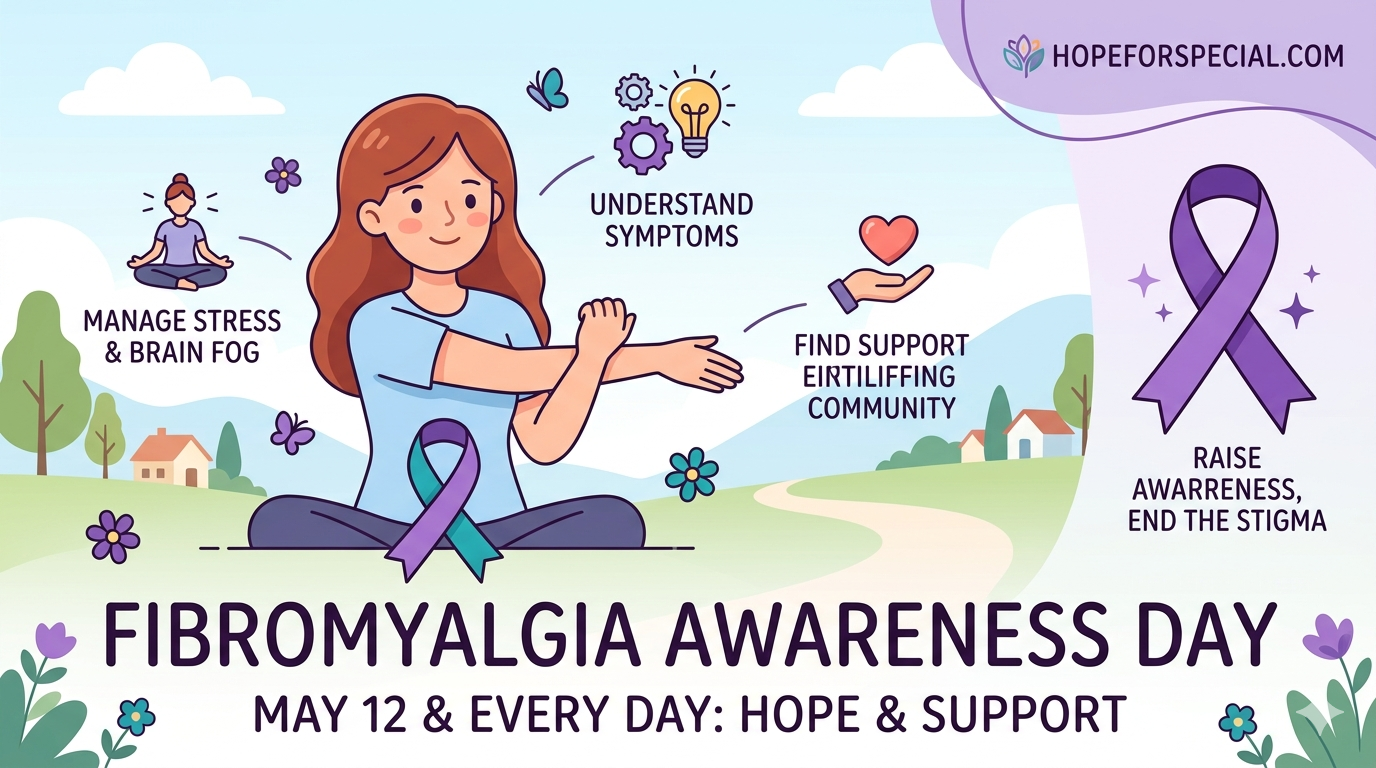
Fibromyalgia Awareness Day 2026 falls on Tuesday, May 12, 2026.
This date is not chosen randomly. It honours the birthday of Florence Nightingale, the founder of modern nursing, who historians now believe may have suffered from fibromyalgia symptoms herself. (Source: National Today)
The day is also shared with International ME/CFS Awareness Day, recognizing the deeply connected struggles of people living with chronic fatigue and chronic pain. (Source: NIH)
🩺 What Is Fibromyalgia? A Simple, Clear Explanation
Fibromyalgia is a chronic, invisible illness affecting the central nervous system. It makes the body hypersensitive to pain signals — like a pain volume dial that is permanently stuck on HIGH.
Here is what makes fibromyalgia unique and frustrating:
- ❌ It does not show up on standard blood tests
- ❌ It does not cause visible inflammation or joint damage
- ❌ It is not psychological — it is a real, measurable neurological condition
- ✅ It can be managed with the right strategies
- ✅ It can coexist with other conditions — including autism, ADHD, and other conditions common in special needs families
The term “fibromyalgia” comes from the Latin fibro (fibrous tissue), Greek myo (muscle), and algos (pain). Together, it literally means “muscle and connective tissue pain.” (Source: National Fibromyalgia Association)
📊 Fibromyalgia Statistics You Need to See in 2026
These numbers are striking — and they tell a story that most awareness articles completely ignore.
| Statistic | Data | Source |
|---|---|---|
| Americans affected by fibromyalgia | More than 12 million | National Day Calendar |
| Global prevalence (adults) | 2–5.4% of the world population | MedRxiv / UK Pain Centre Study, 2025 |
| Women vs men affected | Women are 7x more likely to be diagnosed | National Today |
| Average years before correct diagnosis | 5–7 years | NIH / National Fibromyalgia Association |
| Prevalence in children under 18 | 0.5% to 6.2% depending on age group | PMC / MDPI 2025 Narrative Review |
| Children aged 15–19 affected | Up to 6% | NIH PubMed – Adolescent Fibromyalgia Study |
| Mean age of onset in children | 11.4 to 13.7 years | MDPI Biomedicines 2025 |
| Fibromyalgia patients who also have depression or anxiety | Over 50% | National Fibromyalgia Association |
| First FDA-approved fibromyalgia drug (Lyrica/Pregabalin) approved | 2007 | Holiday Calendar IO |
| Fibromyalgia Awareness Day officially established | 1998 | Holiday Calendar IO |
💡 Key insight most websites miss: Fibromyalgia is NOT just an adult disease. Children — especially adolescent girls — can and do develop fibromyalgia. And when a parent in a special needs family has fibromyalgia, the impact on the entire family system is enormous.
🧒 Fibromyalgia in Children: The Hidden Diagnosis
This is the section almost NO other fibromyalgia awareness website talks about — and it matters deeply to the HopeforSpecial community.
Juvenile Primary Fibromyalgia Syndrome (JPFS) is the term used when fibromyalgia affects children and teenagers. It was first formally described by researchers Yunus and Masi in 1985.
Who Gets It?
Juvenile Primary Fibromyalgia Syndrome is more common in girls, with an estimated prevalence ranging from 0.5% to 6.2%. The mean age at onset is between 11.4 and 13.7 years, although it is likely underdiagnosed in younger children. (Source: PMC/MDPI 2025 Review)
Symptoms in Children vs Adults
| Symptom | In Adults | In Children |
|---|---|---|
| Widespread body pain | ✅ Common | ✅ Common — often described as “growing pains” |
| Fatigue | ✅ Severe | ✅ Often dismissed as laziness |
| Sleep problems | ✅ Non-restorative sleep | ✅ Difficulty falling and staying asleep |
| Concentration issues | ✅ “Fibro fog” | ✅ Poor school performance, labelled as inattentive |
| Headaches | ✅ Common | ✅ Very common — often misdiagnosed as migraine disorder |
| Anxiety and depression | ✅ Common | ✅ Common — often treated separately without the underlying diagnosis |
| Tender points | ✅ Diagnostic marker | ✅ Present but harder to assess in younger children |
Symptoms in children include polymyalgias, polyarthralgias, nonrestorative sleep, difficulty concentrating in school and fatigue. Examination reveals typical tender points, absence of joint swelling, synovitis or nodules and absence of neurological findings. (Source: PubMed)
🚨 How Long Before a Child Gets Diagnosed?
Shockingly, patients presented with pain for 1.8 years on average prior to a diagnosis. All of the cohort had a normal laboratory evaluation. (Source: NIH PMC – Adolescent Fibromyalgia Study)
This means a child can suffer for nearly two full years — going to multiple doctors, being told “nothing is wrong” — before anyone identifies fibromyalgia as the cause.
For parents of special needs children, this has a double layer of difficulty. When a child already has autism, ADHD, or another developmental condition, pain signals may be communicated differently or not communicated at all. A nonverbal child cannot tell you their whole body hurts. A child with sensory processing disorder may already have heightened pain sensitivity that masks the fibromyalgia pattern.
💡 The Fibromyalgia–Autism Connection: What New Research Is Revealing
This is perhaps the most important — and most overlooked — section on fibromyalgia awareness day for families in the special needs community.
A groundbreaking 2025 study from the Walton Centre (a UK neuro-care centre) found something that stopped researchers in their tracks:
There is an increased prevalence of autism in the children of fibromyalgia patients relative to other types of chronic pain patients. The study documented the frequency of autism diagnoses in the offspring of patients with fibromyalgia compared to those with other chronic pain conditions. (Source: MedRxiv 2025)
In other words: if you are a parent with fibromyalgia, your child may have a statistically higher chance of being autistic. And if your child is autistic, YOU may be among the undiagnosed mothers silently fighting fibromyalgia while also fighting for your child.
This is a cycle of chronic pain and chronic caregiving that almost no awareness content addresses. But on fibromyalgia awareness day, it is exactly the conversation we need to have.
💔 A Parent’s Story: “I Thought I Was Just Tired From Caregiving”
Maya is 38 years old. She has been caring for her son Arjun, who has autism and sensory processing disorder, since he was diagnosed at age 3.
For five years, she pushed through exhaustion, widespread pain, and what she called “total brain meltdown” days. She assumed it was caregiver burnout.
“I cried in my rheumatologist’s office when she finally said the word ‘fibromyalgia,'” Maya recalls.
“Not because it was bad news. But because it meant I hadn’t been imagining it. The pain was real. The fog was real. I wasn’t weak.”
Maya’s story is not unusual. Studies consistently show that caregivers of children with disabilities have significantly higher rates of chronic pain conditions, anxiety, depression, and autoimmune disorders than the general population.
If you recognise yourself in Maya’s story, this fibromyalgia awareness day may be the moment that changes everything for you.
⚠️ 13 Symptoms of Fibromyalgia (That Most People Ignore)
Many people with fibromyalgia wait years for a diagnosis because they explain away individual symptoms. Here is the full picture:
Physical Symptoms:
- 🔴 Widespread muscle pain that moves around the body
- 🔴 Extreme fatigue that does not improve with rest
- 🔴 Morning stiffness lasting more than 15 minutes
- 🔴 Tender points — specific spots on the body that hurt when pressed
- 🔴 Headaches and migraines
- 🔴 Irritable bowel syndrome (IBS)
- 🔴 Temporomandibular joint disorder (jaw pain/clicking)
- 🔴 Heightened sensitivity to cold, heat, light, and sound
Mental and Emotional Symptoms:
- 🟣 “Fibro fog” — difficulty thinking clearly, remembering words, focusing
- 🟣 Anxiety and depression
- 🟣 Emotional hyperreactivity — feeling overwhelmed by small stressors
Sleep Symptoms:
- 🔵 Non-restorative sleep — waking up exhausted even after 8–9 hours
- 🔵 Difficulty falling or staying asleep
💡 Key fact: Fibromyalgia does NOT cause visible swelling, joint damage, or abnormal blood test results. This is why it takes so long to diagnose — and why many patients are told “everything looks normal” for years.
(Source: National Fibromyalgia Association – fmaware.org)
🏫 How Fibromyalgia Affects a Child’s School Life
When a child or teenager has fibromyalgia, school becomes one of the most challenging environments they face. Yet most schools — and many teachers — have never heard of Juvenile Primary Fibromyalgia Syndrome.
Here is what JPFS looks like in a classroom:
| School Challenge | What It Looks Like to Teachers | What Is Actually Happening |
|---|---|---|
| Missing school frequently | “This child is absent too often” | Severe fatigue flare-ups make attendance impossible |
| Poor concentration | “Not paying attention, possibly ADHD” | Fibro fog causing genuine cognitive difficulty |
| Can’t complete PE | “Unmotivated or being dramatic” | Real pain prevents physical activity |
| Mood changes | “Behavioural problems” | Pain and sleep deprivation causing emotional dysregulation |
| Poor handwriting / slow work | “Learning disability suspected” | Hand and arm pain making writing physically painful |
Juvenile Primary Fibromyalgia Syndrome results in a significant impact on the quality of life for affected children, adolescents, and their families. (Source: MDPI Biomedicines 2025)
What schools and parents can do:
- Request a 504 Plan or IEP accommodation for physical and cognitive symptoms
- Provide flexible seating to reduce pain from prolonged sitting
- Allow movement breaks every 30–40 minutes
- Permit extended time for written work
- Build in rest periods during the school day
- Communicate openly with the school nurse about pain flares
💊 Fibromyalgia Treatment Options: What Works in 2026
There is no single cure for fibromyalgia. However, a combination of approaches can significantly reduce pain, improve sleep, and restore quality of life. Here is the most current evidence-based overview:
| Treatment | Type | Evidence Level | Who It Helps Most |
|---|---|---|---|
| Aerobic exercise (walking, swimming, cycling) | Lifestyle | High 🟢 | Adults and children — most consistently effective |
| Cognitive Behavioural Therapy (CBT) | Psychological | High 🟢 | Especially effective for children and teens |
| Pregabalin (Lyrica) | Medication | Medium 🟡 | Adults with moderate to severe pain |
| Duloxetine (Cymbalta) | Medication | Medium 🟡 | Adults — especially with co-occurring depression |
| Sleep hygiene protocols | Lifestyle | High 🟢 | All ages |
| Mindfulness and meditation | Mind-body | Medium 🟡 | Reduces pain catastrophising |
| Hydrotherapy (warm water exercise) | Physical therapy | Medium 🟡 | Children and elderly with pain |
| Dietary changes (anti-inflammatory) | Lifestyle | Emerging 🟠 | Reducing processed foods, sugar, gluten triggers |
| Pacing strategies | Self-management | High 🟢 | Prevents the “boom and bust” energy cycle |
💡 For children specifically: Although recent advances have improved the understanding of the underlying pathophysiological mechanisms and therapeutic approaches, its etiology and optimal treatments remain largely unknown. This is why fibromyalgia awareness day matters so much — more research funding means better treatments for children. (Source: MDPI 2025)
Important note for special needs families: Before starting any treatment for a child with fibromyalgia who also has autism, ADHD, or sensory processing differences, always work with a multidisciplinary team. Some medications used for fibromyalgia can interact with medications used for other conditions.
🌡️ What Fibromyalgia Feels Like: Explaining It to Your Child
One of the hardest parts of living with fibromyalgia as a parent is helping your child understand why Mum or Dad sometimes cannot get off the sofa, or why a hug can actually hurt.
Here are age-appropriate explanations you can use:
For toddlers and young children (ages 2–6):
“Mummy’s body has owies inside today. My owies are invisible — you can’t see them with your eyes. But they are real. When my body is having lots of owies, I need to rest so I can feel better. It is not because of anything you did. I still love you completely.”
For primary school children (ages 7–11):
“I have something called fibromyalgia. It means my body’s pain alarm goes off too often — even when there’s nothing actually dangerous. Imagine if your smoke alarm went off every hour, even when there was no fire. That’s what my nervous system does. Some days it is louder than others. On hard days, I need extra help and extra rest.”
For teenagers:
“Fibromyalgia is a neurological condition where my central nervous system amplifies pain signals. Research from 2025 shows it is real, measurable, and affects millions of people — especially women and caregivers. On the days when I seem distant or slow, it is not you. It is my brain chemistry working against me.”
These explanations help children — especially those with special needs who thrive on concrete, logical explanations — understand a parent’s pain without feeling responsible for it.
💜 How to Observe Fibromyalgia Awareness Day 2026 as a Special Needs Family
fibromyalgia awareness day does not have to be observed from a hospital bed or a sofa. Here are gentle, meaningful ways to mark the day:

| Action | How to Do It | Why It Matters |
|---|---|---|
| 🟣 Wear purple | Choose a purple top, ribbon, or nail polish | Starts conversations, shows solidarity |
| 📱 Post on social media | Share a fact + your story with #FibromyalgiaAwarenessDay | Reduces stigma for everyone |
| 💌 Write a letter | Send a card to someone with fibromyalgia | 62% of people with chronic pain say isolation is the hardest part |
| 🕯️ Light a purple candle | In the evening, light a candle in honour of fibromyalgia warriors | Symbolic act of visibility |
| 💰 Donate | Support the National Fibromyalgia Association at fmaware.org | Funds research for better treatments |
| 📚 Read one article | Share what you learned with one other person | Awareness starts with one conversation |
| 🏫 Tell your child’s school | Let teachers know fibromyalgia affects your ability to volunteer or attend | Reduces misunderstanding and judgment |
Raising awareness of fibromyalgia is crucial in overcoming the stigma and misinformation surrounding the condition. Many individuals suffer for years without a diagnosis or adequate support. (Source: Awareness Days)
🧬 The History of Fibromyalgia Awareness Day: A Timeline
Understanding where this day comes from makes it more meaningful to observe.
| Year | Milestone |
|---|---|
| 1970s | The term “fibromyalgia” first used in medical literature, replacing the older “fibrositis” |
| 1985 | Researchers Yunus and Masi formally describe Juvenile Primary Fibromyalgia Syndrome in children |
| 1987 | American Medical Association officially recognizes fibromyalgia as a real medical disorder |
| 1990 | American College of Rheumatology publishes the first diagnostic criteria for fibromyalgia |
| 1992 | First fibromyalgia awareness commemoration on May 12 — Florence Nightingale’s birthday |
| 1998 | National Fibromyalgia Association officially establishes fibromyalgia awareness day |
| 2007 | Lyrica (pregabalin) becomes the first FDA-approved drug specifically for fibromyalgia |
| 2010 | ACR updates diagnostic criteria — no longer requires tender point examination |
| 2025 | New research confirms link between fibromyalgia in mothers and autism prevalence in children |
| 2026 | Fibromyalgia Awareness Day — May 12, 2026 |
(Source: Holiday Calendar IO | Source: National Today)
🆘 When to See a Doctor: A Checklist for Special Needs Parents
If you recognise these signs in yourself as a caregiver, please speak to your doctor. Do not wait for the pain to become unbearable.
See a doctor if you have experienced ANY of the following for more than 3 months:
- ☑️ Widespread pain in at least 4–5 areas of your body
- ☑️ Fatigue that is not explained by sleep deprivation
- ☑️ Waking up exhausted even after a full night’s sleep
- ☑️ Difficulty concentrating or remembering words (brain fog)
- ☑️ Headaches that occur several times a week
- ☑️ IBS symptoms without a confirmed GI diagnosis
- ☑️ Heightened sensitivity to cold, noise, or light
- ☑️ Anxiety or depression that feels physical, not just emotional
Take this list to your appointment. The average fibromyalgia patient sees 3.7 healthcare providers before receiving a diagnosis. Being prepared shortens that journey.
🤝 Support Resources for Fibromyalgia Warriors and Special Needs Families
You do not have to navigate this alone. These organizations provide real support:
| Organization | What They Offer | Website |
|---|---|---|
| National Fibromyalgia Association (NFA) | Research, patient advocacy, support resources | fmaware.org |
| Fibromyalgia Action UK | UK-based support, helpline, community | fmauk.org |
| American Chronic Pain Association | Pain management tools, peer support groups | theacpa.org |
| NIH ME/CFS and Fibromyalgia Research | Latest research updates | nih.gov/mecfs |
| MDPI Biomedicines – JPFS Research 2025 | Pediatric fibromyalgia research | mdpi.com |
| HopeforSpecial Community | Special needs parenting support | hopeforspecial.com |
Voice Search
When is fibromyalgia awareness day?
Fibromyalgia Awareness Day is observed annually on May 12th, a date chosen to coincide with the birthday of Florence Nightingale.
What color is fibromyalgia awareness?
The official awareness color for fibromyalgia is purple, which is often represented by a purple ribbon to show support for those living with the condition.
Can children get fibromyalgia?
Yes, children and adolescents can develop the condition, which is often referred to as Juvenile Primary Fibromyalgia Syndrome (JPFS).
❓ FAQs: Fibromyalgia Awareness Day
Q: What is fibromyalgia awareness day and when is it?
A: Fibromyalgia awareness day is observed every year on May 12. In 2026, it falls on Tuesday, May 12. The day was officially established in 1998 by the National Fibromyalgia Association to raise awareness about this chronic pain condition. It also honours the birthday of Florence Nightingale. (Source: National Today)
Q: What is the awareness color for fibromyalgia?
A: The official awareness color for fibromyalgia is purple. On fibromyalgia awareness day, people are encouraged to wear purple clothing, ribbons, or accessories to show solidarity. (Source: Awareness Days)
Q: Can children get fibromyalgia?
A: Yes, absolutely. Children and teenagers can develop fibromyalgia, known as Juvenile Primary Fibromyalgia Syndrome (JPFS). It is more common in adolescent girls, with a prevalence of 0.5% to 6.2%. The average age of onset is between 11 and 14 years. Children are often misdiagnosed or undiagnosed for nearly two years. (Source: MDPI 2025)
Q: What are the first signs of fibromyalgia in a child?
A: The first signs of fibromyalgia in a child include widespread pain that is often dismissed as “growing pains,” extreme fatigue, poor sleep, headaches, difficulty concentrating at school, and mood changes. Many children are first labelled as having ADHD or anxiety before fibromyalgia is considered. (Source: PubMed)
Q: Is there a connection between fibromyalgia and autism?
A: Emerging research from 2025 suggests that children of mothers with fibromyalgia have a higher prevalence of autism diagnosis compared to children of mothers with other chronic pain conditions. Researchers believe this may be linked to shared immune system pathways. (Source: MedRxiv 2025)
Q: How do I get diagnosed with fibromyalgia?
A: Fibromyalgia is diagnosed based on clinical symptoms. There is no single blood test. A doctor — usually a rheumatologist — evaluates your pain history, sleep patterns, fatigue levels, and cognitive symptoms. The American College of Rheumatology criteria require widespread pain in multiple body areas for at least 3 months. It is important to keep a symptom diary before your appointment.
Q: What is world fibromyalgia awareness day?
A: World Fibromyalgia Awareness Day and National Fibromyalgia Awareness Day are both observed on May 12 each year. The day aims to shine a light on the challenges faced by those living with fibromyalgia and advocate for improved care, support, and recognition. (Source: Awareness Days)
Q: How can I support someone with fibromyalgia on fibromyalgia awareness day?
A: The most powerful thing you can do is believe them. Beyond that, you can wear purple to show solidarity, share awareness posts on social media using #FibromyalgiaAwarenessDay, donate to the National Fibromyalgia Association, send a handwritten card, or simply check in and ask “How can I help today?”
Q: What is fibro fog?
A: Fibro fog is the informal term for the cognitive difficulties experienced by people with fibromyalgia. It includes difficulty concentrating, forgetting words, losing train of thought, and feeling mentally “slow” or foggy. It is caused by the way fibromyalgia affects the central nervous system and is worsened by poor sleep and high pain levels. Many special needs parents describe fibro fog as feeling like they are “parenting in slow motion.”
Q: Does fibromyalgia get worse with stress?
A: Yes. Stress is one of the most consistent fibromyalgia flare triggers. For special needs parents, who experience significantly higher daily stress levels than the average population, this creates a painful cycle: caregiving stress worsens fibromyalgia, which makes caregiving harder, which increases stress. Breaking this cycle requires not just treatment for fibromyalgia but also genuine caregiver support.
💜 Final Thoughts: You Are Seen, You Are Believed
On this fibromyalgia awareness day, we want to say something that many people with fibromyalgia have never heard from a doctor, a family member, or a friend:
Your pain is real. Your fatigue is real. Your brain fog is real.
You did not imagine it. You are not weak. You are not “just stressed.” You are a person fighting an invisible battle — often while simultaneously fighting for your special needs child.
The fibromyalgia warriors in our community are some of the most resilient, most devoted, and most overlooked people in the world. May 12 is the day we change that — one purple ribbon, one honest conversation, one shared article at a time.
💜 Share this article to help someone who may be silently suffering find the words — and the diagnosis — they have been waiting for.


