

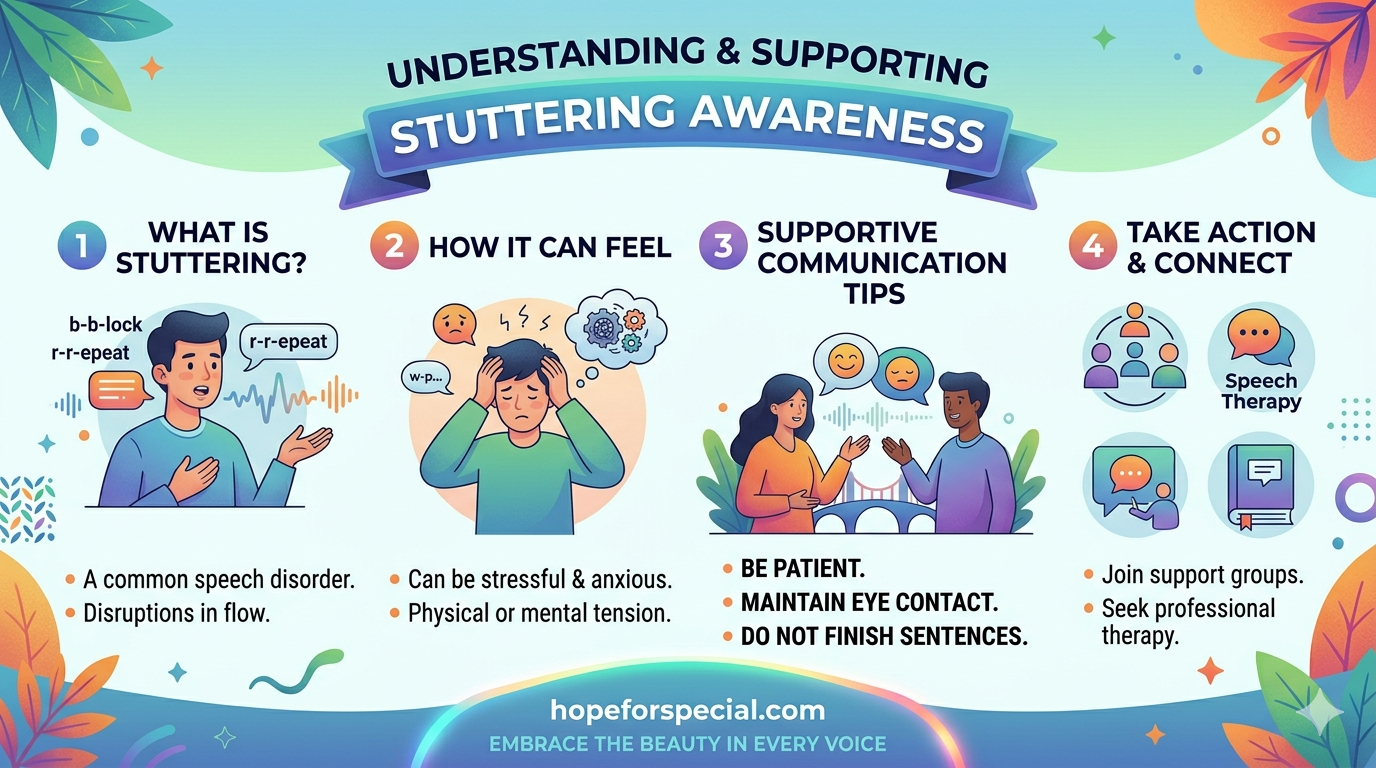
👉 Stuttering Awareness 2026: Helping Children Speak with Confidence 💙🗣️
Stuttering Awareness Week is a time to educate families, schools, and communities about stuttering, communication challenges, and ways to support children with confidence and compassion. In simple words, it helps people understand that stuttering is not a sign of low intelligence—it is a communication difference that deserves patience, respect, and support.
For many children, speaking can feel stressful. However, the right support can transform fear into confidence and connection.

- 💡 What Is Stuttering?
- 🧠 Why Stuttering Awareness Matters
- 📊 Real Statistics About Stuttering Awareness
- ❤️ Emotional Impact of Stuttering on Children
- 💙 Real Parent Story
- 🧩 Common Signs of Stuttering in Children
- 📉 What Causes Stuttering?
- 🎯 How Parents Can Support a Child Who Stutters
- ✅ 1. Slow Down Conversations
- ✅ 2. Listen Without Interrupting
- ✅ 3. Focus on Message, Not Fluency
- ✅ 4. Reduce Pressure
- ✅ 5. Build Confidence Daily 💙
- 📚 Stuttering Awareness Week Activities for Schools
- 📊 Confidence Growth Chart (Example)
- 🧠 Unique Insight
- 📱 AI & Technology Support for Stuttering
- 🎓 How Schools Can Create Inclusive Communication Spaces
- 🧘 Emotional Wellness Tips for Parents
- 🗣️ Voice Search
- 📊 Research Summary Table
- 💬 FAQs About Stuttering Awareness
- ❓ Is stuttering a disability?
- ❓ Can children outgrow stuttering?
- ❓ Does anxiety cause stuttering?
- ❓ Should I correct my child’s speech?
- ❓ Can stuttering affect school performance?
- 🌈 Positive Affirmations for Children Who Stutter
- 📌 Stuttering Awareness Week Ideas for Families
- ❤️ Final Thoughts
- 🚀 Quick Action Checklist
- 🔗 Sources
💡 What Is Stuttering?
Stuttering is a speech condition that affects the smooth flow of speech.
A child who stutters may:
- Repeat sounds or words
- Stretch certain sounds
- Pause while trying to speak
- Show frustration during conversations
👉 Example:
Instead of saying:
“I want water.”
The child may say:
“I-I-I want wa-water.”
🧠 Why Stuttering Awareness Matters
Many children who stutter feel embarrassed or misunderstood.
Unfortunately, some children:
- Avoid speaking in class
- Feel anxious during conversations
- Experience teasing or bullying
- Develop low self-confidence
This is why stuttering awareness is important.
👉 Awareness creates acceptance.
👉 Acceptance creates confidence.
📊 Real Statistics About Stuttering Awareness
Research shows that stuttering affects millions of children worldwide.
📈 Stuttering Statistics Table
| Insight | Data | Source |
|---|---|---|
| Children affected by stuttering | About 5% of children experience stuttering at some point | https://www.nidcd.nih.gov |
| Adults who continue to stutter | Around 1% of global population | https://www.stutteringhelp.org |
| Boys are more likely to stutter | 3–4 times more common in boys | https://www.asha.org |
| Early intervention improves outcomes | Significant improvement with therapy | https://www.cdc.gov |
👉 These statistics highlight why Stuttering Awareness Week matters for families and educators.
❤️ Emotional Impact of Stuttering on Children
Children who stutter often understand more than people realize.
They may feel:
😔 Frustrated
😟 Nervous
😢 Embarrassed
😞 Isolated
However, emotional support can change everything.
💙 Real Parent Story
A mother named Kavya noticed her 7-year-old son stopped raising his hand in class.
At home, he whispered instead of speaking loudly.
One day he said:
“People laugh when I talk.”
That moment changed everything.
During Stuttering Awareness Week, the family learned supportive communication strategies.
Within months:
✔ He became more confident
✔ Classroom participation improved
✔ Anxiety reduced
👉 His mother shared:
“We stopped trying to ‘fix’ his speech and started supporting his voice.”
🧩 Common Signs of Stuttering in Children
🔤 Speech Signs
- Repeating sounds
- Long pauses
- Difficulty starting words
😟 Emotional Signs
- Avoiding eye contact
- Fear of speaking
- Visible tension while talking
🧠 Behavioral Signs
- Avoiding phone calls
- Using fewer words
- Speaking less in groups
📉 What Causes Stuttering?
There is no single cause.
Experts believe stuttering may involve:
| Possible Factor | Explanation |
|---|---|
| Genetics | Family history may play a role |
| Brain processing differences | Speech timing differences |
| Emotional stress | Stress may worsen stuttering |
| Rapid language growth | Common in young children |
👉 Important: Parents do NOT cause stuttering.
🎯 How Parents Can Support a Child Who Stutters
This is the most important part of stuttering awareness.

✅ 1. Slow Down Conversations
Speak calmly and slowly.
👉 Children often mirror communication styles.
✅ 2. Listen Without Interrupting
Avoid finishing sentences.
Instead:
✔ Maintain eye contact
✔ Show patience
✔ Let the child finish speaking
✅ 3. Focus on Message, Not Fluency
Respond to WHAT the child says—not HOW they say it.
✅ 4. Reduce Pressure
Avoid phrases like:
❌ “Slow down.”
❌ “Take a breath.”
These may increase anxiety.
✅ 5. Build Confidence Daily 💙
Celebrate communication efforts.
Even small speaking attempts matter.
📚 Stuttering Awareness Week Activities for Schools
Teachers can play a huge role.
🏫 Classroom Activities
✔ Story-sharing circles
✔ Anti-bullying discussions
✔ Communication diversity lessons
✔ Confidence-building games
📊 Confidence Growth Chart (Example)
Week 1   ██
Week 2   ████
Week 3   ██████
Week 4   █████████
👉 Emotional support leads to steady growth.
🧠 Unique Insight
👉 Children need emotional safety more than “perfect speech.”
A confident child who stutters is more emotionally healthy than a fearful child trying to hide their voice.
This is the heart of true stuttering awareness.
📱 AI & Technology Support for Stuttering
Modern tools can help children practice communication safely.
Helpful tools may include:
- Speech pacing apps
- Audio journaling tools
- AI conversation practice systems
👉 Technology should support confidence—not pressure perfection.
🎓 How Schools Can Create Inclusive Communication Spaces
Schools should:
✔ Allow extra speaking time
✔ Avoid interrupting students
✔ Encourage peer empathy
✔ Support alternative communication methods
🧘 Emotional Wellness Tips for Parents
Parents often feel helpless.
However, your calm support matters deeply.
💡 Self-Care Tips
- Join support groups
- Avoid comparison
- Focus on progress
- Celebrate strengths beyond speech
🗣️ Voice Search
❓ What is Stuttering Awareness Week?
Stuttering Awareness Week is a campaign that spreads understanding about stuttering and promotes support, acceptance, and confidence for people who stutter.
❓ How can I help a child who stutters?
You can help by listening patiently, reducing pressure, encouraging communication, and creating emotionally safe conversations.
📊 Research Summary Table
| Area | Positive Outcome | Source |
|---|---|---|
| Early speech therapy | Better fluency outcomes | https://www.asha.org |
| Parent support | Reduced anxiety | https://www.stutteringhelp.org |
| School awareness | Less bullying | https://www.stopbullying.gov |
| Positive communication environments | Increased confidence | https://www.cdc.gov |
💬 FAQs About Stuttering Awareness
❓ Is stuttering a disability?
Stuttering is considered a communication disorder. However, many people who stutter live highly successful lives.
❓ Can children outgrow stuttering?
Some children naturally improve, especially with early support and reduced pressure.
❓ Does anxiety cause stuttering?
Anxiety does not directly cause stuttering, but stress can make it worse.
❓ Should I correct my child’s speech?
No. Instead of correcting, focus on supportive listening.
❓ Can stuttering affect school performance?
Yes, especially confidence and classroom participation. However, emotional support can help greatly.
🌈 Positive Affirmations for Children Who Stutter
💙 “My voice matters.”
💙 “I deserve to be heard.”
💙 “Speaking differently is okay.”
💙 “I am more than my speech.”
📌 Stuttering Awareness Week Ideas for Families
✔ Family storytelling night
✔ Communication games
✔ Confidence journals
✔ Positive affirmation posters
✔ Watching inspiring speeches together
❤️ Final Thoughts
Stuttering Awareness Week is not only about speech.
👉 It is about dignity, confidence, and emotional safety.
Children who stutter do not need shame.
They need patience.
They need support.
Most importantly, they need people who truly listen.
Every child deserves to feel heard—exactly as they are. 💙
🚀 Quick Action Checklist
✔ Listen patiently
✔ Avoid interrupting
✔ Support confidence
✔ Educate teachers and siblings
✔ Celebrate communication efforts 🎉
🔗 Sources
- National Institute on Deafness and Other Communication Disorders
https://www.nidcd.nih.gov - American Speech-Language-Hearing Association
https://www.asha.org - The Stuttering Foundation
https://www.stutteringhelp.org - CDC Child Development Resources
https://www.cdc.gov


