
Behcet’s Disease in Children — What Every Parent Must Know to Fight Back in 2026
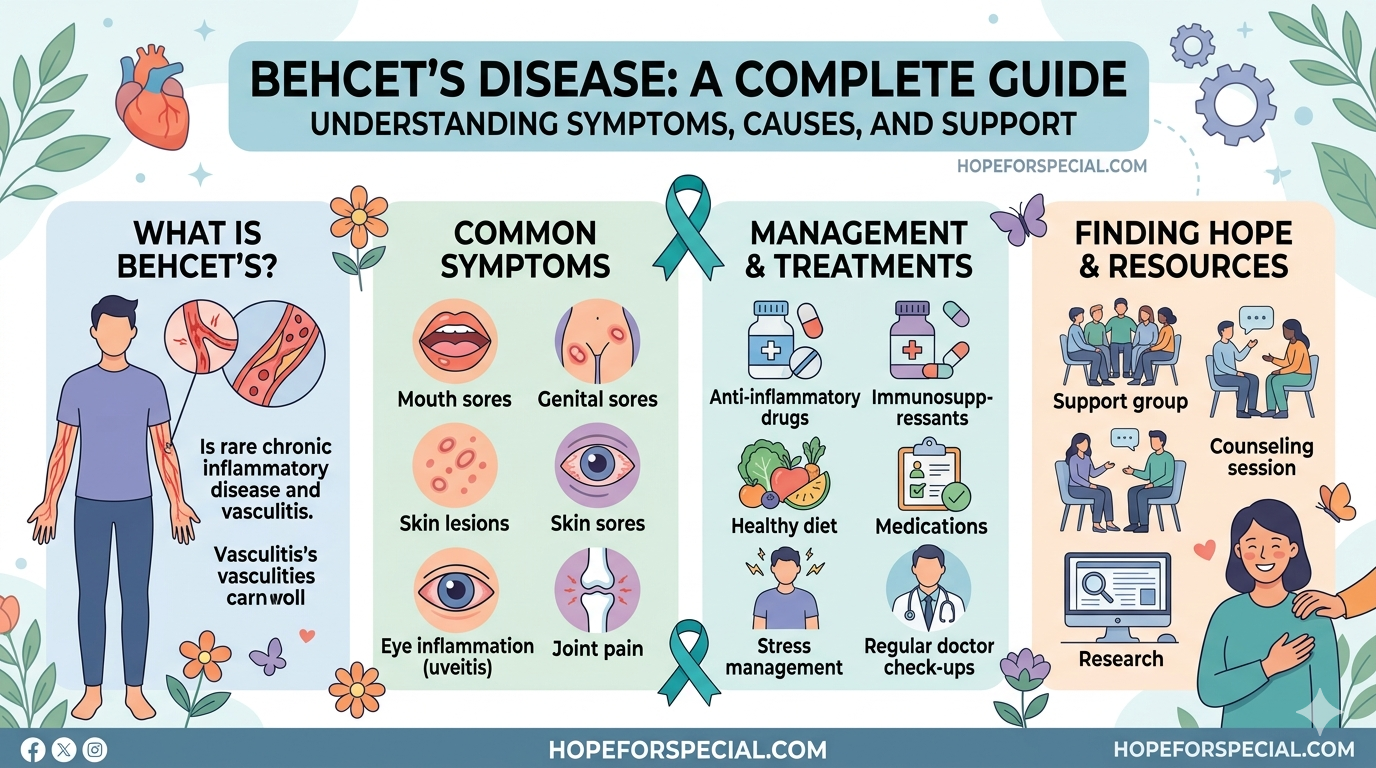
Behcet’s disease is a rare, chronic inflammatory condition that can strike children — causing painful mouth sores, eye inflammation, skin lesions, and blood vessel damage throughout the body. What is Behcet’s disease exactly? It is an autoimmune vasculitis — meaning the immune system attacks the body’s own blood vessels. It affects multiple organ systems simultaneously and can be devastating without early diagnosis. 💛
This is one of the most misunderstood conditions in paediatric medicine.
Many children with Behcet’s disease suffer for years — sometimes a decade — before receiving a correct diagnosis. They are told their mouth sores are stress-related. Their eye pain is dismissed. Their fatigue is called laziness.
This article exists to change that.
Whether you are a parent who suspects something is wrong, a teacher noticing unexplained absences, a paediatrician reconsidering a diagnosis, or a young person living with this condition — this guide is written for you.
You deserve clear answers. You deserve a path forward. Let’s start now. 💪

- What Is Behcet’s Disease? A Clear, Parent-Friendly Explanation 🧬
- 📊 Behcet’s Disease — Key Statistics Every Parent and Clinician Should Know
- 🔍 Behcet’s Disease Symptoms in Children — The Complete Guide
- 🔴 Symptom #1: Recurrent Oral Ulcers (Mouth Sores)
- 🔴 Symptom #2: Genital Ulcers
- 🔴 Symptom #3: Eye Inflammation (Uveitis)
- 🔴 Symptom #4: Skin Lesions
- 🔴 Symptom #5: Joint Pain and Arthritis
- 🔴 Symptom #6: Neurological Symptoms (Neuro-Behcet’s)
- 🔴 Symptom #7: Fatigue and Fever
- 🧩 Behcet’s Disease Symptoms — Quick Reference Table
- 🔬 What Causes Behcet’s Disease? The Science Explained Simply
- 🏥 How Is Behcet’s Disease Diagnosed? The Diagnostic Journey
- 💊 Behcet’s Disease Treatment in Children — What Works in 2026
- 🌍 Behcet’s Disease and the Silk Road — A Fascinating Geographic Story
- 💬 A Parent’s Story: “Nobody Believed Us for Seven Years”
- 🧠 Behcet’s Disease in Children vs Adults — Key Differences
- 🏫 How Behcet’s Disease Affects School Life — What Parents and Teachers Need to Know
- 🔑 Behcet’s Disease — 5 Things You Must Know
- ❓ FAQs — Behcet’s Disease in Children
- Q1: What is Behcet’s disease in simple terms?
- Q2: What are the first signs of Behcet’s disease in children?
- Q3: Is Behcet’s disease hereditary?
- Q4: Can Behcet’s disease cause blindness in children?
- Q5: How is Behcet’s disease diagnosed in children?
- Q6: What triggers Behcet’s disease flares in children?
- Q7: Is there a cure for Behcet’s disease?
- Q8: Where can I find support for Behcet’s disease?
- 🌈 A Final Word to Every Parent Reading This
- ✅ Key Takeaways — What to Remember About Behcet’s Disease
- 📌 Share This Article
What Is Behcet’s Disease? A Clear, Parent-Friendly Explanation 🧬
Behcet’s disease — also written as Behçet’s disease or Behcet’s syndrome — is a systemic vasculitis. That means it is a condition where the immune system causes inflammation in blood vessels throughout the entire body.
It was first described in 1937 by Turkish dermatologist Dr. Hulusi Behçet, who noticed a pattern of three recurring symptoms: mouth ulcers, genital ulcers, and eye inflammation.
Today we know Behcet’s disease is far more complex than those three symptoms suggest.
Here is what parents need to understand clearly:
- Behcet’s disease is not contagious. Your child did not catch it from anyone.
- It is not caused by poor parenting, diet, or hygiene.
- It is an autoimmune and autoinflammatory condition — the immune system is misfiring.
- It follows a relapsing-remitting pattern — meaning it flares up and then calms down.
- It can affect eyes, skin, mouth, genitals, joints, brain, and blood vessels — sometimes all at once.
- In children, it can present differently from adults — making diagnosis even harder.
The good news? With the right diagnosis and treatment plan, many children with Behcet’s disease live full, active, meaningful lives.
The key word is: right diagnosis. And that starts with knowing what to look for. 🔍
📊 Behcet’s Disease — Key Statistics Every Parent and Clinician Should Know
| Statistic | Data | Source |
|---|---|---|
| Global prevalence | Highest in “Silk Road” countries — Turkey (80–370 per 100,000), Iran, Japan | Orphanet — Behcet’s Disease |
| Average diagnostic delay | 6–10 years from symptom onset | American Behcet’s Disease Association |
| Paediatric onset cases | Approximately 3–26% of all BD cases begin in childhood | NIH — National Library of Medicine |
| Male vs female in children | More severe disease in boys; girls slightly more frequently affected in some populations | Orphanet |
| Eye involvement risk | Up to 70% of patients — leading cause of preventable blindness in BD | American Academy of Ophthalmology |
| Neurological involvement | Approximately 5–10% of adult cases; rarer but documented in children | NIH — NINDS |
| HLA-B51 gene association | Present in 50–80% of Behcet’s patients in high-prevalence regions | Genetics Home Reference — NIH |
| Countries with highest rates | Turkey, Iran, Iraq, Japan, South Korea, China, Saudi Arabia | Orphanet |
| Most common paediatric symptom | Recurrent oral ulcers (present in nearly 100% of paediatric cases) | NIH — NCBI |
🔍 Behcet’s Disease Symptoms in Children — The Complete Guide
This is where many parents first find clarity — and where many medical journeys finally begin.
Behcet’s disease symptoms in children can appear one at a time — or in combinations. They come and go. They change in intensity. And they are easily mistaken for other conditions.
Here is a complete breakdown.
🔴 Symptom #1: Recurrent Oral Ulcers (Mouth Sores)
This is the most common and most consistent symptom of Behcet’s disease in children.
These are not ordinary canker sores. They are:
- Extremely painful — often making eating, drinking, and speaking difficult
- Recurring — appearing 3 or more times per year
- Multiple — often appearing in clusters of 3 or more at once
- Slow to heal — typically lasting 1–3 weeks
- Round or oval with a white or yellow centre and a red border
If your child has had mouth sores this frequently and this severely — and especially if other symptoms are also present — Behcet’s disease must be on the diagnostic radar.
🔴 Symptom #2: Genital Ulcers
Genital ulcers in Behcet’s disease are often even more painful than oral ulcers. In children, this symptom can be particularly distressing — and is frequently misattributed to infection or sexual activity, causing significant emotional harm.
Key points:
- They appear on the scrotum in boys and the vulva in girls
- They are not sexually transmitted
- They heal but leave scars — a distinguishing feature from other ulcerative conditions
- They should be examined by a specialist, not dismissed
If your child has both mouth ulcers AND genital sores — this combination is a critical diagnostic signal for Behcet’s disease. Report it to your doctor clearly and urgently.
🔴 Symptom #3: Eye Inflammation (Uveitis)
Eye involvement in Behcet’s disease is one of its most dangerous features — because it can lead to permanent vision loss if left untreated.
The type most commonly seen is uveitis — inflammation of the middle layer of the eye. Symptoms include:
- 👁️ Eye redness
- 👁️ Pain or pressure in the eye
- 👁️ Blurred or decreased vision
- 👁️ Sensitivity to light
- 👁️ Floaters
In children, eye symptoms are sometimes dismissed as conjunctivitis or digital eye strain. Do not accept that explanation if your child has recurring eye issues alongside other BD symptoms.
Any child with suspected Behcet’s disease should receive regular ophthalmology monitoring — even during symptom-free periods.
🔴 Symptom #4: Skin Lesions
Skin manifestations in Behcet’s disease are varied and sometimes bizarre-looking. The most common include:
- Erythema nodosum — tender, red, raised bumps usually on the legs
- Pseudofolliculitis — acne-like sores that are not true acne
- Papulopustular lesions — pus-filled bumps on the face, neck, or back
- Pathergy — an unusual skin reaction where even minor skin trauma (like a needle prick) causes a red bump or pustule to develop within 24–48 hours
The pathergy test — deliberately pricking the skin to observe this reaction — is used as a diagnostic tool for Behcet’s disease in some countries, particularly in the Middle East and Asia.
🔴 Symptom #5: Joint Pain and Arthritis
Up to 50% of children with Behcet’s disease experience joint pain and swelling — most commonly in the knees, ankles, wrists, and elbows.
This type of arthritis:
- Is usually non-destructive — meaning it does not permanently damage joint structure in most cases
- Comes and goes with disease flares
- Can significantly impact a child’s ability to walk, play, and attend school
- Is sometimes the first symptom a parent notices — before mouth sores become frequent
🔴 Symptom #6: Neurological Symptoms (Neuro-Behcet’s)
In a smaller percentage of cases — more common in adults but documented in children — Behcet’s disease affects the central nervous system. This is called Neuro-Behcet’s disease.
Symptoms can include:
- Severe headaches
- Memory and concentration problems
- Balance difficulties
- Personality changes
- In severe cases — stroke-like episodes
Neuro-Behcet’s is a medical emergency when it occurs. If your child with known BD develops sudden neurological symptoms, seek emergency care immediately.
🔴 Symptom #7: Fatigue and Fever
Persistent, unexplained fatigue is one of the most commonly reported — and most commonly dismissed — symptoms of Behcet’s disease in children.
This fatigue is not ordinary tiredness. It is:
- Disproportionate to activity level
- Present even after adequate sleep
- Worsened during flares
- Accompanied by low-grade fever in many cases during active disease
Children experiencing this level of fatigue often miss significant amounts of school. They are sometimes labelled as anxious, school-avoidant, or lazy — when in fact they are fighting a systemic inflammatory disease.
🧩 Behcet’s Disease Symptoms — Quick Reference Table
| Symptom | How Common in Children | Severity | Can It Be Mistaken For? |
|---|---|---|---|
| Oral ulcers | ~100% of paediatric cases | Moderate to severe | Canker sores, herpes, stress |
| Genital ulcers | ~60–75% | Severe | STI, yeast infection, trauma |
| Eye inflammation (uveitis) | ~30–70% | Potentially severe | Conjunctivitis, allergies |
| Skin lesions | ~60–80% | Mild to moderate | Acne, eczema, folliculitis |
| Joint pain | ~30–50% | Moderate | Juvenile arthritis, growing pains |
| Fatigue and fever | Very common | Moderate | Anaemia, depression, viral illness |
| Neurological symptoms | ~5–10% | Severe | Migraine, MS, anxiety |
| Vascular involvement | Rarer in children | Potentially severe | Deep vein thrombosis (DVT) |
🔬 What Causes Behcet’s Disease? The Science Explained Simply
The exact cause of Behcet’s disease is not yet fully understood. But research has identified several key contributing factors.

🧬 Genetic Factors
The strongest genetic association is with a gene variant called HLA-B51.
According to MedlinePlus — NIH Genetics, people who carry the HLA-B51 variant are significantly more likely to develop Behcet’s disease — particularly in high-prevalence populations along the historical Silk Road trade route.
However — and this is important — not everyone with HLA-B51 develops Behcet’s disease. Genetics loads the gun. Something else pulls the trigger.
🦠 Environmental and Infectious Triggers
Researchers believe that bacterial or viral infections may trigger Behcet’s disease in genetically susceptible individuals. Specifically:
- Streptococcal bacteria (the type that causes strep throat) has been studied as a potential trigger
- Herpes simplex virus has also been investigated
- The American College of Rheumatology (ACR) notes that the immune system appears to overreact to these triggers — causing widespread inflammation
🧠 Immune System Dysregulation
At its core, Behcet’s disease is an immune system problem.
The body’s immune response — designed to protect against infection — becomes dysregulated. It begins attacking healthy blood vessels throughout the body. This is why Behcet’s disease can affect so many different organ systems simultaneously.
Research published through NIH PubMed consistently points to abnormalities in both innate and adaptive immune pathways in Behcet’s disease — with elevated levels of inflammatory markers including TNF-alpha and IL-1 beta during active disease phases.
🏥 How Is Behcet’s Disease Diagnosed? The Diagnostic Journey
There is no single blood test or scan that definitively diagnoses Behcet’s disease. This is one of the reasons diagnosis takes so long.
Diagnosis is clinical — meaning it is based on observed symptoms, their pattern, and the exclusion of other conditions.
The International Study Group Criteria for Behcet’s Disease
The most widely used diagnostic framework requires the presence of:
✅ Recurrent oral ulceration (at least 3 times in 12 months)
PLUS at least TWO of the following:
- ✅ Recurrent genital ulceration
- ✅ Eye lesions (uveitis or retinal vasculitis)
- ✅ Skin lesions (erythema nodosum, pseudofolliculitis, or acneiform nodules)
- ✅ Positive pathergy test
The American Behcet’s Disease Association provides detailed diagnostic guidance and patient resources.
Paediatric Diagnostic Challenges
In children, diagnosis is even harder because:
- Children may not report genital symptoms out of embarrassment
- Symptoms may appear years apart — making pattern recognition difficult
- Many paediatricians have limited experience with Behcet’s disease
- Symptoms overlap significantly with Juvenile Idiopathic Arthritis (JIA), Crohn’s disease, and PFAPA syndrome
The Childhood Arthritis and Rheumatology Research Alliance (CARRA) recommends that children with recurrent unexplained oral ulcers alongside systemic symptoms be referred to a paediatric rheumatologist for evaluation.
💊 Behcet’s Disease Treatment in Children — What Works in 2026
There is currently no cure for Behcet’s disease. However, treatment has advanced significantly — and the goal is achievable: suppress inflammation, prevent organ damage, and maintain quality of life.
Here is a clear breakdown of treatment approaches used in 2026:
🔵 Treatment Overview Table
| Treatment Type | Examples | Used For | Authority Source |
|---|---|---|---|
| Corticosteroids | Prednisolone, topical steroids | Flare management, oral/genital ulcers | ACR — Behcet’s |
| Colchicine | Colchicine | Oral ulcers, joint pain, skin lesions | NIH PubMed |
| Immunosuppressants | Azathioprine, Methotrexate | Eye disease, severe systemic involvement | ACR |
| Biologics (TNF inhibitors) | Infliximab, Adalimumab | Severe eye, neurological, vascular disease | NIH — NCBI |
| IL-1 inhibitors | Anakinra, Canakinumab | Refractory paediatric cases | Orphanet |
| Topical treatments | Triamcinolone in Orabase | Oral and genital ulcer pain relief | ABDA |
| Thalidomide | Thalidomide (specialist use) | Severe oral/genital ulcers in older patients | NIH PubMed |
| NSAIDs | Ibuprofen, Naproxen | Joint pain during flares | Paediatric rheumatology standard |
🔵 Emerging Treatments in 2026
The landscape of Behcet’s disease treatment is evolving rapidly. Key developments include:
- JAK inhibitors — being studied for refractory Behcet’s cases where biologics have failed
- Apremilast — an oral phosphodiesterase-4 inhibitor showing promise for mucocutaneous symptoms
- Personalised immunotherapy — emerging research into targeting specific immune pathways based on individual genetic profiles
The National Institute of Arthritis and Musculoskeletal and Skin Diseases (NIAMS) maintains updated clinical trial listings for Behcet’s disease — worth bookmarking if your child’s condition is not responding to standard treatment.
🌍 Behcet’s Disease and the Silk Road — A Fascinating Geographic Story
One of the most distinctive features of Behcet’s disease is its geographic distribution.
It is significantly more common in countries along the ancient Silk Road — the trade route connecting East Asia, Central Asia, the Middle East, and the Mediterranean.
Countries with the highest rates include:
- 🇹🇷 Turkey — highest global prevalence (up to 370 per 100,000 in some regions)
- 🇮🇷 Iran
- 🇮🇶 Iraq
- 🇯🇵 Japan
- 🇰🇷 South Korea
- 🇨🇳 China
- 🇸🇦 Saudi Arabia
- 🇬🇷 Greece and other Mediterranean countries
In Northern Europe and North America, Behcet’s disease is far rarer — which means doctors in these regions may be less familiar with it and less likely to consider it as a diagnosis.
This geographic pattern is one reason why family ancestry matters in the diagnostic conversation. If your family has roots in any of the above regions — and your child has recurring symptoms — Behcet’s disease must be considered.
The Silk Road disease concept is documented by Orphanet — the European reference database for rare diseases.
💬 A Parent’s Story: “Nobody Believed Us for Seven Years”
When Layla was four years old, she had her first mouth sore. Her paediatrician called it a canker sore. By age six, she was getting them monthly — in clusters of five or six at a time.
At age seven, her eyes became red and painful. The ophthalmologist diagnosed conjunctivitis. At age nine, sores appeared on her genitals. The emergency doctor ran tests for infection. All came back negative. The family was told — gently but devastatingly — that the sores were “stress-related.”
Layla’s mother, Fatima, is originally from Turkey. She had vaguely heard of Behcet’s disease from an older relative. She mentioned it to a doctor. She was dismissed.
At age eleven — after seven years of suffering — Layla finally saw a paediatric rheumatologist at a specialist centre. The diagnosis came within three appointments:
Behcet’s disease.
“Seven years,” Fatima says quietly. “Seven years of watching my daughter cry through meals because her mouth was too sore to eat. Seven years of being told it wasn’t serious. Seven years.”
Layla is now fourteen. She is on a carefully managed treatment plan. Her flares are less frequent. She attends school consistently. She is learning to manage her condition — and to advocate for herself.
“The diagnosis didn’t cure her,” Fatima says. “But it gave her a name for what she was fighting. And that name gave us power.” 💛
🧠 Behcet’s Disease in Children vs Adults — Key Differences
| Feature | Children with Behcet’s | Adults with Behcet’s |
|---|---|---|
| Onset recognition | Often delayed — symptoms attributed to other causes | Better recognised by adult rheumatologists |
| Genital ulcer reporting | Frequently underreported due to embarrassment | More consistently reported |
| Eye involvement | Present but may be less severe initially | More severe; leading cause of BD blindness |
| Neurological involvement | Rarer but documented | More common (5–10%) |
| Joint involvement | Common and often prominent | Common |
| Family history | More likely to have a family member with BD | Variable |
| Disease severity | Some studies suggest milder course; others suggest similar | Full spectrum of severity |
| Treatment approach | More cautious — avoiding teratogenic drugs | Full treatment arsenal |
| Emotional impact | School disruption, social isolation, identity challenges | Work and relationship disruption |
Understanding these differences helps parents advocate more effectively in medical settings. If your paediatrician is unfamiliar with paediatric Behcet’s presentations — request a referral to a paediatric rheumatologist. This is your right. 💪
🏫 How Behcet’s Disease Affects School Life — What Parents and Teachers Need to Know
Behcet’s disease is largely invisible to the outside world — except during severe flares. This invisibility creates unique challenges in educational settings.
Challenges children with Behcet’s face at school:
- Frequent absences during flares — particularly when oral ulcers make eating impossible or fatigue is overwhelming
- Pain during meals — school lunch becomes an ordeal when mouth sores are active
- Eye sensitivity — classroom lighting and screen time can aggravate uveitis
- Joint pain — limiting participation in PE and movement between classes
- Emotional toll — anxiety about flares, embarrassment about symptoms, fear of being disbelieved
What parents can do:
- Request a formal health care plan or 504 accommodation from the school
- Educate the school nurse about Behcet’s disease — provide written information
- Ask for flexible attendance policies during documented flares
- Ensure the school has emergency contact protocols if a flare escalates
- Connect with organisations like NIAMS for printable patient resources suitable for school staff
What teachers can do:
- Believe the child. An invisible illness is still a real illness.
- Allow quiet rest periods during low-energy days
- Provide notes or recordings for missed classes
- Never draw attention to absences or limitations publicly
- Treat this child with the same compassion you would offer any child with a visible disability
🔑 Behcet’s Disease — 5 Things You Must Know
Here is what every parent of a child with Behcet’s disease needs to know:
🔑 #1: The diagnosis delay is not your fault — but you can shorten it. Average diagnostic delay is 6–10 years. But parents who document symptoms precisely — dates, photos, patterns — consistently reach diagnosis faster. Start a symptom diary today.
🔑 #2: Behcet’s disease is not the same in every ethnic group. Eye involvement is more severe and more common in patients of Middle Eastern and Asian ancestry. Japanese patients tend to have higher rates of neurological involvement. These differences genuinely affect treatment decisions.
🔑 #3: The pathergy test is not used universally — and its absence doesn’t rule out BD. In Western countries, pathergy testing is rarely done. A negative pathergy test does not mean your child doesn’t have Behcet’s. It simply means one diagnostic tool wasn’t used or wasn’t reactive.
🔑 #4: Mental health support is part of Behcet’s disease treatment. Chronic pain, unpredictable flares, and diagnostic delays cause measurable psychological distress in children with BD. According to research referenced by NIAMS, anxiety and depression are significantly more common in people with Behcet’s disease. Psychological support is not optional — it is medical.
🔑 #5: Remission is possible — and more achievable with early treatment. Many children with Behcet’s disease experience long periods of remission — sometimes years — with appropriate treatment. Early, aggressive management of eye disease in particular can prevent permanent vision loss. The earlier treatment begins, the better the long-term outlook.
❓ FAQs — Behcet’s Disease in Children
Q1: What is Behcet’s disease in simple terms?
Behcet’s disease is a rare autoimmune condition where the body’s immune system inflames blood vessels throughout the body. It causes recurring mouth sores, genital ulcers, eye inflammation, skin lesions, and joint pain — among other symptoms. It follows a pattern of flares and remissions. It is not contagious and is not caused by infection, though infections may trigger flares in susceptible individuals.
Q2: What are the first signs of Behcet’s disease in children?
The most common first sign of Behcet’s disease in children is recurrent, painful mouth ulcers — appearing three or more times per year, in clusters, and lasting longer than typical canker sores. Joint pain, skin lesions, and eye redness are also common early signs. If your child has recurring mouth ulcers alongside any other unexplained symptoms — request a paediatric rheumatology referral.
Q3: Is Behcet’s disease hereditary?
Behcet’s disease has a genetic component — particularly the HLA-B51 gene variant — but it is not directly inherited in a simple Mendelian pattern. Having a parent with Behcet’s disease increases risk, particularly in high-prevalence ethnic groups. However, many people with HLA-B51 never develop the condition. Environmental triggers appear necessary alongside genetic predisposition.
Q4: Can Behcet’s disease cause blindness in children?
Yes — untreated or poorly managed Behcet’s disease can cause permanent vision loss through repeated episodes of uveitis and retinal vasculitis. This is one of the most serious complications. However, with early diagnosis and appropriate treatment — including immunosuppressive therapy and biologics when needed — vision loss is largely preventable. Regular ophthalmology monitoring is essential for all children with BD.
Q5: How is Behcet’s disease diagnosed in children?
Diagnosis is clinical — based on observed symptoms and their pattern over time. The most widely used criteria require recurrent oral ulcers plus at least two other features such as genital ulcers, eye inflammation, skin lesions, or a positive pathergy test. There is no single definitive blood test. A paediatric rheumatologist with experience in vasculitis is the most appropriate specialist to make this diagnosis.
Q6: What triggers Behcet’s disease flares in children?
Common reported triggers include stress, infections (particularly streptococcal infections), certain foods, menstruation in girls, physical trauma to the skin, and fatigue. Keeping a detailed flare diary — noting potential triggers — can help identify patterns specific to your child and help their medical team refine the management plan.
Q7: Is there a cure for Behcet’s disease?
Currently, there is no cure for Behcet’s disease. However, treatment has advanced significantly. Many children achieve long periods of remission with appropriate medical management. The goal of treatment is to suppress inflammation, prevent organ damage — especially to the eyes — and maintain the best possible quality of life. Research into new treatments including JAK inhibitors is ongoing.
Q8: Where can I find support for Behcet’s disease?
- American Behcet’s Disease Association (ABDA) — patient resources, support groups, specialist directory
- NIH NIAMS — Behcet’s Disease — research and clinical information
- Orphanet — rare disease database and expert centre directory
- NIH PubMed — latest research publications
- CARRA — Childhood Arthritis and Rheumatology Research Alliance — paediatric rheumatology research
- HopeForSpecial.com — resources, stories, and community support for special needs families
🌈 A Final Word to Every Parent Reading This
If you have read this far — you are already doing something remarkable.
You are refusing to accept “I don’t know” as a final answer. You are seeking information, clarity, and a path forward for your child.
That is what advocacy looks like in its earliest form.
Behcet’s disease is rare. It is complex. It is frequently misunderstood. But it is manageable — with the right diagnosis, the right specialist, and the right support system around your child.
Your child is not defined by their diagnosis. They are defined by who they are — their laugh, their curiosity, their resilience, their love.
Behcet’s disease is part of their story. It is not the whole story. 💛
Keep asking questions. Keep documenting symptoms. Keep advocating — loudly and calmly and persistently — until someone listens.
Because someone will. And when they do — everything changes.
✅ Key Takeaways — What to Remember About Behcet’s Disease
- Behcet’s disease is a rare autoimmune vasculitis causing inflammation in blood vessels throughout the body
- The most common symptoms are recurrent oral ulcers, genital ulcers, eye inflammation, and skin lesions
- Average diagnostic delay is 6–10 years — documentation and specialist referral are critical
- It is most common in populations along the historic Silk Road trade route
- Eye involvement is the most serious complication — preventable with early treatment
- There is no cure but remission is achievable with appropriate medical management
- Mental health support is an essential part of comprehensive Behcet’s disease care
- Children with BD need school accommodations and informed, compassionate educators
📌 Share This Article
If this article gave you clarity — share it. 💛
Share it with the parent who is being dismissed. Share it with the paediatrician who hasn’t considered this diagnosis. Share it with the school nurse who didn’t know what Behcet’s disease was.
Knowledge is the first treatment. And you just received a full dose.
Bookmark this page. Come back when you need it. And leave your questions or story in the comments below. 💛
At HopeForSpecial.com, we believe every child with a rare or complex condition deserves to be seen, heard, and helped. Explore our full library of resources on rare diseases, autism, ADHD, cerebral palsy, Down syndrome, and special needs parenting — written with research, clinical accuracy, and genuine love.


