
World Day for Cultural Diversity for Dialogue and Development: Why It Matters More Than Ever
The World Day for Cultural Diversity for Dialogue and Development, observed every year on May 21, is a United Nations global celebration that champions the richness of the world’s cultures — and calls every nation to build bridges across difference. What is this day about? It is a day dedicated to promoting understanding between cultures, eliminating discrimination, and building a more inclusive world where every human being — regardless of background, ability, or identity — is valued, heard, and celebrated. 🌍
For families of children with special needs, this day carries a meaning that goes far deeper than flags and festivals.
Because here is the truth that most articles about this day never say:
Cultural diversity and disability inclusion are not separate conversations. They are the same conversation.
A world that learns to embrace cultural difference is a world that learns to embrace neurodiversity. A classroom that welcomes a child who speaks a different language is better equipped to welcome a child who thinks differently. A community that celebrates cultural variety is more likely to celebrate the variety of human minds and bodies.
This article explores why the World Day for Cultural Diversity for Dialogue and Development matters profoundly to special needs families — with research, real stories, practical ideas, and a depth that most websites simply do not offer. 💛

What Is the World Day for Cultural Diversity for Dialogue and Development? 🌏
Let’s start with the foundation.
The World Day for Cultural Diversity for Dialogue and Development was established by the United Nations in 2002. It follows the adoption of UNESCO’s Universal Declaration on Cultural Diversity in 2001 — a landmark document that recognised cultural diversity as “a common heritage of humanity.”
The date — May 21 — was chosen deliberately. It marks the day in 2001 when the UNESCO General Conference adopted that historic declaration.
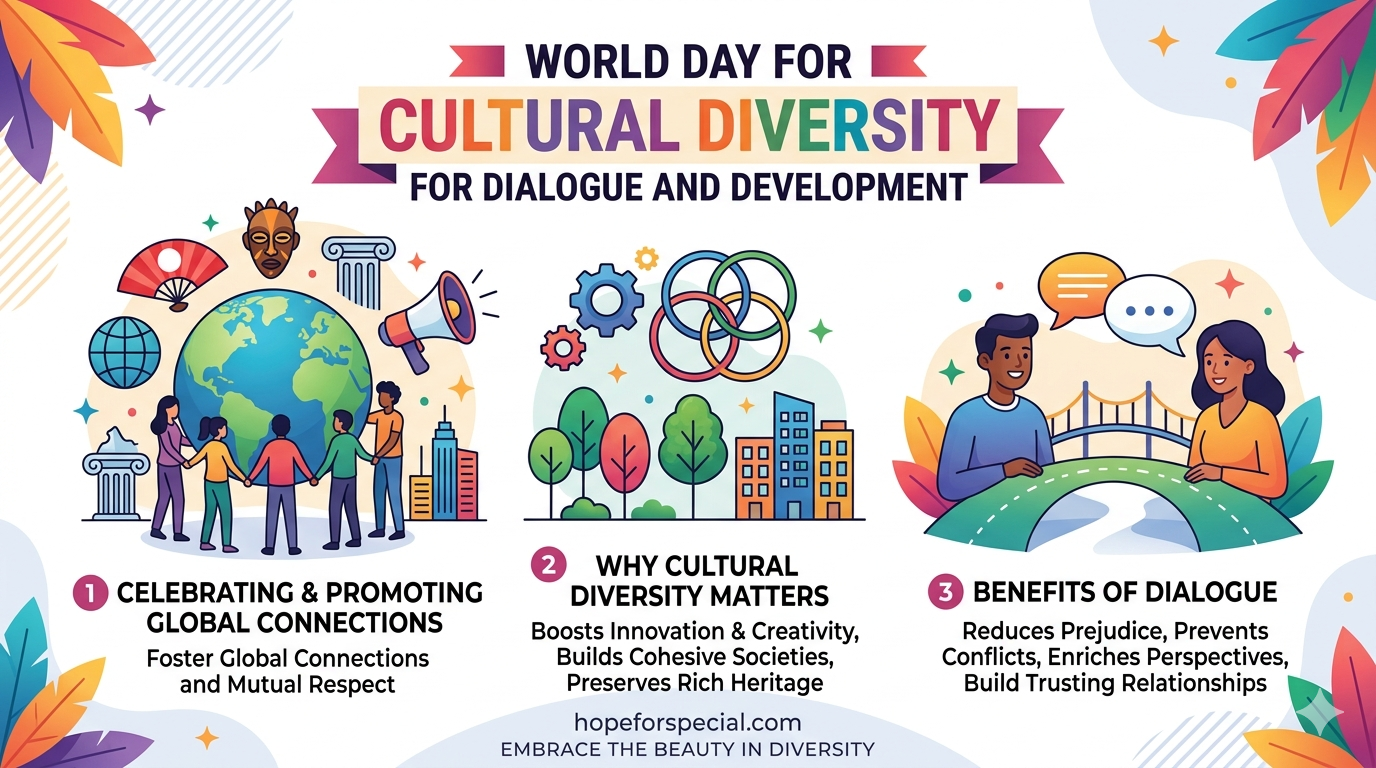
The day has three interconnected pillars:
- 🌱 Cultural Diversity — Celebrating the richness of the world’s 7,000+ languages, thousands of cultural traditions, and countless ways of being human
- 🤝 Dialogue — Building genuine understanding across cultural, linguistic, and social divides
- 🌟 Development — Recognising that cultural diversity is not just beautiful — it is economically and socially productive
According to UNESCO, the creative industries — rooted in cultural diversity — represent one of the fastest-growing sectors of the global economy, generating over $2 trillion annually and employing hundreds of millions of people worldwide.
But for the families reading this on HopeForSpecial.com, the most important pillar is one that is sometimes understated:
The connection between cultural inclusion and disability inclusion. 💛
📊 Key Statistics — Cultural Diversity, Disability, and Inclusion
| Statistic | Data | Source |
|---|---|---|
| Languages spoken worldwide | Over 7,000 active languages | UNESCO — Languages |
| People with disability globally | 1.3 billion (16% of world population) | WHO — Disability |
| Children from minority cultures more likely to have unmet disability needs | Up to 3x more likely in low-income settings | UNICEF — Children with Disabilities |
| Cultural industries’ global contribution | Over $2 trillion annually | UNESCO — Culture & Economy |
| Countries with cultural diversity policies | 148 countries have adopted UNESCO Cultural Diversity Convention | UNESCO Convention 2005 |
| Children in culturally diverse classrooms showing higher empathy | 72% in inclusive multicultural settings | OECD — Education at a Glance |
| Disability and cultural minority overlap | Indigenous people with disability face double discrimination | UN DESA — Disability |
| Economic cost of exclusion (disability + cultural) | Over $1.37 trillion in lost global GDP | World Bank — Disability Inclusion |
| Schools with multicultural inclusion programmes | Show 40% higher special needs integration rates | UNESCO — Inclusive Education |
These numbers tell a story that most people haven’t connected yet. Cultural exclusion and disability exclusion share the same root cause: the failure to value difference. And they share the same solution: genuine, practised inclusion. 💪
Why the World Day for Cultural Diversity for Dialogue and Development Matters for Special Needs Families 🧩
For parents of children with special needs — particularly those from culturally diverse or minority backgrounds — this day touches something much deeper.

Here is why. 👇
🔑 Reason #1: Disability Intersects with Culture in Ways That Are Rarely Acknowledged
A child with autism who is also from a South Asian family faces a double layer of complexity.
In many cultures, disability is still viewed through the lens of shame, divine punishment, or family failing. These cultural beliefs — however deeply held and however understandable their origins — can delay diagnosis, prevent treatment, and isolate both the child and the family.
The World Day for Cultural Diversity for Dialogue and Development calls us to build dialogue across these divides. To understand that cultural beliefs about disability vary enormously — and that building bridges means listening to and honouring those beliefs while also advocating for the child’s right to support and inclusion.
According to UNICEF’s Children with Disabilities report, children from cultural or ethnic minorities with disabilities are among the most marginalised populations on earth — facing discrimination on multiple fronts simultaneously.
Naming that reality — on May 21 and every day — is an act of advocacy. 💛
🔑 Reason #2: Multicultural Classrooms Are More Inclusive Classrooms
Here is something remarkable that research has consistently found:
Schools that successfully integrate cultural diversity also integrate disability more effectively.
Why? Because both require the same fundamental skills:
- Flexibility in how content is delivered
- Openness to different ways of communicating
- Willingness to adapt the environment for individual needs
- A school culture built on respect for difference
The OECD’s Education at a Glance data consistently shows that educational systems with strong multicultural inclusion frameworks perform better on disability inclusion metrics too.
This is not a coincidence. It is a principle: Inclusion is indivisible. A school that includes everyone includes everyone.
🔑 Reason #3: Cultural Diversity Celebrates Different Ways of Thinking — Just Like Neurodiversity Does
The neurodiversity movement — which champions autism, ADHD, dyslexia, and other neurological differences as natural human variation — shares its deepest philosophical roots with the cultural diversity movement.
Both movements say the same essential thing:
There is no single correct way to be human.
Different cultures have different values, different communication styles, different ways of understanding time, relationship, and meaning. Neurodiversity says different brains have different strengths, different processing styles, different ways of experiencing and contributing to the world.
The World Day for Cultural Diversity for Dialogue and Development, at its philosophical core, is a celebration of this principle.
When we teach children to value cultural difference — we are also teaching them to value neurological difference. These lessons reinforce each other beautifully. 🌈
🔑 Reason #4: Dialogue Is the Tool That Changes Everything
The second word in the name of this observance — dialogue — is perhaps the most important.
Dialogue means genuine, respectful, two-way communication. It means listening before speaking. It means sitting with discomfort long enough to understand a perspective different from your own.
For families of children with special needs — dialogue is survival.
Dialogue with teachers who don’t understand your child’s condition. Dialogue with doctors who are unfamiliar with your cultural context. Dialogue with extended family members who hold beliefs about disability that are rooted in tradition. Dialogue with policymakers who make decisions about inclusion funding.
The World Day for Cultural Diversity for Dialogue and Development reminds us that dialogue is a skill we must practice — not a gift we are born with. And the more we practice it across cultural lines, the better we become at practicing it across all lines of difference. 💪
🗓️ World Day for Cultural Diversity for Dialogue and Development 2026 — Theme and Global Activities
The 2026 theme for the World Day for Cultural Diversity for Dialogue and Development is expected to focus on digital culture, AI, and inclusive futures — reflecting the growing conversation about how technology either amplifies or erases cultural and human diversity.
Note: UNESCO announces the official annual theme on their website at unesco.org/en/days/cultural-diversity — check there for the confirmed 2026 theme closer to May 21.
What Typically Happens on May 21 Globally:
| Activity Type | Who Organises It | Purpose |
|---|---|---|
| Cultural festivals and fairs | Schools, municipalities, community groups | Celebrate local cultural diversity |
| Interfaith and intercultural dialogue forums | NGOs, religious organisations, UN agencies | Build understanding across divides |
| Art and music performances | Cultural organisations, artists | Express diversity through creative forms |
| Educational webinars and workshops | UNESCO, universities, schools | Teach about cultural rights and inclusion |
| Social media campaigns (#WorldDiversityDay) | Individuals, organisations globally | Spread awareness and share stories |
| Policy announcements | Governments and UN bodies | Commit to diversity and inclusion measures |
| Disability and diversity intersection events | Special needs organisations | Highlight the cultural-disability connection |
🌟 The Connection Between Cultural Diversity and Special Needs Inclusion — Deep Insights
📌 Insight #1: Language Diversity Is Directly Connected to Communication Disability Inclusion
The world speaks over 7,000 languages. The World Day for Cultural Diversity for Dialogue and Development celebrates this linguistic richness.
But here is what most people don’t connect:
Children who use Augmentative and Alternative Communication (AAC) — communication boards, devices, sign language — are also creating and using languages. Non-verbal communication is a form of linguistic diversity.
When we celebrate the diversity of human languages on May 21 — we should also be celebrating the diversity of human communication. Including the child who uses a speech device. Including the child who communicates through art or music. Including the child whose language is movement and expression rather than words.
The American Speech-Language-Hearing Association (ASHA) recognises that cultural and linguistic diversity directly affects how communication disorders are assessed and treated — making cultural competence an essential professional skill for speech therapists working with special needs children.
📌 Insight #2: Indigenous Cultures Often Hold Ancient Wisdom About Neurodiversity
This is something rarely discussed — and it is profound.
Many indigenous cultural traditions have historically understood neurodiversity not as deficit but as spiritual gift, community role, or natural variation.
Some Native American traditions recognised individuals with different cognitive profiles as “two-spirit” or gifted with special perception. Some West African traditions understood individuals who experienced the world differently as connected to spiritual realms.
These are not medical frameworks. But they remind us that the deficit model of disability — viewing any difference from neurotypical as a problem to be fixed — is itself a cultural construct. It is not universal truth.
The World Day for Cultural Diversity for Dialogue and Development invites us to consider: what can we learn from other cultural frameworks about how to understand, value, and include people who are different?
This is not romanticising disability. It is recognising that our current medical and educational frameworks are not the only possible frameworks — and that genuine dialogue across cultures might enrich how we support children with special needs. 💛
📌 Insight #3: The Arts Are Where Cultural Diversity and Special Needs Meet Most Powerfully
Art, music, dance, and storytelling are the languages that cross every boundary.
They cross linguistic boundaries. They cross cultural boundaries. And they cross neurological boundaries.
A non-verbal child with autism who creates extraordinary visual art is participating in the same fundamental human tradition as a Balinese mask maker, a West African drummer, or an Argentine tango dancer.
The UNESCO Creative Industries report notes that creative expression is the most universal form of human communication — transcending language, culture, and cognitive difference.
On the World Day for Cultural Diversity for Dialogue and Development, celebrating art means celebrating all forms of human creative expression — including those that emerge from minds that work differently. 🎨
🏫 How Schools Can Celebrate World Day for Cultural Diversity with Special Needs Inclusion in Mind
This is the practical section that parents and teachers have been waiting for.
Here is a complete activity guide for schools — combining cultural diversity celebration with disability and neurodiversity inclusion:
🎨 Activity #1: “The Many Ways We Communicate” Wall
What to do: Ask every child in the class to share one way they communicate — in their home language, through art, through gesture, through a communication device, through writing, through music.
Why it works: It normalises all forms of communication — including AAC and sign language — by placing them alongside spoken languages and cultural communication styles.
Materials needed: Paper, art supplies, photographs, printed symbols, communication boards
Inclusive for: Children with autism, non-verbal children, children who are ELL (English Language Learners), children with hearing impairment
🌍 Activity #2: “My Culture, My Strength” Story Circle
What to do: Invite children — and parents — to share one cultural tradition from their family that relates to how their community supports people who are different or who face challenges.
Why it works: It opens a genuine dialogue about how different cultures understand and support disability and difference — building empathy and dismantling shame.
Inclusive for: All children, with particular power for children from minority cultural backgrounds who may feel their family’s understanding of disability is in conflict with the school’s approach
🎵 Activity #3: Global Music and Movement Celebration
What to do: Play music from different cultures and invite children to move, respond, or engage in whatever way feels natural to their body.
Why it works: Music and movement are accessible to all children — including those with physical disabilities, sensory processing differences, or communication challenges. Every child can participate authentically.
Materials needed: Music from at least 5 different cultural traditions, open space, sensory-friendly lighting
Inclusive for: Children with physical disabilities, sensory processing disorder, autism, Down syndrome
📚 Activity #4: “Different Brilliant Minds” Book and Story Day
What to do: Read stories from different cultural traditions featuring characters who are different — including characters with disabilities, different ways of thinking, or unique gifts.
Why it works: Representation in storytelling is one of the most powerful tools for building both cultural and disability inclusion.
Recommended themes: Trickster figures (who often represent different thinking), disability in folklore, stories of community members who contribute differently
Inclusive for: All children — with particular resonance for children with learning disabilities and children from minority cultures
🖌️ Activity #5: “Art Has No Language” Exhibition
What to do: Host a mini art exhibition where every child contributes a piece — created in whatever medium and whatever style feels natural to them. Display it for the whole school.
Why it works: Art exhibitions naturally accommodate every ability level. A child with severe motor disability can create digital art. A non-verbal child can create extraordinary visual work. The exhibition celebrates all contributions equally.
Inclusive for: All children regardless of disability, language, or cultural background
💬 A Parent’s Story: “Two Kinds of Different — and Finally Belonging”
Amara’s son Kofi was born in Ghana. The family moved to the United Kingdom when Kofi was three. He has autism and ADHD.
At his first school in England, Kofi faced two kinds of misunderstanding. His autism was misread as “difficult behaviour.” And his cultural background — his different communication style, his family’s different understanding of childhood — was also misread.
“He was doubly invisible,” Amara says. “They didn’t see his autism. And they didn’t see his culture. They just saw a problem.”
Everything changed when Kofi’s school began celebrating the World Day for Cultural Diversity for Dialogue and Development with genuine intention.
His teacher — herself from a Caribbean background — created a classroom project exploring “all the ways humans are wonderfully different.” She included cultural differences, language differences, and neurological differences in the same conversation.
For the first time, Kofi heard the word “different” used as a celebration rather than a diagnosis.
“He came home that day and said, ‘Mummy, I am African AND my brain is special AND that is two kinds of brilliant,'” Amara recalls.
She couldn’t speak for a moment.
“Two kinds of brilliant. He said it himself. I had been waiting four years to hear him describe himself that way.” 💛
🌐 What the UN and UNESCO Say About Cultural Diversity and Disability Inclusion
The connection between cultural diversity and disability inclusion is not just a philosophical argument. It is embedded in international law and policy.
- The UN Convention on the Rights of Persons with Disabilities (CRPD) explicitly recognises the importance of cultural participation for people with disabilities — calling on governments to ensure that people with disabilities can access cultural events, creative works, and cultural heritage on equal terms.
- The UNESCO Universal Declaration on Cultural Diversity states that “all persons have… the right to express themselves and to create and disseminate their work in the language of their choice” — a principle that directly supports communication diversity and AAC inclusion.
- The UNESCO Convention on the Protection and Promotion of the Diversity of Cultural Expressions (2005) — ratified by 148 countries — commits signatory nations to policies that support cultural diversity in education, media, and public life. These policies, when implemented inclusively, benefit children with special needs significantly.
- The UN Sustainable Development Goals (SDGs) — particularly SDG 4 (Quality Education), SDG 10 (Reduced Inequalities), and SDG 16 (Peace, Justice and Strong Institutions) — all have direct implications for both cultural diversity and disability inclusion.
These frameworks are not just words on paper. They are tools for advocacy. Parents of children with special needs can and should reference them in conversations with schools, local governments, and policymakers. 💪
🧠 What Research Says — Cultural Competence and Special Needs Outcomes
The research on this topic is both clear and underutilised.
- A study referenced by the American Psychological Association (APA) found that culturally competent healthcare and education providers — those trained to understand and respect cultural differences — produced significantly better outcomes for children with special needs from minority backgrounds, including faster diagnosis, better treatment adherence, and higher family engagement.
- Research published through NIH PubMed found that children from culturally and linguistically diverse backgrounds with developmental disabilities were diagnosed an average of 18 months later than their white, English-speaking peers — a gap directly attributable to cultural and linguistic barriers in diagnostic systems.
- The OECD consistently reports that inclusive education systems — those that successfully include children with disabilities — also show stronger outcomes for children from culturally diverse backgrounds, and vice versa. The correlation is robust and consistent across multiple countries and education systems.
- UNESCO’s Global Education Monitoring Report found that teacher training in cultural diversity was one of the strongest predictors of inclusive classroom practice — including inclusion of children with special needs. Teachers who are trained to navigate cultural difference are better equipped to navigate neurological difference.
The evidence is unambiguous. Cultural competence and disability inclusion are not parallel tracks. They are the same track. 💛
🎯 How Special Needs Parents Can Use May 21 as an Advocacy Tool
The World Day for Cultural Diversity for Dialogue and Development is not just a day for celebration. It is a day for strategic advocacy.
Here is how special needs parents can use May 21 powerfully:
✅ In Your Child’s School:
- Request that the school’s May 21 activities explicitly include disability and neurodiversity as forms of human diversity worth celebrating
- Suggest that “Lots of Different Brains” be added as a theme alongside cultural flags and food
- Offer to share your family’s experience of navigating both cultural identity and special needs — your story is educational and powerful
✅ In Your Community:
- Connect with local cultural organisations and ask them to include disability inclusion in their May 21 programming
- Use social media on May 21 to share the connection between cultural diversity and neurodiversity — use hashtags #WorldDiversityDay and #InclusionForAll
- Write to your local councillor or MP/representative linking May 21 to disability funding and inclusion policy
✅ In Your Family:
- Use May 21 as a family conversation day — discuss your cultural heritage, your child’s diagnosis, and how both are part of your family’s beautiful, complex story
- Create a family “diversity celebration” — your culture, your child’s neurodivergent gifts, your family’s unique strengths
- Frame your child’s diagnosis as part of human diversity — not as deviation from it
✅ On Social Media and Blogs:
- Create content connecting cultural diversity day to special needs inclusion
- Share stories of people from diverse cultural backgrounds who also have disabilities
- Amplify the voices of special needs families from minority cultural backgrounds — their experiences are often the most marginalised and the most powerful
❓ FAQs — World Day for Cultural Diversity for Dialogue and Development
Q1: When is the World Day for Cultural Diversity for Dialogue and Development?
The World Day for Cultural Diversity for Dialogue and Development is observed every year on May 21. It was established by the United Nations General Assembly in 2002, following UNESCO’s adoption of the Universal Declaration on Cultural Diversity in November 2001. The official page is maintained at UNESCO’s Cultural Diversity Day.
Q2: What is the purpose of the World Day for Cultural Diversity for Dialogue and Development?
The day has three core purposes. First, to celebrate the richness of the world’s cultural diversity. Second, to promote dialogue and understanding across cultural divides. Third, to highlight that cultural diversity is not just a social value but an economic and developmental asset. For special needs families, it is also an opportunity to connect cultural inclusion with disability and neurodiversity inclusion.
Q3: How can schools celebrate cultural diversity day inclusively for special needs children?
Schools can celebrate inclusively by including neurodiversity and disability as explicit forms of human diversity in their activities. This means celebrating different communication styles (including AAC), different learning approaches, and different ways of experiencing the world — alongside different cultural traditions and languages. Activities like “All the Ways We Communicate” walls and “Different Brilliant Minds” story circles are particularly effective.
Q4: What does cultural diversity have to do with autism or ADHD?
More than most people realise. The neurodiversity movement and the cultural diversity movement share the same foundational principle: there is no single correct way to be human. Children with autism, ADHD, dyslexia, and other neurological differences represent natural human variation — just as cultural traditions represent natural human variation. Teaching children to value one form of diversity builds their capacity to value all forms of diversity.
Q5: Is there a connection between cultural background and special needs diagnosis?
Yes — and it is significant. Research consistently shows that children from minority cultural backgrounds with disabilities are diagnosed later and receive less support than their majority-culture peers. Cultural and linguistic barriers in diagnostic and educational systems create this gap. The World Day for Cultural Diversity for Dialogue and Development is an opportunity to name and address this disparity.
Q6: How can I explain cultural diversity day to my special needs child?
Use concrete, simple language. “Today is a day when the whole world celebrates that every person is different — and that different is beautiful. People come from different countries, speak different languages, have different ways of thinking and learning. And ALL of those differences make the world more amazing.” For children with visual learning preferences, use a globe, photographs, and cultural artifacts to make the concept tangible.
Q7: What is the UN’s role in the World Day for Cultural Diversity for Dialogue and Development?
The United Nations General Assembly established this observance in 2002. UNESCO — the UN’s cultural, educational, and scientific agency — coordinates and leads the global observance each year, setting the annual theme and supporting member states in organising activities. The UNESCO cultural diversity page is the authoritative source for all official information about the day.
Q8: What resources are available for families who want to engage with cultural diversity and inclusion?
- UNESCO — Cultural Diversity Day — official resources and theme
- UNICEF — Children with Disabilities — resources on disability and inclusion
- UN CRPD — disability rights framework
- UNESCO Inclusive Education — educational inclusion resources
- ASHA — Cultural Competence — cultural diversity in communication and special needs
- HopeForSpecial.com — special needs resources, disability awareness calendar, and family support
🌈 A Final Word — Every Child Is a World
The World Day for Cultural Diversity for Dialogue and Development celebrates the idea that our differences — cultural, linguistic, artistic, historical — are our greatest collective wealth.
At HopeForSpecial.com, we believe the same about the children we write for every day.
Every child with special needs is a world.
A world of particular perception. A world of unique gifts. A world of extraordinary resilience. A world that has so much to offer — if the rest of the world will only stop, listen, and genuinely open its doors.
On May 21, the planet pauses to celebrate human difference. Let that celebration include every child. Let it include the child who communicates differently. The child who learns differently. The child whose brain works in ways that science is still learning to understand and appreciate.
Let it include your child. 💛
Because diversity — all of it, cultural and neurological and every other kind — is not a problem to be managed.
It is the whole point. 🌍
✅ Key Takeaways — What to Remember
- The World Day for Cultural Diversity for Dialogue and Development is observed every May 21
- It was established by the UN in 2002 following UNESCO’s Universal Declaration on Cultural Diversity
- Cultural diversity inclusion and disability inclusion share the same philosophical roots and practical tools
- Children from minority cultural backgrounds with disabilities face compounded disadvantage — this day is an opportunity to name and address that
- Schools that successfully integrate cultural diversity also integrate special needs more effectively
- The neurodiversity movement and cultural diversity movement are natural allies
- May 21 can be used strategically by special needs families as an advocacy and awareness tool
📌 Share This Article
If this connected something for you — share it. 💛
Share it with a teacher planning May 21 activities. Share it with a parent from a minority cultural background who feels doubly isolated. Share it with a school that celebrates cultural diversity but hasn’t yet connected it to disability inclusion.
And tell us in the comments: How does your family’s cultural background shape your experience of raising a child with special needs? Your story matters. Your perspective enriches all of us.
Every voice is part of the diversity we are celebrating. Including yours. 🌍
At HopeForSpecial.com, we believe that a world that truly embraces cultural diversity is a world that truly embraces every child — regardless of ability, diagnosis, or difference. Explore our disability awareness calendar, special needs resources, and family support articles — written with research, love, and genuine hope.


