

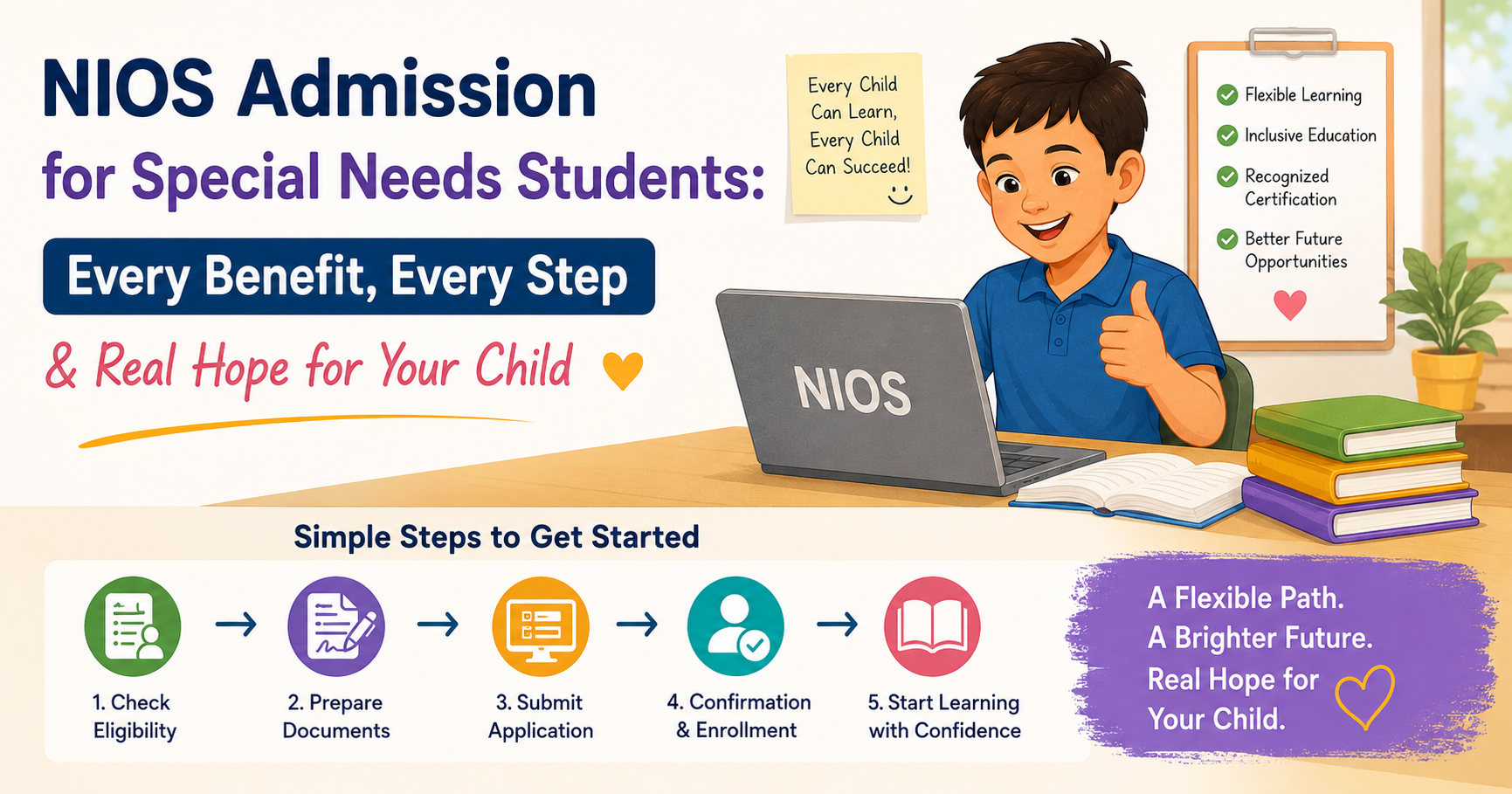
NIOS Admission for Special Needs Students: Every Benefit, Every Step & Real Hope for Your Child in 2026 🎗️
⚡ What You Need to Know First
NIOS admission for special needs students offers a flexible, government-recognized alternative to mainstream schooling. NIOS — the National Institute of Open Schooling — allows children with disabilities to study at their own pace, appear for exams with special accommodations, and earn Class 10 and Class 12 certificates equivalent to CBSE. No attendance requirement. No age limit. Full government recognition. 💙
If your child has autism, cerebral palsy, intellectual disability, visual or hearing impairment, Down syndrome, or any other condition that makes mainstream schooling difficult or impossible — NIOS may be the most important educational option you have never fully explored.
It is not a lesser option. It is not giving up.
NIOS is a lifeline. It is how thousands of special needs children in India are completing their schooling — at their own pace, in their own time, with full government recognition — while the mainstream system said they could not.
This guide tells you everything. Simply. Clearly. With real numbers and real stories.

- ⚡ What You Need to Know First
- 🏫 What Is NIOS?
- 💙 Why NIOS Is Perfect for Special Needs Students
- 1. 📅 No Fixed Time Pressure
- 2. 🏠 Learn From Home
- 3. 📝 Exam Accommodations That Actually Help
- 4. 🧩 Choose Only the Subjects You Need
- 5. 👶 No Age Limit
- 6. 🔄 Multiple Chances to Pass Each Subject
- ✅ Who Qualifies — Disabilities Covered Under NIOS Special Needs Provisions
- 📚 NIOS Courses Available for Special Needs Students
- Open Basic Education (OBE) — Foundation Level
- Secondary Certificate — Class 10 Equivalent
- Senior Secondary Certificate — Class 12 Equivalent
- Vocational Courses
- 🎯 Special Facilities & Exam Accommodations Under NIOS
- Complete List of NIOS Exam Accommodations for Disabled Students
- On-Demand Examination (ODE) — A Revolutionary Feature
- 📋 Eligibility Criteria — Age and Academic Requirements
- For Secondary Level (Class 10)
- For Senior Secondary Level (Class 12)
- For Open Basic Education (OBE)
- Special Age Relaxation for Disabled Students
- 🪜 Step-by-Step NIOS Admission Process for Special Needs Students
- 📁 Documents Required — Complete Checklist
- For Admission
- For Special Accommodation Request (Submit After Enrollment)
- For Scribe Request Specifically
- 💰 Fees — How Affordable Is NIOS?
- NIOS Secondary Course Fees (Approximate 2026)
- NIOS Senior Secondary Fees (Approximate 2026)
- Fee Concessions for Special Needs Students
- 📊 Key Statistics — NIOS and Special Needs Education in India
- ⚖️ NIOS vs. Mainstream School — Honest Comparison for Special Needs Families
- 🌟 Real Examples — What NIOS Special Needs Students Achieve
- Example 1 — Rahul, Autism, Age 19
- Example 2 — Meena, Cerebral Palsy, Age 22
- Example 3 — Arjun, Intellectual Disability (Mild), Age 17
- 💛 A Parent’s Real Story: “NIOS Gave My Son Back His Self-Respect”
- 🔍 What You Must Not Miss About NIOS Admission for Special Needs
- 1. 🎓 Open Basic Education — The Most Underused NIOS Option
- 2. 🏫 Special Schools as NIOS Accredited Institutions — A Hidden Gem
- 3. 📱 NIOS Study Materials in Multiple Formats
- 4. 🧑💼 The Scribe Rules — What Parents Get Wrong
- 5. 🔄 Credit Accumulation — Take Years If Needed
- 6. 🌐 NIOS for Indian Children Abroad
- 7. 💼 NIOS Vocational Courses for Employment — The Under-Discussed Path
- ❓ FAQs — Long-Tail Questions Answered
- Is NIOS valid for college admission in India?
- Can a child with autism enroll in NIOS?
- What is the NIOS admission process for disabled students?
- Does NIOS give extra time for disabled students in exams?
- Can a special needs child get a scribe for NIOS exams?
- What is the age limit for NIOS admission?
- Is NIOS better than CBSE for a child with dyslexia?
- How long does it take to complete NIOS Secondary?
- Can a special needs child do NIOS and attend a special school simultaneously?
- What is NIOS Open Basic Education and who is it for?
- 🔗 Trusted Resources — NIOS and Special Needs Education
- 🏛️ Official NIOS Resources
- 🏛️ Government Disability Resources
- 💛 Support Organizations
- 📚 Education Policy References
- ✨ Final Thoughts: Your Child’s Education Does Not Have a Deadline
🏫 What Is NIOS?
NIOS admission for special needs students starts with understanding what NIOS actually is — because many parents have heard the name but do not fully know what it offers.
NIOS stands for the National Institute of Open Schooling. It is a government body under the Ministry of Education, Government of India. It was established in 1989. Today, it is the largest open schooling system in the world.
NIOS offers:
- 📘 Secondary Certificate (Class 10 equivalent)
- 📗 Senior Secondary Certificate (Class 12 equivalent)
- 📙 Vocational Courses — practical skill-based certificates
- 📕 Open Basic Education (OBE) — for learners who need foundational literacy and numeracy
The certificates issued by NIOS are fully recognized by:
- ✅ All Indian universities
- ✅ All state government universities
- ✅ CBSE and all state boards
- ✅ The Association of Indian Universities (AIU)
- ✅ The University Grants Commission (UGC)
- ✅ All central government recruitment boards
In simple words: a Class 10 or Class 12 certificate from NIOS is equal to a CBSE certificate for the purpose of further education and employment.
💡 Voice Search Answer — What is NIOS and is it valid?
NIOS is the National Institute of Open Schooling — a government body under India’s Ministry of Education. It offers Class 10 and Class 12 certificates that are fully equivalent to CBSE. NIOS certificates are recognized by all Indian universities, the UGC, and government recruitment boards. It is completely valid for higher education and employment.
Reference: NIOS Official Website
💙 Why NIOS Is Perfect for Special Needs Students
The standard school system works well for many children. But it was not designed with special needs children in mind.
NIOS was.
Here is why NIOS admission for special needs students is such a powerful option — explained simply.
1. 📅 No Fixed Time Pressure
In a mainstream school, every child must pass every exam at the same time. If your child needs more time to learn — they fall behind. Then they fail. Then they lose confidence.
NIOS removes this pressure completely.
At NIOS, your child can take as long as they need. They can attempt each subject exam multiple times across different exam cycles — called on-demand exams. There is no “you must pass this year or repeat the whole year.”
2. 🏠 Learn From Home
Children with disabilities often have therapy schedules, hospital appointments, fatigue, or sensory challenges that make daily school attendance impossible or exhausting.
NIOS requires zero compulsory attendance. Your child can study at home. At their own schedule. Around their therapy sessions. Around their good days and difficult days.
3. 📝 Exam Accommodations That Actually Help
This is where NIOS truly shines for special needs students. NIOS offers an extensive range of exam accommodations — adjustments made to the exam format or conditions to help disabled students access the exam fairly.
We will cover all these accommodations in detail below. No other mainstream board in India offers this level of accommodation.
4. 🧩 Choose Only the Subjects You Need
In mainstream school, every student must study a fixed set of subjects. Many of these subjects may be irrelevant or extremely difficult for a special needs child.
At NIOS, students choose their own subjects from a wide menu. You pick only what your child can realistically study and what they need for their future plans.
5. 👶 No Age Limit
Mainstream schools have strict age limits. A child with a significant disability who could not complete schooling at the typical age faces a wall.
NIOS has no upper age limit. A 25-year-old with intellectual disability can enroll and complete their Class 10 or Class 12 alongside a 15-year-old. Each person moves at their own pace.
6. 🔄 Multiple Chances to Pass Each Subject
If a child struggles with one subject — they do not fail the entire year. In NIOS, subjects are independent. Pass five out of six subjects — the sixth can be attempted again in the next exam cycle without redoing the others.
✅ Who Qualifies — Disabilities Covered Under NIOS Special Needs Provisions
NIOS admission for special needs students covers all 21 disabilities recognized under the Rights of Persons with Disabilities Act 2016.
All 21 Recognized Disabilities Qualify
| # | Disability Type | Examples |
|---|---|---|
| 1 | Blindness | Complete vision loss |
| 2 | Low Vision | Partial sight |
| 3 | Leprosy Cured Persons | Post-treatment |
| 4 | Hearing Impairment | Deaf and hard of hearing |
| 5 | Locomotor Disability | Paralysis, limb differences |
| 6 | Dwarfism | Short stature conditions |
| 7 | Intellectual Disability | Down syndrome, cognitive impairment |
| 8 | Mental Illness | Diagnosed psychiatric conditions |
| 9 | Autism Spectrum Disorder | All levels of ASD |
| 10 | Cerebral Palsy | All types |
| 11 | Muscular Dystrophy | All types |
| 12 | Chronic Neurological Conditions | Epilepsy, ataxia, MS |
| 13 | Specific Learning Disabilities | Dyslexia, dyscalculia, dysgraphia |
| 14 | Multiple Sclerosis | |
| 15 | Speech and Language Disability | |
| 16 | Thalassemia | |
| 17 | Haemophilia | |
| 18 | Sickle Cell Disease | |
| 19 | Multiple Disabilities including Deaf-Blindness | |
| 20 | Acid Attack Victims | |
| 21 | Parkinson’s Disease |
Source: RPWD Act 2016 — Ministry of Social Justice
Minimum Disability Requirement
For accessing special accommodations under NIOS, students generally need a Disability Certificate from a government hospital Medical Board. There is no minimum percentage requirement for NIOS enrollment itself — but for specific accommodations, documentation is required.
📚 NIOS Courses Available for Special Needs Students
NIOS admission for special needs students gives access to multiple levels of courses. Here is a clear overview.
Open Basic Education (OBE) — Foundation Level
Who is it for? Children and adults who need foundational literacy, numeracy, and life skills before attempting secondary level.
Levels:
- OBE Level A — equivalent to Class 3
- OBE Level B — equivalent to Class 5
- OBE Level C — equivalent to Class 8
Why it matters for special needs: Many children with moderate or severe intellectual disabilities may not be ready for Class 10 level content. OBE provides a recognized certification path at a more accessible academic level. It is significantly underused by special needs families — and it is one of the most important options NIOS offers.
Secondary Certificate — Class 10 Equivalent
Age eligibility: 14 years and above (no upper limit)
How it works:
- Choose 5 subjects (must include one language)
- Pass each subject independently
- Accumulate passes over multiple exam cycles if needed
- Receive Secondary Certificate on completing all 5 subjects
Subjects available include: Hindi, English, Mathematics, Science and Technology, Social Science, Economics, Home Science, Psychology, Indian Culture and Heritage, Data Entry Operations, and many vocational options
Senior Secondary Certificate — Class 12 Equivalent
Age eligibility: 15 years and above (no upper limit)
How it works:
- Language subject mandatory
- Same accumulation system as secondary
Additional subject streams: Arts, Science, Commerce, Vocational — students choose what matches their interests and abilities
Vocational Courses
NIOS offers standalone vocational certificates in practical skills including:
- 🖥️ Computer and IT skills
- 🍳 Food processing and catering
- 🌿 Agriculture and horticulture
- 👗 Fashion design and textile
- 🏥 Health care worker
- 🔧 Electrical and plumbing basics
These vocational certificates provide direct employability pathways for students who may not pursue academic higher education — an ideal option for many special needs students.
🎯 Special Facilities & Exam Accommodations Under NIOS
This section is the heart of why NIOS admission for special needs students is so transformative. NIOS offers the most comprehensive exam accommodation system of any Indian examination board.
Complete List of NIOS Exam Accommodations for Disabled Students
| Accommodation | Who It Helps | Details |
|---|---|---|
| Scribe / Writer | Visual impairment, locomotor disability, dysgraphia, cerebral palsy | A person writes answers on behalf of the student. Student dictates. Scribe chosen by student. |
| Extra Time | All disabilities with processing or physical limitations | 20 minutes extra per hour of exam (minimum 1 hour additional for 3-hour exam) |
| Exemption from Third Language | All disabled students | Compulsory third language requirement waived |
| Separate Exam Room | Students requiring quiet or specialized conditions | Individual room provided on request |
| Braille Question Papers | Visually impaired students | Question papers in Braille on advance request |
| Large Print Question Papers | Low vision students | Question papers in enlarged print |
| Oral Examination | Non-verbal students, severe dysgraphia, cerebral palsy affecting hands | Student answers orally; examiner records |
| Exemption from Practical Exams | Physical disability affecting practical performance | Practical component exempted; marks redistributed |
| Home-Based Examination | Students physically unable to travel to exam center | Exam conducted at student’s home with invigilator |
| Compensatory Marks | Specific learning disabilities (dyslexia) | Additional marks compensating for spelling and presentation errors |
| Computer/Laptop | Students who cannot write by hand | Allowed with prior approval |
| Sign Language Interpreter | Deaf students | Interpreter present during exam |
| Wheelchair Accessible Centers | Locomotor disability | Exam center with ramp and accessible facilities |
Source: NIOS — Special Facilities for Disabled Learners
On-Demand Examination (ODE) — A Revolutionary Feature
NIOS On-Demand Examination allows students to appear for each subject exam when they are ready — not on a fixed date shared with all students.
For special needs children — who may have:
- Variable health and energy levels
- Seizure conditions that make fixed exam dates risky
- Anxiety around exams that requires extra preparation time
— ODE is genuinely transformative. A child can study a subject for six months, feel ready, and book their exam for that specific week. Then take the next subject six months later.
💡 Voice Search Answer — What special facilities does NIOS provide for disabled students?
NIOS provides extensive exam accommodations for disabled students including: scribes (writers), extra time (20 minutes per hour), Braille question papers, large print papers, oral exams, home-based exams, exemption from practical exams, computer use, sign language interpreters, and compensatory marks for dyslexia. These accommodations are available at Secondary and Senior Secondary levels on submission of a valid Disability Certificate.
📋 Eligibility Criteria — Age and Academic Requirements
For Secondary Level (Class 10)
| Criterion | Requirement |
|---|---|
| Minimum age | 14 years (as on January 1 of admission year) |
| Maximum age | No upper limit |
| Educational qualification | No minimum — open enrollment |
| Nationality | Indian citizen (or OCI/NRI with specific conditions) |
| Disability certificate | Required for special accommodations (not for enrollment) |
For Senior Secondary Level (Class 12)
| Criterion | Requirement |
|---|---|
| Minimum age | 15 years |
| Maximum age | No upper limit |
| Educational qualification | Passed Class 10 (from any recognized board including NIOS) |
| Nationality | Indian citizen |
For Open Basic Education (OBE)
| Criterion | Requirement |
|---|---|
| Minimum age | No minimum age |
| Maximum age | No upper limit |
| Educational qualification | None required for Level A |
| Special needs focus | Specifically designed for learners outside mainstream system |
Special Age Relaxation for Disabled Students
For students with disabilities — NIOS provides additional age relaxation beyond the standard minimum ages. Contact the nearest NIOS Regional Centre for specific relaxation applicable to your child’s situation.
🪜 Step-by-Step NIOS Admission Process for Special Needs Students
Here is the complete, step-by-step guide to completing NIOS admission for special needs students.

Phase 1 — Preparation
Step 1 — Identify the Right Course Level
Ask yourself:
- Is my child ready for Class 10 level content? → Secondary Course
- Do they need foundational skills first? → Open Basic Education
- Are they seeking post-Class 10 certification? → Senior Secondary
- Do they need vocational skills? → Vocational Course
Step 2 — Gather Disability Certificate
For accessing special accommodations — get a Disability Certificate from a government hospital Medical Board. Also apply for the UDID Card at swavlambancard.gov.in.
Step 3 — Choose Subjects
Select subjects based on your child’s:
- Strengths and interests
- Future plans (higher education vs. vocational path)
- Learning capacity
Subject selection advice: Choose fewer, manageable subjects rather than overloading. NIOS allows adding subjects later.
Step 4 — Find the Nearest NIOS Study Centre
NIOS operates through Accredited Institutions (AIs) — schools and centers that are authorized NIOS study centers. Find yours at: NIOS Study Centre Locator
Many special schools across India are also NIOS Accredited Institutions — meaning special needs children can study at their special school and sit for NIOS exams simultaneously.
Phase 2 — Online Admission
Step 5 — Visit the NIOS Admission Portal
Go to: sdmis.nios.ac.in — this is the official NIOS online admission portal.
Step 6 — Register as a New User
- Click “New Registration”
- Enter mobile number and email address
- Create login ID and password
- Verify with OTP
Step 7 — Fill the Online Admission Form
The form asks for:
- Personal details (name, date of birth, address, Aadhaar)
- Academic details (previous schooling if any)
- Subject selection
- Study center preference
- Disability details (if claiming special accommodations)
- Photograph and signature upload
Step 8 — Fill the Special Needs Section
For special needs students — there is a dedicated section in the form:
- Select “Persons with Disability”
- Enter disability type from the RPWD Act list
- Enter Disability Certificate details
- Select the specific accommodations required
Step 9 — Upload Documents
Upload scanned copies of:
- Photograph (passport size, recent)
- Aadhaar card
- Disability Certificate
- Previous academic certificates (if any)
- UDID Card (if available)
Step 10 — Pay Admission Fee
Pay online through:
- Net banking
- Debit card / Credit card
- UPI (Google Pay, PhonePe, Paytm)
Step 11 — Print Acknowledgment
Print or save the acknowledgment receipt with your enrollment number. This is your reference for all future NIOS communications.
Phase 3 — After Admission
Step 12 — Collect Study Materials
NIOS provides printed study materials — called self-learning materials — which are sent by post or collected from the study center. These are specially designed for independent learning.
Step 13 — Submit Request for Special Accommodations
After enrollment, separately submit the Special Facilities Application with your Disability Certificate to your NIOS Regional Centre. Do this as early as possible — well before the exam cycle.
Step 14 — Appear for Examinations
- Main exams are held twice yearly: March–April and October–November
- On-Demand Exams available throughout the year for selected subjects
- Carry original Disability Certificate to the exam center
📁 Documents Required — Complete Checklist
Print this before starting NIOS admission for special needs students.
For Admission
- ✅ Recent passport-size photograph (white background)
- ✅ Aadhaar card (child’s)
- ✅ Birth certificate
- ✅ Disability Certificate (government hospital Medical Board)
- ✅ UDID Card (if available — recommended)
- ✅ Previous academic certificates (if any — not mandatory for open enrollment)
- ✅ Address proof (Aadhaar / Ration Card / Electricity Bill)
- ✅ Parent/guardian Aadhaar (for minors)
- ✅ Bank account details (for fee payment and refund if applicable)
For Special Accommodation Request (Submit After Enrollment)
- ✅ Disability Certificate (original + photocopy)
- ✅ Completed Special Facilities Application Form (from NIOS Regional Centre)
- ✅ Doctor’s certificate specifying the nature of disability and accommodation required
- ✅ UDID Card (if available)
- ✅ Enrollment number (from admission acknowledgment)
For Scribe Request Specifically
- ✅ All above documents
- ✅ Details of the proposed scribe (name, qualification — scribe must not be a graduate in the same subject)
- ✅ Written consent from scribe
💰 Fees — How Affordable Is NIOS?
One of the most important aspects of NIOS admission for special needs students is how affordable it is compared to private school fees.
NIOS Secondary Course Fees (Approximate 2026)
| Component | Amount |
|---|---|
| Registration fee | ₹200 |
| Per subject fee (Indian students) | ₹300–₹400 per subject |
| Admission processing | ₹500 |
| Total for 5 subjects (approx.) | ₹2,500–₹3,500 |
NIOS Senior Secondary Fees (Approximate 2026)
| Component | Amount |
|---|---|
| Registration fee | ₹250 |
| Per subject fee | ₹350–₹500 per subject |
| Admission processing | ₹500 |
| Total for 5 subjects (approx.) | ₹3,000–₹4,500 |
Fee Concessions for Special Needs Students
NIOS provides fee concessions and waivers for students with disabilities in certain categories:
- ✅ BPL families with disabled children — significant fee reduction available
- ✅ Students from SC/ST backgrounds — additional fee concession
- ✅ Students enrolled through NGO or special school study centers — some centers absorb fees through grants
Contact your nearest NIOS Regional Centre for current fee concession details applicable to your child’s specific situation.
Reference: NIOS Fee Structure
💡 Comparison: A private school may charge ₹50,000–₹2,00,000 per year in fees. A special school ₹30,000–₹1,50,000 per year. NIOS total fees for completing the entire Secondary course: approximately ₹2,500–₹3,500. The cost difference is enormous.
📊 Key Statistics — NIOS and Special Needs Education in India
| Statistic | Figure | Source |
|---|---|---|
| NIOS total enrolled learners (cumulative) | Over 3.5 crore | NIOS Annual Report |
| NIOS learners with disabilities | Lakhs across all levels | NIOS Inclusive Education Division |
| Number of NIOS Study Centres across India | 6,500+ | NIOS |
| NIOS pass percentage (Secondary) | ~65–70% | NIOS Results Data |
| Recognized disabilities under RPWD Act 2016 | 21 | Disability Affairs Division |
| Children with disabilities out of school in India | ~28 lakh (estimated) | UDISE+ 2022–23 |
| Children with disabilities enrolled in education | ~61% | UDISE+ 2022–23 |
| NIOS establishment year | 1989 | NIOS |
| Exam sessions per year (NIOS) | 2 (April and October) + On-Demand | NIOS |
| Number of subjects available at NIOS Secondary | 25+ | NIOS Subject List |
⚖️ NIOS vs. Mainstream School — Honest Comparison for Special Needs Families
| Feature | NIOS | Mainstream School |
|---|---|---|
| Attendance requirement | None | 75% mandatory |
| Exam timing | Flexible / On-Demand | Fixed annual schedule |
| Subject choice | Wide, student-chosen | Fixed curriculum |
| Exam accommodations | Extensive (scribe, extra time, oral exam, home exam) | Limited; varies by school |
| Age limit | None | Strict age limits |
| Annual fees | ₹2,500–₹4,500 total | ₹30,000–₹2,00,000+ per year |
| Certificate validity | Fully recognized by all universities | Fully recognized |
| Peer interaction | Limited (home-based study) | Daily social interaction |
| Pace of learning | Completely self-paced | Fixed curriculum pace |
| Therapy compatibility | Highly compatible | Often conflicts with therapy |
| Best suited for | Moderate-severe disabilities; therapy-intensive children; those who failed mainstream | Mild disabilities; children who can manage mainstream pace with support |
Our Honest Recommendation
NIOS is not the right choice for every special needs child. Some children with mild disabilities thrive in inclusive mainstream schools with learning support.
But for children who:
- Cannot maintain regular school attendance due to therapy, health, or disability
- Have been repeatedly failed or held back in mainstream school
- Need exam accommodations that mainstream schools cannot provide
- Are older and missed schooling years due to diagnosis delays
- Have parents who need home-based learning flexibility
— NIOS is not just a good option. It may be the only realistic path to certification.
🌟 Real Examples — What NIOS Special Needs Students Achieve
Example 1 — Rahul, Autism, Age 19
Rahul had autism with significant sensory sensitivities. Regular school was impossible — the noise, the crowds, the rigid schedule caused severe meltdowns. He dropped out of Class 6 in a mainstream school.
At 16, his parents discovered NIOS. Rahul enrolled in the Secondary course. He studied at home. He used On-Demand Exams — appearing when he felt ready, not on a fixed date. He used a quiet room accommodation and extra time.
At age 19, Rahul completed his Class 10 certificate. He then enrolled in a NIOS vocational computer course. He now does freelance data entry work from home.
Example 2 — Meena, Cerebral Palsy, Age 22
Meena has cerebral palsy affecting both hands. Writing is not possible for her. Mainstream exams were a constant battle — she was repeatedly failed for poor presentation despite clear knowledge.
At NIOS, she used a scribe for all exams and was given extra time. Her knowledge — not her handwriting — was assessed.
At 22, Meena completed her Senior Secondary certificate. She is now studying through distance education at a state university for a BA degree.
Example 3 — Arjun, Intellectual Disability (Mild), Age 17
Arjun has mild intellectual disability. He could not keep pace with the Class 10 mainstream curriculum despite being in a special school.
His special school was a NIOS Accredited Institution. He enrolled in OBE Level C first — completing it at age 15. Then he enrolled in NIOS Secondary, choosing simpler subjects including Home Science and Data Entry Operations.
At 17, Arjun has passed 3 of 5 subjects. He is working on the remaining two at his own pace. His parents expect his Class 10 certificate by age 19. No mainstream school would have given him that path.
💛 A Parent’s Real Story: “NIOS Gave My Son Back His Self-Respect”
“My son Kiran has dyslexia and ADHD. He is sixteen now. For nine years, I watched the mainstream school system take apart his confidence piece by piece.
Every exam, he knew the answers. But he could not write fast enough. He reversed letters. His spellings were different from standard. Teacher after teacher marked him down. Failed him. Told me he was ‘not trying hard enough.’
By Class 7, Kiran refused to go to school. He would sit at the door in the morning and cry. He said he was stupid. He was eleven years old and believed he was stupid.
My sister told me about NIOS. I did not believe it at first. A government certificate? Flexible exams? A scribe? Extra time? Compensatory marks for spelling? It sounded too good to be real.
But we tried. We enrolled Kiran at age 13 in the NIOS Secondary course. We got him assessed — Specific Learning Disability certificate showing dyslexia. We submitted it to NIOS Regional Centre and requested compensatory marks and extra time.
He cried when we told him his marks. Not sad crying. Proud crying.
He said: “Amma, I am not stupid. The exams were wrong.”
He was right. The exams were wrong for him. NIOS gave him exams that were right.
Kiran has now passed all five subjects. He is seventeen. He is applying for a vocational computer course at NIOS. He talks about becoming a game designer.
NIOS did not just give my son a certificate. It gave him back his self-respect. And that is worth more than any mark sheet.”
— Lakshmi S., mother of Kiran (dyslexia and ADHD), Chennai, Tamil Nadu 💙
🔍 What You Must Not Miss About NIOS Admission for Special Needs
1. 🎓 Open Basic Education — The Most Underused NIOS Option
Almost every article about NIOS focuses on Class 10 and Class 12. But for children with moderate or severe intellectual disabilities — the Open Basic Education (OBE) levels are the most appropriate and the most overlooked options.
OBE Level A, B, and C provide recognized certifications at Class 3, 5, and 8 equivalents. For families whose children will never realistically reach Class 10 level academics — OBE provides a recognized, government-certified educational achievement that still matters enormously for self-esteem, family pride, and documented educational history.
2. 🏫 Special Schools as NIOS Accredited Institutions — A Hidden Gem
Many special schools across India are registered as NIOS Accredited Institutions. This means your child can continue attending their current special school — with its specialist teachers and integrated therapy — while simultaneously being enrolled in NIOS for their academic certification.
The special school becomes the study center. This integration of special school support and NIOS flexibility is one of the most powerful combinations available to Indian special needs families — and almost no website explains it clearly.
3. 📱 NIOS Study Materials in Multiple Formats
NIOS self-learning materials are available not only in print but also in:
- Audio format — for visually impaired learners
- Braille — for blind learners
- Sign language videos — for deaf learners
- Digital format — downloadable from NIOS website
These multi-format materials are free for enrolled students. Yet most families — even after enrollment — never ask for them and continue struggling with standard printed text that does not work for their child’s learning style.
4. 🧑💼 The Scribe Rules — What Parents Get Wrong
The NIOS scribe (writer) system is powerful — but it has specific rules that parents often misunderstand:
- The scribe must be from a lower academic qualification than the student’s current exam level
- For Secondary exam — scribe should ideally be below Class 10 qualification
- The scribe cannot be a specialist or expert in the exam subject
- The student must submit scribe details to NIOS in advance
- The same scribe must be used for all exams in that session
Many requests are rejected because families bring a graduate or a subject teacher as the scribe — not knowing the restrictions.
5. 🔄 Credit Accumulation — Take Years If Needed
NIOS allows a student to accumulate passes subject by subject over multiple years. Pass one subject in April 2024, one in October 2024, two in April 2025, one in October 2025 — and collect the Secondary Certificate in 2026. This accumulation system is designed for students who need extended time.
But families often do not know how long they can accumulate — the answer is up to five years from enrollment. After five years, re-registration is needed (with subject passes retained in many cases).
6. 🌐 NIOS for Indian Children Abroad
Indian families living abroad — including NRI families whose special needs child is struggling in a foreign school system — can enroll in NIOS from outside India. NIOS has Accredited Institutions in several countries and allows overseas examination through partner centers. This is almost entirely unknown among the NRI special needs parent community.
7. 💼 NIOS Vocational Courses for Employment — The Under-Discussed Path
For special needs children who are unlikely to pursue academic higher education — NIOS vocational certificates provide direct employability. Courses in computer skills, food processing, retail operations, health care assistance, and agriculture provide practical skills with government-recognized certification.
These courses are designed to be practically oriented and are often more accessible for children with intellectual disabilities than academic subjects. Yet most conversations about NIOS for special needs focus exclusively on Class 10 and 12 — missing this vital vocational pathway entirely.
❓ FAQs — Long-Tail Questions Answered
Is NIOS valid for college admission in India?
Yes. NIOS Senior Secondary certificate is fully recognized by all Indian universities, UGC, and state boards for college admission. It is equivalent to CBSE Class 12. Students with NIOS certificates have been admitted to Delhi University, Mumbai University, and other top institutions.
Can a child with autism enroll in NIOS?
Yes. Autism Spectrum Disorder is a recognized disability under RPWD Act 2016. Children with autism can enroll in NIOS at any age. They qualify for all special accommodations including extra time, separate exam room, scribe, and On-Demand Exams. A Disability Certificate is required for accommodations.
What is the NIOS admission process for disabled students?
Register on the NIOS portal at sdmis.nios.ac.in, fill the online form selecting your disability and required accommodations, upload Disability Certificate, pay fees, and submit a Special Facilities Application to your NIOS Regional Centre. Carry original Disability Certificate during exams.
Does NIOS give extra time for disabled students in exams?
Yes. NIOS provides 20 minutes extra per hour of examination for disabled students. For a 3-hour exam, this means 1 hour of additional time — totaling 4 hours. Extra time is granted on submission of a valid Disability Certificate and Special Facilities Application before the exam.
Can a special needs child get a scribe for NIOS exams?
Yes. NIOS provides scribe facility for students with visual impairment, locomotor disability, cerebral palsy, dysgraphia, and other conditions affecting writing. The scribe must have lower academic qualification than the exam level. Submit scribe details to NIOS Regional Centre in advance.
What is the age limit for NIOS admission?
For Secondary level, minimum age is 14 years with no upper limit. For Senior Secondary, minimum age is 15 years with no upper limit. For Open Basic Education, there is no minimum age. Adults of any age can enroll in NIOS at any time.
Is NIOS better than CBSE for a child with dyslexia?
For most children with dyslexia, NIOS is significantly more accessible than CBSE. NIOS offers compensatory marks for spelling errors, extra time, scribe facility, and flexible exam scheduling. CBSE does offer some accommodations but with stricter application processes. NIOS’s On-Demand Exam system is particularly beneficial for children with dyslexia who need to appear when fully prepared.
How long does it take to complete NIOS Secondary?
A student can complete NIOS Secondary in as little as 1 year or spread it over up to 5 years from enrollment. Each subject can be attempted independently. Most special needs students complete it in 2–4 years. After 5 years, re-registration is needed, though previously passed subjects are generally retained.
Can a special needs child do NIOS and attend a special school simultaneously?
Yes — and this is one of the best combinations available. Many special schools are NIOS Accredited Institutions. Your child attends the special school for daily learning and therapy, while being enrolled in NIOS for their academic certification. Check if your child’s special school is a NIOS AI at nios.ac.in.
What is NIOS Open Basic Education and who is it for?
NIOS Open Basic Education (OBE) offers three levels — equivalent to Class 3, 5, and 8. It is designed for learners who need foundational skills before secondary level. For children with moderate intellectual disabilities who may not reach Class 10 level, OBE provides a recognized government certification at a more accessible academic level.
🔗 Trusted Resources — NIOS and Special Needs Education
🏛️ Official NIOS Resources
- NIOS Official Website — All courses, study materials, exam schedules
- NIOS Online Admission Portal — Register and apply
- NIOS Study Centre Locator — Find nearest accredited institution
- NIOS Results Portal — Check exam results
🏛️ Government Disability Resources
- UDID Portal — Swavlamban Card — Apply for UDID Card
- Disability Affairs Division — MOSJE — RPWD Act 2016; all disability schemes
- National Trust — Niramaya, Samarth and other benefits
- Rehabilitation Council of India — Certified special educators
💛 Support Organizations
- Action for Autism India — Autism education resources
- NIMHANS — Child Psychiatry — Assessment and referral
- NIEPID — Intellectual disability education support
- Vidya Sagar — Inclusive education resources
📚 Education Policy References
- Ministry of Education — Samagra Shiksha — Inclusive education policy
- UDISE+ Data Portal — National education statistics
- National Education Policy 2020 — Inclusion and equity in education
✨ Final Thoughts: Your Child’s Education Does Not Have a Deadline
NIOS admission for special needs students is not a backup plan. It is not a consolation prize. It is a genuinely flexible, government-recognized educational pathway designed to say one powerful thing:
Your child’s right to education does not expire because mainstream school was not designed for them. 💙
Kiran in Chennai was told he was stupid by a system that could not see past his dyslexia. NIOS saw him differently. And at seventeen, he cried proud tears over a mark sheet that proved what his mother always knew — he was never the problem. The exams were.
Rahul, with autism, could not survive the noise and crowds of mainstream school. NIOS let him learn at home, appear for exams when he was ready, and earn a certificate that opened doors to work.
Meena, whose hands could not write what her mind knew, finally had exams that heard her voice instead.
These stories are not exceptions. They are what happens when a flexible, inclusive system meets a child whose potential was always there — waiting for the right door.
If your child is currently out of school, struggling in mainstream school, or being told they cannot complete their education — NIOS is that door.
Here is what to do right now:
✅ Today: Visit nios.ac.in and explore the course that fits your child
✅ This week: Get your child’s Disability Certificate if not already done — visit the government hospital Medical Board
✅ This month: Register on sdmis.nios.ac.in and complete the NIOS admission
✅ Before exams: Submit the Special Facilities Application with Disability Certificate to your NIOS Regional Centre
Your child’s education does not have a deadline. NIOS understands that. And now — so do you.
The door is open. Walk through it together. 🎗️
⚠️ Disclaimer: This article is written for informational purposes only. NIOS rules, fees, and procedures change periodically. Always verify current information at nios.ac.in or by contacting your nearest NIOS Regional Centre before applying.


