

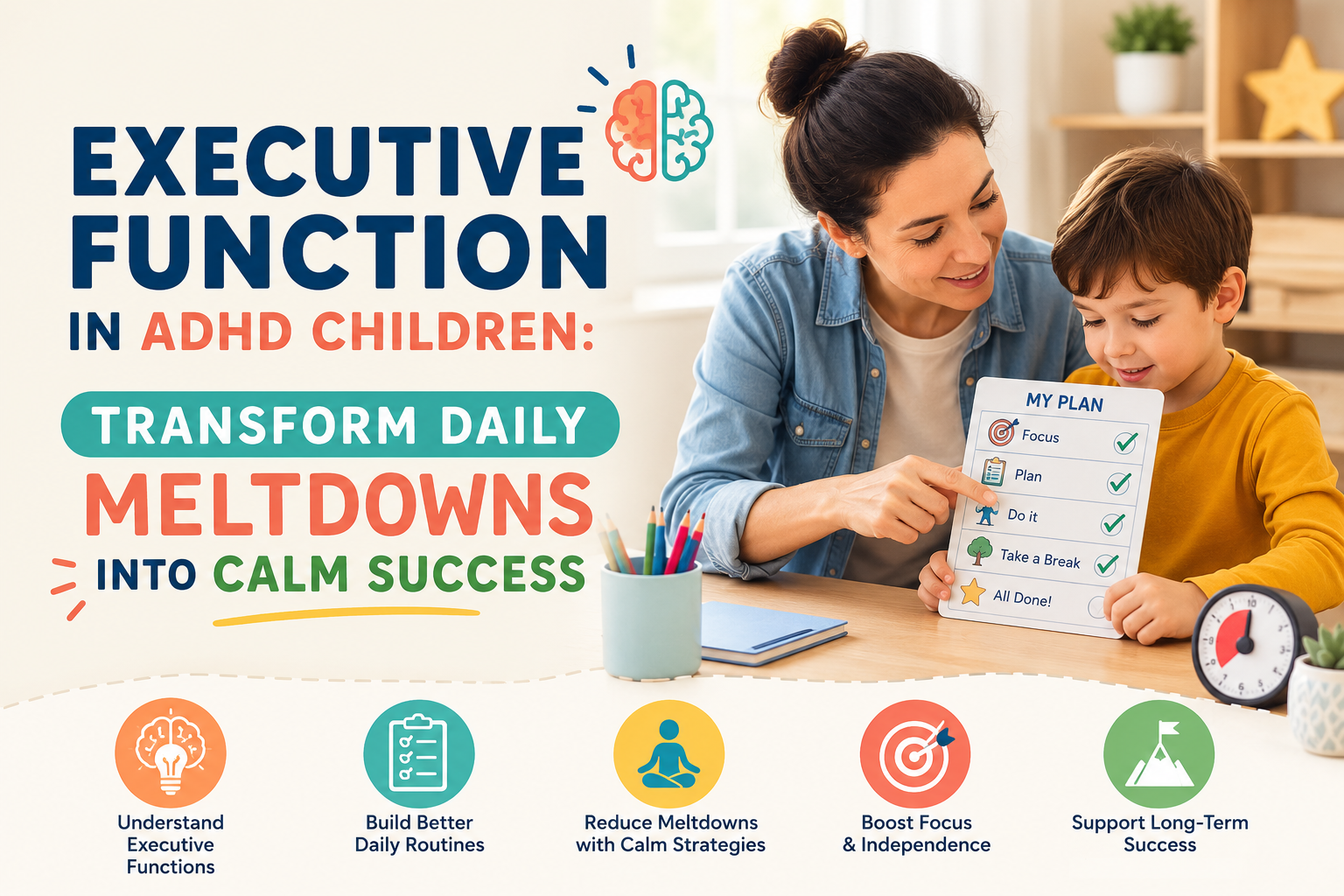
👉 Executive Function in ADHD Children: Transform Daily Meltdowns into Calm Success in 2026 (A Parent’s Practical Guide)
Executive Function in ADHD Children refers to the developmental delay in the brain’s management system—located in the prefrontal cortex—that controls working memory, impulse control, emotional regulation, and task organization. Rather than a lack of willpower, executive dysfunction causes a 30% delay in brain self-regulation. With structured scaffolding, external cues, and daily visual routines, parents can bridge this gap and help their children thrive.

- 👉 Executive Function in ADHD Children 2026 Practical Guide
- 🌟 Why Executive Function in ADHD Children Is the Missing Piece to the Puzzle
- 📊 Key Research Statistics on ADHD & Executive Dysfunction
- 🧠 The 7 Core Executive Function Skills (And How ADHD Affects Each)
- 📖 A Real Parent’s Story: From Morning Chaos to Structured Harmony
- 🛠️ Step-by-Step Practical Routine for Strengthening Executive Skills
- 🎯 What You Must Not Miss: The Role of Dopamine & Brain Energy
- ❓ Frequently Asked Questions
👉 Executive Function in ADHD Children 2026 Practical Guide
🌟 Why Executive Function in ADHD Children Is the Missing Piece to the Puzzle
When parents first search for answers about why their child forgets a backpack for the fifth time in a week, loses focus mid-sentence, or experiences explosive meltdowns over simple homework prompts, they often assume it is a discipline issue. However, pediatric neuroscience from leading organizations like the Harvard Center on the Developing Child shows that Executive Function in ADHD Children operates on a fundamentally different timeline.
Executive function acts as the “conductor” of the human brain orchestra. In neurotypical children, this internal conductor naturally learns to coordinate attention, filter out noise, hold instructions in working memory, and control emotional outbursts. In neurodivergent kids, the conductor’s baton is delayed by roughly 30% compared to age-matched peers.
When you understand that your child is not refusing your directions, but rather lacking the executive bandwidth to execute them, your parenting approach transforms from frustration to empathy.
📊 Key Research Statistics on ADHD & Executive Dysfunction
To truly understand how Executive Function in ADHD Children manifests, we must examine current national health data. According to clinical guidance from the National Institute of Mental Health (NIMH) and research verified by the Centers for Disease Control and Prevention (CDC), ADHD is one of the most common neurodevelopmental conditions worldwide.
| Metric / Clinical Area | Key Statistic | Clinical & Practical Impact | Official Source Link |
| U.S. Prevalence | 11.7% (approx. 7 million U.S. children aged 3–17) | Highlights the broad need for structured executive function strategies in homes and schools. | CDC ADHD Data |
| Co-occurring Conditions | 75–80% have at least one co-occurring challenge | Executive dysfunction often overlaps with anxiety, learning differences, or conduct challenges. | PMC Comorbidity Research |
| Response to Treatment | 70–80% response rate to multimodal care | Combining behavioral executive training with medical guidance yields optimal functional growth. | AAP Clinical Guidelines |
| Global Prevalence | 5.3% – 7% worldwide in school-age children | Confirms executive function delays are universal biological patterns, not localized parenting styles. | CHADD Data & Statistics |
Key takeaway: Executive dysfunction is not a character flaw or a failure of motivation. As highlighted by experts atUnderstood.org, it is a neurobiological difference that responds exceptionally well to targeted scaffolding, environmental modifications, and consistent emotional support.
🧠 The 7 Core Executive Function Skills (And How ADHD Affects Each)
Executive dysfunction impacts core cognitive domains. Recognizing which domain is tripping up your child allows you to implement specific external accommodations.
| Core Executive Skill | How ADHD Affects It (What You See) | Home & Classroom Accommodation |
| 1. Working Memory | Forgetting multi-step oral directions, misplacing items instantly, losing track of reading comprehension. | Replace multi-step verbal commands with a visual daily checklist placed directly at eye level. |
| 2. Impulse Control (Inhibition) | Blurting out answers, interrupting conversations, touching forbidden objects without pausing. | Teach the “Pause & Breathe” hand gesture; provide physical fidget tools for high-focus times. |
| 3. Emotional Control | Explosive meltdowns over minor setbacks, rapid escalation from calm to furious, extreme rejection sensitivity. | Validate emotions before correcting actions (“I see you are angry, let’s cool down together”). |
| 4. Cognitive Flexibility | Extreme resistance to sudden plan changes, difficulty transitioning from games to homework. | Use visual timers (e.g., TimeTimer) to give visual countdown warnings before transitions. |
| 5. Planning & Prioritization | Time blindness, waiting until 9:00 PM to start a major project, getting overwhelmed by large tasks. | Break large tasks into mini-milestones and schedule them on a shared family calendar. |
| 6. Organization | Messy backpacks, lost school papers, messy rooms 10 minutes after cleaning. | Use clear, labeled storage bins and color-coded binders for each academic subject. |
| 7. Self-Monitoring (Metacognition) | Rushing through schoolwork, missing whole pages of questions, failing to catch obvious errors. | Provide a 3-step self-check rubric card (e.g., “1. Name? 2. All questions done? 3. Handed in?”). |
For more depth on these behavioral domains, explore the comprehensive guides available through the Child Mind Institute.
📖 A Real Parent’s Story: From Morning Chaos to Structured Harmony
“For years, our mornings were a battlefield. Our 8-year-old son, Liam, had his diagnosis, but we were treated to daily meltdowns. ‘Put on your shoes’ turned into a 45-minute standoff involving lost socks, tearful arguments, and missed school buses. We thought he was simply being defiant.
Everything changed when our developmental pediatrician explained how Executive Function in ADHD Children works. Liam wasn’t ignoring us; his working memory was simply dumping the command the second he walked toward his closet. We replaced shouted orders with a visual morning flip-chart attached right next to his bed. We gamified the routine with a sand timer. Within three weeks, morning meltdowns dropped by 80%. He felt empowered because the system removed the constant nagging.”
— Sarah M., Parent & Parent-Advocate
🛠️ Step-by-Step Practical Routine for Strengthening Executive Skills

To build sustainable executive habits in your child, implement scaffolding in predictable, structured steps:
| Step Number | Phase & Subtitle | Actionable Strategy for Parents |
| Step 1 | Setup (Days 1–3): Establish Visual Anchors | Place visual schedules, chore charts, and color-coded routines directly in your child’s line of sight instead of relying on spoken reminders. |
| Step 2 | Daily Practice: Chunk Tasks into Micro-Steps | Divide multi-step requests into single, manageable actions (e.g., “Put 5 legos in the box” rather than “Clean your entire room”). |
| Step 3 | Transition Mastery: Externalize Time Anchors | Use color-based visual timers so your child can physically watch time pass rather than reading abstract digital numbers. |
| Step 4 | Metacognition: Model & Practice Self-Talk | Speak your internal planning out loud (e.g., “I feel overwhelmed by these dishes, so I’ll wash 3 plates first, then take a short break”). |
🎯 What You Must Not Miss: The Role of Dopamine & Brain Energy
Most online guides focus exclusively on calendars, charts, and behavioral charts. However, they neglect the core biological driver behind Executive Function in ADHD Children: Dopamine Regulation.
ADHD brains have lower baseline dopamine availability and quicker dopamine reuptake. Dopamine is the neurotransmitter responsible for motivation, focus, and sustained mental effort. When an ADHD child refuses to do a math worksheet, it is not an issue of bad attitude; it is a physiological shortage of the brain chemistry required to initiate mundane tasks.
| Neurotypical Brain | ADHD Brain | Actionable Parenting Strategy |
| Steady baseline dopamine levels during routine tasks. | Lower baseline dopamine; rapid drop during mundane tasks. | Add Novelty: Swap pencils for fun gel pens or write on dry-erase boards. |
| Maintains attention through internal motivation. | Requires high sensory or emotional interest to maintain focus. | Incorporate Movement: Allow seating on wobble cushions or standing at desks. |
| Smoothly initiates low-dopamine activities. | Experiences “task paralysis” when facing low-dopamine activities. | Gamify Routine Tasks: Set a timer and see if they can “beat the clock” to clean up. |
❓ Frequently Asked Questions
Is executive dysfunction the same thing as ADHD?
No, executive dysfunction is a symptom profile, while ADHD is a formal medical diagnosis. Executive dysfunction can also occur in autism, depression, traumatic brain injuries, or anxiety. However, nearly all children diagnosed with ADHD experience significant executive delays.
At what age does executive function fully develop in ADHD children?
In neurotypical individuals, executive functioning fully matures around age 25. For individuals with ADHD, full brain development in the prefrontal cortex typically extends into the late 20s or early 30s.
How can teachers help strengthen Executive Function in ADHD Children at school?
Teachers can provide written directions alongside verbal instructions, allow movement breaks, offer extended time on tests, seat students away from auditory distractors, and break long-term projects into weekly chunked milestones.
To visually understand how executive function skills develop throughout childhood and adolescence, watch Building Core Capabilities for Life by the Harvard Center on the Developing Child. This resource explains the brain architecture behind self-regulation and provides actionable insight into how caregivers can foster resilience and focus in young minds.


