

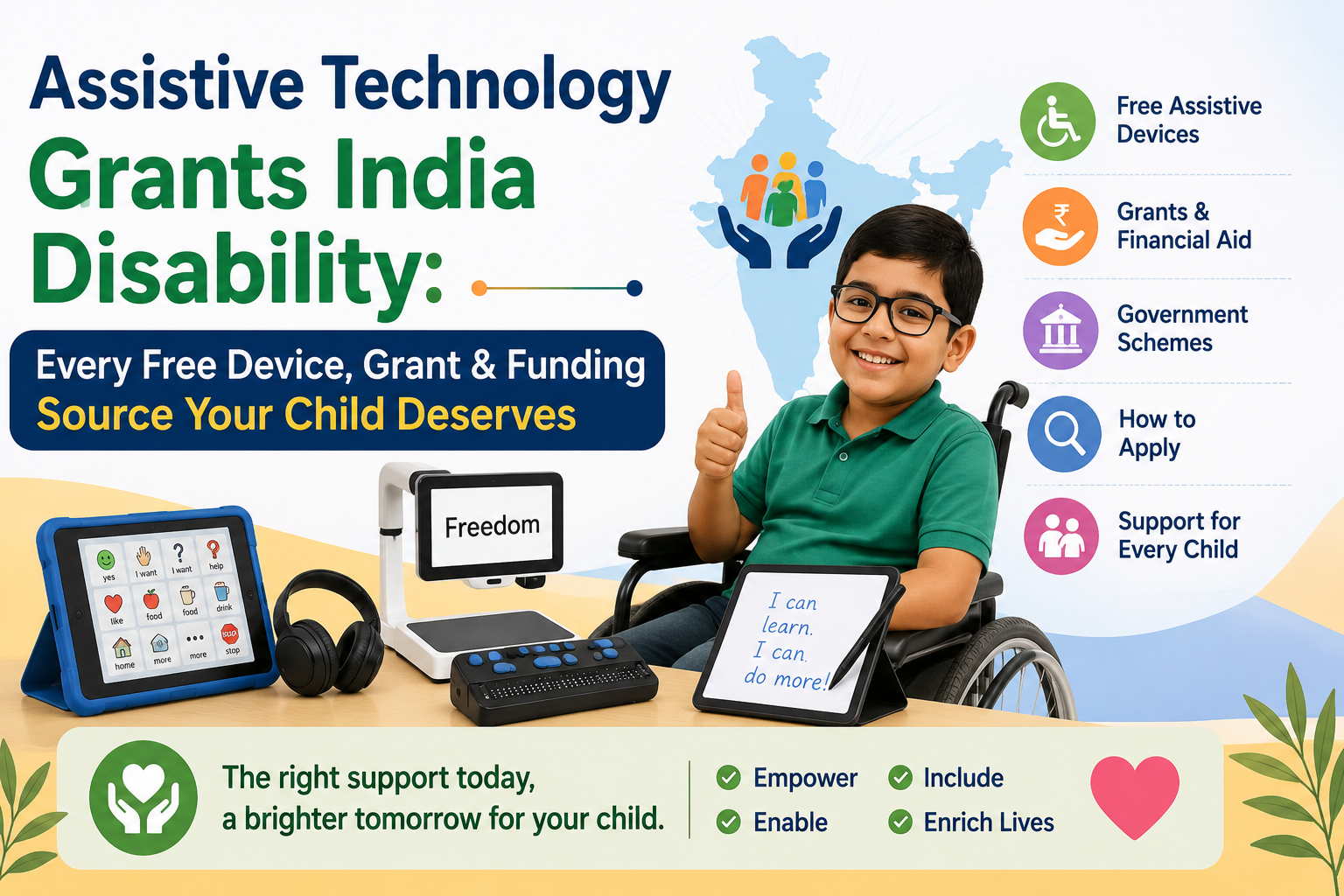
Assistive Technology Grants India Disability: Every Free Device, Grant & Funding Source Your Child Deserves in 2026 🎗️
⚡ What You Need to Know First
Assistive technology grants India disability programs provide free or heavily subsidized wheelchairs, hearing aids, communication devices, braille kits, prosthetics, and more to children and adults with disabilities. The primary scheme is the ADIP Scheme run by the Ministry of Social Justice. Multiple additional grants exist through state governments, NGOs, and corporate CSR funds. A valid Disability Certificate unlocks most of these. 💙
Think of assistive technology as a bridge. It is the bridge between what your child’s body can do right now — and what they could do with the right tool.
A hearing aid is a bridge to sound. A communication device is a bridge to voice. A wheelchair is a bridge to movement. A braille kit is a bridge to reading.
And in India in 2026, these bridges do not have to cost your family a single rupee — if you know where to look.
The sad truth is that most families do not know. They spend months — sometimes years — saving up for equipment their child needed immediately. Equipment that was available for free all along.
This guide changes that. Completely.

- ⚡ What You Need to Know First
- 🔧 What Is Assistive Technology? — Simply Explained
- 💙 Why Assistive Technology Changes Everything for Children With Disabilities
- 1. 🧠 The Brain Window — Why Early AT Matters
- 2. 📚 AT Opens the Door to Education
- 3. 💼 AT Leads to Independence and Employment
- 4. 💰 The Cost Without Grants — The Reality
- 🏛️ The ADIP Scheme — India’s Primary Assistive Technology Grant
- What Is the ADIP Scheme?
- Who Runs the ADIP Scheme?
- ADIP Scheme — Eligibility Criteria
- Income Consideration — Important Detail
- How Devices Are Distributed Under ADIP
- 🎯 What Devices Are Covered — Complete ADIP Grant List
- ✅ Who Qualifies for Assistive Technology Grants in India
- 🪜 Step-by-Step: How to Apply for ADIP and Assistive Technology Grants
- Step 1 — Get Your Disability Certificate
- Step 2 — Apply for UDID Card
- Step 3 — Identify the Right Device
- Step 4 — Find the Applying Authority
- Step 5 — Submit Required Documents
- Step 6 — Assessment and Fitting
- Step 7 — Receive Device and Training
- Step 8 — Register for Repair and Maintenance
- 🗺️ State Government Assistive Technology Schemes
- Key State-Level AT Schemes
- Rashtriya Bal Swasthya Karyakram (RBSK) — For Children Specifically
- Samagra Shiksha Abhiyan — AT for Education
- 🏢 NGO and Corporate CSR Grants for Assistive Technology
- 📱 AAC Devices — Grants for Communication Technology
- 📊 Key Statistics — Assistive Technology and Disability in India
- 📋 Comparison Table — All Major AT Grant Schemes in India
- 💛 A Parent’s Real Story: “A ₹2,20,000 Wheelchair. Provided Free. We Just Had to Know Where to Ask.”
- 🔍 What You Must Not Miss About AT Grants in India
- 1. 🔧 Repair and Maintenance — The Hidden Gap in AT Grant Programs
- 2. 📱 Low-Cost AT Solutions — The Gap Between “Nothing” and “Full Device”
- 3. 🌍 International AT Grant Programs Open to Indian Families
- 4. 🏦 NHFDC Loans — The Bridge When Grants Are Not Enough
- 5. 🎓 AT Grants for Higher Education — Completely Overlooked
- 6. 👩⚕️ The Therapist Recommendation Letter — Its Power Is Underestimated
- ❓ FAQs — Long-Tail Questions Answered
- What is the ADIP scheme for assistive technology in India?
- How do I get a free wheelchair in India for my disabled child?
- Are hearing aids free for disabled children in India?
- Can I get a free communication device for my autistic child in India?
- What is the income limit for ADIP scheme assistive technology grants?
- How often can I claim the ADIP scheme for a new device?
- What documents are needed for assistive technology grants in India?
- Are AAC devices covered by Indian government grants?
- Can NRI families access assistive technology grants for disabled relatives in India?
- How do I find ADIP distribution camps near me in India?
- 🔗 Trusted Resources — Assistive Technology Grants India
- 🏛️ Government Schemes and Portals
- 💛 NGOs and Funding Platforms
- 🗣️ AAC and Communication
- 🏥 Disability Organizations
- ✨ Final Thoughts: The Bridge Your Child Needs Exists — Find It
Assistive Technology Grants India Disability: Every Free Device, Grant & Funding Source Your Child Deserves in 2026 🎗️
🔧 What Is Assistive Technology? — Simply Explained
Assistive technology grants India disability programs exist because assistive technology (AT) is one of the most powerful tools available to children and adults with disabilities. But before we look at the grants — let us understand what assistive technology actually is.
Assistive technology is any device, tool, software, or system that helps a person with a disability do things more easily — or do things they could not do without it.
A Simple Way to Understand It
Imagine your child cannot walk. A wheelchair is assistive technology. It does not cure the condition. But it gives your child the ability to move, explore, go to school, and participate in life.
Imagine your child cannot speak. A speech-generating device is assistive technology. It gives your child a voice — to ask for water, to say “I love you,” to tell you when something hurts.
Imagine your child cannot see. A braille kit is assistive technology. It gives your child the ability to read and write — the same fundamental right as every sighted child.
Assistive technology does not replace therapy. It does not cure disability. What it does is remove barriers — between a child and their education, their communication, their independence, and their dignity.
Categories of Assistive Technology
| Category | Examples | Disabilities Served |
|---|---|---|
| Mobility AT | Wheelchairs, walking frames, crutches, prosthetics, orthoses | Locomotor, CP, MD |
| Communication AT | Speech-generating devices, PECS boards, AAC apps, communication boards | Autism, CP, intellectual disability, speech disability |
| Sensory AT | Hearing aids, cochlear implants, braille kits, magnifiers, screen readers | Visual impairment, hearing impairment |
| Cognitive AT | Picture schedules, reminder apps, simplified learning software | Intellectual disability, autism, learning disability |
| Daily Living AT | Adapted cutlery, dressing aids, bath chairs, adapted keyboards | Physical disability, CP, MD |
| Education AT | Braille typewriters, talking calculators, adapted computers | Visual impairment, physical disability |
Source: World Health Organization — Assistive Technology
💡 Voice Search Answer — What is assistive technology for disabled children in India?
Assistive technology for disabled children in India includes any device or tool that helps a child with a disability function more independently. This includes wheelchairs, hearing aids, communication devices, braille kits, prosthetics, orthoses, and educational aids. The Indian government provides many of these devices free of charge through the ADIP Scheme and state-level programs.
💙 Why Assistive Technology Changes Everything for Children With Disabilities
Before exploring assistive technology grants India disability programs — parents need to understand why AT matters so profoundly. Because some families delay pursuing AT thinking it is “not that important” or “we will manage without.” This delay costs children irreplaceable developmental time.
1. 🧠 The Brain Window — Why Early AT Matters
For children with communication disabilities — including autism, cerebral palsy, and speech disorders — getting a communication device early is not just helpful. It is neurologically critical.
The brain’s language development window is most active in the first five years of life. A child who cannot communicate in those years loses not just words — but neural pathways for language that are harder to build later.
Early AAC access supports language development — it does not replace speech. Multiple studies show that children who receive AAC early develop better communication outcomes than those who wait.
Source: ISAAC — International Society for Augmentative and Alternative Communication
2. 📚 AT Opens the Door to Education
A child who cannot hold a pen cannot access standard education. A child who cannot hear cannot access a standard classroom. A child in a manual wheelchair cannot access a school with stairs.
Assistive technology removes each of these barriers. And education — once accessed — changes the entire trajectory of a life.
3. 💼 AT Leads to Independence and Employment
The long-term data is clear: adults with disabilities who received appropriate assistive technology as children have significantly better employment outcomes, higher rates of independent living, and greater quality of life than those who did not.
Source: WHO Global Report on Assistive Technology 2022
4. 💰 The Cost Without Grants — The Reality
Without assistive technology grants India disability programs, the cost of AT in India is significant:
| Device | Market Cost (India 2026) |
|---|---|
| Manual Wheelchair | ₹8,000 – ₹50,000 |
| Motorized Wheelchair | ₹80,000 – ₹3,00,000 |
| Digital Hearing Aid | ₹25,000 – ₹2,00,000 per ear |
| AAC Speech-Generating Device | ₹50,000 – ₹3,00,000 |
| Prosthetic Limb (basic) | ₹30,000 – ₹5,00,000 |
| Braille Kit | ₹5,000 – ₹20,000 |
| Ankle-Foot Orthosis | ₹5,000 – ₹40,000 |
These costs are impossible for most Indian families without grants. Yet most of these devices are available free — or at drastically reduced cost — through the schemes in this guide.
🏛️ The ADIP Scheme — India’s Primary Assistive Technology Grant
The ADIP Scheme — Assistance to Disabled Persons for Purchase/Fitting of Aids and Appliances — is the Government of India’s flagship assistive technology grant India disability program.
It is run by the Ministry of Social Justice and Empowerment through ALIMCO (Artificial Limbs Manufacturing Corporation of India) — the government’s own AT manufacturing organization.
What Is the ADIP Scheme?
Simply put: the government buys assistive devices and gives them free to eligible persons with disabilities. Or it pays for the device — up to a specific limit — on their behalf.
It is the single most important scheme for assistive technology grants India disability — and it is drastically underused because families do not know about it.
Who Runs the ADIP Scheme?
| Organization | Role |
|---|---|
| Ministry of Social Justice & Empowerment | Policy and budget allocation |
| ALIMCO | Manufacturing and supply of AT devices |
| State governments / NGOs | Organizing distribution camps and individual applications |
| District Social Welfare Officers | Local implementation and verification |
Reference: ALIMCO — Artificial Limbs Manufacturing Corporation of India
ADIP Scheme — Eligibility Criteria
| Criterion | Requirement |
|---|---|
| Disability certification | Valid Disability Certificate (40%+ disability) |
| Age | No restriction — applies to children and adults |
| Income | Annual family income below ₹20,000 per month (₹2.4 lakh per year) |
| Indian citizenship | Required |
| Residency | Must be Indian resident |
| Previous ADIP benefit | Gap of 3–5 years required before claiming same device again |
Income Consideration — Important Detail
The income limit of ₹20,000 per month covers the vast majority of Indian families caring for a child with a disability. Even middle-income families often qualify. Always apply — do not assume you earn too much without checking.
How Devices Are Distributed Under ADIP
Method 1 — ADIP Camps (Most Common)
ALIMCO and implementing agencies organize ADIP distribution camps at district and state levels. These camps bring devices directly to beneficiaries. A medical team assesses needs on-site. Devices are fitted and provided at the camp.
To find upcoming ADIP camps:
- Check ALIMCO website for upcoming camp schedules
- Contact state Disabled Welfare Departments
Method 2 — Individual Application
Apply directly through your District Social Welfare Officer with all required documents. Device is procured and provided after verification.
Method 3 — Through Implementing Agencies
ALIMCO empanels NGOs and government bodies as implementing agencies. These agencies organize applications, assessments, and distribution on behalf of ADIP.
🎯 What Devices Are Covered — Complete ADIP Grant List
This is the section most families have been waiting for. Here is every device available under assistive technology grants India disability programs.
Mobility Devices
| Device | Who It Helps | Grant Coverage |
|---|---|---|
| Manual Wheelchair (adult) | Locomotor disability, CP, MD | Full cost (up to ₹6,000–₹10,000) |
| Manual Wheelchair (children) | Children with mobility disability | Full cost (up to ₹4,500–₹8,000) |
| Motorized/Powered Wheelchair | Severe locomotor, quadriplegia | Partial subsidy (up to ₹45,000) |
| Tricycle (hand-operated) | Locomotor disability | Full cost (up to ₹3,500–₹6,000) |
| Crutches (axillary and elbow) | Locomotor disability | Full cost |
| Walking frame / Rollator | Locomotor disability, elderly | Full cost |
| Prosthetic limb (lower) | Limb difference, amputation | Full cost (JAIPUR FOOT — up to ₹35,000+) |
| Prosthetic limb (upper) | Upper limb difference | Full cost |
| Ankle-Foot Orthosis (AFO) | CP, foot drop | Full cost |
| Knee-Ankle-Foot Orthosis | Locomotor, CP | Full cost |
| Spinal support / CTLSO | Scoliosis, spinal conditions | Full cost |
Hearing Devices
| Device | Who It Helps | Grant Coverage |
|---|---|---|
| Digital Hearing Aid (BTE) | Hearing impairment | Full cost (up to ₹10,000 per ear) |
| Digital Hearing Aid (ITE) | Hearing impairment | Full cost (up to ₹12,000 per ear) |
| Behind-the-ear CROS aid | Single-sided deafness | Full cost |
⚠️ Important Note on Cochlear Implants: Cochlear implants are NOT covered under ADIP. However, several state government schemes and Rashtriya Bal Swasthya Karyakram (RBSK) do cover cochlear implants for children. See the state schemes section below.
Visual Impairment Devices
| Device | Who It Helps | Grant Coverage |
|---|---|---|
| Braille Kit (complete) | Blind and visually impaired | Full cost |
| Braille Typewriter | Blind | Full cost |
| Magnifier (optical) | Low vision | Full cost |
| Optical aids (spectacles) | Low vision (visual disability) | Full cost (up to ₹900) |
| White Cane | Blind | Full cost |
| Talking Watch | Blind | Full cost |
Daily Living and Educational Aids
| Device | Who It Helps | Grant Coverage |
|---|---|---|
| Cerebral Palsy Chair (adapted seating) | Children with CP | Full cost (up to ₹4,500) |
| Standing Frame | CP, locomotor | Partial subsidy |
| Communication Board (basic) | Non-verbal children | Full cost (basic versions) |
| Adapted Cutlery Set | Physical disability, CP | Full cost |
| Writing Aid | Physical disability | Full cost |
| Braille Slate and Stylus | Visual impairment | Full cost |
Reference: ALIMCO Device Catalogue · Ministry of Social Justice — ADIP Scheme
✅ Who Qualifies for Assistive Technology Grants in India
The assistive technology grants India disability ecosystem serves all 21 disabilities recognized under the RPWD Act 2016. Here is a clear eligibility summary across the major schemes.
Qualifying Disabilities (All 21 RPWD Act Categories)
All 21 disabilities under the Rights of Persons with Disabilities Act 2016 qualify — including autism, cerebral palsy, intellectual disability, visual impairment, hearing impairment, locomotor disability, muscular dystrophy, Down syndrome, specific learning disabilities, thalassemia, haemophilia, speech disability, and multiple disabilities.
Source: RPWD Act 2016 — Disability Affairs Division
The UDID Card — Your AT Grant Access Key
The UDID Card (Unique Disability ID) is increasingly the single most important document for accessing all assistive technology grants India disability programs. It serves as:
- ✅ Proof of disability for ADIP applications
- ✅ Identity document for AT camp registration
- ✅ Access key for state and NGO schemes
- ✅ Basis for tracking previous AT grants received
Apply for UDID at: www.swavlambancard.gov.in
🪜 Step-by-Step: How to Apply for ADIP and Assistive Technology Grants

Here is the complete process for accessing assistive technology grants India disability programs.
Step 1 — Get Your Disability Certificate
Visit the nearest government district hospital Medical Board. A team of doctors assesses your child and issues a Disability Certificate stating disability type and percentage. Private hospital certificates are not valid.
Step 2 — Apply for UDID Card
Apply simultaneously at swavlambancard.gov.in. The UDID Card is issued within weeks of Disability Certificate verification and is increasingly required for all AT scheme access.
Step 3 — Identify the Right Device
Work with your child’s therapist — physiotherapist, occupational therapist, speech therapist, or audiologist — to identify the specific AT your child needs. A therapist’s recommendation letter significantly strengthens your application.
Step 4 — Find the Applying Authority
Option A — ADIP Camp: Contact your District Social Welfare Officer or check alimco.in for upcoming ADIP camps in your district. Camps bring devices directly to beneficiaries.
Option B — Direct Application: Visit your District Social Welfare Office with all documents. Submit the ADIP application form with supporting documents.
Option C — Through NGO Implementing Agency: Many NGOs are ALIMCO empaneled implementing agencies. Contact organizations like the Blind People’s Association, ADAPT, Vidya Sagar, Action for Autism, or your state’s disability federation for assistance.
Step 5 — Submit Required Documents
Complete checklist:
- ✅ Disability Certificate (original + photocopy)
- ✅ UDID Card (if issued)
- ✅ Aadhaar card (child’s and parent’s)
- ✅ Income proof (income certificate from Tehsildar / BPL card / salary slip)
- ✅ Passport-size photographs (4 copies)
- ✅ Address proof
- ✅ Therapist’s recommendation letter specifying device needed
- ✅ Bank account details (for direct benefit schemes)
- ✅ Birth certificate (for children)
- ✅ Previous ADIP benefit certificate (if applicable — to confirm gap period)
Step 6 — Assessment and Fitting
Before devices are provided, a medical/technical assessment is done to ensure the right device is provided and correctly fitted. This is particularly important for:
- Wheelchairs — seat width, back height, footrest adjustment
- Hearing aids — audiometric testing and fitting
- Prosthetics — measurement, fitting, and trial
- Orthoses (AFOs) — casting and fitting
Step 7 — Receive Device and Training
After fitting, you receive:
- The device itself
- Basic training on use and maintenance
- Follow-up contact details for repairs
Step 8 — Register for Repair and Maintenance
AT devices require maintenance. Register at your nearest ALIMCO Regional Centre for repair services. Many repairs are free or subsidized under the ADIP scheme.
ALIMCO Regional Centres: www.alimco.in/regional-centers
🗺️ State Government Assistive Technology Schemes
Beyond ADIP, nearly every Indian state runs its own assistive technology grants India disability programs — often with devices not covered by ADIP or with faster distribution timelines.
Key State-Level AT Schemes
| State | Scheme Name | Notable Devices Covered | Contact |
|---|---|---|---|
| Tamil Nadu | Chief Minister’s Differently Abled Welfare Scheme | Cochlear implants for children, motorized wheelchairs | Tamil Nadu Social Welfare Dept |
| Maharashtra | Sanjay Gandhi Niradhar Anudan + AT component | Powered wheelchairs, hearing aids | Maharashtra Social Justice |
| Karnataka | Karnataka Disability Welfare Schemes | AT devices, adapted equipment | Karnataka Social Welfare Dept |
| Delhi | Delhi Disability Assistance Scheme | Hearing aids, wheelchairs, communication aids | Delhi Social Welfare |
| Andhra Pradesh | YSRCP Navasakam (AT component) | Wide range of AT devices | AP Social Welfare |
| Kerala | Kerala Social Security Mission | AT devices for all 21 disabilities | Kerala Social Security Mission |
| Rajasthan | Rajasthan Disability Welfare Scheme | Basic AT devices | Rajasthan Social Welfare Dept |
| West Bengal | WB Disability Welfare Program | AT devices for children and adults | WB Social Welfare Dept |
Rashtriya Bal Swasthya Karyakram (RBSK) — For Children Specifically
RBSK is a national child health screening and early intervention program that covers cochlear implants for children with severe hearing impairment — one of the most expensive AT devices, which ADIP does not cover.
Under RBSK:
- Children aged 0–18 are screened for disabilities at schools and Anganwadis
- Cochlear implants are provided free for eligible children with severe-to-profound hearing loss
- Surgery, device, and rehabilitation are covered
How to access RBSK:
- Contact your District Health Officer
- Ask your pediatrician for an RBSK referral
- Contact your nearest government medical college ENT department
Reference: RBSK — Ministry of Health and Family Welfare
Samagra Shiksha Abhiyan — AT for Education
Under India’s flagship education scheme, students with disabilities enrolled in government schools are entitled to:
- ✅ Free assistive devices (hearing aids, braille kits, adapted equipment) for educational use
- ✅ Resource teacher support
- ✅ Adapted furniture and classroom modifications
- ✅ Accessible school infrastructure
Apply through your child’s school or the Block Resource Centre under Samagra Shiksha.
Reference: Samagra Shiksha — Ministry of Education
🏢 NGO and Corporate CSR Grants for Assistive Technology
Beyond government schemes, assistive technology grants India disability are available through a rich ecosystem of NGOs and corporate CSR programs.
Major NGO Grant Sources
1. Asha for Education Funds educational AT including braille materials, adapted computers, and learning aids for children with disabilities in underserved communities. Contact: www.ashanet.org
2. Give India Foundation Crowdfunding platform connecting families of disabled children with donors specifically for AT equipment including wheelchairs, hearing aids, and AAC devices. Contact: www.giveindia.org
3. Milaap India’s largest crowdfunding platform for medical and disability needs. Hundreds of families have funded AT through Milaap campaigns. Contact: www.milaap.org
4. HelpAge India For elderly persons with disabilities — AT grants including hearing aids, wheelchairs, and vision aids. Contact: www.helpageindia.org
5. CRY (Child Rights and You) Funds programs that support children with disabilities including AT access in underserved communities. Contact: www.cry.org
6. Narayan Seva Sansthan Based in Udaipur, provides free prosthetics, orthoses, and mobility aids at large camps. One of India’s largest AT distributors through donation funding. Contact: www.narayanseva.org
Corporate CSR AT Grant Programs
Many large Indian corporations direct their CSR (Corporate Social Responsibility) funds toward disability AT. These programs are underutilized because families do not know to apply to them.
How to access corporate CSR AT grants:
- Identify corporations with disability-focused CSR programs — Tata, Infosys, Wipro, HDFC, Reliance, and many others have active disability CSR programs
- Contact the company’s CSR department directly with your child’s Disability Certificate and AT requirement
- Apply through NGOs that are empaneled as CSR implementing partners
CSR Portal: The government maintains a CSR tracker at www.csr.gov.in where you can find companies with disability-related CSR programs.
📱 AAC Devices — Grants for Communication Technology
Augmentative and Alternative Communication (AAC) devices represent one of the most life-changing categories of assistive technology grants India disability — and also one of the most difficult to access because they are expensive and not fully covered by ADIP.
What Is AAC?
AAC includes all forms of communication that supplement or replace speech for people who cannot communicate verbally or have limited verbal communication. This includes:
- 🖼️ Picture Exchange Communication System (PECS) — paper-based, low-cost
- 📱 AAC Apps on tablets — Proloquo2Go, TouchChat, LetMeTalk (free), Cboard (free)
- 🔊 Speech-Generating Devices (SGDs) — dedicated devices that produce spoken output
- 👁️ Eye-gaze communication systems — for children who cannot use hands
- ✋ Sign language — Indian Sign Language
AAC Grant Sources in India
| Source | What Is Covered | How to Apply |
|---|---|---|
| ADIP Scheme | Basic communication boards (limited) | Through ALIMCO / District Social Welfare |
| National Trust — Samarth Scheme | AT including some AAC devices | thenationaltrust.gov.in |
| Milaap Crowdfunding | SGDs, tablets with AAC apps | milaap.org |
| Give India | Communication devices | giveindia.org |
| Corporate CSR | SGDs and AAC kits | Direct application to corporations |
| ADAPT Mumbai | AAC assessment and device support | adaptindia.org |
| Action for Autism India | AAC support programs | autism-india.org |
| Vidya Sagar Chennai | AAC assessment and devices | vidyasagar.net |
Free AAC Apps — No Grant Needed
Before pursuing expensive SGDs, explore free AAC apps that can turn a basic Android tablet (often available for ₹8,000–₹12,000) into a functional communication device:
- ✅ Cboard — Free, web-based, works in multiple Indian languages. www.cboard.io
- ✅ LetMeTalk — Free Android app. Strong symbol library.
- ✅ Snap Core First — Trial available; full version requires purchase
- ✅ Kaushal AAC — Developed specifically for Indian languages and context
Resource: ISAAC India — AAC India Network
📊 Key Statistics — Assistive Technology and Disability in India
| Statistic | Figure | Source |
|---|---|---|
| Persons with disability in India (Census 2011) | 2.68 crore (26.8 million) | Census of India |
| WHO estimated AT need globally | 2.5 billion people by 2030 | WHO Global AT Report 2022 |
| Percentage of people with disability accessing AT in LMICs | Less than 3% | WHO — Assistive Technology |
| ADIP Scheme annual beneficiaries | ~5 lakh (500,000) per year | Ministry of Social Justice Annual Report |
| ADIP Scheme annual budget | ₹400+ crore | Ministry of Social Justice |
| ALIMCO devices manufactured annually | 8+ lakh units | ALIMCO Annual Report |
| Children with disabilities out of school in India | ~28 lakh | UDISE+ 2022–23 |
| Cochlear implants provided under RBSK (cumulative) | 1,000+ children | RBSK Reports — Ministry of Health |
| UDID cards issued nationally | ~1 crore (10 million) | UDID Portal |
| Families unaware of AT grant schemes | Estimated 60–70% | NCPEDP Survey 2022 |
📋 Comparison Table — All Major AT Grant Schemes in India
| Scheme | Run By | What It Covers | Income Limit | Age Limit | Apply At |
|---|---|---|---|---|---|
| ADIP Scheme | Ministry of Social Justice / ALIMCO | Wheelchairs, hearing aids, braille, prosthetics, orthoses | ₹20,000/month | None | alimco.in / District Social Welfare Office |
| RBSK | Ministry of Health | Cochlear implants for children | Below poverty line | 0–18 years | Government hospital ENT dept |
| Samagra Shiksha | Ministry of Education | Educational AT for school children | All income levels | School age | School / Block Resource Centre |
| National Trust — Niramaya | National Trust | Health insurance including AT | ₹250–₹500 premium | No limit | thenationaltrust.gov.in |
| National Trust — Samarth | National Trust | Day care; some AT support | All income levels | No limit | thenationaltrust.gov.in |
| State disability schemes | State governments | Varies — hearing aids, wheelchairs, more | State-specific | State-specific | State Social Welfare Dept |
| NHFDC Loans | NHFDC | Low-interest loans for AT | Income-based | No limit | nhfdc.nic.in |
| CSR Corporate Grants | Corporations | Any AT device | Case by case | No limit | Company CSR dept / NGO partners |
| Crowdfunding (Milaap/Give India) | NGO platforms | Any AT device | No restriction | No limit | milaap.org / giveindia.org |
💛 A Parent’s Real Story: “A ₹2,20,000 Wheelchair. Provided Free. We Just Had to Know Where to Ask.”
“My son Vikram has Duchenne Muscular Dystrophy. He is twelve years old. By age nine, he could no longer walk safely without falling.
We knew he needed a powered wheelchair. His physiotherapist at our government hospital had said so clearly — a manual wheelchair would not be safe as his arms weakened. He needed a motorized chair.
We looked at prices. The chair his physiotherapist recommended cost ₹2,20,000. Our family income is ₹18,000 per month. We had ₹40,000 in savings — everything we had built over years.
₹45,000 was not ₹2,20,000. But it was a start.
Then another parent in our MD parent group told me about a corporate CSR program — a large IT company in our city had a disability equipment fund. I applied with Vikram’s Disability Certificate and the physiotherapist’s recommendation.
They approved ₹1,75,000.
Combined with the ADIP subsidy — Vikram’s ₹2,20,000 wheelchair cost our family ₹0.
Zero rupees.
Vikram has been using his powered wheelchair for two years. He goes to school independently. He moves through our home independently. He controls something in a world where his body controls less and less each year.
I cannot tell you what that means for his spirit. But I can tell you it is everything.
We nearly gave up before we found the answer. Please — do not give up. The funding exists. You just have to look in more than one place.”
— Sunita K., mother of Vikram (Duchenne MD), Pune, Maharashtra 💙
🔍 What You Must Not Miss About AT Grants in India
1. 🔧 Repair and Maintenance — The Hidden Gap in AT Grant Programs
Most guides about assistive technology grants India disability focus entirely on obtaining the device. Almost none address what happens when it breaks. A wheelchair with a broken wheel is useless. A hearing aid with a dead battery solves nothing. AT maintenance is a genuine, ongoing need that most grant programs address inadequately.
ALIMCO has regional repair centers — but many are poorly publicized and understaffed. Families should: register at their nearest ALIMCO Regional Centre immediately after receiving a device, ask specifically about warranty terms, and identify a local AT repair technician before the device is ever needed urgently.
2. 📱 Low-Cost AT Solutions — The Gap Between “Nothing” and “Full Device”
Many families assume that without a complete grant, they cannot access AT at all. This is wrong. A basic tablet (₹8,000–₹12,000) with a free AAC app becomes a communication device. A pool noodle costs ₹150 and makes a positioning aid.
A spoon with a thick handle costs ₹200 and enables self-feeding for a child with CP. Occupational therapists call these “low-tech AT solutions” — and they are profoundly underused because parents are always waiting for the “proper” expensive device. Ask your OT about low-tech options you can implement today, while waiting for formal grants.
3. 🌍 International AT Grant Programs Open to Indian Families
Several international organizations provide AT grants or heavily subsidized devices to families in India:
- Motivation (UK-based wheelchair charity) — provides wheelchairs in low-income countries including India through local NGO partners
- CBM Global — German-based organization funding disability rehabilitation including AT in India
- Light for the World — AT programs for visually impaired children in India
These international sources are almost entirely unknown to Indian families searching for AT funding.
4. 🏦 NHFDC Loans — The Bridge When Grants Are Not Enough
The National Handicapped Finance and Development Corporation (NHFDC) provides soft loans at subsidized interest rates (2–5%) for persons with disabilities to purchase AT, start businesses, or fund education. When grants do not fully cover an expensive device — an NHFDC loan can bridge the gap with far better terms than any commercial loan. Most families do not know NHFDC exists. Apply at www.nhfdc.nic.in.
5. 🎓 AT Grants for Higher Education — Completely Overlooked
Special AT grants exist specifically for students with disabilities in higher education — universities and colleges. The University Grants Commission (UGC) guidelines require universities to provide AT support for students with disabilities.
Additionally, scholarship programs for disabled students often include an AT component. If your older child with a disability is entering college — pursue AT support from the institution’s Equal Opportunity Cell (EOC), which all universities are required to maintain under RPWD Act 2016.
6. 👩⚕️ The Therapist Recommendation Letter — Its Power Is Underestimated
A formal recommendation letter from a physiotherapist, occupational therapist, speech therapist, or audiologist specifying the exact device needed — with clinical justification — dramatically increases the success rate of both government and corporate AT grant applications.
Yet families routinely apply without one. Make this letter your first step before any grant application. It demonstrates clinical need, specifies the right device (preventing mismatched grants), and provides professional credibility that government officers and corporate CSR teams respond to.
❓ FAQs — Long-Tail Questions Answered
What is the ADIP scheme for assistive technology in India?
The ADIP Scheme provides free assistive devices — wheelchairs, hearing aids, braille kits, prosthetics, and orthoses — to persons with disabilities with family income below ₹20,000 per month. It is run by the Ministry of Social Justice through ALIMCO. Apply at your District Social Welfare Office or through ALIMCO camps.
How do I get a free wheelchair in India for my disabled child?
Apply through the ADIP Scheme at your District Social Welfare Office with your child’s Disability Certificate, Aadhaar, income proof, and photographs. ALIMCO distributes free wheelchairs at regular camps. Contact your District Social Welfare Officer for upcoming camp dates in your area.
Are hearing aids free for disabled children in India?
Yes. Digital hearing aids are provided free under the ADIP Scheme for children with hearing impairment and family income below ₹20,000 per month. Cochlear implants for children with severe hearing loss are covered under the RBSK program through government hospitals. Apply through your District Social Welfare Office or government hospital ENT department.
Can I get a free communication device for my autistic child in India?
Basic communication boards are available under ADIP. For speech-generating devices, apply to the National Trust Samarth scheme, corporate CSR programs, or crowdfunding platforms like Milaap and Give India. Free AAC apps like Cboard and LetMeTalk can be used on any tablet immediately.
What is the income limit for ADIP scheme assistive technology grants?
The ADIP Scheme income limit is ₹20,000 per month (₹2.4 lakh per year) for the family. This covers the vast majority of Indian families. Always apply regardless of assumptions about income — verification is done officially and many families who think they earn too much actually qualify.
How often can I claim the ADIP scheme for a new device?
Under ADIP, the same device can be claimed again after a gap of 3–5 years, depending on the device type. Children’s devices may be replaced sooner as they outgrow equipment. Keep your original ADIP benefit certificate — you will need it when reapplying for the same category of device.
What documents are needed for assistive technology grants in India?
You need: Disability Certificate from a government hospital Medical Board, UDID Card, Aadhaar card, income certificate or BPL card, passport photographs, address proof, therapist’s recommendation letter, and bank account details. For children, also include birth certificate and parent’s Aadhaar.
Are AAC devices covered by Indian government grants?
Basic AAC devices and communication boards are partially covered under ADIP. Full speech-generating devices are not yet fully covered by ADIP. However, they can be funded through National Trust Samarth scheme, corporate CSR programs, and crowdfunding. Free AAC apps on tablets provide immediate low-cost alternatives while pursuing formal grants.
Can NRI families access assistive technology grants for disabled relatives in India?
Government AT schemes like ADIP require the beneficiary to be an Indian resident. NRI families can support their relatives in India in accessing ADIP by coordinating with the District Social Welfare Office. NRI families can also directly fund AT through organizations like Give India which have international donation mechanisms.
How do I find ADIP distribution camps near me in India?
Contact your District Social Welfare Officer or District Collector’s office for upcoming ADIP camp schedules. Check alimco.in for published camp dates. Join state disability parent WhatsApp groups — camp announcements are frequently shared in these communities. Contact your state’s Social Welfare Department directly.
🔗 Trusted Resources — Assistive Technology Grants India
🏛️ Government Schemes and Portals
- ALIMCO — Assistive Devices — ADIP scheme; device catalogue; camps
- UDID Portal — Swavlamban Card — UDID Card application
- National Trust — Samarth and Niramaya — Schemes for autism, CP, ID, MD
- RBSK — Child Health Program — Cochlear implants for children
- Samagra Shiksha — Educational AT for school children
- NHFDC — Loans for Disabled — Subsidized AT loans
- CSR India Portal — Find corporate disability CSR programs
💛 NGOs and Funding Platforms
- Give India Foundation — AT crowdfunding
- Milaap — Medical and disability crowdfunding
- Narayan Seva Sansthan — Free prosthetics and mobility aids
- Asha for Education — Educational AT grants
🗣️ AAC and Communication
- ISAAC India — AAC — AAC resources and advocacy
- Cboard — Free AAC App — Free multilingual AAC app
- Communication Matters — AAC practical guidance
🏥 Disability Organizations
- Action for Autism India — Autism AT resources
- ADAPT India — CP AT and AAC support
- Vidya Sagar — CP and inclusive education AT
- Blind People’s Association India — Visual impairment AT
✨ Final Thoughts: The Bridge Your Child Needs Exists — Find It
Assistive technology grants India disability programs represent a genuine, government-backed commitment to giving every person with a disability the tools they need to live fully. 💙
Vikram in Pune got a ₹2,20,000 powered wheelchair for zero rupees. Because his mother refused to give up. Because she looked in two places instead of one. Because she combined an ADIP grant with a corporate CSR program that most families do not know exists.
The devices are out there. The funding is out there. The schemes are out there.
What has been missing — until now — is a single, clear, honest guide telling families exactly where to look and exactly what to do.
Now you have it.
Here is your action plan for this week:
✅ Today: If your child does not have a Disability Certificate — book a government hospital appointment this week
✅ This week: Apply for the UDID Card at swavlambancard.gov.in
✅ This week: Ask your child’s therapist for a formal AT recommendation letter
✅ This month: Contact your District Social Welfare Officer about upcoming ADIP camps
✅ This month: Apply to the National Trust Samarth scheme and explore one NGO or CSR funding source
The bridge your child needs — to communication, to mobility, to education, to independence — exists.
You just have to build it. And now you know exactly how. 🎗️
⚠️ Disclaimer: This article is written for informational purposes only. Scheme details, eligibility, and device coverage change periodically. Always verify current information with ALIMCO, your District Social Welfare Officer, and the relevant scheme authorities before applying.


