

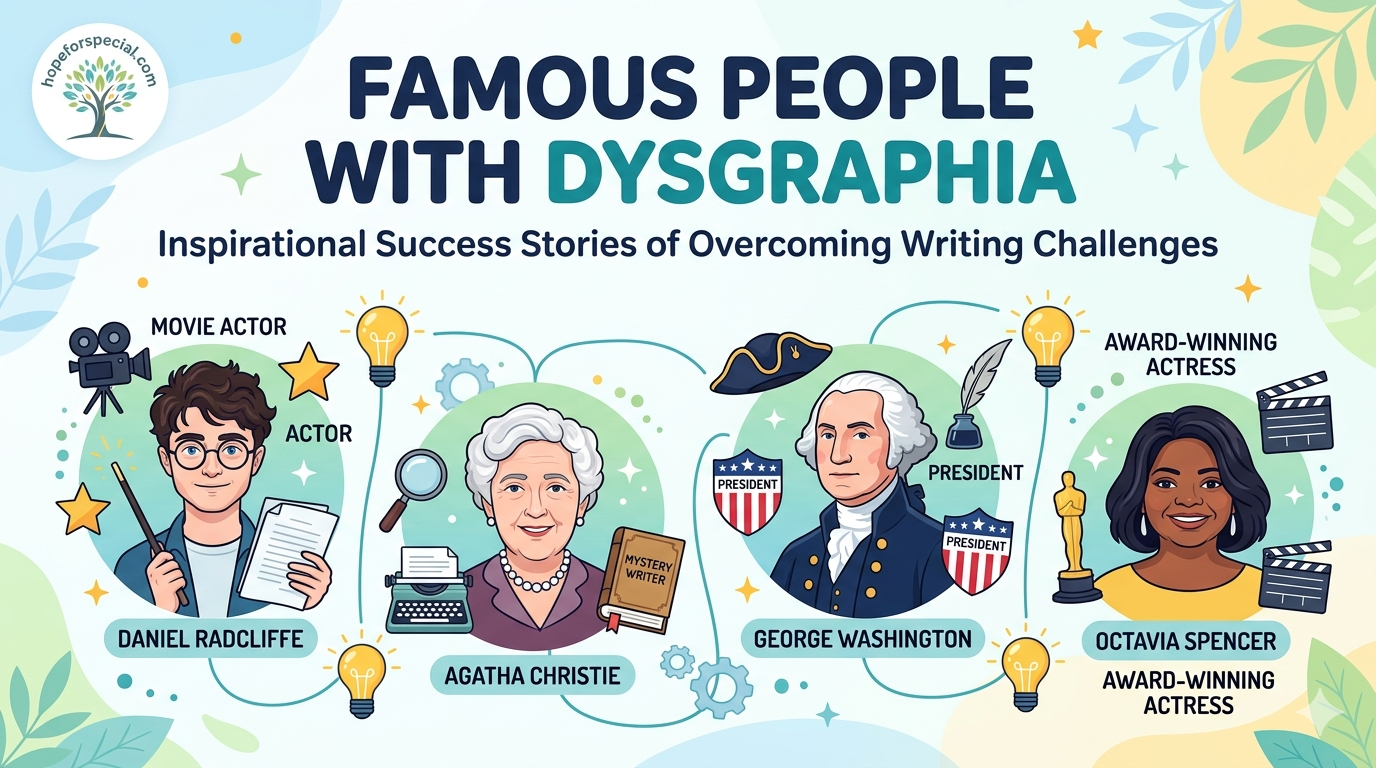
🌟Famous People with Dysgraphia: 10+ Inspirational Success Stories 🌟
Many parents feel worried when their child struggles with writing. You may notice messy handwriting, difficulty forming letters, or trouble expressing thoughts on paper. At first, it may seem like laziness. But often, it could be dysgraphia.
The good news is this:
👉 Dysgraphia does not limit success.
Many well-known figures struggled with writing but still achieved greatness. Our Famous People with Dysgraphia stories offer hope and motivation.

- 🧠 What Is Dysgraphia? (Simple Explanation)
- 📊 Quick Facts About Dysgraphia
- 🧠 Albert Einstein
- 💡 Thomas Edison
- 🎬 Henry Winkler
- 📚 Agatha Christie
- 🎥 Daniel Radcliffe
- 🎖️ George S. Patton
- 🔬 Louis Pasteur
- 🇺🇸 George Washington
- ➕ More Notable Names
- 1. What is dysgraphia in simple words?
- 2. Can people with dysgraphia be successful?
- 3. Do people with dysgraphia have high IQ?
- 4. Is dysgraphia lifelong?
- 5. What are the main symptoms of dysgraphia?
- 6. Can dysgraphia be cured?
- 7. How can parents help a child with dysgraphia?
- 8. Is dysgraphia the same as dyslexia?
- 9. Can people with dysgraphia improve handwriting?
- 10. What careers are good for people with dysgraphia?
🧠 What Is Dysgraphia? (Simple Explanation)
Dysgraphia is a learning disability that affects writing skills. It can impact:
- Handwriting
- Spelling
- Organizing thoughts
According to
👉 https://www.orcam.com/en-us/dysgraphia
dysgraphia does not affect intelligence. Many individuals with dysgraphia are highly creative and capable.
👉 In simple words:
A person with dysgraphia knows what to say but struggles to write it down.

📊 Quick Facts About Dysgraphia
| Fact | Explanation | Source |
|---|---|---|
| Affects writing skills | Difficulty forming letters and organizing thoughts | https://www.parents.com/kids/development/learning-disabilities/what-is-dysgraphia-when-bad-handwriting-is-a-sign-of-something-more-serious/ |
| Can co-exist with dyslexia | Many children have both conditions | https://arxiv.org/abs/2405.07238 |
| Does not affect IQ | Intelligence remains normal or high | https://www.orcam.com/en-us/dysgraphia |
👉 Studies show dysgraphia can affect 10–30% of children. (Parents)
🌟 Famous People with Dysgraphia (Inspiring Examples)
Below are well-known individuals who faced writing difficulties but still achieved success.
🧠 Albert Einstein
- Known for: Theory of Relativity
- Struggled with: Writing and language in school
Einstein had difficulty expressing ideas in written form during his early education. However, his thinking ability was extraordinary.
👉 Lesson: Intelligence is not measured by handwriting.
💡 Thomas Edison
- Known for: Light bulb, 1000+ inventions
- Struggled with: Traditional schooling
Edison performed poorly in school and was often misunderstood. His mother taught him at home.
👉 Lesson: Alternative learning methods can unlock potential.
🎬 Henry Winkler
- Known for: “Happy Days”
- Diagnosed later in life
Winkler discovered his learning difficulty at age 31. He later became a strong advocate for children with learning disabilities.
👉 Lesson: It’s never too late to understand your strengths.
📚 Agatha Christie
- Known for: Best-selling novels
- Struggled with: Writing and spelling
Despite her writing difficulties, she became one of the world’s most famous authors. (HRF)
👉 Lesson: Creativity can overcome technical challenges.
🎥 Daniel Radcliffe
- Known for: Harry Potter
- Has coordination and writing challenges
Radcliffe has spoken about his struggles with motor skills, which impacted writing.
👉 Lesson: Challenges do not define your future.
🎖️ George S. Patton
- Known for: Military leadership
- Struggled with reading and writing
Despite academic struggles, he became a top military strategist.
🔬 Louis Pasteur
- Known for: Vaccines and microbiology
- Faced writing difficulties
He was an average student but made groundbreaking discoveries.
🇺🇸 George Washington
- Known for: First U.S. President
- Struggled with spelling and grammar
Even great leaders faced learning challenges.
➕ More Notable Names
Additional reported figures include:
- Richard Branson
- Tom Cruise (OrCam Techologies)
🧠 What These Success Stories Teach Us
Most websites only list names. But here’s what they miss:
1. Strength-Based Learning
These individuals focused on what they were good at.
2. Alternative Tools
Many used:
- Verbal communication
- Assistive technology
3. Persistence
They did not give up despite struggles.
🏠 Personal Experience
In my work with special needs families, I once met a child who avoided writing completely. He had brilliant ideas but refused to pick up a pencil.
We introduced:
- Voice typing
- Visual storytelling
Within months, his confidence improved.
👉 The biggest shift?
He realized he was smart—just different.
🛠️ How People with Dysgraphia Succeed
✅ Use Technology
- Speech-to-text tools
- Typing instead of handwriting
✅ Break Tasks
- Smaller writing steps
- Visual planning
✅ Use Support Systems
- Teachers
- Therapists
👉 These strategies are widely recommended by experts. (OrCam Techologies)
⚠️ Common Struggles in Dysgraphia
- Poor handwriting
- Slow writing speed
- Difficulty organizing thoughts
👉 Dysgraphia is more than messy writing—it is a neurological processing issue. (Reddit)
🤖 Voice Search Section
Who are famous people with dysgraphia?
Famous people with dysgraphia include Albert Einstein, Thomas Edison, Agatha Christie, and Henry Winkler.
Can people with dysgraphia be successful?
Yes. Many successful people have dysgraphia and achieve great success with support.
Is dysgraphia a disability?
Yes, it is a learning disability that affects writing skills.
📈 What Parents Often Miss (Deep Insight)
Many parents focus only on handwriting.
But dysgraphia also affects:
- Thinking flow
- Written expression
- Confidence
👉 Supporting emotional health is just as important.
❤️ Final Thoughts
Dysgraphia is not a limitation. It is a different way of learning.
The stories of these famous individuals prove one thing:
👉 Success is not about perfect handwriting.
👉 It is about ideas, persistence, and support.
❓ Famous People with Dysgraphia FAQs
1. What is dysgraphia in simple words?
Dysgraphia is a learning disability that makes writing difficult. A child may struggle with handwriting, spelling, or organizing thoughts on paper.
It does not affect intelligence. Many children with dysgraphia are bright and creative.
2. Can people with dysgraphia be successful?
Yes, absolutely.
Many successful individuals like Albert Einstein and Agatha Christie had writing difficulties but still achieved greatness.
With the right support, people with dysgraphia can:
- Excel in academics
- Build careers
- Achieve personal success
👉 Dysgraphia affects writing—not intelligence.
3. Do people with dysgraphia have high IQ?
Yes, many individuals have average or above-average IQ.
Dysgraphia affects:
- Writing skills
- Motor coordination
But it does not affect:
- Thinking ability
- Creativity
4. Is dysgraphia lifelong?
Yes, dysgraphia is usually a lifelong condition.
However, it can be managed with:
- Therapy
- Practice
- Technology
👉 Many adults learn strategies to cope effectively.
5. What are the main symptoms of dysgraphia?
Common symptoms include:
- Messy handwriting
- Slow writing
- Trouble spelling
- Difficulty organizing thoughts
These symptoms may vary from person to person.
6. Can dysgraphia be cured?
No, dysgraphia cannot be cured.
However, it can be improved with:
- Early intervention
- Special education
- Assistive tools
👉 Many individuals learn to manage it successfully.
7. How can parents help a child with dysgraphia?
Parents can help by:
- Encouraging practice
- Using visual tools
- Allowing typing instead of writing
- Seeking professional help
👉 Emotional support is very important.
8. Is dysgraphia the same as dyslexia?
No.
- Dysgraphia → writing difficulty
- Dyslexia → reading difficulty
However, both can occur together. (hopeforspecial.com)
9. Can people with dysgraphia improve handwriting?
Yes, with effort and therapy.
However, improvement may take time. Some individuals may still prefer typing or dictation.
10. What careers are good for people with dysgraphia?
People with dysgraphia can succeed in:
- Technology
- Arts
- Business
- Science
👉 Any career is possible with the right support.


