

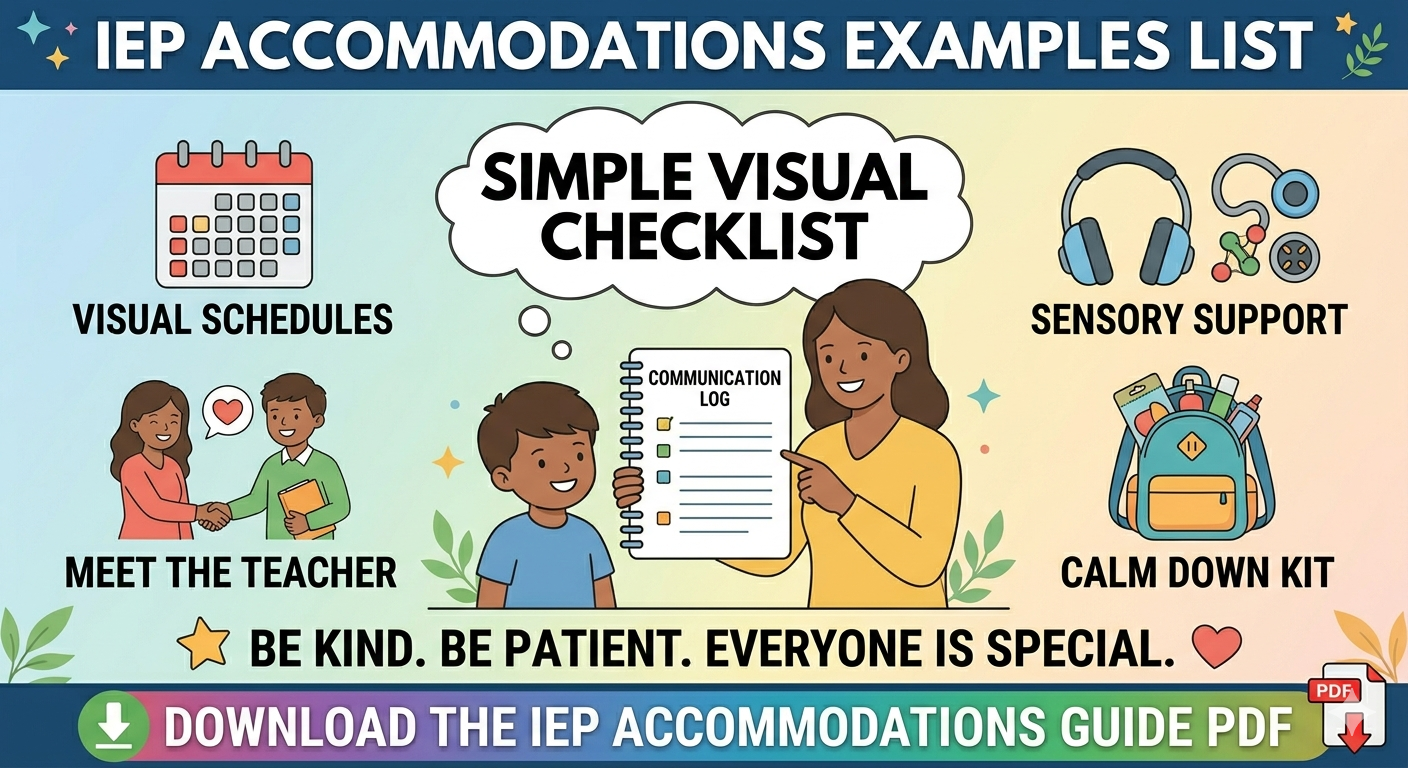
IEP Accommodations Examples List (2026 Complete Parent & Teacher Guide)
Creating the right support plan for a child with special needs can feel confusing. Many parents ask:
👉 What accommodations should be included in an IEP?
This guide provides a clear and practical IEP accommodations examples list. It includes detailed tables, real examples, and expert-backed insights.

What Are IEP Accommodations?
IEP accommodations are changes in how a child learns, not what they learn.
They help students:
- Access the same curriculum
- Reduce barriers
- Learn in a comfortable way
For example:
- Extra time on tests
- Preferential seating
- Visual supports
According to the U.S. Department of Education, accommodations ensure students with disabilities receive equal access to education.

Difference Between Accommodations and Modifications
Many parents confuse these two.
| Accommodations | Modifications |
|---|---|
| Change HOW a student learns | Change WHAT a student learns |
| Same curriculum | Different curriculum |
| Example: extra time | Example: simplified content |
Understanding this difference is very important.
Why IEP Accommodations Matter
IEP accommodations help children:
- Improve focus
- Reduce anxiety
- Build confidence
Research shows that structured support improves learning outcomes for students with disabilities.
👉 https://ies.ed.gov/ncee/wwc/
IEP Accommodations Examples List (Detailed Tables)
Below is a complete IEP accommodations examples list organized by category.
📚 1. Classroom Accommodations
| Accommodation Type | Example |
|---|---|
| Seating | Preferential seating near teacher |
| Instructions | Repeat or simplify instructions |
| Visual Support | Use charts, pictures, schedules |
| Noise Control | Provide quiet workspace |
| Breaks | Allow short breaks during tasks |
👉 Tip: These help improve focus and reduce distractions.
📝 2. Testing Accommodations
| Accommodation Type | Example |
|---|---|
| Extra Time | 1.5x or 2x time for tests |
| Alternative Format | Oral exams instead of written |
| Reduced Questions | Fewer questions with same concept |
| Separate Room | Quiet testing environment |
| Use of Aids | Calculator or reference sheet |
🧠 3. Communication Accommodations
| Accommodation Type | Example |
|---|---|
| Visual Aids | Picture communication systems |
| Assistive Tech | Speech-to-text tools |
| Simplified Language | Short and clear sentences |
| Repetition | Repeat instructions when needed |
According to the Centers for Disease Control and Prevention, communication support improves learning outcomes for children with developmental conditions.
👉 https://www.cdc.gov/autism
👥 4. Social and Behavioral Accommodations
| Accommodation Type | Example |
|---|---|
| Behavior Plan | Positive reinforcement system |
| Social Stories | Teach social skills |
| Calm Down Space | Safe area for breaks |
| Cue Cards | Reminders for behavior |
📖 5. Academic Accommodations
| Accommodation Type | Example |
|---|---|
| Reading Support | Audio books |
| Writing Support | Use of keyboard instead of handwriting |
| Math Support | Use of manipulatives |
| Instructions | Step-by-step guidance |
🧩 6. Sensory Accommodations
| Accommodation Type | Example |
|---|---|
| Sensory Breaks | Scheduled movement breaks |
| Tools | Fidget toys |
| Lighting | Dim lighting if needed |
| Noise | Noise-canceling headphones |
Experts at Autism Speaks recommend sensory supports for children with autism.
👉 https://www.autismspeaks.org
🏫 7. Organizational Accommodations
| Accommodation Type | Example |
|---|---|
| Planner | Use daily planner |
| Checklists | Step-by-step task lists |
| Reminders | Verbal or visual reminders |
| Color Coding | Organize subjects with colors |
🕒 8. Time Management Accommodations
| Accommodation Type | Example |
|---|---|
| Extended Deadlines | Extra time for assignments |
| Chunking Tasks | Break tasks into smaller steps |
| Timers | Use visual timers |
🏠 9. Homework Accommodations
| Accommodation Type | Example |
|---|---|
| Reduced Homework | Fewer problems |
| Flexible Deadlines | Extra submission time |
| Parent Support | Clear instructions for parents |
🎯 How to Choose the Right IEP Accommodations
Not all accommodations work for every child.
Follow these steps:
1. Identify Your Child’s Needs
Focus on:
- Strengths
- Challenges
2. Review Current Performance
Look at:
- School reports
- Teacher feedback
3. Match Needs with Accommodations
Example:
- Difficulty focusing → seating + breaks
4. Keep It Simple
Avoid adding too many accommodations.
5. Monitor and Adjust
Track what works and what does not.
Real-Life Example
A parent noticed their child struggled with writing.
They added:
- Keyboard use
- Extra time
Result:
✔ Better performance
✔ Less stress
Common Mistakes to Avoid
Avoid these:
❌ Too many accommodations
❌ Vague descriptions
❌ No progress tracking
Instead:
✔ Keep it clear
✔ Keep it measurable
Expert Tips for Parents
Experts suggest:
- Be involved in IEP meetings
- Ask questions
- Advocate for your child
According to Understood.org, parent involvement improves student success.
👉 https://www.understood.org
FAQs: IEP Accommodations Examples List
1. How many accommodations should be in an IEP?
There is no fixed number. Focus on what your child needs.
2. Can accommodations be changed?
Yes. They can be updated anytime.
3. Who decides the accommodations?
The IEP team, including parents.
4. Are accommodations the same for all children?
No. Each child’s needs are different.
5. Do accommodations affect grades?
No. They only change how learning happens.
Final Thoughts
A well-planned IEP accommodations examples list can transform your child’s learning experience.
Remember:
👉 Keep it simple
👉 Focus on needs
👉 Track progress
With the right support, every child can succeed.


