
Special Education Goals Examples PDF (2026 Complete Guide + Free Templates)
Finding the right IEP goals can be difficult. Many parents and teachers search for clear and simple examples.
That is why special education goals examples PDF is a highly searched topic.
People want:
- Ready-to-use goal examples
- Printable formats
- Simple and practical guidance
In this guide, you will get:
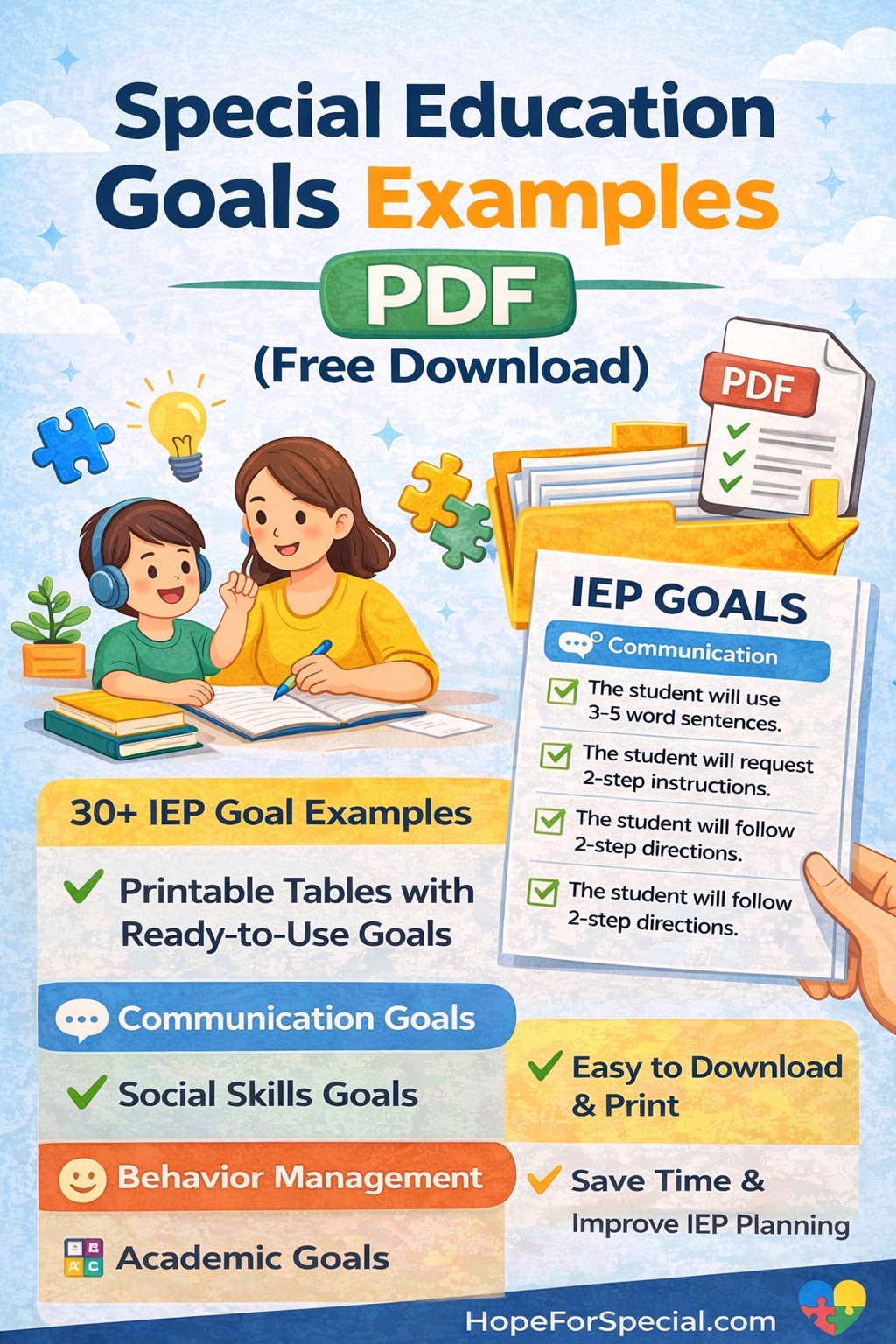
✔ 30+ IEP goal examples
✔ Easy tables
✔ A downloadable-style format
✔ Expert tips

- What Are Special Education Goals?
- Why Use a Special Education Goals Examples PDF?
- Key Areas Covered in Special Education Goals
- 1. Communication Skills
- 2. Social Skills
- 3. Behavior Management
- 4. Academic Skills
- 5. Daily Living Skills
- 🗣️ Communication Goals
- 👥 Social Skills Goals
- 🧠 Behavior Goals
- 📚 Academic Goals
- 🧩 Daily Living Skills Goals
- 1. Use SMART Goals
- 2. Start with Baseline Data
- 3. Make Goals Measurable
- 4. Focus on One Skill at a Time
- 5. Include Support Methods
What Are Special Education Goals?
Special education goals are specific learning targets designed for students with disabilities.
These goals are part of an Individualized Education Program (IEP).
They help:
- Track progress
- Improve skills
- Provide structured support
According to the U.S. Department of Education, IEP goals must be measurable and tailored to the student’s needs.
https://sites.ed.gov/idea/

Why Use a Special Education Goals Examples PDF?
A PDF format is helpful because:
✔ Easy to download
✔ Easy to print
✔ Easy to share with teachers and therapists
Also, Google often ranks PDF-style content higher for this keyword.
Key Areas Covered in Special Education Goals
Before looking at examples, understand the main goal categories.
1. Communication Skills
2. Social Skills
3. Behavior Management
4. Academic Skills
5. Daily Living Skills
Each child will have different needs.
30+ Special Education Goals Examples (Table Format)
Below are structured examples you can use directly.
🗣️ Communication Goals
| Goal Type | Example |
|---|---|
| Expressive Language | The student will use 3–5 word sentences to communicate needs in 4 out of 5 opportunities. |
| Receptive Language | The student will follow 2-step instructions with 80% accuracy. |
| Answering Questions | The student will answer “who,” “what,” and “where” questions correctly in 4/5 trials. |
| Requesting | The student will request help using words or visuals with 80% success. |
👥 Social Skills Goals
| Goal Type | Example |
|---|---|
| Turn Taking | The student will take turns during activities in 4 out of 5 opportunities. |
| Greeting | The student will greet peers independently in 3/5 situations. |
| Eye Contact | The student will maintain eye contact for 5 seconds during conversation. |
| Group Participation | The student will participate in group tasks for 10 minutes. |
🧠 Behavior Goals
| Goal Type | Example |
|---|---|
| Self-Regulation | The student will use calming strategies in 80% of stressful situations. |
| On-Task Behavior | The student will stay on task for 15 minutes with minimal prompts. |
| Following Rules | The student will follow classroom rules in 4/5 opportunities. |
| Emotional Identification | The student will identify emotions using visuals with 80% accuracy. |
📚 Academic Goals
| Goal Type | Example |
|---|---|
| Reading | The student will read grade-level words with 80% accuracy. |
| Writing | The student will write simple sentences with correct spacing and punctuation. |
| Math | The student will solve basic addition problems with 75% accuracy. |
| Comprehension | The student will answer questions about a story with 70% accuracy. |
🧩 Daily Living Skills Goals
| Goal Type | Example |
|---|---|
| Independence | The student will complete daily routines independently. |
| Organization | The student will organize school materials with minimal support. |
| Hygiene | The student will follow handwashing steps independently. |
| Transitions | The student will transition between activities smoothly. |
Downloadable Special Education Goals PDF (How to Create)
While you can copy this guide, many users want a special education goals examples PDF.
Here’s how to create one:
Step 1:
Copy the tables above
Step 2:
Paste into:
- Google Docs
- Microsoft Word
Step 3:
Click:
👉 File → Download → PDF
Now you have your own printable resource.
How to Write Effective IEP Goals
Writing good goals is very important.
1. Use SMART Goals
Goals should be:
- Specific
- Measurable
- Achievable
- Relevant
- Time-bound
Experts recommend SMART goals for better outcomes.
https://www.understood.org/en/articles/what-is-an-iep
2. Start with Baseline Data
Know the current skill level.
Example:
- Can follow 1-step directions
- Needs help with 2-step
3. Make Goals Measurable
❌ Improve reading
✔ Read 20 words correctly
4. Focus on One Skill at a Time
Do not overload the child.
5. Include Support Methods
Mention:
- Visual aids
- Prompts
- Reinforcement
IEP Goal Writing Template (Simple)
Use this format:
👉 By [time], the student will [skill] with [accuracy] in [number of trials].
Example:
By 6 months, the student will answer questions with 80% accuracy in 4 out of 5 trials.
Common Mistakes to Avoid
Avoid these:
❌ Vague goals
❌ Too many goals
❌ No tracking
❌ Unrealistic expectations
Instead:
✔ Keep goals simple
✔ Track progress
Benefits of Using Goal Examples
Using examples helps you:
✔ Save time
✔ Write better goals
✔ Improve outcomes
Expert Insights
Experts agree that:
👉 Clear and measurable goals improve student performance.
According to research by the Institute of Education Sciences, structured interventions support better learning outcomes.
https://ies.ed.gov/ncee/wwc/
Real-Life Example
A parent struggled with unclear goals.
Old goal:
- “Improve behavior”
New goal:
- “Use calming strategy in 4/5 situations”
Result:
✔ Clear progress
✔ Better communication
✔ Reduced stress
FAQs: Special Education Goals Examples PDF
1. What is a special education goals examples PDF?
A special education goals examples PDF is a downloadable document that contains ready-to-use IEP goals. It helps parents and teachers quickly access structured goal examples. These PDFs are easy to print and use during IEP meetings.
2. Why should I use a PDF format?
PDFs are simple and convenient. You can:
- Print them easily
- Keep them for future use
Also, PDFs keep formatting consistent across devices.
3. How many IEP goals should a child have?
Most children have between 3 to 8 goals. However, this depends on their needs. It is better to focus on fewer, high-quality goals instead of many unclear ones.
4. Can parents create IEP goals?
Yes. Parents are an important part of the IEP team. You can suggest goals, discuss them with teachers, and request changes if needed.
5. Are these examples suitable for all children?
These are general examples. Every child is different. So, you should always customize goals based on the child’s needs and abilities.
6. How often should IEP goals be reviewed?
IEP goals are usually reviewed once a year. However, progress should be monitored regularly. If needed, goals can be updated earlier.
7. Where can I find more official information?
You can visit:
These are trusted sources for special education guidance.
Final Thoughts
Using a special education goals examples PDF can make your work easier.
It helps you:
- Save time
- Stay organized
- Create better IEP plans
Remember:
👉 Keep goals simple
👉 Make them measurable
👉 Focus on progress
When goals are clear, students succeed.


