

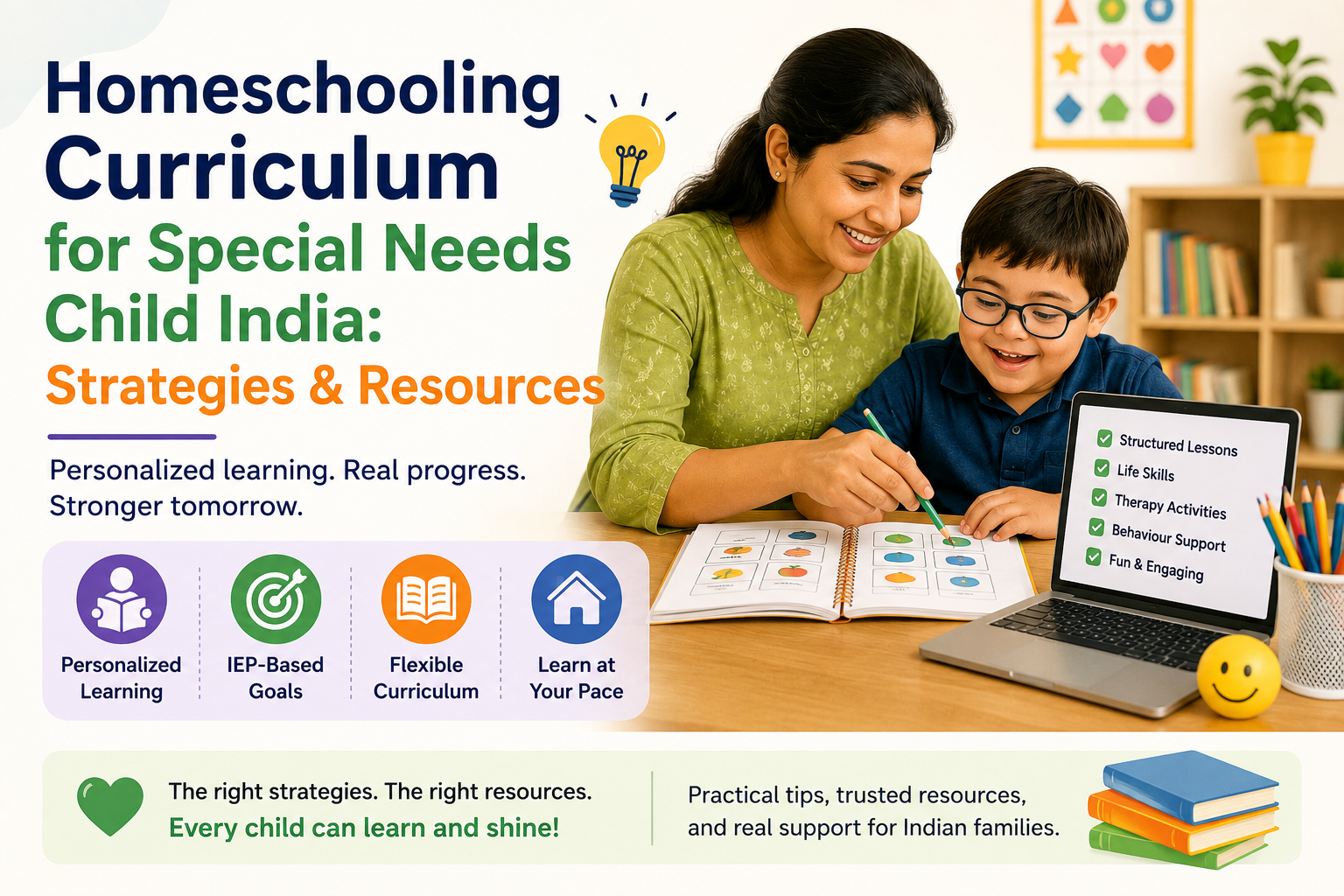
Homeschooling Curriculum for Special Needs Child India: Strategies & Resources 2026
⚡ What You Need to Know First
A homeschooling curriculum for special needs child India should be fully individualized — built around your child’s specific disability, learning style, therapy goals, and daily capacity. The best approach combines NIOS open schooling for certification, structured life skills, embedded therapy activities, and flexible pacing. No single curriculum fits all. India has no mandatory homeschooling registration — but NIOS provides legal, government-recognized certification. 💙
If you are a parent who has tried mainstream school, tried special school, tried everything — and you are now considering teaching your child at home yourself — this guide is for you.
Not the version of homeschooling that looks perfect on Instagram. The real version. The one where some days the lesson plan works beautifully and some days your child is dysregulated by 9 AM and the whole plan goes out the window.
The real homeschooling curriculum for special needs child India is not about recreating school at home. It is about building a learning environment that fits your child — not the other way around.
This guide shows you exactly how.

- ⚡ What You Need to Know First
- 🏠 Why Indian Families Choose to Homeschool Special Needs Children
- Reason 1 — Mainstream School Failed Their Child
- Reason 2 — Special School Is Not Accessible
- Reason 3 — The Child’s Medical and Therapy Schedule Cannot Fit School
- Reason 4 — The Child Thrives With Individualized Attention
- Reason 5 — Wanting to Embed Therapy Into Learning
- ⚖️ Is Homeschooling Legal in India?
- 🧠 Understanding Your Child Before Building a Curriculum
- Step 1 — Know Your Child’s Diagnosis and Learning Profile
- Step 2 — Assess Your Child’s Current Levels
- Step 3 — Identify Your Child’s Learning Style
- Step 4 — Know Your Family’s Capacity
- 🧱 The 7 Core Components of a Special Needs Homeschool Curriculum
- Component 1 — Functional Literacy 📖
- Component 2 — Functional Numeracy 🔢
- Component 3 — Life Skills 🍳
- Component 4 — Communication and Language 💬
- Component 5 — Social and Emotional Learning 🤝
- Component 6 — Vocational and Transition Skills 🔧
- Component 7 — Physical, Creative, and Sensory Learning 🎨
- 📘 Curriculum Approaches — Which Works for Which Child?
- Approach 1 — ABA-Based Curriculum (Applied Behavior Analysis)
- Approach 2 — Montessori-Adapted
- Approach 3 — Orton-Gillingham (for Dyslexia and Reading Difficulties)
- Approach 4 — Unit Study Approach
- Approach 5 — Project-Based Learning
- 🎓 NIOS — The Legal Certification Backbone
- NIOS at a Glance
- NIOS Exam Accommodations for Special Needs Students
- How to Combine NIOS With Homeschooling
- 📚 Subject-by-Subject Curriculum Guide
- Language — Hindi and English
- Mathematics
- Science and Environmental Studies
- Social Studies and Civics
- Life Skills — An Indian Framework
- 💊 Therapy Integration in Your Homeschool Day
- 📅 Building Your Homeschool Schedule — Real Template
- 🛠️ Resources, Materials, and Tools Available in India
- 📊 Key Statistics — Homeschooling and Special Education in India
- 👥 Socialization — Solving the Biggest Concern
- 1. 🎭 Structured Group Activities
- 2. 🏘️ Community Participation
- 3. 👨👩👦 Family and Extended Family
- 4. 🤝 Special Needs Homeschool Co-ops
- 5. 💻 Online Peer Connection
- 💛 A Parent’s Real Story: “I Was Terrified to Teach My Own Child. Three Years Later, He Is Thriving.”
- 🔍 What You Must Not Miss About Special Needs Homeschooling in India
- 1. 🌐 The DIKSHA Platform — A Free Government Resource Nobody Discusses
- 2. 🧪 The Sensory Diet — Non-Negotiable for Many Special Needs Learners
- 3. 🔄 The Documentation System — Your Child’s Learning Portfolio
- 4. 🏫 The Special School Partnership Model
- 5. 💼 The Parent-Teacher Wellbeing Problem
- 6. 🌍 Rural and Semi-Urban Families — The Digital Divide in Special Needs Homeschooling
- ❓ FAQs — Long-Tail Questions Answered
- Is homeschooling legal for special needs children in India?
- What curriculum should I use for homeschooling my autistic child in India?
- How do I get a certificate for my homeschooled special needs child in India?
- How many hours should I homeschool my special needs child per day?
- What is the NIOS Open Basic Education program for special needs?
- How do I teach a non-verbal child with autism at home?
- Can I homeschool a child with cerebral palsy in India?
- What free resources are available for homeschooling special needs children in India?
- How do I connect with other special needs homeschooling families in India?
- How do I balance homeschooling with caring for my special needs child?
- 🔗 Trusted Resources — Homeschooling Special Needs Children in India
- 🏛️ Government Education Resources
- 📚 Free Learning Materials
- 💛 Disability-Specific Support
- 🔬 Evidence and Research
- ✨ Final Thoughts: Your Home Is Already a Learning Environment. Now Build It Intentionally.
🏠 Why Indian Families Choose to Homeschool Special Needs Children
The decision to build a homeschooling curriculum for special needs child India usually does not happen easily. It happens after exhaustion. After trying and failing with mainstream systems. After watching a child shrink instead of grow.
Here are the most common real reasons Indian families choose homeschooling for their special needs children:
Reason 1 — Mainstream School Failed Their Child
The mainstream school system was not designed for children with significant learning differences. Fixed curricula, rigid timetables, standardized examinations, large class sizes, and limited trained support staff make mainstream school genuinely unmanageable for many special needs children.
Many families choose homeschooling after their child has been:
- Repeatedly failed in examinations
- Bullied by peers
- Excluded from classroom activities
- Physically hurt (from being placed in inappropriate environments)
- Told by schools that they “cannot manage” the child
Reason 2 — Special School Is Not Accessible
Quality special schools are concentrated in urban areas. Many Indian families — particularly in tier-2 and tier-3 cities and rural areas — simply do not have a good special school within a practical distance.
Reason 3 — The Child’s Medical and Therapy Schedule Cannot Fit School
Many children with complex disabilities have therapy schedules, hospital appointments, medication regimes, and health management needs that make a fixed school day impossible.
Reason 4 — The Child Thrives With Individualized Attention
Research in special education consistently demonstrates that one-to-one and small group instruction produces better outcomes than classroom-based instruction for most children with disabilities.
A parent who knows their child deeply — their rhythms, their triggers, their interests, their specific learning style — can often teach that child more effectively than any classroom.
Reason 5 — Wanting to Embed Therapy Into Learning
At home, every activity is a therapy opportunity. Breakfast is oral motor therapy. Getting dressed is occupational therapy. Telling you about yesterday is speech therapy. This integration is impossible to achieve in a traditional school setting.
💡 Voice Search Answer — Is homeschooling allowed for special needs children in India?
Yes. Homeschooling is legal in India — there is no law requiring children to attend school, though the RTE Act mandates that school education be provided. For certification, special needs children can enroll in NIOS (National Institute of Open Schooling) which provides government-recognized Class 10 and Class 12 certificates with extensive special accommodations. This makes homeschooling combined with NIOS a fully legal and recognized educational pathway.
⚖️ Is Homeschooling Legal in India?
This is the first question every family considering a homeschooling curriculum for special needs child India asks.
The honest answer: India does not have a specific homeschooling law — either permitting or prohibiting it. There is no registration requirement for homeschooling families. No government approval process.
What the RTE Act Says
The Right to Education Act 2009 mandates that the government ensure every child receives education — but it does not require every child to physically attend a traditional school. The interpretation that matters for special needs families: the obligation is on the government to ensure education is accessible, not on parents to choose a specific delivery method.
Under Section 32 of the RPWD Act 2016 — the government is explicitly required to provide home-based education for children whose disability is so severe they cannot attend school. This means for the most complex special needs children, home-based education is not just permitted — it is a legal entitlement.
The NIOS Solution — Legal Certification
The most practical legal solution for homeschooling families is enrollment in NIOS (National Institute of Open Schooling):
- ✅ Government-recognized open schooling system
- ✅ Provides Class 10 and Class 12 equivalent certificates
- ✅ No attendance requirement
- ✅ Extensive special accommodations (scribe, extra time, oral exam, home-based exam)
- ✅ Certificates recognized by all Indian universities and UGC
For children who are not yet ready for Class 10 level — NIOS Open Basic Education (OBE) provides certified learning at Class 3, 5, and 8 equivalents.
Reference: NIOS — National Institute of Open Schooling
🧠 Understanding Your Child Before Building a Curriculum
The most important step in building any homeschooling curriculum for special needs child India is not choosing a curriculum. It is understanding your specific child deeply before selecting any materials or structure.

Step 1 — Know Your Child’s Diagnosis and Learning Profile
Every special needs diagnosis has different learning implications:
| Diagnosis | Learning Strengths | Learning Challenges | Curriculum Implication |
|---|---|---|---|
| Autism | Visual processing, pattern recognition, deep interest areas, memory for specific topics | Social pragmatics, transitions, flexible thinking, sensory overwhelm | Visual-heavy; interest-based; highly structured; sensory considerations |
| Cerebral Palsy | Often strong cognitive ability; motivation; social engagement | Motor execution, fatigue, physical access to materials | AAC integration; adapted materials; rest breaks; positioning |
| Intellectual Disability (Mild) | Social learning, practical skills, routine-based tasks | Abstract concepts, academic pace, reading and numeracy | Functional, concrete, repetition-based; life skills focus |
| Intellectual Disability (Moderate) | Routine; emotional connection; practical understanding | Academic concepts beyond functional literacy | Life skills primary; functional communication; vocational |
| Down Syndrome | Strong social skills, visual learning, music | Short-term memory, reading acquisition, speech intelligibility | Multisensory; music-integrated; repetition; visual prompts |
| Dyslexia | Verbal reasoning, comprehension, big-picture thinking | Decoding text, spelling, written output | Orton-Gillingham reading; oral learning; audio materials |
| ADHD | Creativity, energy, hands-on engagement | Sustained attention, task completion, organization | Short tasks; movement breaks; gamified learning; timers |
Step 2 — Assess Your Child’s Current Levels
Before building your curriculum, know where your child currently is — not where they “should” be for their age:
- Reading level — Can they read? Sight words only? Independent readers?
- Maths level — Counting? Basic operations? Practical maths only?
- Communication level — Verbal? Non-verbal? AAC user?
- Self-care level — What can they do independently?
- Therapy goals — What are the current OT, PT, SALT goals?
This assessment does not require a formal psychological test. Your daily observation — combined with your child’s therapists’ current reports — provides most of this information.
Step 3 — Identify Your Child’s Learning Style
| Learning Style | Characteristics | Best Teaching Approaches |
|---|---|---|
| Visual learner | Responds well to pictures, charts, color coding | Flashcards, visual schedules, color-coded materials, video |
| Auditory learner | Learns through listening, verbal explanation | Read aloud, audiobooks, songs, verbal repetition |
| Kinesthetic learner | Learns through movement, touch, doing | Hands-on activities, movement-based learning, sensory materials |
| Multi-sensory | Needs multiple input channels simultaneously | Combine visual, auditory, and tactile — every lesson |
Step 4 — Know Your Family’s Capacity
Honest self-assessment is essential. What are you — the homeschooling parent — realistically able to provide?
- How many hours per day can you dedicate to structured teaching?
- What are your own strengths (patient with repetition, creative with activities, good at organizing)?
- What support do you have (grandparents, therapists, co-homeschooling families)?
- What is your budget for materials?
A curriculum that exceeds your family’s realistic capacity will fail — regardless of how excellent it is on paper.
🧱 The 7 Core Components of a Special Needs Homeschool Curriculum
Every effective homeschooling curriculum for special needs child India is built from the same 7 core components — combined in different proportions depending on the child.
Component 1 — Functional Literacy 📖
What it means: Learning to read and write at whatever level serves the child’s life — not necessarily reaching grade-level literacy.
Why it matters: Even basic functional literacy — reading signs, labels, simple instructions — has transformative independence implications.
Approaches:
- Phonics-based reading (Orton-Gillingham for dyslexia; phonic books in Hindi and English)
- Sight word programs for children who do not decode phonetically
- Language experience approach — using the child’s own sentences as reading material
- Augmentative literacy — picture-supported reading and writing
Component 2 — Functional Numeracy 🔢
What it means: Mathematics that serves real life — not academic maths for its own sake.
Why it matters: Telling time, handling money, counting, measuring — these have direct daily independence implications.
Approaches:
- Concrete manipulatives first (blocks, coins, real objects)
- Life math in real contexts (shopping, cooking, measuring)
- Visual and tactile number representations
- Calculator use for children who cannot manage mental arithmetic
Component 3 — Life Skills 🍳
What it means: The skills needed to manage daily life with increasing independence.
Why it matters: For many special needs children — particularly those with moderate to severe intellectual disability — life skills learning is more critical than academic subjects.
Life skills curriculum areas:
| Category | Skills |
|---|---|
| Self-care | Dressing, hygiene, grooming, toileting independently |
| Domestic skills | Simple cooking, cleaning, laundry basics |
| Community skills | Shopping, using transport, navigating familiar places |
| Safety skills | Road safety, stranger safety, emergency responses |
| Health management | Taking medication, identifying pain, seeking help |
| Financial literacy | Recognizing currency, basic transactions, saving |
Component 4 — Communication and Language 💬
What it means: Developing and strengthening every form of communication available to the child.
Why it matters: Communication is the foundation of learning, relationships, and independence.
Approaches by level:
| Communication Level | Curriculum Approach |
|---|---|
| Non-verbal | AAC introduction; PECS; consistent symbol use throughout the day |
| Single words | Vocabulary expansion; MLU (Mean Length of Utterance) extension; requesting practice |
| Phrases | Sentence building; conversation practice; social communication |
| Conversational | Pragmatic skills; narrative; written communication |
Component 5 — Social and Emotional Learning 🤝
What it means: Understanding emotions, building relationships, navigating social situations.
Why it matters: Social skills are essential for quality of life — employment, friendship, family relationships — regardless of academic achievement.
Approaches:
- Emotion recognition activities using pictures and mirrors
- Sibling and peer interaction opportunities
Component 6 — Vocational and Transition Skills 🔧
What it means: Skills that prepare older children and adolescents for adult life — employment, further education, community participation.
Why it matters: Planning for adulthood should begin from early in the homeschool journey — not at the last minute when the child turns 18.
Approaches:
- Interest-based vocational exploration
- NIOS vocational courses (computer skills, food processing, retail, health care)
- Supported work experience
- Self-advocacy training
Component 7 — Physical, Creative, and Sensory Learning 🎨
What it means: Learning through the body, through art, through music, through movement — not only through academic activities.
Why it matters: For many special needs children — particularly autistic and sensory-sensitive children — physical, creative, and sensory activities are the primary route to regulation, engagement, and learning.
Approaches:
- Art and craft (fine motor development + creative expression)
- Music (rhythm, sequencing, emotional regulation)
- Movement and yoga (body awareness, regulation, coordination)
- Sensory play (sensory processing, calming, exploration)
📘 Curriculum Approaches — Which Works for Which Child?
There are several established educational approaches that work well in a homeschooling curriculum for special needs child India context. No single approach is universally best — but each has particular strengths for particular children.
Approach 1 — ABA-Based Curriculum (Applied Behavior Analysis)
Best for: Autism (particularly early intervention, pre-verbal, or children building basic skills)
What it looks like: Breaking skills into tiny, teachable steps. Teaching each step systematically with clear prompts, practice, and positive reinforcement.
Pros:
- ✅ Highly structured — easy for parent-teachers to follow
- ✅ Strong evidence base for autism skill development
- ✅ Clear measurement of progress
Cons:
- ⚠️ Can feel very rigid if applied inflexibly
- ⚠️ Requires parent training in ABA techniques
Indian resources: Contact your child’s ABA therapist for home program guidance. NIMHANS and several private autism therapy centers offer ABA parent training.
Approach 2 — Montessori-Adapted
Best for: Children with intellectual disability, autism (visual learners), sensory learners
What it looks like: Self-directed learning with hands-on materials. Child chooses activities from a prepared environment. Learning emerges from activity rather than direct instruction.
Pros:
- ✅ Highly child-centered
- ✅ Sensory-rich materials are engaging
- ✅ Builds independence and initiative
Cons:
- ⚠️ Requires investment in materials
- ⚠️ Children with very limited self-direction need more structure
Indian resources: Several Indian Montessori materials suppliers and parent networks. Nienhuis and Aditi Montessori materials available online.
Approach 3 — Orton-Gillingham (for Dyslexia and Reading Difficulties)
Best for: Dyslexia, reading difficulties, specific learning disabilities
What it looks like: Systematic, multisensory reading instruction. Each letter-sound correspondence is taught explicitly using visual, auditory, and kinesthetic channels simultaneously.
Pros:
- ✅ Strongest evidence base for reading intervention
- ✅ Multisensory approach helps retention
- ✅ Highly structured — parent-friendly
Indian resources: Orton-Gillingham materials available from international publishers. Some Indian special educators trained in OG offer parent training. The Dyslexia Association of India provides resources.
Reference: Dyslexia Association of India
Approach 4 — Unit Study Approach
Best for: Children with strong interests (common in autism); older children; children who are bored by standard curriculum
What it looks like: All subjects organized around a central theme or interest. If the child loves trains — literacy activities use train stories, maths involves train counting and timetables, science covers how engines work, art involves drawing trains.
Pros:
- ✅ Leverages motivation and interest
- ✅ Natural integration across subject areas
- ✅ High engagement
Cons:
- ⚠️ Requires creative curriculum planning by the parent
Approach 5 — Project-Based Learning
Best for: Older children; vocational preparation; community-based learning
What it looks like: Extended projects that involve planning, doing, presenting, and reflecting. Making a recipe book. Growing a garden. Running a small stall at a local fair. Creating a family photo album.
Pros:
- ✅ Builds multiple skills simultaneously
- ✅ Real-world application
- ✅ Builds pride and sense of accomplishment
🎓 NIOS — The Legal Certification Backbone
The NIOS (National Institute of Open Schooling) is the essential legal foundation for any homeschooling curriculum for special needs child India that aims for certified educational qualification.
NIOS at a Glance
| Feature | Details |
|---|---|
| Governing Body | Ministry of Education, Government of India |
| Certification | Class 10 (Secondary) and Class 12 (Senior Secondary) — equivalent to CBSE |
| Attendance | Zero compulsory attendance |
| Age Limit | 14+ for Secondary; 15+ for Senior Secondary; No upper limit |
| Special Accommodations | Scribe, extra time, oral exam, home-based exam, large print, braille |
| Fees | ₹2,500 – ₹4,500 for complete course |
| Recognition | All Indian universities, UGC, government recruitment |
| Open Basic Education | Class 3, 5, and 8 equivalents for foundational learners |
Reference: NIOS Official Website
NIOS Exam Accommodations for Special Needs Students
This is why NIOS is ideal for the homeschooling curriculum for special needs child India:
- ✅ Scribe — someone writes for the child who cannot write
- ✅ Extra time — 20 minutes additional per hour of exam
- ✅ Oral examination — for children who cannot write
- ✅ Home-based examination — for children unable to travel to exam centers
- ✅ Braille question papers — for visually impaired learners
- ✅ Large print — for low vision learners
- ✅ Exemption from practical exams — for children with physical disabilities
- ✅ On-demand exams — appear when ready, not on a fixed date
How to Combine NIOS With Homeschooling
Step 1 — Enroll in NIOS at sdmis.nios.ac.in
Step 2 — Choose subjects that match your child’s interests and abilities
Step 3 — Teach at home using your chosen curriculum approach
Step 4 — Use NIOS self-learning materials (available in print and digital format) as the primary textbook framework
Step 5 — Submit special accommodation request with Disability Certificate to NIOS Regional Centre
Step 6 — Appear for exams with accommodations when child is ready
📚 Subject-by-Subject Curriculum Guide
Here is a practical, India-specific guide to teaching each subject area as part of your homeschooling curriculum for special needs child India.
Language — Hindi and English
For Reading:
| Level | Approach | Indian Resources |
|---|---|---|
| Pre-reading | Letter recognition; phonemic awareness; book handling | Picture books; felt letters; alphabet mats |
| Early reading | Phonics; sight words; decodable books | Jolly Phonics (available in India); NIOS OBE readers |
| Independent reading | Comprehension; fluency; vocabulary | Pratham Books (free online at prathambooks.org); NIOS textbooks |
Reference: Pratham Books — Free Children’s Books
For Writing:
- Pre-writing: tracing, drawing, sandpaper letters
- Early writing: copying, tracing words, journal dictation
- Composition: oral dictation to parent; scaffolded sentence writing; typed composition
Mathematics
Concrete → Pictorial → Abstract progression is essential for all special needs learners:
| Concept | Concrete Activity | Pictorial | Abstract |
|---|---|---|---|
| Counting | Counting actual objects (coins, blocks) | Counting pictures | Number symbols |
| Addition | Combining groups of objects | Picture problems | Written sums |
| Money | Actual coins and notes | Money pictures | Price lists, shopping scenarios |
| Time | Clock with moveable hands | Clock pictures | Digital and analog reading |
| Measurement | Measuring with ruler, scales | Measurement pictures | Units and conversions |
Indian Math Resources:
- NIOS Secondary Math textbooks (simple, well-structured)
- Khan Academy (free; available in Hindi; video-based)
- Math manipulatives from local educational suppliers
Science and Environmental Studies
For most special needs homeschoolers — science is best taught through:
- ✅ Nature observation (plants, weather, animals)
- ✅ Simple experiments (kitchen science — baking soda and vinegar, growing seeds)
- ✅ Community-connected learning (visiting a farm, a hospital, a market)
- ✅ Body science (anatomy basics — identifying body parts, understanding basic health)
Indian Science Resources:
- NCERT Science books (available free at ncert.nic.in)
- NIOS Science textbooks
Social Studies and Civics
For special needs homeschoolers — social studies is made relevant through:
- ✅ Family and community mapping
- ✅ Understanding local community helpers (doctor, postman, shopkeeper)
- ✅ Simple geography — their city, their state, India
- ✅ Festivals, culture, and traditions
- ✅ Rights and responsibilities (disability rights; civic rights)
Indian Resource: NCERT Social Studies materials — free at ncert.nic.in
Life Skills — An Indian Framework
Daily Living Skills Progression:
| Age Group | Target Skills |
|---|---|
| Early childhood (3–6) | Toileting, simple feeding, basic dressing, greeting |
| Primary age (7–12) | Full self-care independence, simple cooking, community navigation with support |
| Adolescence (13–18) | Meal preparation, laundry, shopping, public transport, basic financial management |
| Young adult (18+) | Supported employment tasks, independent community access, self-advocacy |
💊 Therapy Integration in Your Homeschool Day
One of the most powerful advantages of the homeschooling curriculum for special needs child India is the ability to embed therapy goals into every part of the day.
Embedding Therapy Into Daily Learning
| Time of Day | Activity | Embedded Therapy |
|---|---|---|
| Morning routine | Dressing, breakfast | OT — self-care; SALT — requesting, naming |
| Morning learning | Literacy/maths activity | OT — fine motor (pencil grip, cutting); SALT — vocabulary |
| Mid-morning | Sensory/movement break | PT — gross motor; OT — sensory regulation |
| Pre-lunch | Life skills activity | OT — practical skills; SALT — sequencing, instructions |
| Mealtimes | Cooking, eating | SALT — oral motor, requesting; OT — adapted utensils |
| Afternoon | Creative activity | OT — fine motor; SALT — commenting; PT — positioning |
| Community time | Outing, play, peer interaction | SALT — pragmatics; PT — mobility; OT — community navigation |
| Evening | Family activity | All communication goals; social skills |
Communicating With Therapists
Your child’s therapists — OT, PT, SALT — should inform your homeschool curriculum. Set up a regular (monthly minimum) meeting with each therapist to:
- Review current therapy goals
- Discuss how to embed goals into home learning activities
- Get specific activity suggestions for the coming month
📅 Building Your Homeschool Schedule — Real Template
Here is a realistic daily schedule template for a homeschooling curriculum for special needs child India — adaptable to your child and family.
Sample Daily Schedule (School-Age Child, Moderate Disability)
| Time | Activity | Duration | Notes |
|---|---|---|---|
| 7:00 AM | Wake and morning routine | 60 min | Self-care; OT goals embedded |
| 8:00 AM | Breakfast | 30 min | Life skills; SALT goals |
| 8:30 AM | Sensory warm-up / movement | 15 min | Regulation; PT goals |
| 8:45 AM | Literacy block | 30 min | Reading; phonics; language |
| 9:15 AM | Break + snack | 15 min | Self-directed |
| 9:30 AM | Maths block | 30 min | Concrete activities |
| 10:00 AM | Creative activity | 30 min | Art, music, craft |
| 10:30 AM | Therapy session (if therapist comes home) | 45 min | OT / PT / SALT |
| 11:15 AM | Life skills activity | 30 min | Cooking, cleaning, gardening |
| 11:45 AM | Free choice / sensory play | 30 min | Child-led |
| 12:15 PM | Lunch preparation + eating | 45 min | Life skills; SALT |
| 1:00 PM | Rest / quiet time | 60 min | Essential for many special needs children |
| 2:00 PM | Community outing or outdoor time | 60 min | Social skills; PT; community navigation |
| 3:00 PM | Social / communication activity | 30 min | Peer interaction; social skills |
| 3:30 PM | Screen time (educational) | 30 min | Khan Academy; educational apps |
| 4:00 PM | Family / unstructured time | — | Play; connection; rest |
Total structured learning: approximately 3–4 hours Therapy and life skills embedded throughout: approximately 2 additional hours of purposeful activity
⚠️ Important: This schedule is a template — not a prescription. Your child’s attention capacity, health, therapy schedule, and energy will dictate what is realistic. Even 90 minutes of focused, high-quality homeschooling can be more productive than a full school day in the wrong environment.
🛠️ Resources, Materials, and Tools Available in India
Free Online Resources
| Resource | What It Provides | Link |
|---|---|---|
| NIOS Self-Learning Materials | Free textbooks for all NIOS courses | nios.ac.in |
| NCERT Textbooks | Free standard curriculum textbooks | ncert.nic.in |
| Pratham Books | Free illustrated children’s books in Indian languages | prathambooks.org |
| Khan Academy | Free maths, science, and more in Hindi and English | khanacademy.org |
| Cboard AAC | Free AAC communication app | cboard.io |
| YouTube Education Channels | Extensive free video learning | Multiple channels |
| DIKSHA Platform | Government digital learning content | diksha.gov.in |
Low-Cost Physical Materials in India
| Material | Use | Where to Find |
|---|---|---|
| Manipulative sets (blocks, counters) | Concrete maths learning | Educational toy stores; Amazon India |
| Flashcard sets (Hindi and English) | Vocabulary; sight words; concepts | Stationery shops; online |
| Sensory bins materials (rice, sand, water) | Sensory learning | Home items; very low cost |
| Playdough | Fine motor; creativity | Make at home (flour, salt, water) |
| Picture schedule cards | Routine; visual support | Print at home; social story apps |
| Weighted materials | Sensory regulation | DIY with rice bags |
| Adapted pencil grips | Writing support | Medical supply stores; online |
| Abacus | Maths | Educational stores; ₹100–₹300 |
Digital Tools and Apps
| App/Tool | Purpose | Cost |
|---|---|---|
| Khan Academy Kids | Maths and literacy (early learning) | Free |
| Starfall | Reading phonics | Free basic; paid extended |
| Google Read & Write | Reading support; text-to-speech | Free trial |
| AVAZ AAC | Indian-context AAC app | Paid |
| LetMeTalk | AAC communication | Free |
| Endless Alphabet | Vocabulary | Free basic |
| Teach My Monster | Reading games | Free |
📊 Key Statistics — Homeschooling and Special Education in India
| Statistic | Figure | Source |
|---|---|---|
| Children with disabilities in India under 19 | 78 lakh (7.8 million) | Census of India 2011 |
| Children with disabilities out of school | ~28 lakh (estimated) | UDISE+ Report 2022–23 |
| NIOS enrolled learners (cumulative) | 3.5+ crore | NIOS Annual Report |
| NIOS special needs learners | Lakhs (across all levels) | NIOS Inclusive Education Division |
| Evidence for one-to-one instruction benefit | Significantly higher outcomes vs. classroom | What Works Clearinghouse |
| Early intervention impact on learning outcomes | Greatest before age 6 | NIDCD |
| Families homeschooling special needs (India estimate) | Growing — exact data unavailable | Parent network surveys |
| States with highest out-of-school disabled children | Bihar, UP, Rajasthan, MP | UDISE+ 2022–23 |
| DIKSHA platform active users | 30+ crore | Ministry of Education |
| Pratham Books free titles available | 300+ in 30+ languages | prathambooks.org |
👥 Socialization — Solving the Biggest Concern
The most common concern parents and well-meaning relatives raise about a homeschooling curriculum for special needs child India is socialization. “But will your child learn to be with other children?”
This concern — while understandable — often overlooks a critical reality: for many special needs children, mainstream school provides socialization that is actually damaging — bullying, exclusion, forced interactions they are not supported to manage, and comparison with peers that erodes self-esteem.
Meaningful socialization for special needs homeschoolers comes from:
1. 🎭 Structured Group Activities
- Special needs activity groups (art, music, dance, drama)
- Disability-specific hobby groups
- Scout and guide groups with inclusion focus
- Swimming classes (often easier to access for special needs children)
2. 🏘️ Community Participation
- Regular community outings — market, library, garden, temple, mosque, church
- Interacting with neighbors, shopkeepers, service providers
3. 👨👩👦 Family and Extended Family
- Cousins, siblings, extended family interactions
- Family celebrations and gatherings
- Structured sibling playtime
4. 🤝 Special Needs Homeschool Co-ops
In many Indian cities, homeschooling families — both general and special needs — are forming co-operative homeschool groups where children learn together several days per week. This provides peer interaction in a controlled, supportive environment.
Find local groups through:
- Facebook: “India Homeschoolers,” “Special Needs Homeschooling India”
- WhatsApp communities through therapy centers and special schools
- Local autism and disability parent groups
5. 💻 Online Peer Connection
Online communities — structured digital interactions through safe platforms — provide age-appropriate peer connection for special needs children who find in-person interaction extremely challenging.
💛 A Parent’s Real Story: “I Was Terrified to Teach My Own Child. Three Years Later, He Is Thriving.”
“My son Arjun has autism with intellectual disability. He is nine now. He attended a special school for two years — from age five to seven.
The school was not bad. The teachers genuinely cared. But Arjun was spending two hours per day on transport each way. He would arrive exhausted and dysregulated. His learning window — when he was genuinely available to learn — was maybe 45 minutes on a good day. And the curriculum was the same for every child in his class.
At seven, we decided to try homeschooling. I was terrified. I am a software engineer — not a teacher. I did not know where to start.
I spoke to his occupational therapist, his speech therapist, and his ABA therapist. Each of them gave me specific goals and activities for the coming month. I enrolled Arjun in NIOS Open Basic Education Level A. I joined a homeschooling parent group in Bangalore.
Our first month was chaos. Arjun refused to “do school.” He wanted to play with his trains.
So I taught him through trains.
We counted trains. We sorted trains by color. We read picture books about trains. We watched YouTube videos about how trains work. We visited a railway station and talked about every sign, every person, every routine.
By month three — Arjun was reading 35 sight words. His therapist said his receptive language had improved more in three months than in the previous year.
Three years later — Arjun is completing NIOS OBE Level B content. He can read simple sentences independently. He prepares his own breakfast with minimal supervision. He communicates with 200+ functional exchanges per day using a mix of speech and his AAC app.
Did homeschooling fix his autism? No. Does he still have challenging days? Every week. But he is learning. Really learning. In a way that fits him.
And I am learning too — every single day.”
— *Priya M., homeschooling mother of Arjun (autism with intellectual disability), Bangalore 💙
🔍 What You Must Not Miss About Special Needs Homeschooling in India
1. 🌐 The DIKSHA Platform — A Free Government Resource Nobody Discusses
Most homeschooling guides for India mention Khan Academy and Pratham Books. Almost none mention DIKSHA — the government’s own Digital Infrastructure for Knowledge Sharing platform — which contains thousands of curriculum-aligned digital learning materials in multiple Indian languages, aligned to NCERT and state board curricula.
For parents building a homeschooling curriculum for special needs child India on a tight budget, DIKSHA at diksha.gov.in provides an enormous free library of video lessons, worksheets, and interactive content that is almost entirely overlooked by the special needs homeschooling community.
2. 🧪 The Sensory Diet — Non-Negotiable for Many Special Needs Learners
Most homeschooling curriculum guides focus exclusively on academic content. For children with sensory processing differences — autism, sensory processing disorder, ADHD — the sensory diet (a schedule of sensory activities recommended by an OT) is not optional enrichment. It is a prerequisite for learning.
A child who is not sensorially regulated cannot learn. Including sensory breaks, heavy work activities, and regulation activities in the homeschool schedule is as important as including maths and reading — yet this is almost never discussed in Indian homeschooling guides.
3. 🔄 The Documentation System — Your Child’s Learning Portfolio
Many homeschooling families in India do not maintain any systematic records of their child’s learning — because there is no legal requirement. This is a missed opportunity.
A learning portfolio — photographs of work samples, session notes, therapist reports, NIOS results — serves multiple purposes: it tracks genuine progress, provides evidence for future school transitions, informs IEP development, and gives parents measurable evidence that their work is producing results. More immediately — it is deeply emotionally sustaining to look back at where your child was six months ago and see how far they have come.
4. 🏫 The Special School Partnership Model
Many families assume homeschooling means leaving the special school system entirely. A significant number of Indian families are successfully using a hybrid model — their child attends a special school 2–3 days per week and homeschools 2–3 days per week.
This combines the social benefits, therapy integration, and specialist expertise of the special school with the individualization and flexibility of home learning. Ask your child’s current or prospective special school if a part-time or flexi-attendance arrangement is possible. Many are open to this discussion.
5. 💼 The Parent-Teacher Wellbeing Problem
Homeschooling a special needs child is one of the most demanding roles a parent can take on — combining the emotional weight of special needs parenting with the cognitive and practical demands of curriculum planning and teaching. Parent burnout in homeschooling families is real and significantly underdiscussed.
Building respite into your homeschooling plan from the beginning — not as an afterthought — is essential. This means: not homeschooling 7 days a week, ensuring your child has access to day care or therapy programs while you recharge, and connecting with other homeschooling parents for mutual support.
6. 🌍 Rural and Semi-Urban Families — The Digital Divide in Special Needs Homeschooling
Most homeschooling guides — including many in India — assume access to a smartphone or tablet, stable internet, and a reasonable budget for materials. For families in rural or semi-urban India caring for special needs children — the digital divide is real.
The homeschooling curriculum for these families relies far more heavily on: locally available natural materials (sand, water, leaves, stones for sensory and maths activities), community-based learning (the market, the farm, the community center), oral storytelling traditions, and locally available books through district libraries and Pratham Books’ print distribution programs.
❓ FAQs — Long-Tail Questions Answered
Is homeschooling legal for special needs children in India?
Yes. Homeschooling is legal in India — there is no law requiring school attendance. For government-recognized certification, enroll in NIOS which provides Class 10 and 12 certificates equivalent to CBSE with full special accommodations. Under RPWD Act Section 32, home-based education is a legal right for children with severe disabilities who cannot attend school.
What curriculum should I use for homeschooling my autistic child in India?
The best homeschooling curriculum for an autistic child combines ABA-based skill teaching, visual schedules, interest-based unit studies, AAC for non-verbal children, NIOS for certification, and embedded therapy goals throughout the day. Avoid rigid grade-level curricula — build around your child’s actual developmental level and interests for best engagement and progress.
How do I get a certificate for my homeschooled special needs child in India?
Enroll in NIOS (National Institute of Open Schooling) at nios.ac.in. NIOS provides Class 10 and 12 certificates recognized by all Indian universities with no attendance requirement. For younger or less academically ready children, NIOS Open Basic Education provides certified levels at Class 3, 5, and 8 equivalents. Special exam accommodations are available with a Disability Certificate.
How many hours should I homeschool my special needs child per day?
Most special needs homeschool experts recommend 2–4 hours of structured learning per day for school-age children — not 6 hours. Quality and engagement matter far more than quantity. Children with complex disabilities may have a much shorter optimal learning window. Embed therapy goals throughout daily routines to maximize learning without formal “lesson time.”
What is the NIOS Open Basic Education program for special needs?
NIOS Open Basic Education (OBE) offers three levels equivalent to Class 3, 5, and 8. It is designed for learners who need foundational skills before secondary level. For children with moderate to severe intellectual disability who may not reach Class 10 level, OBE provides a recognized government certification at a more accessible academic level. No age limit; no attendance requirement.
How do I teach a non-verbal child with autism at home?
For a non-verbal autistic child, focus on AAC (Augmentative and Alternative Communication) — starting with picture exchange, progressing to communication apps or speech-generating devices. Use visual schedules, social stories, and concrete hands-on activities. Partner with a Speech-Language Pathologist for specific goals. Every daily activity — dressing, eating, play — is a communication teaching opportunity.
Can I homeschool a child with cerebral palsy in India?
Yes. Homeschooling is particularly effective for children with cerebral palsy who have mobility challenges that make school transport exhausting, whose therapy schedule conflicts with school timetables, or who have been excluded from appropriate classroom participation. Adapted materials, AAC, and embedded physiotherapy activities make homeschooling accessible for children with all levels of CP.
What free resources are available for homeschooling special needs children in India?
Free resources include: NIOS self-learning materials; NCERT textbooks at ncert.nic.in; Pratham Books at prathambooks.org; Khan Academy (Hindi and English); DIKSHA platform at diksha.gov.in; Cboard free AAC app; LetMeTalk AAC app; and YouTube educational channels. Most essential learning materials can be supplemented with low-cost household items.
How do I connect with other special needs homeschooling families in India?
Join Facebook groups: “India Homeschoolers,” “Special Needs Homeschooling India,” “Autism Parents India.” Join WhatsApp communities through your child’s therapy center or special school. Attend local disability parent group meetings. Contact organizations like Action for Autism India and your city’s disability parent federation for connections to local homeschooling communities.
How do I balance homeschooling with caring for my special needs child?
Build respite into your plan from the beginning — not as an afterthought. Schedule regular breaks using the National Trust Samarth scheme for day care support. Join a homeschool co-op where other parents take turns teaching. Keep homeschool sessions short and high-quality rather than long and exhausting. Your wellbeing is a prerequisite for your child’s learning. You cannot pour from an empty cup.
🔗 Trusted Resources — Homeschooling Special Needs Children in India
🏛️ Government Education Resources
- NIOS — National Institute of Open Schooling — Certification; special accommodations; enrollment
- NIOS Online Admission — Apply for NIOS enrollment
- NCERT — Free Textbooks — Standard curriculum materials free
- DIKSHA — Digital Learning Platform — Free government digital content
- Samagra Shiksha — Inclusive education resources
📚 Free Learning Materials
- Pratham Books — Free children’s books in Indian languages
- Khan Academy — Free maths, science, and more
- Cboard AAC — Free AAC app
💛 Disability-Specific Support
- Action for Autism India — Autism homeschooling resources; parent training
- Dyslexia Association of India — Reading difficulties resources
- National Trust — Day care support; caregiver schemes
- NIMHANS Child Psychiatry — Assessment; DEALL program
🔬 Evidence and Research
- What Works Clearinghouse — Special Education — Evidence-based teaching approaches
- NIDCD — Communication and Learning — Language development research
✨ Final Thoughts: Your Home Is Already a Learning Environment. Now Build It Intentionally.
The homeschooling curriculum for special needs child India that works is not the most elaborate one, the most expensive one, or the one that looks most like a school.
It is the one built around your specific child — their diagnosis, their learning style, their interests, their therapy goals, and your family’s realistic capacity to deliver it consistently, day after day. 💙
Priya in Bangalore was terrified. She had no teaching qualification. She did not know where to start. She started with trains — because that is what Arjun loved. And three years later, Arjun is reading. Learning. Growing. In a way that fits him.
You already know your child better than any teacher ever will. You know what lights them up. You know what shuts them down. You know the exact time of day when they are most ready to learn, and the exact moment when pushing further will only make things worse.
That knowledge is your most powerful curriculum resource.
Add the structure — NIOS for certification, therapists for goals, free resources for materials — and you have everything you need to build something extraordinary.
Here is your starting point:
✅ This week: Assess your child’s current levels across literacy, numeracy, communication, and life skills.
✅ This week: Meet with your child’s therapists and ask for monthly home program goals.
✅ This month: Enroll in NIOS Open Basic Education or Secondary at sdmis.nios.ac.in.
✅ This month: Download Pratham Books, DIKSHA app, and Khan Academy — all free.
✅ From Day 1: Build the schedule around your child’s rhythms — not a school bell.
Your child is ready to learn. Your home is ready to teach. Begin. 🎗️
⚠️ Disclaimer: This article is written for informational purposes only. Educational laws, NIOS rules, and scheme details change periodically. Always verify current information with NIOS and relevant authorities before making major educational decisions.


