

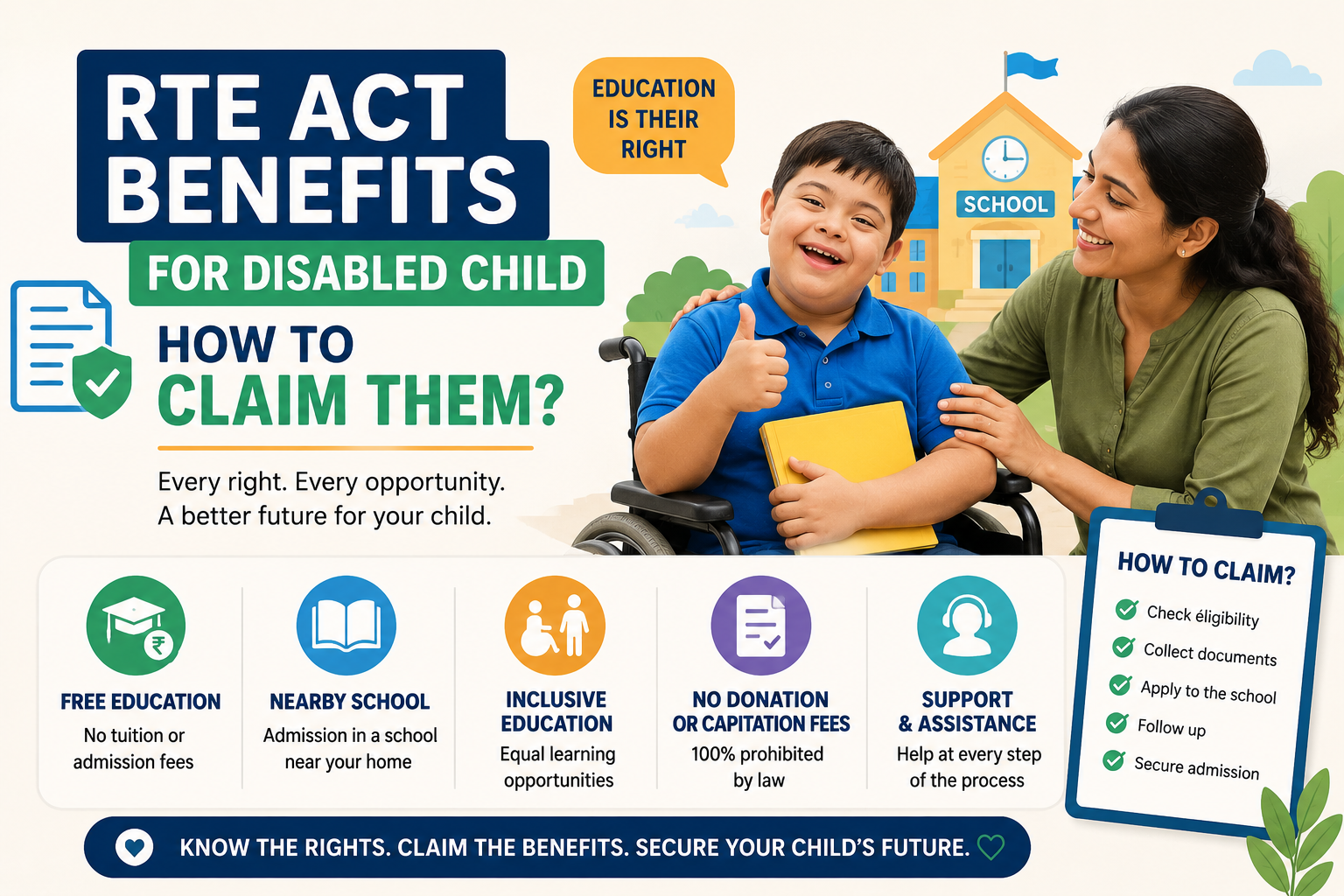
RTE Act Benefits for Disabled Child: How to Claim Them in 2026 🎗️
⚡ What You Need to Know First
RTE Act benefits for disabled child include free education up to age 18, zero discrimination in admissions, 25% reservation in private schools, free special educational support, assistive devices, and the right to a shadow teacher. The Right to Education Act 2009 combined with the RPWD Act 2016 gives every child with a disability in India a powerful legal right to free, appropriate, inclusive education. 💙
If a school has told you your child cannot be admitted because of their disability — that school broke the law.
If a school charged you fees for a child with a disability — that school broke the law.
If a school refused to provide a shadow teacher, learning support, or exam accommodations for your disabled child — that school broke the law.
These are not opinions. They are legal facts. And this guide is going to make every one of them completely clear — in simple words that every parent can understand and act on.
Because your child’s education is not a privilege. It is a constitutional right. And no school — government or private — can take it away.

- ⚡ What You Need to Know First
- 🏛️ What Is the RTE Act? — Simply Explained
- ⚖️ How the RTE Act and RPWD Act Work Together
- 📚 RTE Act Benefits for Disabled Children — Complete List
- Benefit 1 — Free Education Up to Age 18
- Benefit 2 — Admission Cannot Be Refused
- Benefit 3 — 25% Reservation in Private Schools
- Benefit 4 — Appropriate Learning Environment
- Benefit 5 — Special Education Support
- Benefit 6 — Shadow Teacher / One-to-One Aide
- Benefit 7 — Free Assistive Devices
- Benefit 8 — Exam Accommodations
- Benefit 9 — No Expulsion or Denial of Promotion
- Benefit 10 — Home-Based Education for Severe Disabilities
- 🎟️ The 25% Reservation — What It Means for Disabled Children
- 📅 Free Education Up to Age 18 — The Extended Right Explained
- 📝 No Detention Policy — What It Means for Special Needs Children
- 👩🏫 Shadow Teacher Rights Under RTE and RPWD Act
- 🏫 What Schools Are Legally Required to Provide
- Infrastructure Requirements
- Educational Support Requirements
- Material Support Requirements
- Human Support Requirements
- 🏢 Inclusive vs. Special Schools — Your Child’s Legal Choice
- 🪜 How to Use RTE Act Benefits — Step by Step
- Step 1 — Get the Disability Certificate
- Step 2 — Identify Your Target School
- Step 3 — Apply for Admission
- Step 4 — Request an IEP Meeting Before or at Admission
- Step 5 — Request Specific Accommodations in Writing
- Step 6 — Connect With the Block Resource Teacher
- Step 7 — Follow Up on the IEP Annually
- 🚨 What to Do When a School Violates RTE Rights
- 📊 Key Statistics — RTE Act and Disabled Children in India
- 💛 A Parent’s Real Story: “They Said My Daughter Couldn’t Be Admitted. Then I Showed Them the Law.”
- 🔍 What You Should Not Miss About RTE Act and Disability
- 1. 📋 The IEP Is a Legal Document — Not Just a Suggestion
- 2. 🏫 The Neighborhood School Provision — Stronger Than Most Parents Know
- 3. 💰 Reimbursement Under the 25% Quota — What Private Schools Must Not Do
- 4. 📱 Digital Accessibility — The New Frontier of RTE for Disabled Students
- 5. 🎓 Transition Planning — The Gap Between School and Life That RTE Doesn’t Address
- 6. 🌐 Pre-Primary Education — The Most Critical Gap
- 7. ✈️ Transferability — When Families Move States
- ❓ FAQs — Long-Tail Questions Answered
- What are the RTE Act benefits for a disabled child in India?
- Can a private school refuse admission to a disabled child under RTE?
- How do I apply for the 25% RTE quota for my disabled child in a private school?
- Does RTE Act cover children with autism and cerebral palsy?
- What is the age limit for free education for disabled children under RTE?
- How do I complain if a school denies RTE rights to my disabled child?
- Is a shadow teacher free under RTE for a disabled child?
- What is an IEP and is my disabled child entitled to one under RTE?
- Can a disabled child get exam accommodations in school under RTE?
- Does RTE apply to CBSE and private schools for disabled children?
- 🔗 Trusted Resources — RTE Act Rights for Disabled Children
- 🏛️ Government Legal References
- 📚 Education and Disability Data
- 💛 Advocacy and Support Organizations
- 🏥 Legal Aid Resources
- ✨ Final Thoughts: The Law Is on Your Child’s Side — Use It
🏛️ What Is the RTE Act? — Simply Explained
RTE Act benefits for disabled child flow from a law called the Right of Children to Free and Compulsory Education Act 2009 — known as the RTE Act.
The RTE Act says something very simple and very powerful: every child in India has the right to free and compulsory education.
Let us break this down in the simplest possible way.
Free Education
“Free” means the school cannot charge you any fee. No tuition fee. No development fee. No activity fee. No uniform cost. No textbook cost. Nothing.
Compulsory Education
“Compulsory” means the government must ensure that every child gets an education. It is not optional for the government. It must happen.
For Every Child
“Every child” means every child. Rich children. Poor children. Children from cities. Children from villages. Children with disabilities. Children without disabilities.
Every. Single. Child.
The RTE Act originally covered children aged 6 to 14. But here is where it becomes especially important for special needs families:
For children with disabilities — the RTE Act extends free and compulsory education all the way to age 18.
That is four extra years of free education that most families do not know their disabled child is entitled to.
💡 Voice Search Answer — What does the RTE Act say about disabled children?
The Right to Education Act 2009 guarantees free and compulsory education for all children. For children with disabilities, this right extends to age 18 — not just age 14 like for other children. Disabled children cannot be denied admission to any government or government-aided school. Private schools must reserve 25% of seats for disadvantaged children including those with disabilities. All provisions are free of charge.
Reference: Right to Education Act 2009 — Ministry of Education
⚖️ How the RTE Act and RPWD Act Work Together
RTE Act benefits for disabled child are significantly strengthened when combined with another powerful law — the Rights of Persons with Disabilities Act 2016 (RPWD Act).
Think of it this way:
- The RTE Act gives the right to education
- The RPWD Act specifies exactly what that education must look like for a disabled child
Together, they form the most powerful legal protection available to special needs families in India.
What Each Law Adds
| Provision | RTE Act 2009 | RPWD Act 2016 |
|---|---|---|
| Free education | Up to age 14 (age 18 for disabled) | Reinforces and extends |
| Inclusive education | Requires mainstream inclusion | Mandates inclusive education as default |
| No discrimination in admission | Yes — all schools | Yes — explicitly prohibits disability-based discrimination |
| Special education support | Mentioned broadly | Specific IEP, trained staff, support services |
| 25% reservation | Private schools | Extended provisions |
| Assistive devices | Not specifically mentioned | Explicitly required |
| Shadow teacher / aide | Not specifically mentioned | Explicitly required |
| Exam accommodations | Not specifically mentioned | Explicitly required |
| Age limit | 14 (18 for disabled) | No upper age limit for educational rights |
Sources: RTE Act 2009 · RPWD Act 2016
📚 RTE Act Benefits for Disabled Children — Complete List
Here is every RTE Act benefit for disabled child that Indian law guarantees. Print this list. Know it. Use it.

Benefit 1 — Free Education Up to Age 18
All other children have the right to free education up to age 14. Children with disabilities have this right extended to age 18 under Section 3(2) of the RTE Act.
Free means:
- ✅ No tuition fees
- ✅ No admission fees
- ✅ Free textbooks
- ✅ Free uniforms
- ✅ Free mid-day meals
- ✅ Free transportation (where applicable)
Benefit 2 — Admission Cannot Be Refused
No government school or government-aided school can refuse admission to a child with a disability. This includes:
- ✅ Neighborhood government schools
- ✅ Kendriya Vidyalayas
- ✅ State government schools
- ✅ Government-aided private schools
If any of these schools refuses your child’s admission due to disability — it is illegal. Full stop.
Benefit 3 — 25% Reservation in Private Schools
Section 12(1)(c) of the RTE Act requires all private unaided schools to reserve 25% of seats in Class 1 (or nursery/pre-primary) for children from disadvantaged groups and economically weaker sections.
Children with disabilities fall within the “disadvantaged group” category. This means:
- ✅ Your disabled child can apply for admission to any private school under the 25% quota
- ✅ The education is completely free — the school cannot charge any fees for these seats
- ✅ The government reimburses the school for these children’s education costs
Benefit 4 — Appropriate Learning Environment
Schools are required to provide an appropriate learning environment for every child with a disability. This includes:
- ✅ Accessible physical infrastructure (ramps, accessible toilets)
- ✅ Appropriate seating and classroom positioning
- ✅ Sensory-friendly modifications where needed
- ✅ Appropriate learning materials
Benefit 5 — Special Education Support
Children with disabilities are entitled to specialized educational support:
- ✅ Special educators for additional learning support
- ✅ Resource teachers in mainstream schools (Block Resource Teachers under Samagra Shiksha)
- ✅ Individualized Education Plans (IEPs)
- ✅ Remedial teaching
Benefit 6 — Shadow Teacher / One-to-One Aide
Under combined RTE + RPWD Act provisions, children who need one-to-one support in a mainstream classroom are entitled to a shadow teacher (also called an educational aide or inclusion support teacher).
The school — not the parent — is responsible for providing this support.
Benefit 7 — Free Assistive Devices
Children with disabilities in government schools are entitled to free assistive devices through the Samagra Shiksha Abhiyan — the government’s centrally-sponsored education scheme.
This includes:
- ✅ Hearing aids
- ✅ Braille kits
- ✅ Communication boards
- ✅ Adapted furniture
- ✅ Low-vision aids
Benefit 8 — Exam Accommodations
Children with disabilities are entitled to exam accommodations at every level:
- ✅ Extra time
- ✅ Scribe / writer
- ✅ Separate exam room
- ✅ Oral examination option
- ✅ Large print question papers
Benefit 9 — No Expulsion or Denial of Promotion
The RTE Act prohibits schools from expelling or denying promotion to a child on the basis of non-performance in examinations. This is particularly significant for children with disabilities who may progress more slowly academically.
Benefit 10 — Home-Based Education for Severe Disabilities
Under Section 32 of the RPWD Act — for children whose disability is so severe that they cannot attend school — the government must provide home-based education. The education comes to the child.
🎟️ The 25% Reservation — What It Means for Disabled Children
The 25% reservation under RTE Act benefit for disabled child is one of the most powerful but least utilized provisions in Indian education law.
How It Works — Simply Explained
Imagine a private school has 100 seats in Class 1.
Under RTE Section 12(1)(c), 25 of those seats must be reserved for children from disadvantaged groups — including children with disabilities.
These 25 children study completely free. The school is reimbursed by the state government for their education cost.
Who Can Apply
To apply for the 25% RTE quota seat in a private school, a child with a disability needs:
- ✅ Disability Certificate (showing disability — note: many states do not require a minimum disability percentage for RTE quota)
- ✅ Age within the admission age bracket for the school
- ✅ Proof of residence in the school’s neighborhood (usually within a specified distance)
- ✅ Aadhaar card or birth certificate
How to Apply
Step 1 — Find the list of RTE-recognized schools in your area through your state education department website
Step 2 — Apply online through your state’s RTE admission portal during the annual admission window (typically February–April for the following academic year)
Step 3 — Submit disability documentation
Step 4 — Lottery or selection process (if more applicants than seats)
Step 5 — Admission confirmed; school cannot charge any fees
State RTE Admission Portals
| State | Portal |
|---|---|
| Maharashtra | student.maharashtra.gov.in |
| Karnataka | schooleducation.kar.nic.in |
| Delhi | edudel.nic.in |
| Tamil Nadu | rte.tnschools.gov.in |
| Rajasthan | rajpsp.nic.in |
| Gujarat | rte.orpgujarat.com |
| Uttar Pradesh | rte25.upsdc.gov.in |
Reference: Ministry of Education — RTE Implementation
⚠️ Important: Private unaided minority schools are exempt from the 25% RTE reservation. All other private schools are covered.
📅 Free Education Up to Age 18 — The Extended Right Explained
The regular RTE Act gives children free education from age 6 to age 14. But Section 3(2) of the RTE Act extends this right to age 18 for children with disabilities.
This is one of the most important and least known RTE Act benefits for disabled child in India.
What Does This Mean in Practice?
| Child Without Disability | Child With Disability |
|---|---|
| Free education: Age 6–14 | Free education: Age 6–18 |
| 8 years of free schooling | 12 years of free schooling |
| Must complete by Class 8 | Can continue through Class 12 level |
| No extension available | 4 additional years guaranteed |
Why This Extra Time Matters
Children with disabilities often need:
- More time to complete each grade
- Additional years for foundational skill building
- Extended time for vocational and life skills education
The 4 extra years are not charity. They are a legal recognition that children with disabilities may need more time — and that this time must be provided free of charge.
What Schools Cannot Do
Under this provision, schools cannot:
- ❌ Discharge a disabled student at age 14 because “the RTE obligation is over”
- ❌ Start charging fees at age 14 for a disabled child who continues enrollment
- ❌ Refuse to provide support services to a disabled student aged 15–18
📝 No Detention Policy — What It Means for Special Needs Children
The RTE Act originally included a “No Detention Policy” — meaning children could not be held back (detained/failed) in Classes 1 through 8. They were automatically promoted regardless of examination performance.
This policy was significantly modified in 2019. Here is the current position:
Current Position (2019 Amendment)
- Students can now be detained in Class 5 and Class 8 if they fail examinations
- However, students must be given a re-examination opportunity before detention
- The no-detention policy remains in effect for Classes 1–4 and Classes 6–7
What This Means for Children With Disabilities
For children with disabilities — the no-detention provisions interact with the RPWD Act’s requirement for appropriate assessment and reasonable accommodation.
Key protections:
- ✅ Examinations for disabled children must be conducted with appropriate accommodations
- ✅ A child cannot be detained based on an examination that did not accommodate their disability
- ✅ IEP-based assessment — measuring progress against the child’s own individualized goals — is the recommended approach
- ✅ Schools must consult with special educators before making detention decisions for disabled children
Reference: RTE Amendment 2019 — Ministry of Education
👩🏫 Shadow Teacher Rights Under RTE and RPWD Act
The shadow teacher — also called an educational aide, one-to-one assistant, or inclusion support teacher — is one of the most valuable and most contested RTE Act benefits for disabled child in practice.
What Is a Shadow Teacher?
A shadow teacher is a trained professional who supports a child with a disability within a mainstream classroom. They:
- ✅ Provide individualized attention alongside the class teacher
- ✅ Adapt classroom activities for the child’s needs
- ✅ Support communication for non-verbal children
- ✅ Assist with physical tasks for children with motor difficulties
- ✅ Implement the child’s IEP goals throughout the school day
The Legal Position on Shadow Teachers
The RPWD Act 2016, Section 16(i) requires governments and schools to provide “necessary support individualized or otherwise in environments that maximize academic and social development.” This is widely interpreted to include shadow teacher provision.
Additionally, under Samagra Shiksha Abhiyan — the government funds:
- Resource teachers at Block level for inclusive education
- In-school special educator support
- Training for regular teachers on inclusion
The Reality — And What Parents Can Do
In practice, government provision of shadow teachers is inconsistent. Here is how parents can push for this right:
Step 1 — Get a formal recommendation from your child’s therapist or special educator stating that a shadow teacher is needed
Step 2 — Write formally to the school Principal and District Education Officer requesting shadow teacher provision
Step 3 — If the school denies it — file a complaint with the State Commission for Protection of Child Rights (SCPCR)
Step 4 — Contact the Block Resource Centre under Samagra Shiksha about the resource teacher assigned to your child’s school
Step 5 — If government provision is delayed, raise the issue with the State Disability Commissioner
🏫 What Schools Are Legally Required to Provide
Under combined RTE Act benefits for disabled child provisions and the RPWD Act, here is a complete list of what schools must legally provide:
Infrastructure Requirements
- ✅ Wheelchair-accessible entrance — ramps, no steps at entry
- ✅ Accessible classrooms — ground floor for children who cannot use stairs
- ✅ Accessible toilets — at least one toilet accessible for wheelchair users
- ✅ Accessible drinking water — at accessible height
Educational Support Requirements
- ✅ Individualized Education Plan (IEP) — written for each disabled child; reviewed annually
- ✅ Modified curriculum — appropriate to the child’s learning level
- ✅ Differentiated instruction — teaching methods that accommodate the child’s learning style
- ✅ Regular progress monitoring — against IEP goals, not only against grade-level curriculum
- ✅ Parent involvement — IEP meetings must include parents
Material Support Requirements
- ✅ Assistive devices — provided free through Samagra Shiksha for government school students
- ✅ Adapted textbooks — braille, large print, audio formats as needed
- ✅ Adapted stationery — pencil grips, adapted scissors, weighted tools
- ✅ Communication support — AAC devices, symbol boards, PECS materials
Human Support Requirements
- ✅ Trained special educator — on staff or visiting regularly
- ✅ Resource room — dedicated space for additional learning support
- ✅ Shadow teacher — where individually required
- ✅ Sign language interpreter — for deaf children in mainstream settings
Source: Samagra Shiksha — Inclusive Education Guidelines
🏢 Inclusive vs. Special Schools — Your Child’s Legal Choice
A critical RTE Act benefit for disabled child that most parents are not aware of: the choice of educational setting belongs to the parent and child — not to the school or the government officer.
The Default — Inclusive Education
Under both the RTE Act and the RPWD Act, inclusive education in mainstream schools is the default right. This means:
- The government must first attempt to include your disabled child in a mainstream neighborhood school
- The mainstream school must provide all necessary support to make inclusion work
- A disabled child cannot be redirected to a special school simply because it is more convenient for the system
The Exception — Parental Choice
However, if you as a parent believe a special school better serves your child’s needs — you have the right to choose it. And if the government runs or funds the special school — it must be provided free of charge.
The Honest Conversation
Neither inclusive education nor special school is universally “better.” The right choice depends on your child’s:
- Type and severity of disability
- Communication level
- Available local options
- Family circumstances
What matters legally is that the choice is yours to make — not a bureaucrat’s, not a school principal’s.
🪜 How to Use RTE Act Benefits — Step by Step
Here is exactly how to access RTE Act benefits for disabled child in practice.
Step 1 — Get the Disability Certificate
Visit your nearest government district hospital Medical Board. Get a Disability Certificate showing disability type and percentage. Also apply for the UDID Card at swavlambancard.gov.in.
Decide between:
Step 2 — Identify Your Target School
- Option A — Neighborhood government school (entitled by right)
- Option B — Government-aided school (entitled by right)
- Option C — Private school under 25% RTE quota
Step 3 — Apply for Admission
For government schools: submit application directly with Disability Certificate and Aadhaar.
For private schools under 25% quota: apply through your state’s RTE admission portal (see portals listed above).
Step 4 — Request an IEP Meeting Before or at Admission
Write to the school Principal requesting an Individualized Education Plan (IEP) meeting within the first month of admission. Bring your child’s therapists’ reports and recommendations. The IEP should be a collaborative document — school staff + parents + therapists.
Step 5 — Request Specific Accommodations in Writing
Submit a written letter to the Principal listing every accommodation your child needs:
- Shadow teacher (if required)
- Assistive devices
- Exam accommodations
- Physical accessibility modifications
- Resource room access
Always communicate in writing. Keep copies of everything.
Step 6 — Connect With the Block Resource Teacher
Under Samagra Shiksha, every educational Block has Resource Teachers for different disability categories. Ask the school to connect you with the Block Resource Teacher assigned to your child’s disability area.
Step 7 — Follow Up on the IEP Annually
The IEP must be reviewed at least annually. Attend every IEP meeting. Bring updated therapist reports. Push for goals that are ambitious but realistic.
🚨 What to Do When a School Violates RTE Rights
RTE Act benefits for disabled child are not self-implementing. When schools violate these rights — and many do — parents need to know exactly where to complain.
Escalation Pathway — Step by Step
Level 1 — School Principal
Write a formal complaint letter to the Principal. State the specific right being violated. Give 7 days to respond. Keep a copy.
Level 2 — District Education Officer (DEO)
If the school does not respond or the problem continues — file a written complaint with the DEO. Include your previous correspondence with the school.
Level 3 — State Commission for Protection of Child Rights (SCPCR)
Every state has an SCPCR with the power to investigate RTE violations and direct schools to comply. Find your state’s SCPCR at ncpcr.gov.in.
Level 4 — National Commission for Protection of Child Rights (NCPCR)
For cases where state-level redress has failed — file with NCPCR online at ncpcr.gov.in. NCPCR has the power to impose penalties on schools violating RTE.
Level 5 — State Disability Commissioner
For disability-specific violations — including under the RPWD Act 2016 — file with the State Commissioner for Persons with Disabilities.
Level 6 — High Court
If all else fails — file a writ petition in the State High Court. Many parents have successfully used the court system to enforce RTE and RPWD rights for their disabled children. Legal aid is available through District Legal Services Authorities (DLSA) — free of charge.
Important — Always Communicate in Writing
When dealing with schools about your child’s rights:
- ✅ Always submit complaints in writing (email or registered post)
- ✅ Keep copies of everything
- ✅ Note dates of every interaction
- ✅ If verbal conversations happen — follow up with a written summary: “As discussed today, I am confirming that…”
Written records protect you if the dispute escalates.
📊 Key Statistics — RTE Act and Disabled Children in India
| Statistic | Figure | Source |
|---|---|---|
| Children with disabilities in India under 19 | 78 lakh (7.8 million) | Census of India 2011 |
| Children with disabilities enrolled in school | ~61% | UDISE+ Report 2022–23 |
| Children with disabilities out of school | ~28 lakh estimated | UDISE+ Report 2022–23 |
| States with RTE online admission portals for disability | 25+ states | Ministry of Education |
| Samagra Shiksha disability component budget (2023–24) | ₹4,000+ crore | Ministry of Education Annual Report |
| Children with disabilities in mainstream government schools | ~29 lakh | UDISE+ 2022–23 |
| Special schools recognized by government | 600+ | Rehabilitation Council of India |
| Private schools required to implement 25% RTE quota | All unaided non-minority private schools | RTE Act Section 12 |
| Complaints filed with NCPCR related to disabled children (annually) | Thousands | NCPCR Annual Report |
| Age extension for free education for disabled children | Up to age 18 (vs 14 for others) | RTE Act Section 3(2) |
💛 A Parent’s Real Story: “They Said My Daughter Couldn’t Be Admitted. Then I Showed Them the Law.”
“My daughter Riya has Down syndrome. She is eight years old now. When she was five, we tried to get her admitted to the government primary school in our area in Jaipur.
The headteacher told us — very politely, very firmly — that the school was not equipped for children like Riya. That she would be better off at a special school. That they did not have trained staff. That other children would be disturbed.
I was devastated. I did not know what to say. I went home and cried for two days.
Then I spoke to another parent in our Down syndrome parent group — a mother who had been fighting these battles for three years. She told me to go back with a piece of paper.
She helped me print Section 3(2) and Section 12 of the RTE Act. She told me to write a formal letter to the school requesting admission under these provisions, citing the RPWD Act 2016 Section 16, and stating that denial of admission on the basis of disability is illegal.
I was terrified. I had never written a legal letter. But I wrote it. I submitted it in person. I asked for a written response.
Within one week — Riya had an admission date.
The school gave her a seat in Class 1. They connected us with the Block Resource Teacher. Riya now has a resource room session three times a week. Her class teacher has been genuinely kind — she was just never trained or told this was possible.
Riya is thriving. She knows all her classmates by name. She loves art class. Last week she brought home a drawing she made herself and said “Mama, look.”
All of this happened because I showed them the law.
You have the same law. Use it.”
— Kavita S., mother of Riya (Down syndrome), Jaipur, Rajasthan 💙
🔍 What You Should Not Miss About RTE Act and Disability
1. 📋 The IEP Is a Legal Document — Not Just a Suggestion
Most parents and even many teachers treat the Individualized Education Plan as a school’s internal document — something they write and file away. In reality, the IEP is a legally binding commitment by the school to provide specific educational support to a specific child.
If the school writes an IEP and then does not implement it — that is a breach of the educational right under the RPWD Act. Parents should: read the IEP carefully before signing, ensure it contains specific, measurable goals (not vague statements), keep a copy, and formally request an update meeting if goals are not being met.
2. 🏫 The Neighborhood School Provision — Stronger Than Most Parents Know
The RTE Act’s neighborhood school provision means that your disabled child has a priority right to attend the nearest government school to your home — regardless of whether that school currently has inclusive education infrastructure. The school’s unpreparedness is the government’s problem to solve — not a reason to deny your child admission. Schools that claim they are “not set up” for inclusion are required to become set up — and Samagra Shiksha funds exist specifically to pay for this transformation.
3. 💰 Reimbursement Under the 25% Quota — What Private Schools Must Not Do
Private schools receiving RTE 25% quota students often attempt to extract money from these families through indirect means — “voluntary” donations, parent association fees, activity fees, uniform fees at specific shops. All of these are illegal. Every single cost associated with the education of an RTE quota student must be borne by the school and reimbursed by the government. Document and report any attempt by a private school to charge money to an RTE quota family.
4. 📱 Digital Accessibility — The New Frontier of RTE for Disabled Students
As Indian schools increasingly move to digital learning platforms — particularly post-COVID — a new barrier has emerged for children with visual impairment, physical disability, and intellectual disability.
Digital content that is not accessible (no audio description, no keyboard navigation, no simplified language option) effectively excludes disabled children from the learning environment. The RPWD Act’s accessibility provisions apply to digital educational content. Parents of disabled children whose schools use inaccessible digital platforms have the right to request accessible alternatives.
5. 🎓 Transition Planning — The Gap Between School and Life That RTE Doesn’t Address
The RTE Act ends at age 18. And at 18, most disabled students face a catastrophic “transition cliff” — no structured pathway from school to further education, vocational training, or employment. This transition gap is one of the most significant failures of the current legal framework.
Families should begin planning for post-school life from age 14 — pursuing NIOS vocational courses, connecting with NHFDC for employment support loans, and identifying adult disability day programs before the school chapter ends.
6. 🌐 Pre-Primary Education — The Most Critical Gap
The RTE Act begins at age 6. But the most neurologically critical period for children with disabilities is birth to age 6 — the early intervention window. India’s early childhood education framework (under the National Education Policy 2020 and ICDS Anganwadi system) does not robustly include children with disabilities.
The most powerful advocacy for disabled children’s educational rights in India right now is around extending meaningful legal protection to the birth-to-6 age group — where the investment produces the greatest return.
7. ✈️ Transferability — When Families Move States
A common problem: a family establishes their disabled child in a school with a good IEP and resource teacher support, then moves to a different city. The IEP does not automatically transfer. The child must start the admission process again.
In the new state, the parent may face resistance and delays. The legal rights, however, remain fully transferable — the child’s disability rights travel with them. Always carry certified copies of previous IEPs, Disability Certificate, UDID Card, and therapist reports when relocating.
❓ FAQs — Long-Tail Questions Answered
What are the RTE Act benefits for a disabled child in India?
RTE Act benefits for disabled child include: free education up to age 18, no discrimination in admissions, 25% reservation in private schools, free assistive devices, shadow teacher support, individualized education plans, exam accommodations, accessible infrastructure, and home-based education for severe disabilities. These rights are legally enforceable.
Can a private school refuse admission to a disabled child under RTE?
No. Private schools participating in the 25% RTE quota cannot refuse admission to a disabled child who qualifies under the disadvantaged group category. Government and government-aided schools cannot refuse admission to any disabled child. Refusal on grounds of disability is illegal under both the RTE Act and RPWD Act 2016.
How do I apply for the 25% RTE quota for my disabled child in a private school?
Apply through your state’s online RTE admission portal during the annual admission window (typically February–April). Submit your child’s Disability Certificate, Aadhaar, birth certificate, and proof of residence within the school’s neighborhood. Admission is free — the school cannot charge any fees to RTE quota students.
Does RTE Act cover children with autism and cerebral palsy?
Yes. All 21 disabilities recognized under the RPWD Act 2016 — including autism spectrum disorder, cerebral palsy, intellectual disability, Down syndrome, visual impairment, hearing impairment, and others — are covered under RTE Act disability provisions. Children with these conditions qualify for all RTE disability benefits including free education to age 18.
What is the age limit for free education for disabled children under RTE?
Under Section 3(2) of the RTE Act, children with disabilities are entitled to free and compulsory education up to age 18. This is four years more than the age 14 limit for other children. Schools cannot charge fees for disabled children up to age 18 and cannot deny them educational support during this extended period.
How do I complain if a school denies RTE rights to my disabled child?
Write a formal complaint to the school Principal first. If unresolved, escalate to the District Education Officer, then the State Commission for Protection of Child Rights (SCPCR) at ncpcr.gov.in, then the National Commission for Protection of Child Rights (NCPCR). For disability-specific violations, also approach the State Commissioner for Persons with Disabilities. Free legal aid is available through District Legal Services Authorities.
Is a shadow teacher free under RTE for a disabled child?
Under Samagra Shiksha Abhiyan, government schools are allocated Block Resource Teachers who provide support to disabled children across multiple schools. For children who need dedicated one-to-one shadow teacher support, the school and government are legally required to arrange this under RPWD Act Section 16(i). Parents should request this in writing and escalate if denied.
What is an IEP and is my disabled child entitled to one under RTE?
An IEP (Individualized Education Plan) is a customized learning plan written specifically for a child with a disability. Under the RPWD Act 2016, all children with disabilities in Indian schools are entitled to an IEP. The IEP outlines specific educational goals, support services, accommodations, and assessment methods appropriate for the individual child. Schools are legally required to create, implement, and review IEPs annually.
Can a disabled child get exam accommodations in school under RTE?
Yes. Children with disabilities are entitled to exam accommodations including extra time, scribe or writer facility, separate examination room, oral examination option, and large print question papers. These accommodations apply to school-level examinations and board examinations. Parents must request accommodations in writing with supporting Disability Certificate documentation well before the examination.
Does RTE apply to CBSE and private schools for disabled children?
Yes. RTE provisions apply to all schools — government, government-aided, and private unaided schools (for the 25% quota). CBSE-affiliated schools must follow both RTE Act requirements and RPWD Act provisions. The 25% reservation applies to all private unaided non-minority schools regardless of board affiliation.
🔗 Trusted Resources — RTE Act Rights for Disabled Children
🏛️ Government Legal References
- Right to Education Act 2009 — Full Text — Complete RTE Act text
- RPWD Act 2016 — Disability Affairs Division — Full RPWD Act text
- National Commission for Protection of Child Rights — RTE complaints; child rights
- Samagra Shiksha — Inclusive Education — School support schemes
- Ministry of Education — RTE Implementation — State-wise implementation data
📚 Education and Disability Data
- UDISE+ Data Portal — National school and disability enrollment data
- Rehabilitation Council of India — Special educator certification
- UDID Portal — UDID Card application
💛 Advocacy and Support Organizations
- Disability Rights India Foundation (DRIF) — Legal support for disability rights
- NCPEDP — National Centre for Promotion of Employment for Disabled — Rights advocacy
- Action for Autism India — Autism education rights
- ADAPT India — CP inclusion education support
- Vidya Sagar — Inclusive education resources
🏥 Legal Aid Resources
✨ Final Thoughts: The Law Is on Your Child’s Side — Use It
RTE Act benefits for disabled child are not theoretical provisions buried in legal textbooks. They are real, enforceable rights that have been used by parents across India to open school doors that were slammed shut, to force schools to provide shadow teachers they refused to arrange, and to get private schools to admit children who were turned away.
Kavita in Jaipur showed a school a piece of paper — and her daughter Riya’s life changed. 💙
You have the same piece of paper. This entire article is your piece of paper.
The law says:
✅ Your child cannot be denied admission
✅ Education is free until age 18
✅ Private schools must reserve seats
✅ IEPs are your child’s right
✅ Shadow teachers exist for children who need them
✅ Exam accommodations are mandatory
✅ Complaints will be heard — from DEO to NCPCR to High Court
Your child’s education is not a favor any school is doing your family. It is a constitutional right that every child in this country — with any disability, of any background, from any city or village — is entitled to.
Know your rights. Use your rights. And never let anyone tell your child that their education is negotiable.
Here is your action plan:
✅ This week: Get your child’s Disability Certificate and UDID Card if you do not have them
✅ This week: Identify your target school — government neighborhood school or private 25% quota
✅ This month: Apply for admission in writing, citing RTE Section 3(2) and Section 12(1)(c)
✅ First month of school: Request an IEP meeting and submit written requests for all required accommodations
✅ If denied: Write to the DEO. Escalate to SCPCR. Use the law.
The door to your child’s education is open. The law opened it. Now walk through it together. 🎗️
⚠️ Disclaimer: This article is written for informational and educational purposes only. Laws and their implementation vary by state. Always consult a qualified education law advocate or the District Legal Services Authority for advice specific to your situation.


