
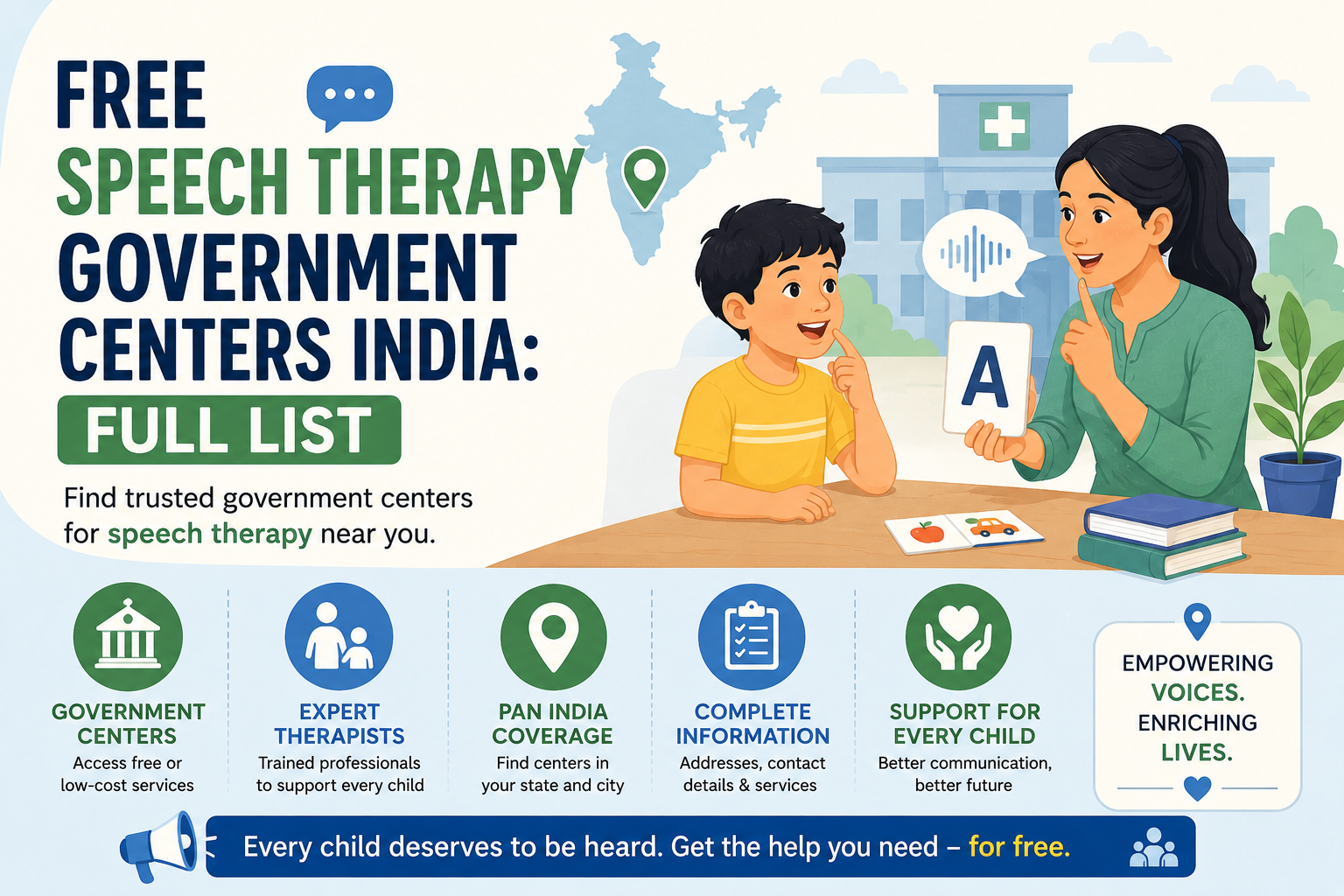
Free Speech Therapy Government Centers India: 2026 Full List🎗️
⚡ What You Need to Know First
Free speech therapy government centers India exist across the country through institutions like AIIMS, NIMHANS, Ali Yavar Jung National Institute, district government hospitals, and Samagra Shiksha-funded school programs. Children with autism, cerebral palsy, intellectual disability, hearing impairment, cleft palate, and stuttering qualify. Services are free or heavily subsidized. A doctor’s referral and Disability Certificate open access. 💙
Your child has something to say.
Maybe not yet in words. Maybe in sounds, gestures, a look in their eyes that tells you exactly what they mean even when the words will not come. But the voice — the unique, irreplaceable voice of your child — is in there.
Speech therapy helps bring it out. And in India in 2026, you do not need to spend ₹2,000 per session to access it.
Free speech therapy government centers India are real. They exist. And this guide is going to tell you exactly where they are, how to access them, and what to expect when you get there.

- ⚡ What You Need to Know First
- 🗣️ What Is Speech Therapy? — Simply Explained
- 🧩 Which Children Need Speech Therapy?
- ⏰ Why Early Speech Therapy Changes Everything
- 🏛️ National Government Institutes Offering Free Speech Therapy
- 🔬 NIMHANS — Speech Therapy in Bangalore
- 🏥 AIIMS and Government Medical Colleges
- AIIMS Campuses With Speech Therapy Services
- Government Medical Colleges — ENT and Audiology Departments
- 🗺️ State-Level Government Speech Therapy Centers — City by City
- Delhi & NCR
- Mumbai & Maharashtra
- Bangalore & Karnataka
- Chennai & Tamil Nadu
- Hyderabad & Telangana / Andhra Pradesh
- Kolkata & West Bengal
- Other Key Cities
- 📚 School-Based Speech Therapy — Samagra Shiksha
- 👶 RBSK — Free Speech Screening for Children
- 🪜 How to Access Free Speech Therapy — Step by Step
- Step 1 — Get a Medical Assessment
- Step 2 — Obtain a Disability Certificate (If Applicable)
- Step 3 — Contact Your Nearest Government Center
- Step 4 — Complete the Assessment
- Step 5 — Receive Therapy Plan and Begin Sessions
- Step 6 — Maintain Consistency and Track Progress
- 📝 What to Expect in Speech Therapy Sessions
- 🏠 Home Practice — How to Support Therapy Between Sessions
- 📊 Key Statistics — Speech Therapy and Communication Disorders in India
- 💛 A Parent’s Real Story: “At 4 Years Old, Rohan Said ‘Mama’ for the First Time. We Cried for an Hour.”
- 🔍 What You Must Not Miss About Free Speech Therapy in India
- 1. 🎓 The RCI Registration — How to Verify Your Therapist Is Qualified
- 2. 🌐 Teletherapy — The New Frontier of Free Speech Therapy Access
- 3. 🏘️ Community-Based Rehabilitation (CBR) — Reaching Rural Families
- 4. 🧪 Functional Communication Vs. Oral Speech — The Critical Distinction
- 5. 💰 The ADIP Scheme for Communication Devices — Completely Underused
- 6. 🎭 Group Therapy — The Power of Peer Communication
- 7. 🗓️ The Waiting List Reality — And How to Navigate It
- ❓ FAQs
- Where can I get free speech therapy for my child in India?
- Is speech therapy free at government hospitals in India?
- What is the Ali Yavar Jung National Institute and how do I access it?
- At what age should I start speech therapy for my child?
- Can autistic children benefit from speech therapy at government centers?
- How do I get a speech therapy referral in India?
- Is speech therapy available for stuttering at government centers in India?
- What documents do I need for free speech therapy at government centers?
- Does insurance cover speech therapy in India?
- How long does speech therapy take to show results for children?
- 🔗 Trusted Resources — Free Speech Therapy in India
- ✨ Final Thoughts: Your Child’s Voice Is Worth Fighting For
🗣️ What Is Speech Therapy? — Simply Explained
Free speech therapy government centers India exist to help children and adults who have difficulty with speech, language, communication, or swallowing. But first — let us understand what speech therapy actually is.
Think of it this way. Imagine your child’s voice is like a garden. All the plants are there — the thoughts, the feelings, the things they want to say. But something is blocking the water from reaching them. Speech therapy is the person who finds the blockage and clears it — so the garden can grow.
A speech therapist — also called a Speech and Language Therapist (SLT) or Speech-Language Pathologist (SLP) — is a trained professional who works on:
What Speech Therapists Work On
| Area | What It Means | Example |
|---|---|---|
| Articulation | How sounds are made | Child says “wabbit” instead of “rabbit” |
| Language | Understanding and using words | Child cannot follow instructions or use sentences |
| Fluency | Smooth, flowing speech | Child stutters or stammers |
| Voice | Pitch, volume, quality | Child’s voice is too loud, too soft, or hoarse |
| Pragmatics | Social use of language | Child cannot take conversational turns |
| AAC | Alternative communication | Using devices, signs, pictures to communicate |
| Feeding and swallowing | Safe eating and drinking | Child gags, chokes, or has difficulty swallowing |
| Oral motor function | Muscle control for speech | Weak lip or tongue movement |
Speech therapy is not about forcing a child to speak. It is about finding every possible way your child can communicate — and making that pathway stronger, clearer, and more effective.
💡 Voice Search Answer — What is speech therapy for children in India?
Speech therapy for children in India is provided by trained Speech and Language Therapists to help children with difficulties in speaking, understanding language, communicating, and swallowing. It helps children with autism, cerebral palsy, hearing impairment, intellectual disability, cleft palate, stuttering, and developmental delays. Free speech therapy is available at government hospitals, national institutes like Ali Yavar Jung, NIMHANS, AIIMS, and through Samagra Shiksha school programs.
🧩 Which Children Need Speech Therapy?
Before exploring free speech therapy government centers India, parents need to know whether their child actually needs speech therapy — because many families delay seeking help, hoping children will “catch up” on their own.
Conditions That Commonly Require Speech Therapy
| Condition | How Speech Therapy Helps |
|---|---|
| Autism Spectrum Disorder | Language development, AAC, pragmatic communication, echolalia management |
| Cerebral Palsy | Oral motor function, dysarthria, AAC, feeding and swallowing |
| Intellectual Disability | Vocabulary development, language comprehension, functional communication |
| Hearing Impairment | Oral speech development, lip reading support, cochlear implant rehabilitation |
| Cleft Lip and Palate | Articulation therapy post-surgery, hypernasality management |
| Stuttering / Stammering | Fluency techniques, confidence building, communication strategies |
| Developmental Language Delay | Vocabulary building, sentence structure, comprehension |
| Down Syndrome | Oral motor therapy, language development, intelligibility improvement |
| Selective Mutism | Gradual communication building, anxiety management |
| Aphasia / Acquired disorders | Recovery of language function post-stroke or injury |
Developmental Red Flags — When to Seek Help
If your child is:
- 12 months — not babbling or making sounds
- 15 months — not using any single words
- 18 months — fewer than 10 words; not pointing to things
- 24 months — not combining two words; fewer than 50 words
- 3 years — speech is difficult for familiar people to understand; not using sentences
- 4 years — speech is difficult for strangers to understand; stuttering started after age 3
- Any age — sudden loss of previously acquired speech or language skills
Do not wait. Contact your pediatrician for a referral. The research on early intervention is absolutely clear: earlier is always better.
⏰ Why Early Speech Therapy Changes Everything
Free speech therapy government centers India matter so urgently because of the neuroscience of language development.
The brain has a language-sensitive period — a window during the early years when language pathways are being formed at an extraordinary rate. During this window:
- Neural connections for language are highly plastic (changeable)
- New language patterns can be established more easily than at any later point
- The brain can compensate for delays more effectively
- The investment in therapy produces the largest return
This window does not stay open forever. It is most active from birth to age 5. After age 7, it begins narrowing. After adolescence, language learning and remediation become significantly harder — not impossible, but harder.
Every month of early speech therapy during the preschool years produces more benefit than years of therapy begun in school age.
This is why finding free speech therapy government centers India now — not next year — is one of the most important things you can do for your child.
Source: National Institute on Deafness and Other Communication Disorders — NIDCD
🏛️ National Government Institutes Offering Free Speech Therapy
India has a network of nationally funded institutes that provide world-class speech therapy — completely free or at heavily subsidized rates. These are the backbone of free speech therapy government centers India.

Tier 1 — National Institutes Under Ministry of Social Justice
These are the highest-level government speech therapy resources in India.
1. Ali Yavar Jung National Institute of Speech and Hearing Disabilities (AYJNISHD)
The most important single institution for free speech therapy government centers India.
Main campus: Mumbai (Bandra) Regional centers: Delhi, Kolkata, Bhubaneswar, Secunderabad
Services provided completely free:
- ✅ Comprehensive speech and language assessment
- ✅ Individual speech therapy
- ✅ Group therapy programs
- ✅ Hearing assessment and hearing aid fitting
- ✅ Cochlear implant rehabilitation therapy
- ✅ Stuttering treatment programs
- ✅ AAC assessment and training
- ✅ Cleft palate speech therapy
- ✅ Parent training and home program guidance
- ✅ Teacher training for inclusive communication
AYJNISHD also trains India’s speech therapists — meaning their clinical staff represent the most current, evidence-based practice in the country.
Contact: www.ayjnishd.gov.in
2. NIEPID — National Institute for Empowerment of Persons with Intellectual Disabilities
Main campus: Manovikasnagar, Secunderabad (Hyderabad) Regional centers: Multiple across India
Speech therapy services at NIEPID focus on children and adults with intellectual disability, autism, Down syndrome, and multiple disabilities.
Services:
- ✅ Communication assessment for non-verbal and minimally verbal individuals
- ✅ AAC system selection and training
- ✅ Functional communication development
- ✅ Parent and teacher training programs
Contact: www.niepid.nic.in
3. NILD — National Institute for the Locomotor Disabled
Kolkata-based institute providing speech therapy as part of comprehensive rehabilitation for children with locomotor disabilities including cerebral palsy.
Contact via Ministry of Social Justice: socialjustice.gov.in
4. National Institute for Mentally Handicapped (NIMH) Regional Centers
Multiple regional centers providing speech therapy integrated with intellectual disability rehabilitation services.
🔬 NIMHANS — Speech Therapy in Bangalore
The National Institute of Mental Health and Neurosciences (NIMHANS) in Bangalore is one of India’s most prestigious institutions — and a critical resource for free speech therapy government centers India.
What NIMHANS Provides
- ✅ Child Psychiatry and Neurology Department — comprehensive assessment for autism, language disorders, ADHD
- ✅ Speech-Language Pathology services — individual and group therapy
- ✅ Communication DEALL Program — a pioneering autism-specific communication therapy developed at NIMHANS, widely used across India
- ✅ AAC assessment and intervention
- ✅ Caregiver training programs
- ✅ Research-linked clinical programs — access to latest evidence-based approaches
DEALL — A NIMHANS Innovation for Autism Communication
The DEALL (Developmental, Individual Difference, Relationship-based) approach developed at NIMHANS is one of India’s most important contributions to autism communication therapy. It integrates speech therapy with developmental and sensory approaches — and is evidence-based within the Indian context.
Families who cannot physically access NIMHANS can ask their local speech therapist about DEALL training — the program has been disseminated across India.
Contact: www.nimhans.ac.in
🏥 AIIMS and Government Medical Colleges
AIIMS (All India Institute of Medical Sciences) campuses across India and government medical colleges are critical free speech therapy government centers India — particularly for children with complex medical conditions requiring integrated care.
AIIMS Campuses With Speech Therapy Services
| AIIMS Campus | Key Services | Contact |
|---|---|---|
| AIIMS New Delhi | Comprehensive SLP; cochlear implant rehab; cleft palate | www.aiims.edu |
| AIIMS Bhopal | SLP services; neurology-linked therapy | www.aiimsbhopal.edu.in |
| AIIMS Jodhpur | SLP assessment and therapy | www.aiims.edu/en/aiims-jodhpur.html |
| AIIMS Rishikesh | SLP with neurology integration | www.aiimsrishikesh.edu.in |
| AIIMS Bhubaneswar | SLP services | www.aiimsbhubaneswar.edu.in |
| AIIMS Patna | SLP assessment | www.aiimspatna.org |
Government Medical Colleges — ENT and Audiology Departments
Every government medical college in India has an ENT (Ear, Nose, Throat) department with audiological services — and most have speech-language pathology services either within ENT or in a dedicated department.
Services available at government medical college SLP departments:
- ✅ Hearing and speech assessment
- ✅ Individual speech therapy
- ✅ Stuttering therapy
- ✅ Voice disorders treatment
- ✅ Post-surgical speech therapy (cleft palate, laryngectomy)
- ✅ Aphasia rehabilitation
How to access: Visit the hospital outpatient department (OPD). Ask for ENT or Speech and Language Pathology OPD. A referral from your pediatrician speeds the process.
🗺️ State-Level Government Speech Therapy Centers — City by City
Beyond national institutes, every state in India has government speech therapy resources through state hospitals, rehabilitation centers, and district health infrastructure.
Delhi & NCR
| Institution | Services | Contact |
|---|---|---|
| AYJNISHD Delhi Regional Centre | Full speech therapy; AAC; hearing | ayjnishd.gov.in |
| AIIMS New Delhi — SLP Department | Comprehensive; cochlear implant rehab | aiims.edu |
| Safdarjung Hospital | SLP outpatient services | Delhi Government |
| Lady Hardinge Medical College | SLP and audiology | Delhi Government |
| LNJP Hospital SLP Services | Assessment and therapy | Delhi Government |
Mumbai & Maharashtra
| Institution | Services | Contact |
|---|---|---|
| AYJNISHD Main Campus — Bandra | India’s premier SLP institute; all services free | ayjnishd.gov.in |
| KEM Hospital | SLP outpatient; swallowing therapy | Mumbai Government |
| BYL Nair Hospital | SLP and audiology | Mumbai Government |
| Civil Hospital Nagpur | SLP services | Maharashtra Government |
| Civil Hospital Pune | Speech therapy; hearing | Maharashtra Government |
Bangalore & Karnataka
| Institution | Services | Contact |
|---|---|---|
| NIMHANS | Autism communication; SLP; AAC | nimhans.ac.in |
| Bangalore Medical College & Research Institute | SLP outpatient | Karnataka Government |
| Victoria Hospital | SLP and ENT-linked services | Karnataka Government |
| Dharwad Institute of Mental Health | SLP for intellectual disability | Karnataka Government |
Chennai & Tamil Nadu
| Institution | Services | Contact |
|---|---|---|
| Government Stanley Medical College | SLP outpatient | Tamil Nadu Government |
| Government Kilpauk Medical College | SLP services | Tamil Nadu Government |
| Institute of Child Health Chennai | Pediatric SLP | Tamil Nadu Government |
| AYJNISHD Chennai Outreach | Regional services | ayjnishd.gov.in |
Hyderabad & Telangana / Andhra Pradesh
| Institution | Services | Contact |
|---|---|---|
| NIEPID — Secunderabad | Communication therapy for ID and autism | niepid.nic.in |
| AYJNISHD Secunderabad Regional Centre | Full SLP services | ayjnishd.gov.in |
| Osmania General Hospital | SLP outpatient | Telangana Government |
| Gandhi Hospital | SLP services | Telangana Government |
Kolkata & West Bengal
| Institution | Services | Contact |
|---|---|---|
| AYJNISHD Kolkata Regional Centre | Full SLP services | ayjnishd.gov.in |
| NILD Kolkata | SLP for locomotor disabilities | socialjustice.gov.in |
| Medical College Kolkata | SLP outpatient | West Bengal Government |
| NRS Medical College | SLP and audiology | West Bengal Government |
Other Key Cities
| City | Key Center | Contact |
|---|---|---|
| Ahmedabad | Civil Hospital; BJ Medical College SLP | Gujarat Government |
| Jaipur | SMS Medical College SLP; RUHS | Rajasthan Government |
| Lucknow | SGPGI SLP Department; King George Medical University | UP Government |
| Chandigarh | PGIMER SLP Department | pgimer.edu.in |
| Bhopal | AIIMS Bhopal SLP; Hamidia Hospital | MP Government |
| Kochi | Government Medical College SLP; IQRAA Hospital | Kerala Government |
📚 School-Based Speech Therapy — Samagra Shiksha
One of the most widely available but underutilized forms of free speech therapy government centers India is the school-based provision under Samagra Shiksha Abhiyan — India’s centrally-sponsored school education scheme.
What Samagra Shiksha Provides for Communication
Under the inclusive education component of Samagra Shiksha:
- ✅ Block Resource Teachers (BRTs) — trained in disability including communication disorders; deployed to support children in multiple government schools
- ✅ Itinerant teachers — visiting specialists who provide speech-language support in schools
- ✅ Resource rooms — dedicated spaces for specialist support including communication therapy
- ✅ Assistive communication devices — provided free to eligible children
- ✅ Teacher training — mainstream teachers trained in inclusive communication strategies
How to Access School-Based Speech Therapy
Step 1 — Enroll your child in a government school
Step 2 — Inform the school Principal of your child’s communication disorder with supporting documentation (Disability Certificate, medical reports)
Step 3 — Request that your child be included in the Block Resource Teacher’s support program
Step 4 — Ask for the contact details of the Block Resource Teacher assigned to your child’s school
Step 5 — Contact the Block Resource Centre at your district’s education office for additional support
Reference: Samagra Shiksha — Ministry of Education
👶 RBSK — Free Speech Screening for Children
The Rashtriya Bal Swasthya Karyakram (RBSK) is a national child health screening program that provides free developmental screening — including communication and hearing screening — for all children aged 0–18.
What RBSK Does for Communication
- ✅ Free developmental screening at Anganwadis and government schools
- ✅ Identification of children with speech, language, and hearing delays
- ✅ Referral to District Early Intervention Centres (DEICs) for assessment and therapy
- ✅ Free hearing aids for children identified with hearing impairment
- ✅ Cochlear implant referrals for eligible children
District Early Intervention Centres (DEICs) — Free Speech Therapy
DEICs — funded under RBSK — are government-run centers providing free multidisciplinary assessment and early intervention including speech therapy for children from birth to 6 years.
Every district in India is supposed to have a DEIC. Implementation varies — but they represent a significant free resource where they are operational.
How to access DEIC:
- Ask your pediatrician or Anganwadi worker for a DEIC referral
- Contact your District Chief Medical Officer’s office
- Ask at your nearest government district hospital
Reference: RBSK — Ministry of Health and Family Welfare
🪜 How to Access Free Speech Therapy — Step by Step
Here is the complete, practical process for accessing free speech therapy government centers India.
Step 1 — Get a Medical Assessment
Visit your pediatrician and describe your concerns about your child’s speech, language, or communication. Request:
- ✅ Hearing test (audiometry) — hearing problems must be ruled out before speech therapy begins
- ✅ Developmental assessment
- ✅ Referral to government speech therapy services
Step 2 — Obtain a Disability Certificate (If Applicable)
If your child has a recognized disability causing the communication disorder — autism, cerebral palsy, intellectual disability, hearing impairment — obtain a Disability Certificate from your government hospital Medical Board. This document:
- Accelerates access to government speech therapy services
- Qualifies your child for free assistive communication devices
- Is required for ADIP scheme access (free hearing aids, AAC devices)
Apply for UDID Card simultaneously at: www.swavlambancard.gov.in
Step 3 — Contact Your Nearest Government Center
Use the city-by-city guide above. Start with the national institutes (AYJNISHD, NIMHANS, AIIMS) if accessible — they offer the most comprehensive services.
For government medical colleges:
- Visit the OPD (Outpatient Department)
- Ask for ENT or Speech and Language Pathology department
- Arrive early — government OPDs have limited slots per day
Step 4 — Complete the Assessment
At the speech therapy center, your child will have a comprehensive assessment:
- Case history — your detailed account of concerns, development, and family history
- Speech and language assessment — standardized and informal measures of your child’s communication
- Hearing screening (if not already done)
- Oral motor examination — assessment of the muscles used for speech
- AAC assessment — if your child is non-verbal or minimally verbal
The assessment typically takes 1–2 sessions.
Step 5 — Receive Therapy Plan and Begin Sessions
After assessment, the speech therapist will:
- Provide a diagnosis and detailed report
- Explain the therapy goals and plan
- Schedule regular therapy sessions
- Provide a home program for between-session practice
Step 6 — Maintain Consistency and Track Progress
Speech therapy works through consistent repetition and practice. The biggest predictor of outcome is:
- ✅ Regular attendance at therapy sessions
- ✅ Daily home practice of therapist-prescribed activities
- ✅ Parent engagement in every session — learning techniques to use at home
- ✅ Timely review of therapy goals (typically every 3–6 months)
📝 What to Expect in Speech Therapy Sessions
Parents accessing free speech therapy government centers India often do not know what to expect from sessions. Here is a realistic picture.
A Typical Session Structure (30–60 minutes)
Opening (5 minutes)
- Greeting routine — same each session (builds predictability)
- Brief review of home practice from last week
- Introduction of today’s goals
Core Therapy Activities (20–40 minutes)
Activities depend on the child’s goals but commonly include:
| Goal | Activity Example |
|---|---|
| Articulation of specific sounds | Sound games; minimal pairs; word lists; connected speech practice |
| Vocabulary building | Object naming; category sorting; picture description; story-based activities |
| Following instructions | Following 1, 2, 3-step instructions in structured games |
| Sentence building | Expanding from single words to phrases and sentences |
| Pragmatic skills | Turn-taking games; conversation practice; social scenario role-play |
| AAC training | Device exploration; symbol selection practice; functional communication practice |
| Oral motor exercises | Specific exercises for tongue, lip, jaw strength and coordination |
| Fluency | Easy onset techniques; slow speech practice; fluency shaping |
Closing and Home Program (5–10 minutes)
- Summary of what was practiced
- Demonstration of home activities for the week
- Parent questions answered
What Parents Should Do During Sessions
Active parent participation is essential — particularly at free speech therapy government centers India where session frequency may be limited (often once weekly or fortnightly due to demand).
- ✅ Sit in every session where the therapist permits
- ✅ Take notes or brief videos of techniques demonstrated (with permission)
- ✅ Ask the therapist to explain the “why” behind each activity
- ✅ Discuss any home practice challenges honestly
- ✅ Implement home program daily — not just before the next session
🏠 Home Practice — How to Support Therapy Between Sessions
At free speech therapy government centers India, the gap between sessions can be one to two weeks. What happens between sessions is as important as the sessions themselves.
The 80/20 Rule of Speech Therapy
80% of language learning happens in daily life — not in the therapy room.
The therapy session teaches the technique. The daily home practice builds the skill.
Effective Home Practice Principles
1. Daily Over Intensive
15 minutes of daily practice produces far better results than 90 minutes once a week. Make speech practice a non-negotiable daily activity — like brushing teeth.
2. Embed Practice in Real Activities
The most powerful practice happens in real, meaningful contexts:
| Daily Activity | Speech Practice Opportunity |
|---|---|
| Mealtimes | Requesting food; naming items; mealtime conversation |
| Bathing | Body part naming; action words; requesting |
| Dressing | Clothing vocabulary; color naming; sequencing |
| Play | Commenting; requesting; turn-taking communication |
| Reading together | Vocabulary; comprehension; story retelling |
| Walks and outings | Environmental vocabulary; observation and commenting |
3. Follow the Child’s Lead
For young children and autistic children especially — following the child’s interest and commenting on what they are doing (rather than directing) is one of the most powerful language facilitation strategies.
Strategy example: Child picks up a ball. Instead of saying “What is that? Say ‘ball'” — you say “Ball! Big red ball. You have the ball.”
4. Use the Therapist’s Specific Targets
Each session, ask the therapist: “What specific sounds/words/sentences should I focus on this week?” Work on exactly those — not a general mix.
5. Celebrate Every Attempt
For children building communication — every attempt to communicate deserves positive acknowledgment. Not just successes. Attempts. This builds the confidence to keep trying.
📊 Key Statistics — Speech Therapy and Communication Disorders in India
| Statistic | Figure | Source |
|---|---|---|
| Prevalence of communication disorders in India | ~7–10% of population | Rehabilitation Council of India |
| Children with hearing impairment in India | ~6.3 lakh (under 14) | Census of India 2011 |
| Registered Speech-Language Pathologists in India | ~80,000+ | Rehabilitation Council of India |
| Children with autism in India (estimated) | 1 in 68 children | INCLEN Study — Indian Pediatrics |
| Government institutes providing free speech therapy | 5 national + 200+ state-level | Ministry of Social Justice |
| AYJNISHD annual outreach beneficiaries | 1 lakh+ | AYJNISHD Annual Report |
| RBSK children screened annually | 3+ crore | RBSK Annual Report |
| Early intervention benefit — language outcomes | Significantly better before age 3 | NIDCD — Language Development |
| Private speech therapy average cost in India (per session) | ₹800 – ₹2,500 | [Market survey — 2024] |
| Children with speech disorders receiving therapy in India | Estimated <15% of those who need it | RCI Communication Survey |
💛 A Parent’s Real Story: “At 4 Years Old, Rohan Said ‘Mama’ for the First Time. We Cried for an Hour.”
“Rohan is my son. He has autism. He was completely non-verbal until age four.
We live in Kolkata. We are a middle-class family — my husband drives an auto-rickshaw. When Rohan was diagnosed at age two and a half, the developmental pediatrician at the government hospital told us he needed speech therapy.
We visited three private speech therapists. The cheapest was ₹900 per session. We could afford maybe one session per week. But the therapist said Rohan needed three sessions minimum. ₹2,700 per week. That was more than my husband earned in a week.
We gave up for eight months. Eight months where Rohan received no speech therapy. I still feel guilty about those months.
Then our neighbor — whose child also has a disability — told us about AYJNISHD’s Kolkata Regional Centre.
I went alone the first day. I did not know what to expect. There was a queue. There were other parents like me — worried, hopeful faces. The assessment took two sessions. The therapist — a young woman who was gentle with Rohan even when he had a meltdown — told us he would be enrolled for twice-weekly individual therapy and once-weekly parent training.
All free.
We attended every session for fourteen months.
The therapist taught us something called “aided language stimulation” — how to use picture symbols during daily life to model communication without pressuring Rohan to speak.
At four years and two months, Rohan pointed to a picture of me and said “Mama.”
I know that seems like a small thing. It was not small. It was everything.
He now uses a communication app on a tablet. He has approximately 80 functional communication exchanges per day — requests, comments, greetings. He is five now. The speech therapist says his trajectory is excellent.
Those eight months without therapy hurt him. I know that. But from the day we walked into AYJNISHD Kolkata — his life changed.
If you are sitting at home wondering if the free therapy is “good enough” — please go. It was better than anything we could have paid for.”
— Sunita B., mother of Rohan (autism), Kolkata, West Bengal 💙
🔍 What You Must Not Miss About Free Speech Therapy in India
1. 🎓 The RCI Registration — How to Verify Your Therapist Is Qualified
Every legitimate Speech-Language Pathologist (SLP) practicing in India must be registered with the Rehabilitation Council of India (RCI). RCI registration requires a recognized academic qualification and ensures minimum competency standards.
Parents accessing free speech therapy government centers India — or private therapists — should verify that their therapist has RCI registration. You can search the RCI database at www.rehabcouncil.nic.in. An unregistered “speech therapist” has no guaranteed qualifications — and in a field where incorrect techniques can actually harm development, this matters enormously.
2. 🌐 Teletherapy — The New Frontier of Free Speech Therapy Access
Since 2020, teletherapy (online speech therapy through video calls) has emerged as a genuine, evidence-supported option for children in cities without accessible government speech therapy centers. Several government-linked programs and NGOs now provide remote speech therapy — allowing families in rural and semi-urban areas to access therapists they could never physically reach.
AYJNISHD has explored teletherapy outreach programs. NIMHANS has digital consultation services. Ask about remote or hybrid therapy options when you contact any national institute — geography need not be an absolute barrier.
3. 🏘️ Community-Based Rehabilitation (CBR) — Reaching Rural Families
Most guides about free speech therapy government centers India focus exclusively on urban institutions. For the majority of Indian families in rural and semi-urban areas — the nearest AYJNISHD center may be 200 km away. The Community-Based Rehabilitation (CBR) framework — promoted by WHO and implemented through several Indian NGOs and state governments — brings speech therapy services to community level through trained CBR workers.
These workers receive supervised training from qualified SLPs and implement speech-language activities in homes and local centers. Contact your district Social Welfare Officer or NIEPID regional center to ask about CBR programs in your area.
4. 🧪 Functional Communication Vs. Oral Speech — The Critical Distinction
Many families delay accessing speech therapy or feel it “isn’t working” because they measure success exclusively by whether their child begins speaking in words. This misses a fundamental principle of modern speech-language pathology: functional communication is the goal — not specifically oral speech.
A child who learns to reliably communicate “I want water,” “I need to use the toilet,” and “That hurts” through pictures, a communication device, or signs — has achieved real, life-changing communication progress. The speech therapist’s job is to find the most efficient communication pathway for each child — not to force all children down the oral speech pathway. Understanding this reframes what “success” looks like.
5. 💰 The ADIP Scheme for Communication Devices — Completely Underused
The ADIP scheme — which provides free assistive devices through ALIMCO — includes communication boards and basic AAC tools for non-verbal children. Yet almost no families seeking free speech therapy government centers India know that their child’s first AAC device may be available free alongside their speech therapy. Additionally, tablets loaded with free AAC apps (Cboard, LetMeTalk) represent a low-cost alternative. Ask your speech therapist specifically about AAC options and ADIP access from your first session.
6. 🎭 Group Therapy — The Power of Peer Communication
Most discussions of speech therapy focus on individual sessions. But group speech therapy — where multiple children with communication goals work together in a structured, therapist-facilitated format — has significant evidence advantages: it provides real communication practice with peers, builds social pragmatic skills in authentic contexts, reduces cost burden (more children served per therapist hour), and creates a sense of community among children who struggle similarly.
\Government centers including AYJNISHD and NIEPID offer group therapy programs. Ask specifically about group options — they may be available faster than individual waitlists.
7. 🗓️ The Waiting List Reality — And How to Navigate It
Major government institutes providing free speech therapy government centers India often have significant waiting lists — particularly for individual therapy. A realistic wait time at AYJNISHD Mumbai can be several weeks to months. Parents should: Apply at multiple centers simultaneously — not sequentially.
Begin home language stimulation activities immediately while waiting (ask for a provisional home program at your initial visit). Ask about group therapy which typically has shorter waits. Check state-level government medical colleges — they often have shorter waits than national institutes.
❓ FAQs
Where can I get free speech therapy for my child in India?
Free speech therapy in India is available at Ali Yavar Jung National Institute (AYJNISHD) with centers in Mumbai, Delhi, Kolkata, Secunderabad, and Bhubaneswar; NIMHANS in Bangalore; NIEPID in Hyderabad; all AIIMS campuses; government medical college SLP departments; and through Samagra Shiksha school-based programs and RBSK District Early Intervention Centres.
Is speech therapy free at government hospitals in India?
Yes. Speech therapy at government hospitals — including AIIMS, AYJNISHD, NIMHANS, NIEPID, and government medical colleges — is either completely free or available at nominal charge (₹10–₹50 registration fee). Children from BPL families access all services completely free. Bring your child’s medical records, Aadhaar, and Disability Certificate if applicable.
What is the Ali Yavar Jung National Institute and how do I access it?
Ali Yavar Jung National Institute of Speech and Hearing Disabilities (AYJNISHD) is India’s premier government center for speech therapy, hearing assessment, and hearing aid fitting — all provided free of charge. Main campus is in Mumbai (Bandra). Regional centers in Delhi, Kolkata, Secunderabad, and Bhubaneswar. Visit with your child’s medical records, Aadhaar, and doctor’s referral. Contact: ayjnishd.gov.in.
At what age should I start speech therapy for my child?
Start as early as possible. The brain’s language development window is most active from birth to age 5. If your child shows any speech or language delay — at any age — seek assessment immediately. Many government centers including AYJNISHD and DEIC programs serve children from infancy. Do not wait for your child to “catch up” on their own.
Can autistic children benefit from speech therapy at government centers?
Yes. Government centers including AYJNISHD, NIMHANS, and NIEPID have specific autism communication programs. Services include AAC assessment and training, functional communication development, social pragmatic therapy, and parent training in naturalistic communication strategies. The DEALL program at NIMHANS is specifically designed for autism communication. Children with autism should access these services as early as possible.
How do I get a speech therapy referral in India?
Visit your pediatrician and describe your concerns about your child’s speech, language, or communication development. Request a referral to speech therapy at your nearest government hospital or national institute. You can also self-refer to AYJNISHD and most government medical college SLP departments by visiting the OPD directly with your child’s medical records.
Is speech therapy available for stuttering at government centers in India?
Yes. AYJNISHD specifically offers fluency programs for children and adults who stutter. Government medical college SLP departments also provide stuttering therapy. Evidence-based programs including the Lidcombe Program (for children) and Camperdown Program (for adults) are available at well-equipped centers. A referral from your pediatrician or ENT doctor is typically required.
What documents do I need for free speech therapy at government centers?
Typically required: Aadhaar card, birth certificate, doctor’s referral letter, previous medical reports (developmental assessment, audiometry, diagnosis letters), Disability Certificate (if your child has a recognized disability), and UDID Card if available. BPL families should bring their ration card for complete fee waiver. Call your target center before visiting to confirm their specific requirements.
Does insurance cover speech therapy in India?
Standard health insurance policies in India generally do not cover speech therapy. However, the National Trust Niramaya health insurance scheme covers therapy costs for children with autism, cerebral palsy, intellectual disability, and multiple disabilities — with a premium of only ₹250–₹500 per year and coverage up to ₹1 lakh annually. Apply at thenationaltrust.gov.in.
How long does speech therapy take to show results for children?
Results depend on the severity of the disorder, the child’s age, the frequency of therapy, and the consistency of home practice. Many families notice initial improvements within 6–12 weeks of consistent therapy. Significant functional communication improvements typically emerge over 6–18 months. Early intervention (before age 5) produces faster results. Consistent daily home practice accelerates progress significantly.
🔗 Trusted Resources — Free Speech Therapy in India
🏛️ National Government Institutes
- AYJNISHD — Ali Yavar Jung National Institute — India’s premier speech and hearing center; Mumbai, Delhi, Kolkata, Secunderabad, Bhubaneswar
- NIMHANS — National Institute of Mental Health — Speech therapy; DEALL autism communication program; Bangalore
- NIEPID — Intellectual Disability Institute — AAC; communication for ID and autism; Secunderabad
- AIIMS New Delhi — Comprehensive SLP; cochlear implant rehabilitation
- RBSK — Child Health Screening Program — Free screening; DEIC referrals
- Samagra Shiksha — Inclusive Education — School-based speech therapy
💛 Professional Bodies
- Rehabilitation Council of India — SLP registration verification; therapist directory
- Indian Speech Language Hearing Association (ISHA) — Professional organization; find qualified therapists
🤝 Support Organizations
- National Trust — Niramaya health insurance; Samarth day care
- Action for Autism India — Autism communication resources
- ADAPT India — CP communication therapy; Mumbai
📱 Free AAC Resources
- Cboard — Free AAC App — Free multilingual AAC app
- NIDCD — Communication Disorders Resources — Research-based guidance
✨ Final Thoughts: Your Child’s Voice Is Worth Fighting For
Free speech therapy government centers India are not a lesser option. They are not “good enough for people who cannot afford better.” At AYJNISHD — India’s national institute for speech and hearing — you are accessing the same expertise that trains the country’s speech therapists.
Sunita in Kolkata sat in a queue with other worried parents. She did not know what to find on the other side of that queue. She found a therapist who was gentle with her son even during his meltdowns. She found a program that taught her — not just Rohan — how to help him communicate. 💙
And fourteen months later, she heard “Mama.”
Your child has something to say. The voice is in there. The right support helps it find its way out.
Here is your action plan:
✅ Today: If you have concerns about your child’s speech or communication — call your pediatrician today for a referral.
✅ This week: Contact AYJNISHD at ayjnishd.gov.in or your nearest government medical college SLP department. Find out OPD days and timing.
✅ This week: Apply for your child’s UDID Card at swavlambancard.gov.in if not already done.
✅ First appointment: Bring all medical records, Aadhaar, Disability Certificate, and a list of your specific concerns. Ask about the home program immediately.
✅ Every day: Practice. Even 15 minutes. Even imperfectly. Consistently.
The queue at the government center is worth joining. Your child’s voice is worth every step of the journey. 🎗️
⚠️ Disclaimer: This article is written for informational purposes only. Service availability, waiting times, and specific programs at government centers change. Always verify current information directly with the institution before visiting.


