

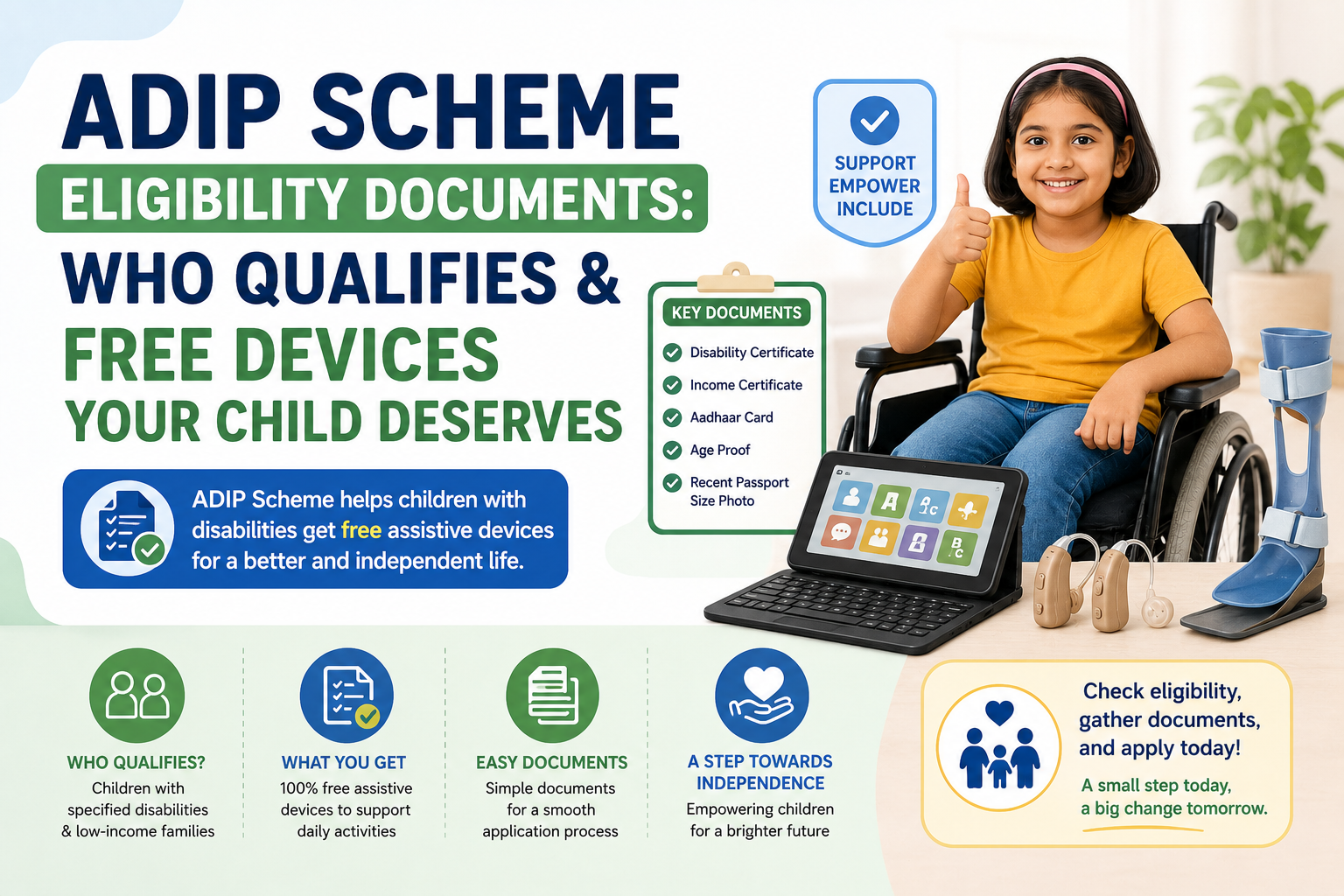
ADIP Scheme Eligibility Documents: Who Qualifies & Free Devices Your Child Deserves in 2026 🎗️
⚡ What You Need to Know First
ADIP scheme eligibility documents required are: a valid Disability Certificate (40%+ disability from government hospital), Aadhaar card, income certificate showing family income below ₹20,000 per month, passport-size photographs, address proof, and bank account details. Children of all ages qualify. No application fee exists. Documents are submitted at District Social Welfare Offices or ALIMCO camps. Free devices are provided after verification. 💙
Imagine your child needs a wheelchair. Or a hearing aid. Or a communication device. And you are staring at a price tag of ₹50,000 — ₹2,00,000.
And then someone tells you: the government will give your child that device for free. You just need the right papers.
That is exactly what the ADIP scheme does. And that is exactly what this guide helps you get.
The ADIP scheme — Assistance to Disabled Persons for Purchase/Fitting of Aids and Appliances — is India’s most important assistive technology grant program. It provides free wheelchairs, hearing aids, braille kits, prosthetics, communication devices, orthoses, and more to eligible persons with disabilities.
The only thing standing between your child and these free devices is the right documents. This guide tells you every single one — clearly, simply, and completely.

- ⚡ What You Need to Know First
- 🏛️ What Is the ADIP Scheme? — Simply Explained
- 🏢 Who Runs the ADIP Scheme?
- ✅ ADIP Scheme Eligibility Criteria — Complete Overview
- Core Eligibility Requirements
- All 21 Qualifying Disabilities Under RPWD Act 2016
- Income Eligibility — The Detail Most Families Misunderstand
- 📁 ADIP Scheme Eligibility Documents — Complete Master List
- 📄 Document 1: Disability Certificate — The Most Critical Document
- What Is a Disability Certificate?
- Critical Requirements for the Disability Certificate
- How to Get a Disability Certificate
- What If the Disability Percentage Is Below 40%?
- The UDID Card — Apply Simultaneously
- 💰 Document 2: Income Proof — What Qualifies
- 📅 Document 3: Age Proof Documents
- 🪪 Document 4: Identity and Address Proof
- Identity Proof — Acceptable Documents
- Address Proof — Acceptable Documents
- Address Mismatch — A Common Problem
- 🏥 Document 5: Therapist Recommendation Letter — The Game-Changer
- 🏦 Document 6: Bank Account Details
- Bank Account Requirements
- If Your Child Does Not Have a Bank Account
- Aadhaar-Bank Seeding — Essential Step
- 👶 Documents for Children — Special Requirements
- Complete Document List for Child Applicants
- Applying on Behalf of a Non-Verbal or Severely Disabled Child
- 🧬 Documents for Different Disability Types
- Visual Impairment
- Hearing Impairment
- Locomotor Disability / Cerebral Palsy
- Autism / Intellectual Disability
- Thalassemia / Haemophilia / Sickle Cell Disease
- 📍 Where and How to Submit ADIP Scheme Eligibility Documents
- Option 1 — ADIP Camps (Most Common and Efficient)
- Option 2 — District Social Welfare Office (Direct Application)
- Option 3 — Through Empaneled NGO Implementing Agencies
- ⏱️ ADIP Camp vs. Direct Application — Comparison
- ✔️ After Submission — What Happens Next
- Stage 1 — Document Verification (1–2 weeks)
- Stage 2 — Physical Assessment (At Camp or by Referral)
- Stage 3 — Device Procurement and Fitting
- Stage 4 — Training and Handover
- Stage 5 — Register for Repairs
- 🎯 Devices Available Under ADIP — Complete List
- 📊 Key Statistics — ADIP Scheme in India
- ❌ Common Document Mistakes That Cause ADIP Rejection
- Mistake 1 — Disability Certificate From Private Doctor
- Mistake 2 — Disability Below 40%
- Mistake 3 — Expired Income Certificate
- Mistake 4 — Address Mismatch Between Documents
- Mistake 5 — No Therapist Recommendation
- Mistake 6 — Missing Bank Aadhaar Seeding
- Mistake 7 — Applying for the Same Device Too Soon
- Mistake 8 — Photographs Not Meeting Requirements
- Mistake 9 — Self-Attested Copies Not Signed
- Mistake 10 — Not Getting an Acknowledgment Receipt
- 💛 A Parent’s Real Story: “We Got Rohan’s Wheelchair Free. It Took 3 Visits and the Right Papers.”
- 🔍 What You Must Not Miss About ADIP Documents
- 1. 📱 The UDID Card Difference — How It Streamlines Everything
- 2. 🔧 The Condition Report for Early Replacement
- 3. 📋 The Implementing Agency Advantage
- 4. 🌍 The Interstate Application Problem
- 5. 💊 Medical Conditions That Worsen — Reassessment Rights
- 6. 🏫 School-Based ADIP Access Through Samagra Shiksha
- ❓ FAQs — Long-Tail Questions Answered
- What documents are needed for the ADIP scheme?
- What is the income limit for ADIP scheme eligibility?
- Can a child apply for the ADIP scheme?
- Is the ADIP scheme completely free?
- How long does ADIP scheme approval take?
- What is the disability percentage required for ADIP scheme?
- Can autism qualify for ADIP scheme devices?
- How do I find ADIP camps near me?
- Can I get a free hearing aid under the ADIP scheme?
- What happens if my ADIP application is rejected?
- 🔗 Trusted Resources — ADIP Scheme Eligibility Documents
- ✨ Final Thoughts: The Right Papers Open the Right Doors
ADIP Scheme Eligibility Documents 2026 Full Guide
🏛️ What Is the ADIP Scheme? — Simply Explained
ADIP scheme eligibility documents matter because the ADIP scheme is one of the most valuable disability support programs in India — and most families never access it because they do not understand the document requirements.
Let us start simply.
The ADIP Scheme in Simple Words
Imagine a store that gives away essential items — wheelchairs, hearing aids, white canes, braille kits, artificial limbs — completely free. You just need to show them some papers to prove you qualify.
The ADIP scheme is that store. Run by the Indian government.
The full name is: Assistance to Disabled Persons for Purchase/Fitting of Aids and Appliances.
It was created because the government recognized that assistive devices — the tools that help disabled persons live, move, communicate, and learn — are too expensive for most families. And that no child should go without a wheelchair or a hearing aid simply because their family cannot afford it.
The Numbers That Show Why ADIP Matters
Without ADIP:
- A manual wheelchair costs ₹8,000 – ₹50,000
- A digital hearing aid costs ₹25,000 – ₹2,00,000
- A braille kit costs ₹5,000 – ₹20,000
- A prosthetic limb costs ₹30,000 – ₹5,00,000
With ADIP: ₹0
💡 Voice Search Answer — What documents are needed for ADIP scheme?
The ADIP scheme eligibility documents required are: Disability Certificate from a government hospital showing 40% or more disability, Aadhaar card, income certificate showing family income below ₹20,000 per month, passport-size photographs (3–4 copies), address proof, and bank account passbook. For children, also include birth certificate and parent’s identity documents. All documents must be self-attested photocopies with originals for verification.
Reference: ALIMCO — Artificial Limbs Manufacturing Corporation of India
🏢 Who Runs the ADIP Scheme?
Before understanding ADIP scheme eligibility documents, you need to know who manages this program — because it helps you know exactly where to submit your papers.
The Three-Level System
Level 1 — Policy Level: Ministry of Social Justice and Empowerment — sets the rules, budget, and guidelines for ADIP.
Level 2 — Manufacturing and Supply Level: ALIMCO (Artificial Limbs Manufacturing Corporation of India) — India’s government-owned company that manufactures and distributes most assistive devices under ADIP. ALIMCO has regional centers across India. Reference: www.alimco.in
Level 3 — Distribution Level: Implementing Agencies — State governments, NGOs, and government institutions that ALIMCO empanels to organize ADIP camps and receive individual applications at the local level.
Also involved: District Social Welfare Officers (DSWOs) — your primary contact point for individual ADIP applications at the district level.
ALIMCO Regional Centers
ALIMCO has regional centers in key cities:
- Kanpur (headquarters)
- Delhi
- Mumbai
- Chennai
- Kolkata
- Bangalore
- Hyderabad
- Bhopal
- Jabalpur
- Jaipur
Find your nearest center at: www.alimco.in
✅ ADIP Scheme Eligibility Criteria — Complete Overview
Understanding eligibility before gathering ADIP scheme eligibility documents saves time and frustration. Here is everything you need to qualify.

Core Eligibility Requirements
| Criterion | Requirement | Notes |
|---|---|---|
| Disability Certification | 40% or more disability certified | From government hospital Medical Board |
| Disability Type | Any of 21 RPWD Act disabilities | All recognized disability types covered |
| Income Limit | Family income ≤ ₹20,000/month | ₹2.4 lakh annual maximum |
| Citizenship | Indian citizen | Overseas Indians not covered |
| Residency | Must be Indian resident | Current address required |
| Age | No minimum or maximum | Infants to elderly all qualify |
| Previous Benefit | 3–5 year gap for same device | Different devices can be claimed sooner |
| Bank Account | Active account in beneficiary’s name | For adult claimants |
Source: Ministry of Social Justice — ADIP Guidelines
All 21 Qualifying Disabilities Under RPWD Act 2016
Every disability listed in the Rights of Persons with Disabilities Act 2016 qualifies for ADIP benefits:
- ✅ Blindness
- ✅ Low Vision
- ✅ Leprosy Cured Persons
- ✅ Hearing Impairment (Deaf and Hard of Hearing)
- ✅ Locomotor Disability
- ✅ Dwarfism
- ✅ Intellectual Disability
- ✅ Mental Illness
- ✅ Autism Spectrum Disorder
- ✅ Cerebral Palsy
- ✅ Muscular Dystrophy
- ✅ Chronic Neurological Conditions
- ✅ Specific Learning Disabilities
- ✅ Multiple Sclerosis
- ✅ Speech and Language Disability
- ✅ Thalassemia
- ✅ Haemophilia
- ✅ Sickle Cell Disease
- ✅ Multiple Disabilities including Deaf-Blindness
- ✅ Acid Attack Victims
- ✅ Parkinson’s Disease
Source: RPWD Act 2016 — Ministry of Social Justice
Income Eligibility — The Detail Most Families Misunderstand
The income limit is ₹20,000 per month (₹2,40,000 per year) for the entire family — not per person.
Important points:
- This is family income — not individual income
- It covers most middle-income Indian families
- Always apply — do not assume you earn too much without official verification
- For BPL families — all services are completely free with no additional income documentation
📁 ADIP Scheme Eligibility Documents — Complete Master List
Here is the complete, definitive list of ADIP scheme eligibility documents. Gather all of these before applying.
Master Document Checklist
| # | Document | Purpose | Mandatory? |
|---|---|---|---|
| 1 | Disability Certificate | Proves disability type and percentage | ✅ Yes — Non-negotiable |
| 2 | UDID Card | National disability ID | ✅ Strongly recommended |
| 3 | Aadhaar Card | Identity verification | ✅ Yes |
| 4 | Income Certificate | Proves income below ₹20,000/month | ✅ Yes (unless BPL) |
| 5 | BPL Ration Card | Replaces income certificate for BPL families | ✅ If applicable |
| 6 | Passport-size Photographs | Application identification | ✅ Yes (3–4 copies) |
| 7 | Address Proof | Confirms residency | ✅ Yes |
| 8 | Bank Passbook | Bank account details for subsidies | ✅ Yes |
| 9 | Birth Certificate | For children applicants | ✅ For children |
| 10 | Therapist Recommendation Letter | Specifies device needed | ✅ Strongly recommended |
| 11 | Previous ADIP Certificate | Gap period verification | ✅ If previously received |
| 12 | Parent/Guardian ID | For minor applicants | ✅ For children |
📄 Document 1: Disability Certificate — The Most Critical Document
The Disability Certificate is the foundation of all ADIP scheme eligibility documents. Without it, no application proceeds.
What Is a Disability Certificate?
It is an official government document issued by a Medical Board at a government hospital that certifies:
- The type of disability (e.g., autism, cerebral palsy, visual impairment)
- The percentage of disability (must be 40% or above for ADIP)
- Whether the disability is permanent or temporary
- The specific body system affected
Critical Requirements for the Disability Certificate
- ✅ Must be issued by a government hospital Medical Board — not a private doctor
- ✅ Must show minimum 40% disability (ADIP requirement)
- ✅ Must be in the prescribed government format
- ✅ Must be signed and stamped by the Medical Board
- ✅ Permanent disability certificates do not expire
- ✅ Temporary certificates must be current (check expiry date)
How to Get a Disability Certificate
Step 1 — Visit your nearest government district hospital or government medical college
Step 2 — Go to the Medical Board counter or Disability Assessment section (call ahead to confirm assessment days)
Step 3 — Bring all medical reports related to your disability:
- Diagnosis letters from specialists
- Medical history
- Previous assessments
- For children: developmental assessment reports, pediatric neurologist reports
Step 4 — Medical Board (team of 2+ government doctors) assesses your child and reviews records
Step 5 — Certificate issued within 7–30 days depending on the hospital
What If the Disability Percentage Is Below 40%?
If the certificate shows less than 40% — you can:
- Request a re-assessment from the Chief Medical Officer
- Get additional specialist reports to support a higher assessment
- Appeal the assessment decision through the District Disability Officer
The UDID Card — Apply Simultaneously
Apply for the UDID Card (Unique Disability Identification Card) at the same time as your Disability Certificate.
The UDID is a national smart card that increasingly serves as the primary proof of disability for ADIP and all other government schemes.
Apply online at: www.swavlambancard.gov.in
💰 Document 2: Income Proof — What Qualifies
Income proof is the second most important of all ADIP scheme eligibility documents.
Acceptable Income Proof Documents
| Document Type | Issued By | Validity |
|---|---|---|
| Income Certificate | Tehsildar / Mamlatdar / Talathee | Usually 6 months — get fresh one |
| BPL Ration Card | State Food Department | Valid as long as current |
| Salary Slip (if employed) | Employer | Last 3 months |
| Self-Declaration Affidavit | Notarized | Where income certificate unavailable |
Most Important Income Certificate Rules
Get a fresh income certificate. Income certificates older than 6 months are often rejected. This is one of the most common causes of ADIP application rejection.
Where to get an income certificate:
- Tehsildar office (rural areas)
- Mamlatdar office (Maharashtra)
- SDO or BDO office (many states)
- Common Service Centres (CSC) in many states — faster processing
- Online portals in states like Maharashtra, Karnataka, and Tamil Nadu
What the income certificate must show:
- Family name and address
- Annual or monthly family income (must be ₹2,40,000/year or ₹20,000/month or less)
- Official stamp and signature of issuing officer
For BPL Families
If your family has a BPL (Below Poverty Line) ration card — this substitutes for the income certificate in most states. It is simpler and faster. Present your BPL card alongside the ration card.
📅 Document 3: Age Proof Documents
Age proof is required for all ADIP scheme eligibility documents submissions — particularly important for children.
Acceptable Age Proof Documents
| Document | Issued By | Notes |
|---|---|---|
| Birth Certificate | Municipal Corporation / Gram Panchayat | Strongest age proof |
| Aadhaar Card | UIDAI | Contains date of birth |
| School Certificate / Transfer Certificate | School | For school-age children |
| Passport | Government of India | Where available |
| Voter ID | Election Commission | For adults |
| Hospital birth record | Government hospital | For very young children |
For Infants and Very Young Children
For children under 1 year — the birth certificate from the hospital or municipal body is the primary document. If birth registration is delayed (common in rural areas), approach your nearest government hospital for a birth record certificate.
🪪 Document 4: Identity and Address Proof
Identity Proof — Acceptable Documents
| Document | Notes |
|---|---|
| Aadhaar Card | Best option — accepted universally |
| Voter ID Card | For adults |
| Passport | Where available |
| PAN Card | Supplementary only |
| Driving License | For adults |
Address Proof — Acceptable Documents
| Document | Notes |
|---|---|
| Aadhaar Card | If current address matches |
| Voter ID | If current address matches |
| Ration Card | Widely accepted |
| Electricity Bill | Last 3 months; in applicant’s or parent’s name |
| Water Bill | Last 3 months |
| Bank Passbook | With current address |
| Rent Agreement | Notarized; for rented accommodation |
Address Mismatch — A Common Problem
If your Aadhaar shows a previous address and you have moved — either:
- Update your Aadhaar address first (at any Aadhaar Seva Kendra)
- Submit an additional address proof document showing current address
Address mismatch is one of the top reasons ADIP applications are delayed. Resolve it before submission.
🏥 Document 5: Therapist Recommendation Letter — The Game-Changer
While not always listed as mandatory, a therapist recommendation letter is one of the most powerful of all ADIP scheme eligibility documents — and most families do not include it.
What Is the Therapist Recommendation Letter?
It is a formal letter from your child’s treating therapist — physiotherapist, occupational therapist, speech therapist, audiologist, or orthopedic specialist — stating:
- Your child’s diagnosis and disability
- The specific assistive device needed and why
- The clinical rationale for that particular device specification
- The expected benefit to the child’s function
Why This Letter Matters
Without the letter: You might receive a basic device that does not meet your child’s specific needs.
With the letter: The assessing team understands exactly what your child needs — and selects the most appropriate device from the available range.
Additionally, for complex cases (motorized wheelchair, specialized orthosis, AAC device), the therapist letter significantly increases the chance of approval.
Who Can Write This Letter?
- ✅ Physiotherapist (for mobility devices)
- ✅ Occupational Therapist (for daily living aids, adapted equipment, AAC)
- ✅ Audiologist (for hearing aids)
- ✅ Speech-Language Pathologist (for communication devices)
- ✅ Orthopedic Specialist (for prosthetics, orthoses)
- ✅ Ophthalmologist (for visual aids, braille equipment)
The therapist must be registered with the Rehabilitation Council of India or hold a recognized qualification.
🏦 Document 6: Bank Account Details
The ADIP scheme delivers some benefits through Direct Benefit Transfer (DBT) — direct payment to bank accounts. Having the correct bank details ready is an essential part of ADIP scheme eligibility documents preparation.
Bank Account Requirements
- ✅ Active savings bank account
- ✅ Account in the beneficiary’s name (for adult applicants)
- ✅ For children — joint account with parent/guardian is acceptable
- ✅ Account must be linked to Aadhaar (Aadhaar-bank seeding)
- ✅ Bring the passbook — first page showing: name, account number, IFSC code, branch address
If Your Child Does Not Have a Bank Account
Open a minor’s savings account at any nationalized bank — SBI, Bank of Baroda, Punjab National Bank, etc. Required documents for opening:
- Child’s birth certificate
- Parent’s Aadhaar
- Parent’s passport photo
- Child’s passport photo (where required)
A minor’s account can be opened the same week in most nationalised banks. Do this early — do not let it delay your ADIP application.
Aadhaar-Bank Seeding — Essential Step
Your bank account must be “seeded” with (linked to) your Aadhaar number for DBT to work. Do this at your bank branch or through internet banking. Ask for “Aadhaar linking” at the bank counter.
👶 Documents for Children — Special Requirements
Parents applying for ADIP scheme eligibility documents on behalf of their minor children need additional documents.
Complete Document List for Child Applicants
| Document | Who It Relates To | Purpose |
|---|---|---|
| Disability Certificate | Child | Confirms disability type and % |
| UDID Card (or application receipt) | Child | National disability ID |
| Birth Certificate | Child | Proves age and identity |
| Child’s Aadhaar Card | Child (if issued) | Identity |
| Child’s Photograph | Child | Application identification (3–4 photos) |
| Parent/Guardian Aadhaar Card | Parent | Guardian identity |
| Parent/Guardian Photograph | Parent | Application documentation |
| Income Certificate | Family | Family income verification |
| Address Proof | Family | Current residence |
| Bank Passbook | Parent (joint account with child) | Payment details |
| Therapist Recommendation | Child’s treating therapist | Device specification |
| School Certificate | Child (if school-age) | Age and address verification |
Applying on Behalf of a Non-Verbal or Severely Disabled Child
For children who cannot speak for themselves or participate in assessment:
- Parent or legal guardian applies as the representative
- Bring a signed parental consent letter (even if not formally required — it clarifies the relationship)
- Medical reports from the treating specialist should describe the device need in specific clinical terms
🧬 Documents for Different Disability Types
ADIP scheme eligibility documents may require additional medical reports depending on your child’s disability.
Visual Impairment
| Additional Document | Issued By |
|---|---|
| Ophthalmologist report | Eye specialist at government hospital |
| Visual acuity test result | Ophthalmologist |
| Medical records confirming blindness or low vision | Government hospital |
Hearing Impairment
| Additional Document | Issued By |
|---|---|
| Audiometry report | Audiologist — AYJNISHD or government hospital |
| ENT specialist report | Government hospital ENT department |
| Hearing loss measurement in decibels | Audiologist |
Locomotor Disability / Cerebral Palsy
| Additional Document | Issued By |
|---|---|
| Orthopedic specialist report | Government hospital orthopedic department |
| Physiotherapy assessment | Registered physiotherapist |
| Functional mobility assessment | Physiotherapist or OT |
Autism / Intellectual Disability
| Additional Document | Issued By |
|---|---|
| Developmental pediatrician diagnosis letter | Government hospital |
| Psychologist’s assessment report | Registered clinical psychologist |
| Speech-language assessment (if requesting AAC) | Registered SLP |
| IQ assessment report (for intellectual disability) | Clinical psychologist |
Thalassemia / Haemophilia / Sickle Cell Disease
| Additional Document | Issued By |
|---|---|
| Hematologist report | Government hospital blood bank or hematology |
| Blood test reports confirming condition | Certified laboratory |
📍 Where and How to Submit ADIP Scheme Eligibility Documents
Option 1 — ADIP Camps (Most Common and Efficient)
ALIMCO and state implementing agencies organize ADIP distribution camps regularly across all districts. These are the fastest route to receiving devices.
At a camp:
- Medical team and ALIMCO representatives are present
- Documents are verified on-site
- Physical assessment for the device is done same day
- Device is fitted and provided at the camp (where available) or ordered
How to find camps:
- Check www.alimco.in for scheduled camp dates
Option 2 — District Social Welfare Office (Direct Application)
For individual applications between camps:
Step 1 — Visit the District Social Welfare Office in your district headquarters
Step 2 — Ask for the ADIP application form
Step 3 — Complete the form with all personal, disability, and device details
Step 4 — Submit with self-attested photocopies of all documents (originals for verification)
Step 5 — Receive acknowledgment receipt with application reference number
Step 6 — Follow up at regular intervals using your reference number
Option 3 — Through Empaneled NGO Implementing Agencies
Many NGOs across India are empaneled as ALIMCO implementing agencies. They:
- Collect applications from families
- Organize assessment camps
- Coordinate device supply and fitting
Ask organizations like ADAPT Mumbai, Vidya Sagar Chennai, Action for Autism India, or your local disability NGO if they are ALIMCO implementing agencies.
⏱️ ADIP Camp vs. Direct Application — Comparison
| Factor | ADIP Camp | Direct Application |
|---|---|---|
| Speed of device receipt | Fast — often same day | Slower — weeks to months |
| Assessment | On-site by medical team | Through DSW office |
| Convenience | One-stop process | Multiple office visits |
| Availability | Periodic — check schedule | Year-round |
| Document verification | On-the-spot | At office |
| Best for | First-time applicants; mobility devices | Specific or complex device needs |
| Our recommendation | Primary approach | Backup when no camp is scheduled |
✔️ After Submission — What Happens Next
After submitting all ADIP scheme eligibility documents, here is the process:
Stage 1 — Document Verification (1–2 weeks)
Your submitted documents are verified for completeness and authenticity. If any document is missing or incorrect — you will be contacted (which is why leaving contact details clearly on the form matters).
Stage 2 — Physical Assessment (At Camp or by Referral)
A medical/technical team assesses your child to determine the appropriate device specification:
- Wheelchair — seat dimensions, back height, footrest position
- Hearing aid — audiometric testing and fitting
- Prosthetics — measurement and fitting
- Orthoses — casting and fitting to the body
Stage 3 — Device Procurement and Fitting
The device is procured from ALIMCO or approved suppliers and fitted to your child. At camps, many standard devices are available immediately. Custom devices take additional time.
Stage 4 — Training and Handover
Basic training on using and maintaining the device is provided. You receive:
- The device
- User instructions
- ALIMCO repair center contact details
- Warranty information
Stage 5 — Register for Repairs
Register at your nearest ALIMCO Regional Centre for maintenance and repair services. Keep this contact information safe.
🎯 Devices Available Under ADIP — Complete List
Knowing what devices ADIP covers helps you prepare accurate ADIP scheme eligibility documents — particularly the therapist recommendation letter.
Mobility Devices
| Device | Who Needs It | ADIP Coverage |
|---|---|---|
| Manual Wheelchair (adult) | Locomotor disability, CP | Full cost up to ₹6,000–₹10,000 |
| Manual Wheelchair (children) | Children with mobility disability | Full cost up to ₹4,500–₹8,000 |
| Motorized Wheelchair | Severe locomotor, quadriplegia | Partial subsidy up to ₹45,000 |
| Tricycle (hand-operated) | Locomotor disability | Full cost |
| Crutches | Locomotor disability | Full cost |
| Walking Frame / Rollator | Locomotor, elderly | Full cost |
| Prosthetic Leg (Jaipur Foot) | Limb difference, amputation | Full cost |
| Ankle-Foot Orthosis (AFO) | CP, foot drop | Full cost |
| Spinal Support | Scoliosis, spinal conditions | Full cost |
Hearing Devices
| Device | Coverage |
|---|---|
| Digital Hearing Aid (BTE) | Full cost up to ₹10,000 per ear |
| Digital Hearing Aid (ITE) | Full cost up to ₹12,000 per ear |
Visual Impairment Devices
| Device | Coverage |
|---|---|
| Braille Kit (complete set) | Full cost |
| Braille Typewriter | Full cost |
| White Cane | Full cost |
| Magnifier | Full cost |
| Talking Watch | Full cost |
| Optical Aids (spectacles) | Full cost up to ₹900 |
Daily Living and Educational Aids
| Device | Coverage |
|---|---|
| CP Chair (adapted seating) | Full cost up to ₹4,500 |
| Communication Board (basic) | Full cost (basic versions) |
| Adapted Cutlery Set | Full cost |
| Writing Aids | Full cost |
Reference: ALIMCO Device Catalogue · Ministry of Social Justice — ADIP Scheme
📊 Key Statistics — ADIP Scheme in India
| Statistic | Figure | Source |
|---|---|---|
| Annual ADIP scheme beneficiaries | ~5 lakh (500,000) per year | Ministry of Social Justice Annual Report |
| Annual ADIP budget allocation | ₹400+ crore | Ministry of Social Justice |
| ALIMCO devices manufactured annually | 8+ lakh units | ALIMCO Annual Report |
| Income limit for ADIP eligibility | ₹20,000/month (₹2.4 lakh/year) | ADIP Guidelines |
| Minimum disability % required | 40% | ADIP Guidelines |
| Persons with disability in India (Census 2011) | 2.68 crore (26.8 million) | Census of India |
| UDID cards issued nationally | ~1 crore (10 million) | UDID Portal |
| Families unaware of ADIP scheme | Estimated 60–70% | NCPEDP Survey 2022 |
| States with highest ADIP camp reach | UP, MP, Maharashtra, Tamil Nadu | ALIMCO Regional Data |
| Gap period before claiming same device | 3–5 years | ADIP Guidelines |
❌ Common Document Mistakes That Cause ADIP Rejection
This is critical information. Most ADIP rejections are avoidable. Here are the most common ADIP scheme eligibility documents errors — and how to prevent each one.
Mistake 1 — Disability Certificate From Private Doctor
❌ Problem: Certificate issued by a private specialist, not a government hospital Medical Board
✅ Solution: Only government hospital Medical Board certificates are accepted. Visit the nearest government district hospital’s disability assessment section.
Mistake 2 — Disability Below 40%
❌ Problem: Certificate shows 35% disability — below the ADIP threshold
✅ Solution: Request a re-assessment or appeal to the Chief Medical Officer with additional specialist reports supporting a higher disability percentage.
Mistake 3 — Expired Income Certificate
❌ Problem: Income certificate is 8 months old — most offices require under 6 months
✅ Solution: Get a fresh income certificate within 1–2 months of submitting your ADIP application. Do not use old certificates.
Mistake 4 — Address Mismatch Between Documents
❌ Problem: Aadhaar shows old address; electricity bill shows new address; they do not match
✅ Solution: Update Aadhaar address at any Aadhaar Seva Kendra before applying. Or submit both documents explaining the change with a current residence certificate.
Mistake 5 — No Therapist Recommendation
❌ Problem: Application submitted without specifying the device needed or clinical rationale
✅ Solution: Always include a therapist recommendation letter specifying the exact device, model specifications (where relevant), and clinical justification. This dramatically improves both approval rate and device appropriateness.
Mistake 6 — Missing Bank Aadhaar Seeding
❌ Problem: Bank account not linked to Aadhaar — DBT payment fails
✅ Solution: Visit your bank branch and request Aadhaar-bank account seeding before application. Confirm seeding through the UIDAI website or SMS.
Mistake 7 — Applying for the Same Device Too Soon
❌ Problem: Claiming the same category of device less than 3 years after previous claim
✅ Solution: Keep your previous ADIP benefit certificate. Check the gap period for your specific device category. If the device has worn out before the gap period — submit a condition report from a therapist explaining premature failure.
Mistake 8 — Photographs Not Meeting Requirements
❌ Problem: Old photographs; wrong size; dark background; child not clearly visible
✅ Solution: Take fresh, clear passport-size photographs with white background. Bring 4–5 copies. For infants — hold the infant facing forward for the photograph.
Mistake 9 — Self-Attested Copies Not Signed
❌ Problem: Photocopies submitted without the applicant’s or parent’s signature
✅ Solution: Sign every photocopy yourself. Write “Self Attested” above your signature. Bring original documents for counter-verification at the office.
Mistake 10 — Not Getting an Acknowledgment Receipt
❌ Problem: Documents submitted but no receipt obtained — no way to track or follow up
✅ Solution: Always insist on a written acknowledgment with an application reference number. Without this — you have no proof of submission.
💛 A Parent’s Real Story: “We Got Rohan’s Wheelchair Free. It Took 3 Visits and the Right Papers.”
“My son Rohan is seven. He has cerebral palsy — spastic diplegia. He cannot walk independently. We live in a small town in Madhya Pradesh. My husband works as a teacher in a government school. We earn about ₹28,000 per month combined.
Rohan needed a wheelchair desperately. He was being carried everywhere. Our backs were suffering. More importantly — he had no independence. He could not explore. He could not choose where he wanted to go.
The pediatric specialist in the nearest city told us about the ADIP scheme. She said Rohan would qualify and the wheelchair would be free.
But she did not tell us exactly what papers we needed.
We went home. We gathered those papers. But the income certificate was seven months old. Rejected again.
Fresh income certificate. Third visit.
Third visit — all documents were accepted. The officer told us an ALIMCO camp was coming to our district in three weeks.
At the camp, a technical team from ALIMCO measured Rohan. They assessed his sitting posture, his hip width, his trunk control. A physiotherapist at the camp reviewed our recommendation letter.
Two weeks later, Rohan’s wheelchair arrived. It was fitted at a follow-up visit.
The wheelchair cost zero rupees.
The first day Rohan used it at home — he pushed himself from his bedroom to the kitchen, turned around, and came back. Back and forth, back and forth. He was laughing. He had never moved through our house on his own before.
I want every family to know: the scheme works. The documents are manageable. But gather everything before your first visit. Do not make three trips when one will do.“
— Meera T., mother of Rohan (cerebral palsy), Madhya Pradesh 💙
🔍 What You Must Not Miss About ADIP Documents
1. 📱 The UDID Card Difference — How It Streamlines Everything
Most ADIP guides treat the UDID Card as optional. In 2026, it is effectively essential. The UDID Card digitally stores all disability documentation — meaning camp officers and DSW offices can verify your disability details instantly rather than manually checking physical certificates. Applications with UDID Cards are processed significantly faster.
Furthermore, the government is increasingly integrating all disability benefits — ADIP, pension, railway concessions, income tax — through the UDID system. Applying for UDID simultaneously with your Disability Certificate at swavlambancard.gov.in takes 20 minutes and saves significant administrative burden in all future benefit claims.
2. 🔧 The Condition Report for Early Replacement
One of the most useful but unknown ADIP processes is the condition report — used when a device wears out before the standard 3–5 year replacement gap. Many families with active children find that wheelchairs, AFOs, and hearing aids wear out faster than the scheme anticipates.
A condition report from a registered therapist stating that the device has failed and is no longer safe or functional can support an early replacement claim. This is almost never mentioned in standard ADIP guidance — yet it protects families from years of using dangerously compromised equipment.
3. 📋 The Implementing Agency Advantage
Direct applications through District Social Welfare Offices are processed — but slowly, and with significant administrative variability. Applications submitted through ALIMCO-empaneled NGO implementing agencies are often processed faster, with better device quality matching, and with the support of staff experienced in navigating ADIP requirements.
Finding your nearest empaneled implementing agency — through ALIMCO’s website or your state disability federation — is one of the highest-value actions a family can take before applying.
4. 🌍 The Interstate Application Problem
Families who have recently moved states face a significant and underdiscussed problem: ADIP benefits are administered at state and district level, but families are often in a transitional state where their Disability Certificate is from their previous state and their income certificate is from their new location.
The technical position is that you apply in your current state of residence — but the practical navigation of this situation can be complex. Always check with your new district DSW office about acceptable documentation from a previous state.
5. 💊 Medical Conditions That Worsen — Reassessment Rights
For progressive conditions — muscular dystrophy, multiple sclerosis, some neurological conditions — disability percentage increases over time. A child who was assessed at 45% disability two years ago may now have 75% disability, qualifying for a higher tier of device.
Parents of children with progressive conditions should request reassessment of disability percentage periodically — and update their ADIP eligibility accordingly. A higher disability percentage opens access to more sophisticated devices under the ADIP scheme.
6. 🏫 School-Based ADIP Access Through Samagra Shiksha
A pathway almost entirely unknown to families: under the Samagra Shiksha Abhiyan, government schools are allocated funding to provide assistive devices to enrolled students with disabilities. This operates through a different channel than ADIP but covers many of the same devices for school-age children.
If your child is enrolled in a government school — ask the Principal about Samagra Shiksha disability device provisions specifically. Some families have accessed devices through this route faster than through the ADIP camp system.
❓ FAQs — Long-Tail Questions Answered
What documents are needed for the ADIP scheme?
ADIP scheme eligibility documents required are: Disability Certificate from a government hospital showing 40%+ disability, Aadhaar card, income certificate showing family income below ₹20,000 per month, passport-size photographs, address proof, and bank passbook. For children, also include birth certificate and parent’s Aadhaar. Self-attested photocopies plus originals for verification.
What is the income limit for ADIP scheme eligibility?
The ADIP scheme income limit is ₹20,000 per month (₹2,40,000 per year) for the entire family. BPL families are automatically eligible — submit BPL ration card instead of income certificate. Always apply regardless of assumptions about income — official verification determines actual eligibility.
Can a child apply for the ADIP scheme?
Yes. There is no minimum age for ADIP scheme eligibility. Infants and very young children qualify. The parent or legal guardian applies on behalf of the child. Required documents include the child’s Disability Certificate, birth certificate, and parent’s identity documents alongside the standard eligibility papers.
Is the ADIP scheme completely free?
Yes. Devices provided under the ADIP scheme are completely free for eligible beneficiaries. There is no application fee, processing fee, or device cost for persons with disabilities who meet the eligibility criteria. BPL families receive all services without any charge whatsoever.
How long does ADIP scheme approval take?
At an ADIP camp, assessment and device fitting can happen on the same day for standard devices. Through direct District Social Welfare Office applications, approval typically takes 4–12 weeks depending on the state and district. Camp-based applications are consistently faster than individual office applications.
What is the disability percentage required for ADIP scheme?
The ADIP scheme requires a minimum of 40% disability as certified on the Disability Certificate issued by a government hospital Medical Board. Children with less than 40% certified disability do not qualify. If you believe the assessment underestimates the disability — request a re-assessment through the Chief Medical Officer.
Can autism qualify for ADIP scheme devices?
Yes. Autism Spectrum Disorder is one of the 21 recognized disabilities under the RPWD Act 2016. Children with autism and a Disability Certificate showing 40%+ disability qualify for ADIP scheme devices including communication boards, AAC devices, and other relevant assistive aids. Contact your District Social Welfare Office or nearest ALIMCO camp for assessment.
How do I find ADIP camps near me?
Check alimco.in for scheduled camp dates. Contact your District Social Welfare Officer or District Collector’s office. Join state disability parent WhatsApp groups — camp announcements are frequently shared in these communities. Contact your state’s Social Welfare Department website directly for upcoming camp schedules.
Can I get a free hearing aid under the ADIP scheme?
Yes. Digital hearing aids are provided free under the ADIP scheme for persons with hearing impairment and family income below ₹20,000 per month. Required ADIP scheme eligibility documents include Disability Certificate showing hearing impairment, audiometry report, Aadhaar, income proof, and photographs. Apply at your nearest government hospital or ALIMCO camp.
What happens if my ADIP application is rejected?
If rejected, request the written reason for rejection from the District Social Welfare Office. Address the specific issue — usually a missing or incorrect document. Reapply with corrected documentation. If you believe the rejection is unjust, file a complaint at pgportal.gov.in or approach the State Commissioner for Persons with Disabilities.
🔗 Trusted Resources — ADIP Scheme Eligibility Documents
🏛️ Official Government Resources
- ALIMCO — Official ADIP Portal — Camp schedule; device catalogue; regional centers
- UDID Portal — Swavlamban Card — Apply for UDID Card online
- Disability Affairs Division — RPWD Act — 21 qualifying disabilities
- CPGRAMS Grievance Portal — File complaints about scheme access
💛 Support Organizations
- National Trust — Niramaya health insurance; Samarth; complementary schemes
- Action for Autism India — Autism device guidance
- ADAPT India — CP device support; Mumbai
- Narayan Seva Sansthan — Free prosthetics and mobility devices
- NCPEDP — Disability Rights Advocacy — Rights information
📋 Complementary Schemes
- NHFDC — Subsidized Loans — When ADIP does not fully cover costs
- National Scholarship Portal — Disability scholarships
- Samagra Shiksha — School-based device provision
✨ Final Thoughts: The Right Papers Open the Right Doors
ADIP scheme eligibility documents are the key that opens the door to free devices your child genuinely needs. 💙
Meera in Madhya Pradesh made three trips before she had every document right. The third trip worked. The wheelchair arrived. And Rohan pushed himself back and forth across his own house — laughing — for the first time.
Three trips was three trips too many. That is why this guide exists — so your family can gather every document correctly the first time and walk through that door in one visit.
The scheme works. The devices are real. The process is manageable with the right preparation.
Here is your action plan — starting today:
✅ Today: Check if your child has a valid Disability Certificate showing 40%+ disability. If not — book a government hospital appointment this week.
✅ This week: Apply for the UDID Card at swavlambancard.gov.in.
✅ This week: Get a fresh income certificate from your Tehsildar or Common Service Centre.
✅ This week: Ask your child’s therapist for a formal recommendation letter specifying the device needed.
✅ This week: Check your bank account is Aadhaar-seeded and bring the passbook.
✅ Before applying: Check alimco.in for upcoming ADIP camps in your district.
✅ At application: Bring self-attested copies of everything, originals for verification, and insist on an acknowledgment receipt.
The device your child needs is waiting. The documents are in your hands. Go and get it. 🎗️
⚠️ Disclaimer: This article is written for informational purposes only. ADIP scheme rules, income limits, covered devices, and application procedures change periodically. Always verify current information with ALIMCO or your District Social Welfare Officer before applying.


