

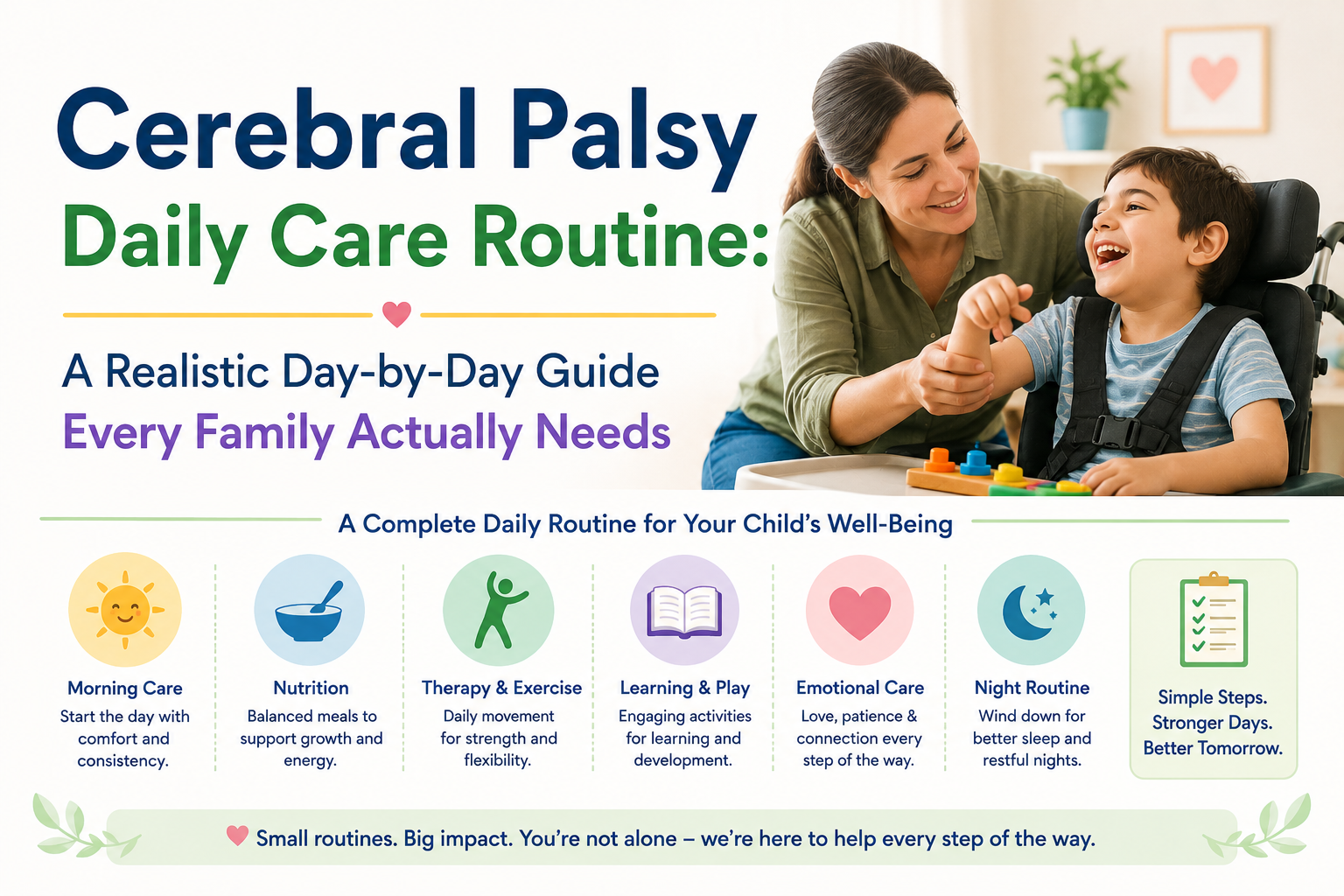
Cerebral Palsy Daily Care Routine: A Realistic Day-by-Day Guide Every Family Actually Needs in 2026 🎗️
⚡ What You Need to Know First
A cerebral palsy daily care routine should balance therapy, rest, nutrition, communication, play, and emotional connection — all within a structured but flexible schedule. The ideal routine is built around your child’s specific CP type, energy levels, therapy goals, and family life. Consistency reduces anxiety. Flexibility prevents burnout. Both your child and you deserve a routine that actually works. 💙
There is no perfect routine. No one-size schedule. No morning-to-night plan that works exactly the same for every child with cerebral palsy.
But there is a realistic one. One built on what physiotherapists, occupational therapists, speech therapists, and most importantly — experienced CP parents — know actually works day after day.
That is exactly what this guide gives you.
Not an ideal day. A real one. With all the messiness, the therapy battles, the small victories, the exhausted evenings, and the moments of pure joy that define life with a child with cerebral palsy.

- ⚡ What You Need to Know First
- 🧠 Understanding Cerebral Palsy Before Building a Routine
- 📅 Why a Routine Matters So Much for Children With CP
- 1. 🧠 Neuroplasticity Responds to Repetition
- 2. 😌 Predictability Reduces Anxiety
- 3. 💪 Consistency Builds Strength and Function
- 4. 👨👩👧 Caregiver Wellbeing Improves
- 5. 🌙 Sleep Improves
- 🧱 The Building Blocks of a Good CP Daily Routine
- 🌅 Morning Routine — Step by Step
- 6:00–6:30 AM — Wake and First Positioning
- 6:30–7:00 AM — Personal Care Routine
- 7:00–7:30 AM — Dressing
- 7:30–8:00 AM — Breakfast
- 🏋️ Mid-Morning — Therapy and Active Learning Time
- 8:30–10:30 AM — The Optimal Therapy Window
- Integrating PT Into the Morning
- Occupational Therapy Activities — Built Into Play
- ☀️ Afternoon Routine — Rest, Nutrition and Gentle Activity
- 🌙 Evening Routine — Family Time and Wind Down
- 5:00–6:00 PM — Dinner
- 6:00–7:00 PM — Family and Leisure Time
- 7:00–7:30 PM — Bathing
- 7:30–8:00 PM — Bedtime Preparation
- 🛏️ Bedtime Routine — Sleep and Positioning
- 📋 Sample Full Day Routine — Adaptable Template
- 💊 Therapy Integration — Making It Part of Life, Not Apart From Life
- 🥗 Nutrition and Feeding in the CP Daily Routine
- Why Nutrition Is Especially Important in CP
- Daily Nutritional Priorities
- Feeding Safety — Non-Negotiables
- 💬 Communication in the Daily Routine
- 💛 Emotional Wellbeing — Yours and Your Child’s
- 📊 Key Statistics — Cerebral Palsy and Daily Care
- 💛 A Parent’s Real Story: “There Is No Perfect Routine. There Is Just Ours.”
- 🔍 What You Must Not Miss About CP Daily Routines Miss
- 1. 🌡️ Pain Management Is a Daily Priority — Not an Afterthought
- 2. 🦴 Bone Health Is a Daily Concern
- 3. 🌬️ Respiratory Care for Children With Severe CP
- 4. 🌿 Sensory Diet — Underused Therapeutic Tool
- 5. 👥 Sibling Impact in the Daily Routine
- 6. 🔧 Equipment Maintenance Is Part of the Routine
- ❓ FAQs
- What should a daily routine for a child with cerebral palsy include?
- How many hours of therapy should a child with cerebral palsy have daily?
- What is the best sleeping position for a child with cerebral palsy?
- How do you manage spasticity at home in a daily routine?
- Can a child with cerebral palsy go to school?
- How do you make mealtimes easier for a child with cerebral palsy?
- What exercises should a child with cerebral palsy do daily?
- How do I create a sensory routine for my child with cerebral palsy?
- What are the signs that my child with CP’s daily routine needs adjustment?
- How do I balance therapy and normal childhood for my child with CP?
- 🔗 Trusted Resources — Cerebral Palsy Daily Care and Routine
- ✨ Final Thoughts: Your Routine Is Enough
Cerebral Palsy Daily Care Routine Full 2026 Guide
🧠 Understanding Cerebral Palsy Before Building a Routine
Before designing any cerebral palsy daily care routine, you need to understand that cerebral palsy is not one condition. It is an umbrella term covering several movement and posture disorders caused by brain injury during development — before birth, during birth, or in early childhood.
The type of CP your child has fundamentally shapes what their daily routine looks and feels like.
The Four Main Types of Cerebral Palsy
Spastic CP (Most Common — ~80% of cases)
- Muscles are tight and stiff
- Movement is difficult and sometimes painful
- Stretching, positioning, and physiotherapy are daily essentials
- Morning stiffness is common — routines must account for extra time to warm up muscles
Dyskinetic/Athetoid CP
- Involuntary, uncontrolled movements
- Movements increase with excitement or stress
- Calm, low-stimulation environments during key daily activities (mealtimes, dressing) reduce involuntary movement
- Energy expenditure is very high — rest periods are non-negotiable
Ataxic CP
- Balance and coordination are primarily affected
- Walking and fine motor tasks are challenging
- Safety modifications in the home environment are essential daily considerations
- Activities that build core stability are particularly important
Mixed CP
- Combines features of two or more types
- Daily routine needs to address multiple sets of challenges simultaneously
CP Severity — GMFCS Levels
The Gross Motor Function Classification System (GMFCS) is used by therapists worldwide to classify CP severity into five levels:
| GMFCS Level | Description | Daily Routine Implications |
|---|---|---|
| Level I | Walks without limitations | Routine similar to peers; some therapy integration |
| Level II | Walks with limitations | Mobility aids sometimes; more therapy time |
| Level III | Walks with mobility aids | Significant therapy; adapted equipment essential |
| Level IV | Limited self-mobility; powered mobility | High support needs; positioning central to routine |
| Level V | Transported in manual wheelchair | Full care routine; positioning, feeding, communication all need specialist support |
Source: CanChild — GMFCS
Understanding your child’s GMFCS level helps you build a cerebral palsy daily care routine that is realistic for their actual needs — not too ambitious, not under-challenging.
💡 Voice Search Answer — What should a daily routine for a child with cerebral palsy include?
A daily routine for a child with cerebral palsy should include: structured morning care with stretching and positioning, integrated physiotherapy and occupational therapy exercises, nutritious mealtimes with adapted equipment if needed, rest periods, communication practice, play and sensory activities, evening wind-down, and consistent sleep positioning. The routine should be consistent but flexible enough to accommodate therapy appointments and the child’s variable energy levels.
📅 Why a Routine Matters So Much for Children With CP
The cerebral palsy daily care routine is not just about organization. It is therapeutic in itself.
Here is why structure is medicine for children with CP:
1. 🧠 Neuroplasticity Responds to Repetition
The developing brain — even an injured one — responds to consistent, repeated practice. Every time your child reaches for a cup, transfers weight during walking, or uses their communication device — they are building and strengthening neural pathways.
Research in pediatric neurorehabilitation consistently shows that high repetition of meaningful, functional movements produces greater neuroplastic change than lower-repetition therapy sessions alone.
A daily routine embeds these repetitions naturally into everyday life.
Source: Novak et al. — Evidence-based CP Rehabilitation (Developmental Medicine & Child Neurology)
2. 😌 Predictability Reduces Anxiety
Many children with CP have associated conditions — intellectual disability, autism, sensory processing differences, epilepsy — that make unpredictability distressing. A consistent daily routine reduces the cognitive load of “what comes next” and allows the child to participate more actively in transitions.
3. 💪 Consistency Builds Strength and Function
Stretching tight muscles once a week does little. Stretching daily, as part of a morning routine, makes a measurable difference. Positioning correctly at mealtimes every day builds postural stability. Practice accumulates.
4. 👨👩👧 Caregiver Wellbeing Improves
A predictable routine reduces decision fatigue for parents and caregivers. When morning care follows the same sequence every day, it requires less mental energy — freeing cognitive and emotional capacity for the moments that matter most.
5. 🌙 Sleep Improves
Children with CP have significantly higher rates of sleep disturbance than their peers — up to 44% have significant sleep problems according to research. A consistent bedtime routine is one of the most evidence-supported interventions for improving sleep in children with neurodevelopmental conditions.
Source: Sleep in Children With Cerebral Palsy — Developmental Medicine & Child Neurology
🧱 The Building Blocks of a Good CP Daily Routine
Every effective cerebral palsy daily care routine is built from the same core blocks. The timing and proportion of each block changes based on your child’s needs — but these elements belong in every CP child’s day.
The 8 Essential Daily Blocks
| Block | What It Includes | Why It Matters |
|---|---|---|
| 🌅 Morning Care | Positioning, stretching, hygiene, dressing | Sets physical tone for the day; prevents contractures |
| 🍽️ Mealtimes | Nutrition, feeding support, positioning | Energy, growth, oral motor development |
| 💪 Active Therapy | PT exercises, OT activities, speech practice | Skill development, neuroplasticity |
| 📚 Learning Time | Educational activities, AAC, cognitive tasks | Development, school preparation |
| 🎮 Play | Free and guided play, sensory activities | Joy, motivation, social development |
| 😴 Rest | Nap (if needed), quiet time | Energy restoration; muscle recovery |
| 🌙 Evening Wind-Down | Gentle activities, bathing, family time | Transition to sleep; emotional connection |
| 🛏️ Sleep Positioning | Correct positioning, sleep system | Prevent deformity; quality sleep |
🌅 Morning Routine — Step by Step
The morning is one of the most important parts of the cerebral palsy daily care routine. Muscles are stiffest after sleep. Getting the morning right sets the physical and emotional tone for the entire day.

6:00–6:30 AM — Wake and First Positioning
Do not rush the waking transition. Children with spastic CP especially need time to move from sleep to wakefulness without being startled or rushed into position changes.
✅ Wake your child gently — voice first, then touch
✅ Allow 5 minutes of gradual arousal before any care begins
✅ Side-lying stretch — if your child sleeps on their back, gently move them to side-lying position for the first few minutes. This begins the day’s first passive stretch.
✅ Gentle massage of tight muscle groups — calves, hamstrings, hip flexors — before any upright positioning
Why this matters: Morning spasticity is highest immediately after waking. Rushing a child with spastic CP from horizontal to upright without warming up muscles increases pain, resistance, and sets up a difficult start to the day.
6:30–7:00 AM — Personal Care Routine
Toileting / Nappy Change / Catheter Care
- ✅ Use transfer equipment correctly — hoist, transfer board — to protect both your child’s hips and your own back
- ✅ Positioning during personal care matters: side-lying or supported sitting as appropriate
- ✅ Narrate what you are doing — “Now I am going to change your nappy” — even for non-verbal children. Predictability during personal care is a dignity issue.
Oral Care
- ✅ Teeth cleaning — use adapted toothbrush if grip is difficult
- ✅ For children with drooling: oral motor warm-up (gentle jaw massage, lip exercises) can be part of morning dental care
- ✅ Position upright or semi-reclined — never supine (lying flat) for oral care due to aspiration risk
Face washing and skincare
- ✅ Check skin for any pressure marks from overnight positioning — particularly bony prominences (heels, hips, shoulders)
- ✅ Moisturize pressure-prone areas daily
7:00–7:30 AM — Dressing
Dressing is not just about clothing. It is a daily occupational therapy opportunity.
For children working on upper limb function:
- ✅ Practice pulling arms through sleeves (hand-over-hand assistance if needed)
- ✅ Allow extra time — rushed dressing becomes adult-led dressing, losing the therapeutic opportunity
Clothing adaptations that make mornings easier:
- 👗 Loose, stretchy fabrics
- 👟 Velcro fastened shoes
- 👕 Front-opening tops for children with limited shoulder range
- 🩲 Seamless socks for sensory-sensitive children
Positioning for dressing:
- Most effective: seated on bed edge with back support, or in adapted seating
- For GMFCS Level IV–V: dressing on changing table or bed, with positional support
7:30–8:00 AM — Breakfast
See the Nutrition section below for full detail. Key morning feeding points:
- ✅ Correct seating position is the single most important safety factor
- ✅ Allow adequate time — rushing feeding increases aspiration risk
- ✅ Oral motor warm-up before first bite if your child has swallowing difficulties
- ✅ Medication with food if prescribed — note any food interactions with specific medications
🏋️ Mid-Morning — Therapy and Active Learning Time
8:30–10:30 AM — The Optimal Therapy Window
Research on pediatric rehabilitation shows that mid-morning is typically the peak alertness and cooperation window for young children. This is the best time for:
✅ Physiotherapy exercises
✅ Occupational therapy activities
✅ Speech and AAC practice
✅ Educational and cognitive activities
Integrating PT Into the Morning
You do not need a physiotherapy clinic to do PT. Much of the cerebral palsy daily care routine PT component happens at home, guided by the goals your physiotherapist sets.
Floor time activities (15–20 minutes):
- Prone (tummy time) over a wedge — builds back and neck extension strength
- Supported sitting practice on a therapy ball — builds core stability
- Rolling practice — both directions — builds motor planning and trunk rotation
- Reaching activities in supported sitting — reaching toward a toy, a cup, a favorite object
Standing program (if applicable to GMFCS level):
- Time in standing frame — 30–60 minutes is typical
- Standing programs maintain bone density, hip development, bowel function, and provide weight-bearing benefits
- Make standing time engaging — position at a table height activity, watch a favorite show, use an AAC device
Stretching program (daily — non-negotiable for spastic CP): Follow your physiotherapist’s specific program. Common daily stretches include:
- Hamstring stretch
- Hip flexor stretch
- Ankle/calf stretch (Achilles tendon — critical for preventing equinus contracture)
- Shoulder and elbow stretches (for upper limb spasticity)
⚠️ Critical Point: Never attempt stretches your physiotherapist has not demonstrated to you in person. Incorrect stretching technique can cause harm. Ask your PT to watch you performing the home program at least twice before doing it independently.
Occupational Therapy Activities — Built Into Play
OT goals live naturally inside play activities. This is the magic of good home programming:
| OT Goal | Home Activity |
|---|---|
| Hand grip strength | Squeezing playdough, water play with squeeze toys |
| Pincer grasp | Picking up small cereal pieces, threading beads |
| Bilateral hand use | Clapping games, drum playing, holding a bowl while stirring |
| Visual tracking | Watching a slow-moving ball, bubbles, light activities |
| Self-feeding | Spoon practice with thick foods — yogurt, mashed banana |
| Dressing skills | Doll dressing, practice with fasteners on a frame |
☀️ Afternoon Routine — Rest, Nutrition and Gentle Activity
12:00–1:00 PM — Lunch
Lunchtime is the most important feeding opportunity of the day for most children — when hunger is genuine and alertness is still reasonable.
Mealtime setup checklist:
- ✅ Correct supportive seating — hips at 90°, feet supported, trunk upright
- ✅ Adapted utensils if needed — weighted spoon, angled cutlery, non-slip mat under bowl
- ✅ Communication support ready — AAC device, symbol board for meal choices
- ✅ Enough time — minimum 30 minutes for children with feeding difficulties
- ✅ Appropriate food texture — as per SALT (speech and language therapist) guidance
1:00–2:30 PM — Rest Period
Children with CP expend significantly more energy on basic movement and postural control than their peers. Rest is not optional. It is therapeutic.
Rest period options by GMFCS level:
- GMFCS I–II: Quiet reading time, low-stimulation activities, or short nap if needed
- GMFCS III–IV: Supported lying on a therapy mat with positional wedges; light sensory activity; nap
- GMFCS V: Comfortable positioning in sleep system or adapted chair; sleep or quiet rest
During rest — positioning matters:
Even during rest, ensure your child is not in a position that increases spasticity patterns (e.g., lying with hips and knees extended and ankles plantarflexed — the “stretched out” spastic position). Use positioning equipment to maintain good alignment during rest.
2:30–4:00 PM — Afternoon Activity
This is a good time for:
✅ Outdoor time — fresh air, sensory input from natural environments, vitamin D
✅ Social activities — playdate with peers, community group, siblings
✅ Creative activities — art, music, sensory play
✅ Screen time — if used, this is a good slot. Educational apps, cause-and-effect computer games, AAC device exploration
✅ Snack — small nutritious snack; continue working on self-feeding skills
🌙 Evening Routine — Family Time and Wind Down
5:00–6:00 PM — Dinner
Repeat the mealtime setup from lunch. Evening meals are often rushed because parents are tired and dinner preparation has been squeezed into limited time.
Evening mealtime survival tips:
- Batch cook adapted food textures on weekends to reduce weekday cooking stress
- Involve your child in simple meal preparation tasks at their ability level — stirring, pouring, tearing bread — this is meaningful OT practice
6:00–7:00 PM — Family and Leisure Time
This hour is intentionally protected from therapy and structured activity in an ideal cerebral palsy daily care routine. It is for:
💙 Connection — not goals
💙 Play — not practice
💙 Being together — not working
Children with CP spend enormous amounts of their day in therapeutic activities driven by adult goals. This hour is their time. Follow their lead. Respond to their interests. Let them be the child — not the patient.
7:00–7:30 PM — Bathing
Bathing is:
- A hygiene necessity
- A sensory experience
- A physiotherapy opportunity
- A bonding moment
Safe bathing for children with CP:
- ✅ Non-slip bath mat is non-negotiable
- ✅ Bath seat or bath support for children who cannot sit independently
- ✅ Warm water (not hot — children with sensory differences may not reliably detect heat)
- ✅ Shower chair for older or heavier children
- ✅ Hoist for bath transfers for GMFCS IV–V
Therapeutic opportunities in the bath:
- Warm water reduces spasticity — use this window for passive stretching
- Water play builds hand function and sensory tolerance
- Pouring activities build bilateral coordination
- Washing self (with support) builds body awareness and self-care skills
7:30–8:00 PM — Bedtime Preparation
- ✅ Teeth cleaning (second time)
- ✅ Skin check and moisturizing
- ✅ Final medication if prescribed
- ✅ Changing into comfortable nightwear (loose, soft fabrics)
- ✅ Communication — review the day using AAC, pictures, or speech; “What was your favourite thing today?”
- ✅ Favorite book or story — reading aloud supports language, communication, and emotional closeness regardless of the child’s verbal ability
🛏️ Bedtime Routine — Sleep and Positioning
8:00 PM — Sleep Positioning
Sleep positioning is one of the most clinically significant elements of the cerebral palsy daily care routine — yet it is among the most commonly neglected outside specialist clinical settings.
Why sleep positioning matters for CP:
Children with CP sleep for 10–12 hours per day. During that time, unmanaged spasticity patterns can:
- ❌ Increase hip dislocation risk
- ❌ Worsen scoliosis
- ❌ Promote contracture development
- ❌ Cause pressure sores
- ❌ Disrupt sleep quality
Sleep systems for CP — custom-made positioning equipment — address all of these risks simultaneously. If your child does not have a sleep system assessment:
- Ask your physiotherapist or occupational therapist for a referral
- Contact your local wheelchair and equipment service
- In India: approach ALIMCO (www.alimco.in) for positioning equipment; contact ADIP scheme for funding
General safe sleep positioning principles:
| CP Type | Recommended Base Position | Key Supports |
|---|---|---|
| Spastic diplegia | Side-lying | Pillow between knees; ankle position neutral |
| Spastic hemiplegia | Lying on less affected side | Affected arm forward; hip and knee slightly flexed |
| Spastic quadriplegia | Side-lying with full support | Specialist sleep system; head support; trunk roll |
| Dyskinetic | Semi-reclined or side-lying | Minimize positions that trigger involuntary movement |
⚠️ Important: Sleep positioning for children with CP should always be planned with a qualified physiotherapist or occupational therapist. This table provides general orientation only — not clinical guidance.
📋 Sample Full Day Routine — Adaptable Template
Here is a complete sample cerebral palsy daily care routine for a school-age child with spastic diplegia at GMFCS Level III. Adapt times and activities for your child’s specific needs.
| Time | Activity | Therapeutic Focus |
|---|---|---|
| 6:00 AM | Gentle wake; side-lying stretch; gentle massage | Spasticity management; warmth |
| 6:30 AM | Personal care — toileting, oral care, face wash | Daily living; dignity; oral motor |
| 7:00 AM | Dressing (participation-focused) | OT — self-care skills |
| 7:30 AM | Breakfast in adaptive seating | Nutrition; oral motor; self-feeding |
| 8:15 AM | School preparation / home learning setup | Cognitive; communication |
| 8:30 AM | PT home program — stretching, floor activities | Flexibility; strength; motor skills |
| 9:00 AM | School (or home learning with NIOS/home program) | Academic; social; communication |
| 10:30 AM | Standing program (30 min) with activity | Weight bearing; bone density; posture |
| 11:00 AM | OT activity — fine motor, self-care practice | Hand function; independence skills |
| 12:00 PM | Lunch — adaptive seating, utensils | Nutrition; self-feeding; communication |
| 1:00 PM | Rest / quiet time (positioning maintained) | Energy restoration; muscle recovery |
| 2:30 PM | Outdoor time / sensory play | Sensory input; social; vitamin D |
| 3:30 PM | Snack + AAC practice / communication activity | Nutrition; language development |
| 4:00 PM | Creative or leisure activity — child-led | Joy; motivation; creative expression |
| 5:00 PM | Dinner — family mealtime | Nutrition; social; family connection |
| 6:00 PM | Family leisure time — child-led play | Emotional connection; wellbeing |
| 7:00 PM | Bath — sensory; passive stretching in warm water | Hygiene; spasticity reduction; bonding |
| 7:30 PM | Bedtime prep — teeth, skin check, medication | Daily care; comfort |
| 7:45 PM | Story / communication review of day | Language; emotional processing |
| 8:00 PM | Sleep — correct positioning system applied | Deformity prevention; quality sleep |
💊 Therapy Integration — Making It Part of Life, Not Apart From Life
The most sustainable cerebral palsy daily care routine is one where therapy is woven into daily activities — not bolted on as an additional burden.
The “Therapy in Daily Life” Framework
| Daily Activity | Hidden Therapy Opportunity |
|---|---|
| Dressing | OT — hand function, sequencing, self-care |
| Mealtimes | SALT — swallowing, oral motor, communication |
| Bathing | PT — stretching in warm water, body awareness |
| Play | PT, OT — movement, coordination, hand skills |
| Storytelling | SALT — language, communication, vocabulary |
| Outdoor walks | PT — weight bearing, balance, endurance |
| Cooking together | OT — bilateral coordination, sensory, life skills |
| School work | OT, SALT — writing, communication, cognition |
The Importance of Rest From Therapy Too
Children with CP are often in a constant state of therapeutic demand. Every activity is an opportunity for someone to work on a goal. This is exhausting for children.
Build in genuinely free time — where nothing is a therapeutic goal. Where your child simply is, plays, chooses, rests. This is not wasted time. It is essential for psychological wellbeing and intrinsic motivation.
🥗 Nutrition and Feeding in the CP Daily Routine
Feeding is one of the most complex aspects of the cerebral palsy daily care routine — and one of the most significant for health outcomes.
Why Nutrition Is Especially Important in CP
- Children with CP have higher caloric needs due to increased muscle tone and movement effort
- Feeding difficulties (dysphagia) affect approximately 35–40% of children with CP
- Malnutrition is common and directly impacts immune function, bone health, growth, and cognitive development
- Constipation is very common — dietary fiber and hydration are daily management priorities
Source: Surveillance of Cerebral Palsy in Europe (SCPE)
Daily Nutritional Priorities
✅ Adequate calories — children with CP often need more than standard age-based recommendations
✅ High protein — supports muscle maintenance and growth
✅ Calcium and Vitamin D — essential for bone density (many CP children have reduced bone density due to reduced weight bearing and anticonvulsant medications)
✅ Fiber and fluids — prevent constipation
✅ Iron — anemia is more common in CP; monitor with regular blood tests
Feeding Safety — Non-Negotiables
- ✅ Always feed in upright or semi-reclined position — never lying flat
- ✅ Never rush feeding — allow adequate time
- ✅ Follow SALT-prescribed texture guidelines — IDDSI (International Dysphagia Diet Standardisation Initiative) levels
- ✅ Watch for signs of aspiration: coughing, color change, wet/gurgly voice after eating
- ✅ If concerned about swallowing safety — request a videofluoroscopy swallow study
Resource: IDDSI Framework — International Dysphagia Diet Standardisation
💬 Communication in the Daily Routine
Communication is not a separate therapy session. It is woven through the entire cerebral palsy daily care routine.
Communication Opportunities Throughout the Day
| Time | Communication Activity |
|---|---|
| Morning | “What clothes do you want?” — choice-making |
| Breakfast | Requesting food, drink — AAC or sign |
| Play | Commenting on activities, requesting turns |
| Learning time | Answering questions, following instructions |
| Mealtime | Social communication, sharing, requesting |
| Bathing | Body part naming, requesting items |
| Bedtime | Reviewing the day, expressing feelings |
AAC — Augmentative and Alternative Communication
For children who are non-verbal or minimally verbal — AAC is not a last resort. It is a first right.
Research consistently shows that AAC does not reduce a child’s motivation to develop speech — it supports it. Children who use AAC are more communicatively active, more socially engaged, and show better language development outcomes than those left without communication support.
Resource: ISAAC — International Society for Augmentative and Alternative Communication
💛 Emotional Wellbeing — Yours and Your Child’s
The most overlooked element of the cerebral palsy daily care routine is emotional sustainability — for both the child and the caregiver.
For Your Child
Children with CP experience higher rates of:
- Depression — especially in school age and adolescence
- Low self-esteem — from daily awareness of difference
Build these into the daily routine:
✅ One moment of pure fun — daily, non-negotiable, child-chosen
✅ Acknowledgment of effort — “I saw how hard you worked on that” — not just achievement
✅ Communication about feelings — daily check-in using their communication system
✅ Connection to peers — even if just brief, even if just online
For You — The Caregiver
Caregiver burnout in CP families is real and common. Studies show that primary caregivers of children with cerebral palsy report significantly higher rates of psychological distress, sleep deprivation, and reduced quality of life than general population parents.
Source: Parental Wellbeing in CP — Developmental Medicine & Child Neurology
Your daily routine must include:
- ✅ At least one daily moment that is yours alone — even 10 minutes
- ✅ Connection with other CP parents — WhatsApp groups, Facebook communities, local support groups
- ✅ Regular respite — even brief — is not selfish; it is essential maintenance
- ✅ Your own medical and psychological check-ins — you cannot pour from an empty vessel
📊 Key Statistics — Cerebral Palsy and Daily Care
| Statistic | Figure | Source |
|---|---|---|
| Global prevalence of cerebral palsy | ~1 in 500 births | Surveillance of CP in Europe (SCPE) |
| Prevalence in India (estimated) | ~25 lakh (2.5 million) persons | Indian Academy of Cerebral Palsy |
| Percentage of CP children with feeding difficulties | ~35–40% | SCPE Network |
| Percentage with significant sleep problems | ~44% | Developmental Medicine & Child Neurology |
| Percentage with co-occurring intellectual disability | ~50% | CDC — Cerebral Palsy Data |
| Percentage with co-occurring epilepsy | ~35–40% | CDC — Cerebral Palsy Data |
| Percentage with pain as daily experience | ~75% | Novak et al. — DMCN |
| Most common CP type | Spastic (~80% of cases) | American Academy of Neurology |
| Evidence for early intervention effectiveness | Strong evidence — best outcomes before age 5 | Novak et al. — JAMA Pediatrics |
| Caregiver depression rates in CP families | ~30–40% report significant symptoms | DMCN Research |
💛 A Parent’s Real Story: “There Is No Perfect Routine. There Is Just Ours.”
“My daughter Ananya has spastic quadriplegia — GMFCS Level IV. She is eight years old. She uses a power wheelchair. She communicates through a speech-generating device.
In her first two years after diagnosis, I tried to build the ‘perfect’ routine. I read every therapy handout. I watched every YouTube video. I made spreadsheets. I set alarms.
And every day felt like failure. Because the stretching took longer than the spreadsheet said. Because Ananya had a bad sensory day and refused the standing frame. Because I burned the adapted lunch and she could not eat the backup option because of its texture.
Then our occupational therapist said something I will never forget.
She said: ‘The best routine is the one you can actually do. Not the one that looks perfect on paper.’
So we rebuilt. We kept the non-negotiables — positioning, stretching, safe feeding, sleep system, daily communication. But we made everything else flexible. If Ananya’s energy was low on a Tuesday, we skipped the afternoon OT activity and sat in the garden together. If she had a great morning, we did extra PT because she wanted to.
Ananya is now eight. She moves through her day with more confidence. She requests activities on her device. She tells us when she is tired. She tells us what she wants for breakfast.
Our routine is not in a spreadsheet anymore. It lives in all of us — in how we move through the morning together, in how she reaches for her cup, in how we both know that bath time means warm water and funny songs and no therapy goals.
There is no perfect routine. There is just ours. And ours is enough.”
— Priya M., mother of Ananya (spastic quadriplegia, GMFCS IV), Bangalore, India 💙
🔍 What You Must Not Miss About CP Daily Routines Miss
1. 🌡️ Pain Management Is a Daily Priority — Not an Afterthought
Research shows that approximately 75% of children with CP experience pain on a regular basis — most commonly from muscle tightness, joint problems, and positioning issues. Yet most CP daily routine guides never mention pain. A daily routine that ignores pain is not realistic. Ask your child’s physiotherapist about pain assessment tools appropriate for your child’s communication level. Address pain proactively — through positioning, warmth, stretching, and medication as prescribed — rather than reactively.
2. 🦴 Bone Health Is a Daily Concern
Children with CP — particularly those who are non-ambulatory — have significantly reduced bone density compared to their peers. This is caused by reduced weight bearing, muscle pull on bone, and often anticonvulsant medications which reduce calcium absorption. Daily weight bearing through standing programs, adequate calcium and Vitamin D in the diet, and regular monitoring are essential components of the CP daily care routine that most routine guides completely omit.
3. 🌬️ Respiratory Care for Children With Severe CP
Children with GMFCS Level IV–V CP have significant risk of respiratory complications — aspiration pneumonia, reduced lung capacity, and poor secretion clearance. Chest physiotherapy — either hands-on techniques or assisted cough devices — may need to be part of the daily routine. This is rarely mentioned in general CP routine guides. If your child has recurrent chest infections, request a respiratory physiotherapy assessment.
4. 🌿 Sensory Diet — Underused Therapeutic Tool
Many children with CP have sensory processing differences — either hypersensitivity (over-responding to sensory input) or hyposensitivity (under-responding). An occupational therapist can design a sensory diet — a daily schedule of sensory activities that regulate the nervous system and improve attention, behavior, and participation throughout the day. This is profoundly underused in CP daily care planning.
5. 👥 Sibling Impact in the Daily Routine
When a child with CP requires significant daily care, siblings can feel invisible — their needs always secondary, family routines always adapted to the CP child’s schedule. A realistic CP daily routine acknowledges and actively builds in sibling connection time. Including siblings in therapy-as-play activities — where the sibling is a participant, not just an observer — builds family cohesion and reduces sibling resentment.
6. 🔧 Equipment Maintenance Is Part of the Routine
Wheelchairs need cleaning. Ankle-foot orthoses need checking for pressure marks. AAC devices need charging. Feeding equipment needs sterilizing. Sleep systems need checking for correct positioning. These equipment maintenance tasks are a genuine daily time cost that no routine guide accounts for — but every experienced CP parent knows they are non-negotiable.
❓ FAQs
What should a daily routine for a child with cerebral palsy include?
A cerebral palsy daily care routine should include morning stretching, personal care, nutritious adapted mealtimes, physiotherapy exercises, occupational therapy activities, communication practice, rest periods, outdoor time, family leisure, evening bathing, and correct sleep positioning. Balance therapy with genuine play and family connection daily.
How many hours of therapy should a child with cerebral palsy have daily?
Most children with CP benefit from 1–2 hours of structured therapeutic activity daily — divided across physiotherapy, occupational therapy, and speech therapy. However, therapy embedded in daily activities (mealtimes, dressing, play) adds additional practice hours. Quality and consistency matter more than total hours. Follow your therapist’s specific program.
What is the best sleeping position for a child with cerebral palsy?
Side-lying with appropriate supports is generally recommended for most children with spastic CP. A specialist sleep positioning system — prescribed by a physiotherapist or OT — is the gold standard. Correct sleep positioning prevents hip dislocation, scoliosis progression, and pressure sores. Never leave positioning decisions without professional guidance.
How do you manage spasticity at home in a daily routine?
Daily spasticity management includes morning warm-up and passive stretching, warm baths (which temporarily reduce tone), correct positioning throughout the day, standing programs for weight bearing, and prescribed orthoses. Regular physiotherapy reviews ensure home stretching programs remain appropriate as your child grows.
Can a child with cerebral palsy go to school?
Yes. Many children with CP attend mainstream schools with support, special schools, or use NIOS open schooling. The right educational setting depends on the child’s GMFCS level, cognitive ability, communication level, and available school support. Early intervention and continued therapy support school participation significantly.
How do you make mealtimes easier for a child with cerebral palsy?
Use appropriate adaptive seating with hips at 90°, adapted utensils, non-slip mat, and adequate time. Follow speech and language therapist guidance on food textures. Never rush feeding. Offer food choices using AAC or symbols. Warm food to appropriate temperature. Watch for aspiration signs — coughing or color change during eating.
What exercises should a child with cerebral palsy do daily?
Daily exercises should be prescribed by your child’s physiotherapist and specific to their CP type and GMFCS level. Generally, daily routines include passive stretching of tight muscle groups, active strengthening exercises, standing program time, and functional movement practice embedded in play and daily activities.
How do I create a sensory routine for my child with cerebral palsy?
Ask your occupational therapist for a sensory diet assessment. Generally, a sensory routine includes proprioceptive input (deep pressure, heavy work activities), vestibular input (swinging, rocking), and tactile activities (play with different textures). Sensory activities are timed throughout the day to regulate arousal and support participation.
What are the signs that my child with CP’s daily routine needs adjustment?
Signs include increased irritability or crying at specific routine points, increased spasticity or pain, worsening sleep, regression in skills, caregiver burnout, or persistent refusal of specific activities. Review the routine with your physiotherapist and OT every 3–6 months and whenever your child’s health or abilities change significantly.
How do I balance therapy and normal childhood for my child with CP?
Protect at least one daily hour of genuinely child-led, non-therapeutic play. Embed therapy into daily activities rather than adding it as separate sessions. Include siblings and peers in activities. Follow your child’s interests — motivation dramatically increases therapy effectiveness. Remember that connection, joy, and play are therapeutic too.
🔗 Trusted Resources — Cerebral Palsy Daily Care and Routine
🏥 Clinical and Research Resources
- CanChild — Cerebral Palsy Resources — GMFCS, evidence-based CP resources
- Cerebral Palsy Alliance Research — Latest CP research and family resources
- Surveillance of CP in Europe (SCPE) — CP prevalence and data
- CDC — Cerebral Palsy — Facts, causes, and management
- IDDSI — Dysphagia Diet Framework — Feeding texture guidelines
💛 Indian CP Resources
- Indian Academy of Cerebral Palsy — Indian CP specialists and resources
- ADAPT India — Cerebral Palsy — Mumbai-based CP support and school
- Vidya Sagar — Chennai and Bangalore CP education
- ALIMCO — Assistive Devices — Equipment and positioning aids
- National Trust — Niramaya health insurance; support schemes
🗣️ Communication Resources
- ISAAC — AAC International — AAC resources and advocacy
- Communication Matters UK — AAC practical guidance
📚 Research Journals
- Developmental Medicine & Child Neurology — Leading CP research journal
- JAMA Pediatrics — CP Early Intervention — Evidence-based intervention research
✨ Final Thoughts: Your Routine Is Enough
The cerebral palsy daily care routine that works is not the one that looks perfect in a PDF. It is the one you can actually live. Day after day. With love, with exhaustion, with small victories that only you and your child know about. 💙
Ananya’s mother in Bangalore said it perfectly: “The best routine is the one you can actually do.”
You do not need to do every stretch every single day. You do not need to turn every bath into a therapy session. You do not need to feel guilty for the days when dinner was whatever survived the chaos and bedtime was ten minutes late.
What your child needs most — above any specific exercise or any therapy session — is a parent who shows up. Who tries. Who adjusts. Who notices. Who loves.
The cerebral palsy daily care routine in this guide is a framework. Take what works. Leave what does not. Adjust it for your child, your family, your resources, your culture.
And know this: the fact that you are reading this — searching for ways to make your child’s daily life better — means you are already doing the most important thing.
Keep going. You are enough. Your routine is enough. Your child is fortunate to have you. 🎗️
⚠️ Disclaimer: This article is written for informational purposes only. Always follow the specific guidance of your child’s physiotherapist, occupational therapist, speech and language therapist, and medical team. This guide does not replace professional clinical advice.


