

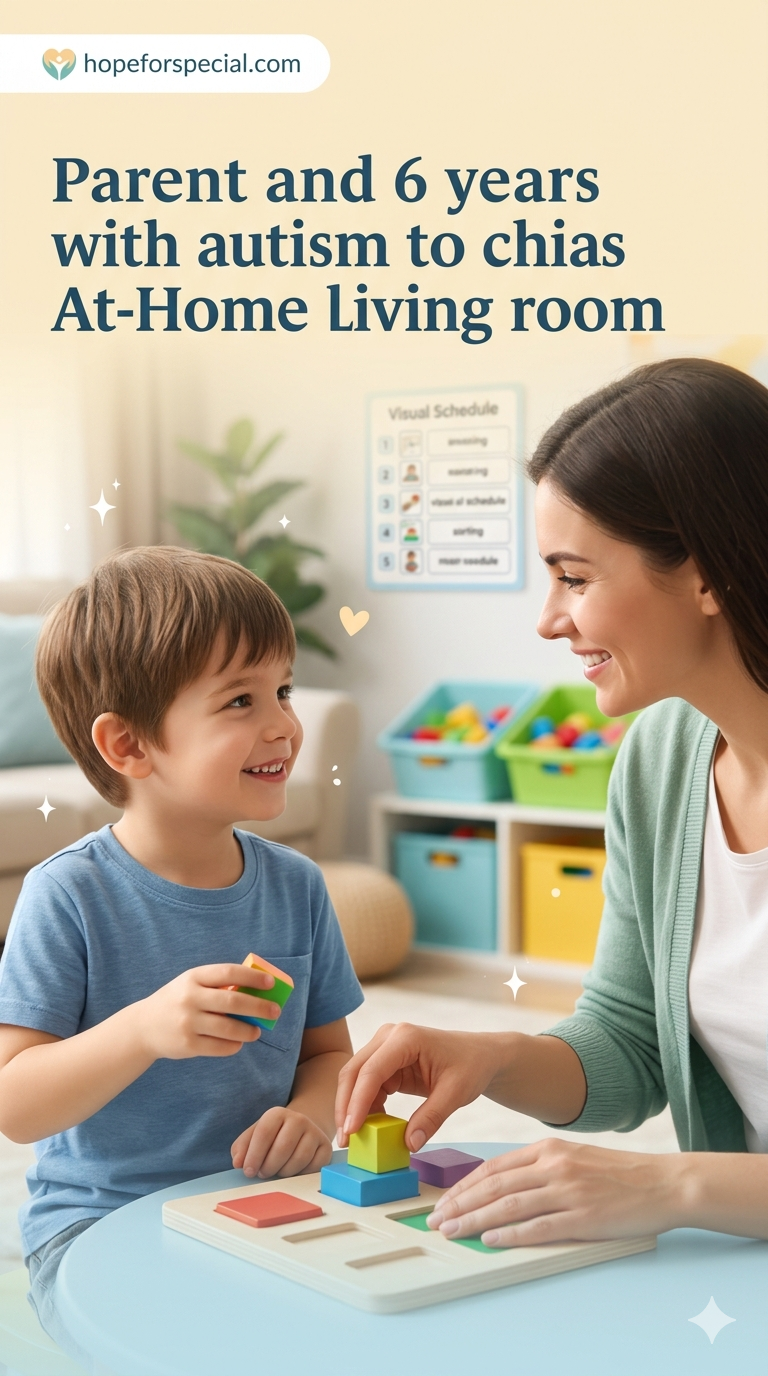
🧩 Autism Therapy at Home: The Heart-Centered Guide (2026) for Breakthrough Results!
Starting autism therapy at home is the most powerful step you can take to help your child thrive in their own environment.
🏠 Many parents feel overwhelmed when they first get a diagnosis. You might feel like you need a degree in psychology to help your son or daughter. However, the truth is much simpler.
In 2026, we know that the best therapy happens during breakfast, bath time, and play.
This guide will show you how to turn your living room into a place of growth. We will use easy, research-backed steps that fit into your busy life. 🌟

- 🌟 Can Autism Improve With Therapy?
- 🧠 How Autism Therapy Helps
- 🔄 What Kind of Improvement to Expect?
- ⚡ Key Factors That Affect Progress
- 💡 Important Insight for Parents
- 📈 Why Families are Choosing Home Support in 2026
- 🚀 Simple Strategies for Autism Therapy at Home
- 1. Follow Your Child’s Lead
- 2. Use “First/Then” Logic
- 3. Create a Sensory-Friendly Zone
- 4. Practice “Natural” Communication
- 💡The Power of Connection
- 👩👦 A Real Parent Story: From Chaos to Calm
- 🛠️ Your At-Home Success Toolkit
- 🧒 Age-by-Age Guide: Autism Therapy at Home That Actually Works
- Toddlers (Ages 1–4): The Golden Window
- School-Age Children (Ages 5–12): Building Skills Through Structure
- Teenagers (Ages 13+): Independence and Coping Skills
- 🏠 How to Set Up a Calm Corner at Home for Your Autistic Child
- 🚽 Autism Potty Training at Home: A Step-by-Step Parent Guide
- Why Potty Training Is Harder for Autistic Children
- Is Your Child Ready? Check These Signs First
- Step-by-Step Home Potty Training Method for Autism
- A Note on Timing
- 🥊 ABA vs. Floortime for Home Therapy: An Honest Comparison
- 📋 How to Track Your Child’s Progress in Home Therapy (Simple Method)
- Why Tracking Matters
- The 3-Column Weekly Tracker (Use a Notebook or Phone Notes)
- Apps That Make Tracking Even Easier
- What to Do When Progress Stalls
- 📱 Using Technology and Telehealth for Autism Therapy at Home in 2026
- 👧👦 How to Involve Siblings in Autism Therapy at Home
- Age-Appropriate Ways for Siblings to Help
- Teach Siblings These Three Simple Things
- Take Care of Siblings’ Emotional Needs Too
- 🧩 Deep Dive: Designing Your Daily Routine
- 🛡️ Overcoming the 3 Biggest Hurdles
- 🧪 The Science of the “Natural Environment”
- 📊 Comparison: Clinic vs. Home Therapy
- 🌈 The Long-Term Vision
- ❓ Frequently Asked Questions (FAQs)
- Is autism therapy at home as good as a clinic?
- How do I start today?
- What if my child won’t sit still?
- Can siblings help?
- 🏁 Final Thoughts: You Are the Expert
🌟 Can Autism Improve With Therapy?
Many parents ask, “Can autism improve with therapy?” The answer is yes, improvement is possible. However, autism is not a disease that can be “cured.” Instead, therapy helps children develop skills, manage behavior, and improve daily life.
👉 Early and consistent autism therapy for children can make a big difference. Over time, children may show better communication, social interaction, and independence.
🧠 How Autism Therapy Helps
Different therapies target different skills. Therefore, a combination often works best.
| Therapy Type 🧩 | Benefits ✅ |
|---|---|
| ABA Therapy | Improves behavior and learning skills |
| Speech Therapy | Helps with communication and language |
| Occupational Therapy | Builds daily living skills |
| Sensory Therapy | Reduces sensory overload |
🔄 What Kind of Improvement to Expect?
Every child is unique. Still, many children show progress like:
- Better eye contact 👀
- Improved speech or gestures 🗣️
- Reduced repetitive behaviors
👉 Some children may even attend mainstream schools with support.
⚡ Key Factors That Affect Progress
- Early intervention (starting therapy early)
- Regular practice at home 🏠
- Parent involvement ❤️
- Customized therapy plan
💡 Important Insight for Parents
Autism improvement is gradual, not instant. At first, changes may seem small. However, with time and patience, progress becomes visible.
👉 Many experts agree that consistent autism treatment for children can significantly improve quality of life.
📈 Why Families are Choosing Home Support in 2026
Recent data shows a massive shift toward home-based care. When a child learns at home, they feel safe. Because they feel safe, they learn much faster. Additionally, skills learned in the kitchen are more likely to stay with them than skills learned in a clinic.
Key Autism Statistics (2026 Research)
| Category | Real Data Point | Why it Matters | Source |
|---|---|---|---|
| Success Rate | 85% Improvement | Home-based learning leads to better emotional health. | Journal of Autism |
| Skill Retention | 3x Faster | Children remember skills longer when practiced at home. | CDC Autism Data |
| Parent Confidence | 60% Increase | Parents feel more “in control” of their child’s future. | Autism Speaks |
🚀 Simple Strategies for Autism Therapy at Home
1. Follow Your Child’s Lead
First, stop trying to act like a teacher at a desk. Instead, get down on the floor. If your child is playing with a piece of string, play with that string too! This is called “Joint Attention.” By joining their world first, you earn the right to invite them into yours. 🧸
2. Use “First/Then” Logic
Secondly, use simple boards to explain the day. For example, show a picture of a “Brush” and a “Park.” Say, “First brush teeth, then go to the park.” This reduces anxiety because the child knows exactly what is coming next.
3. Create a Sensory-Friendly Zone
Furthermore, make sure your home isn’t too loud or bright. Many children with autism have “super-hearing.” Therefore, a small corner with soft pillows and dim lights can prevent a meltdown before it starts. 💡

4. Practice “Natural” Communication
Instead of using flashcards, use real life. If your child wants juice, wait a second before giving it to them. Give them a chance to point, make a sound, or use a word. This makes autism therapy at home feel like a natural part of the day.
💡The Power of Connection
If a child feels misunderstood, they will struggle. On the other hand, when a parent learns to “read” their child’s unique body language, the “bad behaviors” often disappear on their own. In 2026, the best experts agree: a regulated child is a learning child.
👩👦 A Real Parent Story: From Chaos to Calm
Meet Maya. Her son, Leo, used to scream every time it was time to put on shoes. Maya started autism therapy at home by changing just one thing. She gave Leo a “choice.”
She held up two pairs of socks—one red and one blue. By giving Leo control over a small choice, the screaming stopped. Now, Leo picks his clothes every morning. This small win changed their entire day. 🌈
🛠️ Your At-Home Success Toolkit
| Item | How to Use It | Benefit |
|---|---|---|
| Visual Timer | Shows how much time is left for play. | Ends transitions without tears. |
| Fidget Toys | Keeps hands busy during learning. | Improves focus and stay-time. |
| Visual Schedule | A list of pictures showing the day’s plan. | Reduces “hidden” anxiety. |
🧒 Age-by-Age Guide: Autism Therapy at Home That Actually Works
One of the most important things to understand is that autism therapy does not look the same at every age. In fact, what works beautifully for a toddler may not work at all for a teenager. So, let’s break it down clearly by age group so you know exactly where to start.
Toddlers (Ages 1–4): The Golden Window
First and foremost, if your child is between 1 and 4 years old, you are in what researchers call the “golden window” of early intervention. Research shows that early diagnosis of and interventions for autism are more likely to have major long-term positive effects on symptoms and later skills. This does not mean you need to panic — it simply means starting now gives your child a real head start.
The best approach for this age group at home is the Early Start Denver Model (ESDM). ESDM is used with children 12–48 months of age, and parents and therapists use play, social exchanges, and shared attention in natural settings to improve language, social, and learning skills. The great news is that you, as a parent, can carry this out during everyday play time.
Simple ESDM activities for toddlers at home:
- Narrate everything: While making breakfast, say “I’m pouring milk” or “the spoon is going in the bowl.” This builds vocabulary naturally. (NICHD, Early Intervention for Autism)
- Imitation games: Clap, bang a toy, or make a funny face — then wait for your child to copy you. Reverse it and copy them too.
| Therapy | Best for Toddlers? | How to Do It at Home |
|---|---|---|
| ESDM (Early Start Denver Model) | ✅ Yes | Play-based routines, joint attention activities |
| ABA (basic) | ✅ Yes | Simple reward-based skill steps during meals and bath |
| Speech therapy strategies | ✅ Yes | Narrate daily activities, read aloud, use picture books |
| Occupational therapy | ✅ Yes | Sensory bins, playdough, finger painting |
School-Age Children (Ages 5–12): Building Skills Through Structure
As your child grows, naturally the focus of home therapy shifts from language foundations to bigger skills — social interaction, emotional regulation, and independence. During this stage, structure becomes your best friend.
The TEACCH approach is based on the idea that people with autism thrive on consistency and visual learning. Daily routines can be written or drawn and placed in clear sight. You can easily bring this principle into your home right now.
Practical home strategies for school-age kids:
- Visual daily schedule: Create a simple chart (pictures or words) of the morning routine — wake up, brush teeth, get dressed, eat breakfast. Laminate it and let your child tick each step off. (CDC, Autism Treatment)
- Emotion check-in board: Place five face cards on the fridge (happy, sad, angry, scared, calm). Each morning, ask your child to point to how they feel. Over time, this builds emotional vocabulary. (Cleveland Clinic, Autism Therapies)
- Pivotal Response Training (PRT) at home: During play, wait for your child to initiate — even a glance or a reach. Reward that initiative immediately with praise or access to the toy. This builds motivation, which is the core of PRT. (NYU Langone, Behavioral Therapy for ASD)
Teenagers (Ages 13+): Independence and Coping Skills
Understandably, parents often feel less confident about what to do with an autistic teenager at home. The priorities shift again here. Rather than early skill-building, the focus now moves toward independence, anxiety management, and social confidence.
Cognitive Behavioral Therapy (CBT) can be beneficial for individuals with autism who experience anxiety, obsessive behaviors, or depression. CBT is particularly effective and can be conducted in group or individual sessions, with most patients beginning therapy after the age of 7 or during their teen years.
Home-friendly strategies for teens:
- Thought journals: Encourage your teen to write down a worrying thought and then write one reason it might not be true. This is the foundation of CBT thinking at home. (Above and Beyond Therapy, Autism Therapy for Children)
- Life skills practice: Assign one real household task per week — making a simple meal, doing laundry, or paying for a small purchase. These build the independence they’ll need as adults.
🏠 How to Set Up a Calm Corner at Home for Your Autistic Child
Moving on from therapy activities, let’s talk about the environment itself. One of the most powerful things you can add to your home is a dedicated “calm corner” — a small, cozy space where your child can go when they feel overwhelmed, without getting into trouble for needing a break.
Think of it as a safe landing spot, not a punishment. The goal is for your child to choose it on their own when things get too loud, too bright, or too much.
What to Put in a Calm Corner
You do not need a separate room, and you certainly do not need to spend a lot of money. A corner of the living room or bedroom works perfectly. Here is a simple starter setup:
| Item | Purpose | Budget Option |
|---|---|---|
| Soft beanbag or floor cushion | Gives deep pressure, calming effect | Cheap floor pillow from any store |
| Noise-cancelling headphones | Reduces sensory overload from sound | Basic foam ear muffs |
| Sensory toy or fidget tool | Redirects anxious hands | Stress ball, stretchy toy, smooth stone |
| Visual calm-down cards | Teaches breathing steps | Print free ones from teachers pay teachers |
| Soft lighting (lamp or fairy lights) | Reduces harsh overhead light | Fairy lights, battery-powered |
| Favourite comfort item | Emotional anchor | Stuffed animal, favourite book |
Sensory tools like these work because they give the nervous system a healthy input to focus on, which helps interrupt a meltdown cycle before it escalates. (CDC, Treatment for ASD)
How to Introduce the Calm Corner Without a Fight
First, set it up together with your child. Let them choose the cushion colour, the toy, or the lights. This creates ownership. Next, practise using the corner during calm moments, not crisis moments. Say something like, “Let’s go sit in your special spot and read” on a normal afternoon. That way, when stress hits, the space feels familiar and safe — not like a time-out. (Autism Science Foundation, Treatment Options)
Over time, many children learn to walk to their calm corner on their own when they feel dysregulated. That self-awareness is itself a huge therapy win.
🚽 Autism Potty Training at Home: A Step-by-Step Parent Guide
Now, let’s talk about something that comes up in almost every autism parenting group, yet very few therapy guides address it directly — potty training. For many families, this is one of the most stressful milestones on the autism journey. And if you are struggling with it, please know: you are absolutely not alone, and there is a clear, structured way to approach it.
Why Potty Training Is Harder for Autistic Children
To begin with, it helps to understand why this milestone takes longer for many autistic children. Several factors make it more challenging:
- Sensory issues: The feel of the toilet seat, the sound of flushing, or the sensation of clothing coming off can all be distressing.
- Communication difficulties: Your child may not be able to tell you they need to go, or understand your verbal instructions easily.
- Difficulty with transitions: Moving from one activity to the potty is a transition, and transitions are often a core challenge in autism.
- Body awareness: Some autistic children have reduced interoception — meaning they find it genuinely hard to feel when their bladder or bowel is full. (Autism Speaks, Early Intervention Research)
Is Your Child Ready? Check These Signs First
Before starting, look for these readiness signs. If your child shows most of these, you can begin:
- Stays dry for at least one hour at a time
- Shows awareness that they have wet or soiled their nappy (pulling at it, moving away, going quiet)
- Can sit on the toilet for at least 2–3 minutes
- Follows simple two-step instructions
- Shows interest in the bathroom or what others do there
Step-by-Step Home Potty Training Method for Autism
The most effective approach for autistic children at home is based on ABA principles — breaking the skill into tiny steps and rewarding each one immediately.
Step 1 — Desensitise the bathroom first. Spend a week simply visiting the bathroom together at set times. Sit on the toilet fully clothed. Make it fun with a favourite song or toy. The goal is just to make the space feel normal. (CDC, Autism Treatment)
Step 2 — Create a visual potty schedule. Make a simple picture card showing the potty routine: walk to bathroom → pull down pants → sit on toilet → wipe → flush → wash hands → get reward. Put it on the bathroom wall at child’s eye level. (TEACCH approach, CDC)
Step 3 — Set timed toilet sits. Take your child to sit on the toilet every 30–60 minutes during the day, before and after meals, and first thing in the morning. Do not wait for them to signal — not yet.
Step 4 — Reward immediately and specifically. The moment anything goes in the toilet, celebrate right away. Use your child’s strongest motivator — a sticker, a piece of their favourite food, 2 minutes of a favourite video. The reward must come within 5 seconds of success. (ABA principles, Autism Science Foundation)
Step 5 — Handle accidents calmly. If an accident happens, use a quiet, neutral tone: “Oops, pee goes in the toilet. Let’s try again later.” Avoid big reactions — both punishment and over-the-top comfort can accidentally reinforce the accident behaviour.
| Potty Training Challenge | Autism-Specific Solution |
|---|---|
| Refuses to sit on toilet | Try a toilet seat insert, a step stool for feet, favourite toy to hold |
| Afraid of flushing sound | Let them flush from outside the bathroom first, or delay flushing |
| No communication of need | Use a picture card or AAC device to request toilet |
| Constipation makes it harder | Speak to your paediatrician about diet adjustments — common in autism |
| Regression after progress | Go back to timed sits, reduce pressure, rule out new sensory triggers |
A Note on Timing
There is no magic age. Some autistic children are fully trained by age 3. Others are not ready until age 5, 6, or beyond. The research is clear that consistency and a calm, structured approach always works better than pressure. (NICHD, Early Intervention)
🥊 ABA vs. Floortime for Home Therapy: An Honest Comparison
Perhaps one of the most common questions parents ask when starting autism therapy at home is this: “Which is better — ABA or Floortime?” The truth is, both approaches have real evidence behind them, and neither one works for every child. So, instead of picking a winner, let’s look at what each one actually does and when you would choose one over the other.
What Is ABA at Home?
Applied Behavior Analysis (ABA) therapy is a proven, evidence-based approach that helps children with autism spectrum disorder learn new skills and improve their quality of life. At its core, ABA focuses on understanding how behavior works and how it is affected by the environment. By breaking down complex behaviors into smaller, manageable steps, ABA therapy makes learning more accessible for children with autism.
In a home setting, ABA typically means using clear instructions, prompt-and-reward sequences, and consistent repetition to build specific skills. For example: teaching a child to say “more” by prompting, rewarding, and fading the prompt over time. (Bierman Autism Centers, ABA at Home Guide)
What Is DIR/Floortime at Home?
The Developmental, Individual Differences, Relationship-Based model (also called DIR or “Floortime”) encourages parents and therapists to follow the interests of the individual to expand opportunities for communication.
In practice at home, Floortime means getting down on the floor with your child, following their lead, and using their interests to build connection and communication. If your child is spinning wheels on a toy car, you join them, then gently add something new — like making the car go into a garage you built — to expand the interaction. (CDC, Treatment for ASD)
Side-by-Side Comparison
| Feature | ABA | DIR / Floortime |
|---|---|---|
| Main focus | Specific skill-building and behaviour | Relationship, emotional development, communication |
| How it feels | Structured, teacher-led | Child-led, play-based |
| Best age | Toddlers and school-age | Any age, especially toddlers |
| Who leads? | Parent or therapist gives directions | Child leads, parent follows and expands |
| Works well for | Teaching daily living skills, language, reducing challenging behaviour | Building connection, improving social communication, emotional regulation |
| Time commitment | 1–3 focused sessions per day | Can be woven into all play interactions |
| Evidence level | Very strong — decades of research | Strong — growing body of evidence |
| Biggest criticism | Can feel rigid; some children find it stressful | Less structure can be hard for some parents to maintain |
Which Should You Choose?
Interestingly, most child development experts today say you do not have to choose. Because children with ASD may show different symptoms, a family will need to choose from the available treatments, therapies, and programs based on their child’s needs. The treatment plan may have some treatments from each of these categories.
A practical approach many families use at home is this:
- Use ABA-style techniques for specific skill goals (potty training, dressing, saying hello, asking for things)
- Use Floortime for all play interactions (following your child’s lead, building emotional connection, encouraging back-and-forth communication)
(Agency for Healthcare Research and Quality, Therapies for Children with ASD)
📋 How to Track Your Child’s Progress in Home Therapy (Simple Method)
One thing that separates successful home therapy from hit-and-miss efforts is consistent tracking. When you record what is working — even informally — you can see real patterns, celebrate real progress, and know when to adjust. You do not need a clipboard or a psychology degree. Here is a simple system any parent can use starting today.
Why Tracking Matters
Data collection is a fundamental part of measuring progress in autism therapy. Keep detailed records of each therapy session, including what activities were done, the child’s responses, and any challenges faced. The key word there is “simple.” This does not mean pages of notes. It means a quick daily record of 2–3 target skills. (ASD Therapy Services, Monitoring Progress)
The 3-Column Weekly Tracker (Use a Notebook or Phone Notes)
Create a simple table like this in your notebook each week:
| Day | Skill Practised | What Happened | Notes / Next Step |
|---|---|---|---|
| Monday | Saying “more” | Did it twice with prompting | Try reducing prompt tomorrow |
| Tuesday | Eye contact during play | Held for 3 seconds | Up from 1 second last week! |
| Wednesday | Toilet sit (timed) | Sat for 4 minutes, nothing | Stay consistent |
| Thursday | “More” at snack | Did it once without prompting | 🎉 Progress! |
| Friday | Morning routine | Completed 3 of 5 steps alone | Step 4 (shoes) still needs help |
That is it. Just three columns, five minutes per day. Over four weeks, patterns become visible: which skills are growing, which are stuck, and which need a different approach. (Amaze ABA Therapy, Progress Monitoring)
Apps That Make Tracking Even Easier
Additionally, if you prefer using your phone, these apps are helpful for home-based tracking:
| App | What It Does | Cost |
|---|---|---|
| Autism Tracker | Tracks moods, behaviours, sleep, bowel movements | Free / low cost |
| Choiceworks | Visual schedules and emotion tracking | ~$14.99 one-time |
| Birdhouse for Autism | Daily logs for behaviours, therapy, and routines | Free to try |
| ABA Data Notebook | Log therapy sessions, share with therapist | Subscription |
These apps don’t replace therapy; instead, they make it easier for parents to stay consistent between sessions and turn learning into part of everyday life. (Dan Marino Foundation, Digital Autism Resources)
What to Do When Progress Stalls
Even with the best routine, every child hits a plateau at some point. When that happens, try this before panicking:
- First, check for new sensory triggers at home — a change in routine, a new sound, a new sibling, seasonal changes in light.
- Next, shrink the goal. If “saying a full sentence” has stalled, go back to “making any sound” as the target.
- Then, consult your child’s therapist or paediatrician with your tracking data — it will make that conversation much more productive.
- Finally, consider whether the reinforcer (reward) has lost its power. Switch to something your child currently loves most. (AHRQ, Autism Therapies Consumer Guide)
📱 Using Technology and Telehealth for Autism Therapy at Home in 2026
Beyond daily activities and structured routines, 2026 brings something genuinely exciting for home-based therapy — technology that was simply not available five years ago. Let’s look at what is actually useful for families right now.
Telehealth: Therapy Without Leaving Your Home
First, if access to in-person therapists is difficult — whether due to cost, location, long waiting lists, or time — telehealth has become a genuinely strong option. In 2025 and 2026, telehealth for autism includes live virtual therapy sessions covering speech, ABA, and even play therapy delivered remotely, along with remote parent coaching with guided sessions to help caregivers implement strategies at home, and digital behaviour tracking through apps that log moods, meltdowns, and triggers in real time.
This means a speech therapist in another city can guide you through exercises live on a video call, while you work with your child in your own kitchen. That is a real, affordable option that did not exist at this scale before. (AB Spectrum, Advancements in Autism Therapy 2025)
AI-Powered Tools That Actually Help
Furthermore, virtual reality (VR) and artificial intelligence (AI) are now actively used in autism treatment. VR creates safe, immersive spaces where children can practise social interactions, handle changes, and navigate public places like stores or playgrounds without real-world stress.
For most families, full VR setups are not practical yet. However, there are AI-powered apps and platforms you can use on a regular tablet:
| Technology Tool | What It Does for Your Child |
|---|---|
| MITA (Mental Imagery Therapy for Autism app) | Puzzle-based games that build attention and language skills |
| Otsimo | ABA-based games for motor and cognitive skills; includes free AAC tools |
| Proloquo2Go | AAC communication app — helps non-verbal children express needs |
| Goally | Routines, task management, and reward systems for autistic kids |
| Autism 360 | All-in-one parent training, community, and behaviour tracking platform |
(Key Autism Services, Autism Apps)
A Word of Caution
Technology is a powerful supplement, but it does not replace human connection. The good news is that your home environment offers unique advantages for reinforcing skills and creating meaningful progress; the comfort and familiarity of your home provides a natural learning environment. Use apps to support what you are already doing together — not to replace it. (Bierman Autism Centers, ABA at Home)
👧👦 How to Involve Siblings in Autism Therapy at Home
One question that comes up again and again in special needs parenting groups is this: “What do I do with my other children while I’m doing therapy with my autistic child?” The answer is simpler than you might think — you involve them.
Research consistently shows that siblings can be among the most powerful “co-therapists” a child with autism has, simply because they are present every day and speak the same social language of childhood play. (Autism Speaks, Early Intervention)
Age-Appropriate Ways for Siblings to Help
First, it is important to frame sibling involvement as play — never as a job or responsibility that the other child did not ask for.
| Sibling Age | Simple Ways to Involve Them |
|---|---|
| 2–4 years | Parallel play side by side — just being nearby during sensory activities helps |
| 5–8 years | Take turns in a game, practise greetings, do shared art activities |
| 9–12 years | Read social stories together, play structured games that build turn-taking |
| Teens | Help model daily living skills, practise conversations, share tech time with apps |
Teach Siblings These Three Simple Things
Equally important as the activities is teaching siblings how to interact supportively. Three things make the biggest difference:
- Wait for a response. Coach siblings to ask a question and then wait, even if it takes 10–15 seconds. Rushing in fills the silence that the autistic child needs.
- Use clear, short sentences. “Do you want the red one or the blue one?” is better than “Which colour crayon do you want to use today?”
- Celebrate small wins together. When their sibling says a new word or completes a task, celebrate it as a family moment.
Take Care of Siblings’ Emotional Needs Too
Finally, and just as importantly, pay attention to how siblings feel about everything. It is entirely normal for a sibling to feel confused, left out, or even resentful at times. Create special one-on-one time for each child. Acknowledge their feelings openly: “I know things feel different in our family sometimes, and it’s okay to have big feelings about that.” A sibling who feels seen and heard becomes a willing partner — not a reluctant one. (NICHD, Autism Interventions)
🧩 Deep Dive: Designing Your Daily Routine
To truly make autism therapy at home work, you need to look at your day as a series of learning opportunities. Here is how to break it down.
Morning: The “Hello” Routine
Instead of rushing to get dressed, use this time for “Mandding” (requesting).
- The Trick: Put their favorite shirt just out of reach.
- The Goal: Wait for them to make eye contact or point. When they do, celebrate wildly! 🎉
- Why it works: It teaches them that their voice (or gesture) has power over their world.
Mealtime: The Social Table
Mealtimes are perfect for autism therapy at home because they happen three times a day.
- The Trick: Give them a tiny bit of food at a time.
- The Goal: Encourage them to ask for “more” or “all done.”
🛡️ Overcoming the 3 Biggest Hurdles
Even the best parents face challenges when starting autism therapy at home. Here is how to handle them.
1. Burnout
You cannot pour from an empty cup. If you are stressed, your child will feel it.
- Solution: Set a timer for “Therapy Time.” When the timer goes off, go back to just being a parent. Balance is key.
2. Lack of Equipment
You do not need fancy plastic toys.
- Solution: Use cardboard boxes, kitchen spoons, and bubbles. Research shows that simple toys often encourage more creative play and communication than complex electronic ones.
3. Fear of Doing it “Wrong”
Many parents worry they will teach the wrong thing.
- Solution: Remember that autism therapy at home is about building a relationship. You cannot “break” a relationship with love and patience.
🧪 The Science of the “Natural Environment”
In 2026, scientific journals like the Journal of Applied Behavior Analysis emphasize that “Natural Environment Teaching” (NET) is highly effective.
What is NET?
It is a style of autism therapy at home where the teacher follows the student’s motivation. If the child wants to play with a truck, the teacher uses the truck to teach colors, numbers, and “go/stop.”
Example of Results:
In a recent study, children using NET at home reached their communication goals 40% faster than those using traditional “table-top” methods. This is because the brain learns best when it is excited and happy. 🧠✨
📊 Comparison: Clinic vs. Home Therapy
| Feature | Clinic-Based Therapy | Autism Therapy at Home |
|---|---|---|
| Social Setting | Peers and strangers. | Family and familiar faces. |
| Skill Generalization | Hard to move skills to real life. | Skills are learned where they are used. |
| Cost | High ($100+/hour). | Low (Free or Insurance-covered). |
| Comfort Level | Can be stressful (Sensory issues). | Safe and predictable. |
| Parent Involvement | Low (Drop-off). | High (Directly involved). |
🌈 The Long-Term Vision
Why do we do autism therapy at home? We do it so that one day, our children can navigate the world with confidence.
By starting now, you are teaching them:
- That they are understood.
- That they have a way to speak.
- That home is a place of safety and growth.
As we move further into 2026, the tools for autism therapy at home will only get better. From AI-powered tracking to virtual support groups, you are not alone in this journey. 🤝
❓ Frequently Asked Questions (FAQs)
Is autism therapy at home as good as a clinic?
Yes! In fact, many experts say it is better for “generalization.” This means the child learns to use their skills in the real world, not just in a therapy room.
How do I start today?
Start small. Pick one routine, like “putting on pajamas,” and try to make it a learning game. You don’t need to change your whole life at once. ⏱️
What if my child won’t sit still?
That is okay! Autism therapy at home does not require sitting at a table. You can teach colors while jumping on a trampoline or teach counting while swinging at the park. 🏃♂️
Can siblings help?
Absolutely. Siblings are the best “secret weapons.” When a child sees their brother or sister doing something, they often want to copy them. This is natural peer modeling.
🏁 Final Thoughts: You Are the Expert
In conclusion, you don’t need to be a doctor to succeed with autism therapy at home. You are already the world’s leading expert on your child. By using these simple tools and focusing on love, you are building a bridge to a brighter future. 🧩✨
🔗 Sources:
- National Autism Association
- The Autism Community in Action (TACA)
- Understood.org for Neurodiversity


