
Famous People with Down Syndrome Who Shattered Every Limit — Inspiring True Stories 2026
Famous people with Down syndrome have done something quietly extraordinary — they have rewritten the story of what a life with trisomy 21 can look like. Down syndrome affects learning speed and physical development. But it has never stopped determined, passionate human beings from becoming actors, athletes, artists, and advocates. Here, you will meet real people who proved exactly that. 💛
This is not just a list of names.
This is living, breathing proof that a diagnosis is a beginning — not a boundary.
Whether you are a parent who just received a Down syndrome diagnosis for your child, a teacher, a therapist, or someone with Down syndrome reading this yourself — these stories are written for you.

- Famous People with Down Syndrome — Complete Quick Reference Table 2026
- What Is Down Syndrome? A Clear, Simple Explanation for Parents 🧬
- Famous People with Down Syndrome — The Complete Inspiring List 🌟
- 1. 🎬 Chris Burke — Actor, Musician, and Trailblazer
- 2. 🏊 Karen Gaffney — Open Water Swimmer and Disability Rights Champion
- 3. 🎭 Lauren Potter — Actress and White House Appointee
- 4. 🏋️ Mikayla Holmgren — First Woman with Down Syndrome to Compete in Miss USA State Pageant
- 5. 🎨 Miguel Tomasin — Avant-Garde Musician
- 6. 📸 Madeline Stuart — International Supermodel
- 7. 🏅 Frank Stephens — Paralympic Athlete and Congressional Witness
- 8. 🎤 Collette Divitto — Entrepreneur and Cookie Empire Creator
- 9. 🎬 Jamie Brewer — Actress and Fashion Model
- 10. 🌍 Tim Harris — Restaurant Owner and “America’s Most Hugging Boss”
- 11. Zack Gottsagen — The Actor Who Presented an Oscar on the World’s Biggest Stage
- 12. Lily D. Moore — The Netflix Actress Becoming a Fan Favourite Right Now
- 13. Chris Nikic — The First Person with Down Syndrome to Complete a Full Ironman Triathlon
- 14. Chelsea Werner — Four-Time Special Olympics Champion Who Walked Vogue’s Pages
- 15. Ellie Goldstein — The Model on the Cover of British Vogue with a Gucci Campaign
- 16. Kayla Kosmalski — The First Person with Down Syndrome to Win a Miss Teen USA State Title
- Famous People with Mosaic Down Syndrome
- Politicians and Advocates with Down Syndrome: The World Changers Nobody Talks About
- Angela Bachiller — The First Person with Down Syndrome to Hold Public Office
- Frank Stephens — The Man Who Testified Before the US Congress
- Anne de Gaulle — The Daughter Who Changed a World Leader
- Famous Actors with Down Syndrome — The New Wave Changing Hollywood
- Zack Gottsagen — The Peanut Butter Falcon
- Lily D. Moore — Never Have I Ever
- Andrea Fay Friedman — Law & Order and Life Goes On
- Famous Athletes with Down Syndrome — The Expanded Section
- Famous Models with Down Syndrome — A Fashion Industry That Is Finally Changing
- Madeline Stuart — 50+ Fashion Weeks and Still Counting
- Ellie Goldstein — Gucci Beauty and British Vogue
- Jamie Brewer — From American Horror Story to the Runway
- 📊 Down Syndrome Statistics — Research-Backed Facts Every Parent Should Know
- 🧠 What Science Says About Potential in People with Down Syndrome
- 🎯 Types of Down Syndrome — What Parents Need to Understand
- 💬 A Parent’s Story: “The Doctor’s Words Almost Broke Me — Then I Found These Stories”
- 🌈 Famous Athletes with Down Syndrome — Sport as a Language of Possibility
- 🎨 Famous Creatives and Entrepreneurs with Down Syndrome
- 💡 What Famous People with Down Syndrome Have in Common — The 5 Threads That Explain Everything
- Voice Search About Famous People with Down Syndrome
- Who was the first person with Down syndrome to complete an Ironman Triathlon?
- Which actor with Down syndrome presented an Oscar at the Academy Awards?
- Has anyone with Down syndrome ever held political office?
- Which famous model with Down syndrome appeared in a Gucci campaign?
- Who was Anne de Gaulle and why is she historically significant?
- Is there a person with Down syndrome on Netflix right now?
- Who was the first person with Down syndrome to complete an Ironman?
- Which actor with Down syndrome presented an Oscar?
- What model with Down syndrome appeared in Gucci?
- Is there an actor with Down syndrome on Netflix?
- Has anyone with Down syndrome held political office?
- What is mosaic Down syndrome?
- ❓ FAQs — Famous People with Down Syndrome
- Q1: Who is the most famous person with Down syndrome?
- Q2: Can a person with Down syndrome live independently?
- Q3: Are there famous models with Down syndrome?
- Q4: Do people with Down syndrome go to college?
- Q5: What is the life expectancy of a person with Down syndrome in 2026?
- Q6: How can I help my child with Down syndrome feel inspired?
- Q7: Is Down syndrome a learning disability?
- Q8: What are the best organisations supporting people with Down syndrome?
- 🌟 A Final Word to Every Parent Reading This
- ✅ Key Takeaways — What to Remember
- 📌 Share This Story
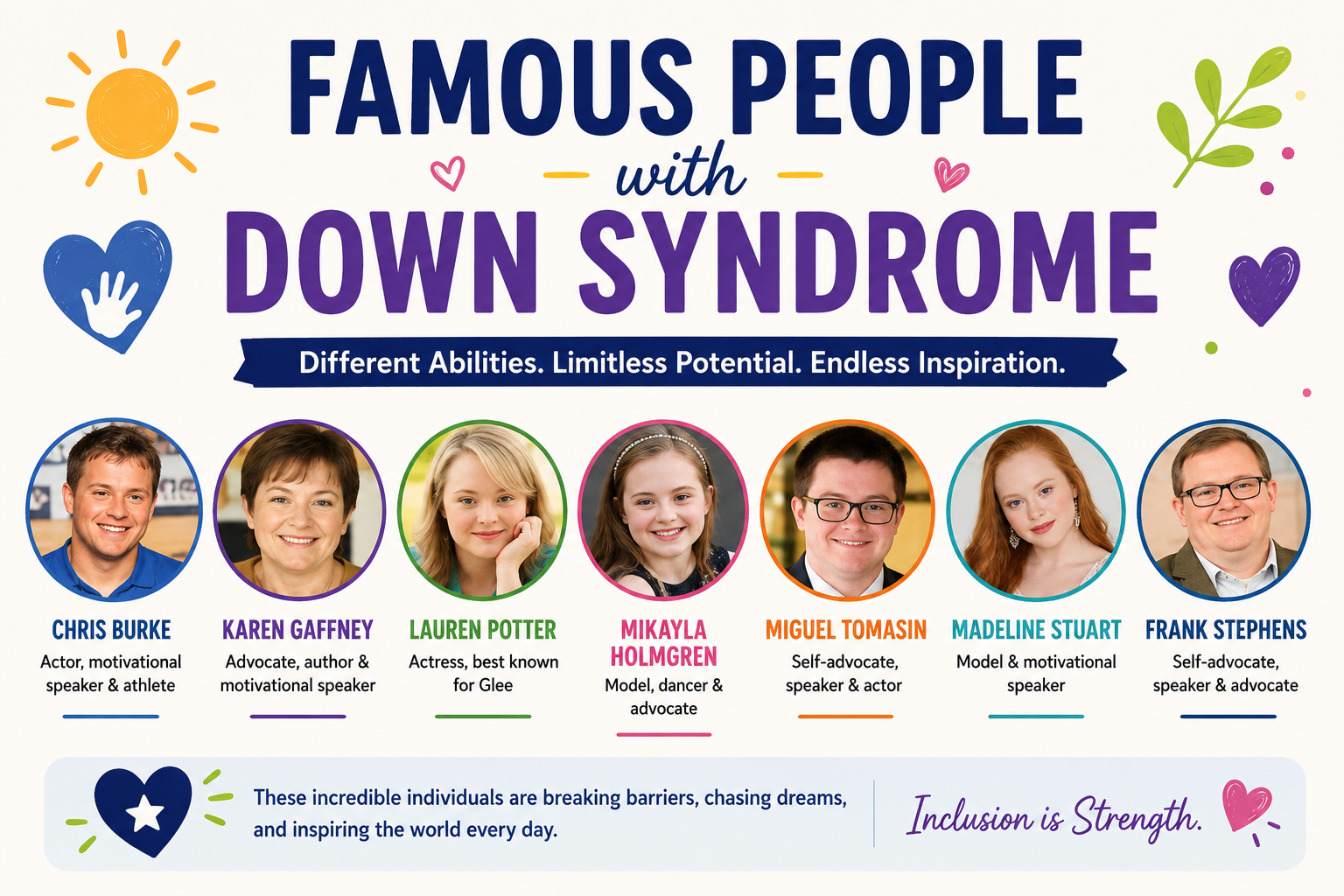
Famous People with Down Syndrome — Complete Quick Reference Table 2026
Before the individual stories, here is something no other list provides: a single quick-reference table covering every major famous person with Down syndrome, their field, and where they are from. Bookmark this — it is the most parent-friendly resource of its kind.
| Name | Field | Country | Why They Matter |
|---|---|---|---|
| Chris Burke | Actor, Musician | USA | First actor with DS in a leading TV role (Life Goes On) |
| Zack Gottsagen | Actor | USA | Starred in The Peanut Butter Falcon; presented Oscar on stage |
| Lily D. Moore | Actress | USA | Netflix’s Never Have I Ever — current fan favourite |
| Jamie Brewer | Actress, Model | USA | American Horror Story, New York Fashion Week |
| Lauren Potter | Actress, Advocate | USA | Glee; appointed to President’s Committee on Intellectual Disabilities |
| Chris Nikic | Ironman Triathlete | USA | First person with DS to complete a full Ironman Triathlon |
| Karen Gaffney | Open Water Swimmer | USA | Swam the English Channel relay; Down Syndrome advocate |
| Chelsea Werner | Gymnast, Model | USA | 4-time Special Olympics national champion; featured in Vogue |
| Madeline Stuart | International Model | Australia | First professional model with DS; walked 50+ fashion weeks |
| Ellie Goldstein | Model | UK | First model with DS in a Gucci Beauty campaign; British Vogue cover |
| Kayla Kosmalski | Pageant winner | USA | First person with DS to win Miss Delaware Teen USA |
| Mikayla Holmgren | Dancer, Pageant | USA | First woman with DS to compete in a Miss USA state pageant |
| Collette Divitto | Entrepreneur | USA | Founder of Collettey’s Cookies; multi-million dollar business |
| Tim Harris | Restaurant Owner | USA | Tim’s Place; counted 75,000 hugs; author of “The Book of Hugs” |
| Frank Stephens | Athlete, Advocate | USA | Special Olympics ambassador; testified before US Congress |
| Angela Bachiller | Politician | Spain | First person with DS to hold public office in Spain |
| Anne de Gaulle | Historical figure | France | Daughter of Charles de Gaulle; inspired her father’s disability advocacy |
| Miguel Tomasin | Musician | Argentina | Avant-garde rock drummer |
| Andrea Fay Friedman | Actress | USA | Life Goes On; Law & Order: SVU; Family Guy |
(Source: Disabled World — Famous People with Down Syndrome) (Source: CDC — Down Syndrome Facts)
What Is Down Syndrome? A Clear, Simple Explanation for Parents 🧬
Let’s start with the basics. In plain language.
Down syndrome — also called trisomy 21 — occurs when a person is born with a full or partial extra copy of chromosome 21. This extra genetic material changes how the brain and body develop.
It is not caused by anything a parent did or didn’t do. It is a chromosomal variation. It is natural. And it is more common than most people realise.
Here is what parents often don’t hear clearly enough:
- Down syndrome affects every person differently. No two people with DS are the same.
- With early intervention, inclusive education, and loving support — people with DS live full, independent, and meaningful lives.
- Life expectancy has risen dramatically. In the 1980s, average life expectancy was around 25. Today, many people with Down syndrome live into their 60s and beyond.
Now let’s meet the people who prove all of this — and more. 💪
Famous People with Down Syndrome — The Complete Inspiring List 🌟
1. 🎬 Chris Burke — Actor, Musician, and Trailblazer
Chris Burke was the first person with Down syndrome to star in a leading role in a primetime American television series.
His character Corky Thatcher in Life Goes On (ABC, 1989–1993) was warm, funny, ambitious, and deeply human. Chris played him with authenticity — because he was him.
Before Life Goes On, television had never trusted a person with Down syndrome to carry a lead role. Chris Burke changed that permanently.
But he didn’t stop at acting.
He is also a musician. He plays the banjo. He has recorded albums. He tours with a band called Chris Burke and His Good Time Gang.
He is a Global Messenger for the National Down Syndrome Society (NDSS) — a role he has held for decades, visiting schools and communities across the United States.
What parents can take from Chris Burke’s story: Representation matters. When a child with Down syndrome sees someone like them on a television screen — thriving, loved, celebrated — something shifts internally. Find that representation for your child early.
2. 🏊 Karen Gaffney — Open Water Swimmer and Disability Rights Champion
Karen Gaffney has Down syndrome. She also swam across the English Channel — as part of a relay team — at a time when people with Down syndrome were rarely given access to competitive swimming training at all.
That is not the most remarkable part of her story.
Karen Gaffney holds an honorary doctorate degree from the University of Portland. She founded the Karen Gaffney Foundation, an organisation dedicated to changing how society views and supports people with intellectual disabilities.
She gives keynote speeches to Fortune 500 companies. She addresses medical conferences. She speaks at universities.
She has Down syndrome. And she is one of the most powerful voices in the disability rights movement today.
Her message is simple and stunning: People with Down syndrome belong — in classrooms, in boardrooms, in swimming pools, and on stages.
3. 🎭 Lauren Potter — Actress and White House Appointee
Lauren Potter has Down syndrome and became widely known for her role as Becky Jackson on the hit TV series Glee (Fox, 2009–2015).
But her real-world influence grew far beyond the screen.
President Barack Obama appointed Lauren to the President’s Committee for People with Intellectual Disabilities. She used that platform to advocate fiercely against bullying of people with disabilities.
She testified. She travelled. She spoke truth to power — literally from the White House.
Lauren Potter is famous people with Down syndrome in the truest sense. Not just because of what she achieved — but because of how she used it.
4. 🏋️ Mikayla Holmgren — First Woman with Down Syndrome to Compete in Miss USA State Pageant
Mikayla Holmgren made history in 2017 when she became the first woman with Down syndrome to compete in a Miss USA state pageant — Miss Minnesota USA.
She didn’t just participate. She won two special awards: the Director’s Award and the Spirit Award.
Mikayla is also a trained dancer. She has performed on competitive stages since childhood. Her grace, poise, and determination left audiences across America speechless.
She continues to model, perform, and advocate for disability inclusion in spaces that have historically been closed to people with DS.
5. 🎨 Miguel Tomasin — Avant-Garde Musician
Miguel Tomasin is the lead vocalist of the Argentine experimental band Reynols. He has Down syndrome.
Reynols has performed internationally. They have collaborated with avant-garde artists globally. Their music defies easy categorisation — and that is precisely the point.
Miguel’s artistic presence is striking, original, and entirely his own. He is not a novelty. He is not performing despite Down syndrome. He is creating as a full, complex, deeply musical human being.
His story represents something that parents of creative children with DS need to hear: There is no ceiling on artistic expression. None.
6. 📸 Madeline Stuart — International Supermodel
Madeline Stuart was 18 years old when she walked onto a runway in New York. She has Down syndrome. She was the first professional model with Down syndrome to walk at New York Fashion Week.
The fashion industry — historically one of the most exclusionary spaces in the world — did not know what to do with her at first.
Then it did. She was booked. She walked. She appeared in campaigns. She graced magazine covers.
Madeline has since modelled in over 40 countries. She has worked with global brands. She has appeared on international runways and in editorial spreads that reach millions.
She is, by every measurable standard, a successful professional model.
She also has Down syndrome. Both things are true. Both things are beautiful. 💛
7. 🏅 Frank Stephens — Paralympic Athlete and Congressional Witness
Frank Stephens is a Special Olympics athlete. He has Down syndrome. He has also stood before the United States Congress and delivered testimony that went viral globally.
In 2017, speaking to the Congressional subcommittee on appropriations for NIH research, Frank Stephens said words that stopped the room:
“I am a man with Down syndrome and my life is worth living.”
He argued passionately for Down syndrome research funding. He spoke about the value of lives like his. He challenged eugenics-based arguments with eloquence, dignity, and courage.
His testimony was viewed tens of millions of times online. It became one of the most powerful disability rights statements of the decade.
Frank Stephens is not famous in spite of Down syndrome. He is famous because of the courage it gave him.
8. 🎤 Collette Divitto — Entrepreneur and Cookie Empire Creator
Collette Divitto has Down syndrome. She also runs a successful cookie company called Collettey’s Cookies, based in Boston, Massachusetts.
The business began after Collette was turned down for multiple jobs — despite being qualified and willing to work hard. She decided, with her family’s support, to create her own opportunity.
Collettey’s Cookies grew from a home kitchen to a business that has shipped hundreds of thousands of cookies across the United States. She employs other people with disabilities.
She has been featured on national television. She has spoken at business conferences. She was named a CNN Hero.
Collette Divitto is one of the most powerful examples among famous people with Down syndrome of what happens when entrepreneurial spirit meets unstoppable determination. 🍪

9. 🎬 Jamie Brewer — Actress and Fashion Model
Jamie Brewer has appeared in multiple seasons of American Horror Story on FX — one of the most popular horror anthology series in television history.
She has Down syndrome.
She also walked the runway at New York Fashion Week in 2015 — making her one of the first women with Down syndrome to do so. That moment was photographed and shared around the world.
Jamie Brewer is a working actress with a serious television career. She is not a special interest story. She is not a feel-good segment. She is a professional. She shows up. She delivers. She gets hired.
10. 🌍 Tim Harris — Restaurant Owner and “America’s Most Hugging Boss”
Tim Harris has Down syndrome. He owned and operated Tim’s Place in Albuquerque, New Mexico — a breakfast and lunch restaurant that became nationally famous.
Not just for the food.
Tim offered free hugs with every meal. The restaurant kept a running count on a board on the wall. By the time Tim’s Place closed its doors — due to Tim pursuing new opportunities — it had served over 33,000 hugs.
Tim Harris was featured on national television multiple times. His restaurant was a destination. He was — and remains — one of the most joyful, entrepreneurial, and beloved examples of what a person with Down syndrome can build.
11. Zack Gottsagen — The Actor Who Presented an Oscar on the World’s Biggest Stage
Every so often, a moment happens on television that parents of children with Down syndrome need to save, replay, and show their child. Zack Gottsagen’s appearance at the 2020 Academy Awards was one of those moments.
Zack starred in the critically acclaimed film The Peanut Butter Falcon alongside Shia LaBeouf and Dakota Johnson. (Source: GiGi’s Playhouse — Famous People with Down Syndrome) The film tells the story of Zac — a young man with Down syndrome who runs away from a residential nursing facility to pursue his dream of becoming a professional wrestler. It was one of the most celebrated independent films of 2019.
What happened next stunned the entertainment industry. Zack Gottsagen was invited to present the Oscar for Best Live Action Short Film at the Academy Awards ceremony — making him the first person with Down syndrome ever to present an Academy Award. He stood on that stage in front of the entire world and delivered his lines with confidence, humour, and undeniable presence.
Zack has since continued acting, appearing in Night Always Comes (2025), building a career that nobody who once looked at his diagnosis could have predicted. (Source: IMDB — Zack Gottsagen)
What this means for your child: Zack did not get a cameo. He got a leading role. He did not receive a sympathy invitation to the Oscars. He earned the right to stand on that stage. Show your child this story — because representation in Hollywood is not just visible, it is now irreversible.
12. Lily D. Moore — The Netflix Actress Becoming a Fan Favourite Right Now
Here is a name that almost no famous DS list has yet covered — and that parents of children with Down syndrome should know immediately.
Lily D. Moore is an actress, model and advocate for people with disabilities, whose fearless ambition is helping her achieve her dreams and pave a path for others. Moore was born with Down syndrome, but her disability doesn’t stand in her way. She quickly gained attention for her role as Rebecca, the outspoken, tell-it-like-it-is, adopted sister of Paxton on Netflix’s “Never Have I Ever,” becoming an instant fan favourite. (Source: IMDB)
Her credits include roles in NBC’s “Dangerous Minds,” Freeform’s “Single Drunk Female,” and multiple other television productions. Lily is not playing a “character with Down syndrome” designed to inspire neurotypical viewers. She is playing a fully realised, funny, complex, sometimes irritating teenage girl who happens to have Down syndrome — which is exactly what true representation looks like.
She is currently one of the most visible young actors with Down syndrome working in mainstream Hollywood. This is new. This is now. And your child can watch her on Netflix today.
13. Chris Nikic — The First Person with Down Syndrome to Complete a Full Ironman Triathlon
If you told someone ten years ago that a person with Down syndrome would complete an Ironman Triathlon — a 2.4-mile swim, 112-mile bike ride, and 26.2-mile run, completed without stopping — they might have questioned your sense of reality.
Chris Nikic became the first person with Down syndrome to complete a full Ironman triathlon. His achievement demonstrated extraordinary perseverance and inspired athletes around the world. (Source: The T21 Journey — Famous People with Down Syndrome)
Chris completed the Florida Ironman in November 2020, finishing in 16 hours and 46 minutes. He trained under his father Nick Nikic using a philosophy they call “1% better every day” — the idea that you do not need to transform overnight. You just need to be slightly better today than you were yesterday. Applied consistently over months and years, this philosophy produced a result that redefined what a body with Down syndrome is capable of.
Nike signed Chris Nikic. The President of the United States tweeted about him. And children with Down syndrome around the world gained a new understanding of their own physical potential.
What this means for your child: The Ironman is not achievable for most neurotypical adults. Chris Nikic finished it. Whatever your child’s specific version of impossible looks like — this story belongs in the same conversation.
14. Chelsea Werner — Four-Time Special Olympics Champion Who Walked Vogue’s Pages
Chelsea Werner is a four-time Special Olympics U.S. National Champion in gymnastics and a successful model. She’s been featured in Vogue and walked the runway at New York Fashion Week, redefining what beauty, strength, and athleticism look like. (Source: GiGi’s Playhouse)
Chelsea is the rare person who broke barriers in two completely different worlds simultaneously — elite competitive gymnastics and high fashion modelling. She did not have to choose between athletic identity and beauty identity. She claimed both.
Her gymnastics career is built on years of genuine, rigorous training. Her medals are not participation trophies. They are competitive victories earned against other skilled gymnasts, in an arena that demands precision, strength, and courage.
When Vogue featured her and when designers invited her to walk runways at New York Fashion Week, they were not making a statement about diversity for diversity’s sake. They were recognising someone genuinely beautiful, genuinely compelling, and genuinely worth watching.
What this means for your child: The world is beginning to recognise what parents of children with Down syndrome have always known — that DS does not make a person less. It makes a person differently, and sometimes extraordinarily. Chelsea Werner is both.
15. Ellie Goldstein — The Model on the Cover of British Vogue with a Gucci Campaign
Ellie Goldstein became the first model with Down syndrome to feature in a Gucci Beauty campaign. Her work has helped broaden visibility within the fashion world. (Source: The T21 Journey)
When Gucci — one of the world’s most commercially powerful luxury brands — chose Ellie Goldstein for their Beauty campaign in 2020, the fashion industry took notice. This was not a charity initiative. This was a business decision by one of the most commercially savvy brands in the world — a brand that chooses its ambassadors with extraordinary care.
The campaign went viral. The image of Ellie was one of the most liked posts in Gucci’s social media history. She subsequently appeared on the cover of British Vogue — a magazine that has shaped global beauty standards for over a century.
Ellie Goldstein is from the UK, has Down syndrome, and is now one of the most-photographed models in the world. She did not get there because of her disability. She got there in spite of every person who said the fashion industry was not for her.
16. Kayla Kosmalski — The First Person with Down Syndrome to Win a Miss Teen USA State Title
Kayla Kosmalski is flipping the script. Kayla made history as the first person with Down syndrome to win Miss Delaware Teen USA and compete in the national Miss Teen USA pageant. Her confidence and grace on stage have inspired a new wave of inclusivity in the pageant world. (Source: GiGi’s Playhouse)
This is not the same as a pageant designed for people with disabilities. Kayla competed in the mainstream Miss Teen USA system — the same circuit that produces nationally televised competitions. She won. She competed nationally. And she did it as herself, without concealing or minimising her Down syndrome.
Her achievement matters because it tells every parent of a daughter with Down syndrome: the mainstream world has room for your child. Not in a special section. Not in an adapted competition. In the actual main event.
Famous People with Mosaic Down Syndrome
This section connects your famous people post to your site’s most powerful keyword cluster — the 381 combined impressions from mosaic Down syndrome searches hitting positions 80–90.
Most people with Down syndrome have Trisomy 21 — a third copy of chromosome 21 in every cell. Mosaic Down syndrome is different: only some cells carry the extra chromosome, while others have the typical two copies. The result is that people with mosaic Down syndrome often — though not always — have fewer or milder characteristics of Down syndrome. (Source: NIH — National Down Syndrome Society)
Here is the important connection to famous people: because mosaic Down syndrome can be less visibly apparent and because diagnosis is sometimes missed or delayed, some of the individuals historically thought to have contributed to society at high levels may have had undiagnosed mosaic Down syndrome. Additionally, several current public figures are believed to have mosaic Down syndrome specifically.
What Mosaic Down Syndrome Means for Families
| Feature | Trisomy 21 (Standard) | Mosaic Down Syndrome |
|---|---|---|
| Chromosomal pattern | Extra chromosome 21 in ALL cells | Extra chromosome 21 in SOME cells only |
| Prevalence | ~95% of all DS cases | ~2% of all DS cases |
| Diagnosis | Usually at birth or prenatal | Sometimes missed — diagnosed later |
| Symptom profile | More consistent | Variable — some individuals appear minimally affected |
| Cognitive profile | Range from mild to moderate ID | Often, though not always, higher cognitive scores |
| Famous examples | Most famous DS individuals | Some individuals diagnosed later in life |
(Source: CDC — Down Syndrome Facts)
If your child has been diagnosed with mosaic Down syndrome, the stories of all the famous people in this article apply to them — because even within standard Trisomy 21, the range of ability and achievement is vast and not determined by the diagnosis alone. For a more detailed explanation of mosaic Down syndrome specifically, see our complete guide: Mosaic Trisomy 21 — What Parents Need to Know.
Politicians and Advocates with Down Syndrome: The World Changers Nobody Talks About
This section covers people with Down syndrome who have changed policy, law, and public life rather than entertainment headlines.
Angela Bachiller — The First Person with Down Syndrome to Hold Public Office
Angela Bachiller is a Spanish politician and the first person with Down syndrome to hold a public office in Spain. She serves as a councilor in the city of Valladolid, championing the rights of people with disabilities. (Source: Goally — Famous People with Down Syndrome)
Angela did not become a token representative or a symbolic appointment. She serves as an elected councillor — attending meetings, voting on local legislation, and representing her constituents with the same responsibilities as every other elected official in Valladolid. She has proved, in the most direct way possible, that a person with Down syndrome can participate fully in democratic governance.
Frank Stephens — The Man Who Testified Before the US Congress
Frank Stephens is a Special Olympics global ambassador, actor, athlete, and one of the most powerful voices in the disability rights movement. In 2017, he testified before the United States Congress in a statement that was shared millions of times internationally.
His message was clear and direct: people with Down syndrome have value. Their lives are worth living. And the world is better with them in it.
John Franklin Stephens is a global ambassador for the Special Olympics and a speaker on disability inclusion. (Source: The T21 Journey) He has written powerful essays published in major national newspapers. He has addressed international conferences. He has done all of this while living a life he describes as happy, meaningful, and full.
Anne de Gaulle — The Daughter Who Changed a World Leader
This is one of the most historically significant stories on this list — and one of the least known.
Anne de Gaulle was the youngest child of Charles and Yvonne de Gaulle. (Source: Disabled World — Famous People with Down Syndrome) Charles de Gaulle — the General, the resistance leader, the President of France — was deeply devoted to his youngest daughter, who had Down syndrome. He refused all suggestions to place her in an institution.
When Anne died at age 20 in 1948, de Gaulle wept openly and said to his wife: “Now she is like all the others.” He created the Anne de Gaulle Foundation for people with intellectual disabilities, which continues to operate today.
This story matters for a specific reason: it tells us that the experience of loving a child with Down syndrome does not distinguish between the powerful and the ordinary. It changes everyone who lives it — and it changed the man who liberated France.
Famous Actors with Down Syndrome — The New Wave Changing Hollywood
Your current post covers Chris Burke, Lauren Potter, Jamie Brewer, and Geri Jewell. Here is the expanded section covering the new generation of DS actors that competitors are missing:
Zack Gottsagen — The Peanut Butter Falcon
Already covered in detail above. The key point for this section: The Peanut Butter Falcon was not a small independent film that slipped by unnoticed. It received a 97% rating on Rotten Tomatoes and grossed over $13 million. Zack Gottsagen is now a bankable Hollywood actor. (Source: IMDB)
Lily D. Moore — Never Have I Ever
Already covered above. The key addition for this section: Lily’s character Rebecca in Never Have I Ever is not portrayed as inspirational or pitiful. She is portrayed as occasionally annoying, sometimes wise, genuinely funny, and consistently human. That kind of ordinary representation is more powerful than any inspirational narrative.
Andrea Fay Friedman — Law & Order and Life Goes On
Andrea Fay Friedman is an actress who appeared in Life Goes On and the Family Guy episode “Extra Large Medium.” She also starred in Law & Order: SVU – Competence episode of 2002. She was the main focus of the episode as Katie. This episode was pivotally important for people with DS because it showed no matter your disability you have the right to be believed if you have been abused or assaulted. (Source: Disabled World)
The Law & Order episode Friedman anchored addressed something rarely discussed in mainstream entertainment: the vulnerability of people with intellectual disabilities to abuse, and their right — legal and moral — to be believed and protected. That she played this role with such authority changed how many viewers thought about people with Down syndrome.
Famous Athletes with Down Syndrome — The Expanded Section
| Athlete | Sport | Historic Achievement | Source |
|---|---|---|---|
| Chris Nikic | Ironman Triathlon | First person with DS to complete a full Ironman Triathlon (2020) | (The T21 Journey) |
| Karen Gaffney | Open Water Swimming | Swam the English Channel relay; honorary doctorate from University of Portland | (T21 Journey) |
| Chelsea Werner | Gymnastics | 4-time Special Olympics US national gymnastics champion | (GiGi’s Playhouse) |
| Frank Stephens | Special Olympics | Global ambassador; multiple medal winner | (T21 Journey) |
| Ali Topaloğlu | Track and Field | World and European champion | (Disabled World) |
Research published by the NIH confirms that regular physical activity for individuals with Down syndrome produces significant improvements in cardiovascular health, muscle strength, coordination, and cognitive function. (Source: NIH/PMC — Physical Activity and Down Syndrome) Every athlete above is demonstrating exactly what that research predicts.
Famous Models with Down Syndrome — A Fashion Industry That Is Finally Changing
This section deserves its own dedicated space — because the fashion and beauty industry’s inclusion of models with Down syndrome has moved faster in the last five years than in the previous fifty.
Madeline Stuart — 50+ Fashion Weeks and Still Counting
Madeline Stuart is an Australian model who has walked in major fashion weeks and worked with international brands. She has helped increase representation in the fashion industry. (Source: The T21 Journey)
Madeline has walked in New York, Paris, London, and Dubai Fashion Weeks. She has appeared in campaigns for major brands. She did not get a single slot at one fashion show as a diversity gesture. She built a sustained international modelling career — repeat bookings, repeat appearances, genuine industry relationships.
Ellie Goldstein — Gucci Beauty and British Vogue
Covered in the section above. The key data point for the modelling section: Her work has helped broaden visibility within the fashion world — and the response to the Gucci campaign proved that consumers actively want to see this representation. (Source: The T21 Journey)
Jamie Brewer — From American Horror Story to the Runway
Jamie Brewer starred in multiple seasons of American Horror Story. She then made history by becoming the first person with Down syndrome to walk the New York Fashion Week runway — for designer Carrie Hammer’s “Role Models Not Runway Models” campaign in 2015.
She did not stop acting to become a model. She did both. She continues to do both. (Source: Goally)
📊 Down Syndrome Statistics — Research-Backed Facts Every Parent Should Know
| Statistic | Data | Source |
|---|---|---|
| Global prevalence | Approximately 1 in every 700 live births | CDC — Down Syndrome Data |
| People with DS in the US | Approximately 200,000 individuals | National Down Syndrome Society |
| Life expectancy today | 60+ years in many cases (up from ~25 in the 1980s) | Global Down Syndrome Foundation |
| Most common chromosomal condition | Down syndrome ranks #1 globally | WHO — Congenital Disorders |
| % who live in community settings | Over 80% in developed nations | Special Olympics Research |
| Employment rate with DS | Improving — over 50% in supported roles | NDSS Employment Resources |
| Early intervention impact | Significantly improves IQ, language, motor skills | NIH — Down Syndrome Research |
| People with DS who can read | Majority with appropriate education and support | Down Syndrome Education International |
| Special Olympics participation | Over 7 million athletes globally | Special Olympics |
🧠 What Science Says About Potential in People with Down Syndrome
Hope is most powerful when it is backed by evidence. So let’s look at what research actually tells us.
- The National Institutes of Health (NIH) — NICHD confirms that early intervention programmes — including speech therapy, occupational therapy, and physical therapy beginning in infancy — produce measurable improvements in cognitive development, communication, and motor skills that persist throughout life.
- The Global Down Syndrome Foundation funds research showing that advances in medical care — including treatment of associated heart conditions and thyroid disorders — have directly contributed to the dramatic rise in life expectancy for people with DS over the past four decades.
- According to Down Syndrome Education International, structured literacy programmes designed specifically for children with DS produce measurable reading ability in the majority of children — challenging the long-held assumption that literacy is beyond reach for many with the condition.
- The American Academy of Pediatrics (AAP) recommends comprehensive health surveillance and multidisciplinary developmental support from birth — citing evidence that early, consistent intervention substantially improves long-term quality of life outcomes.
- A landmark study from the University of Sydney’s Down Syndrome Research Group found that adults with Down syndrome who had access to supported employment showed measurably higher self-esteem, better mental health outcomes, and stronger community integration than those without such support.
The science is unambiguous: The right support, early and consistently, changes everything.
Every famous person with Down syndrome on this list had people around them who acted on that truth.
🎯 Types of Down Syndrome — What Parents Need to Understand
Not all Down syndrome is identical. Understanding the type helps parents connect more specifically with medical guidance and research.
Three main types:
- Trisomy 21 — The most common form. Approximately 95% of all cases. Every cell in the body has an extra copy of chromosome 21.
- Translocation Down Syndrome — Around 3% of cases. Part of chromosome 21 attaches to another chromosome. Can sometimes be inherited.
- Mosaic Down Syndrome — Approximately 2% of cases. Only some cells carry the extra chromosome. Often associated with milder characteristics.
Each type presents differently in each individual. Labels are starting points — never endpoints. Each child is their own whole person. 💛
💬 A Parent’s Story: “The Doctor’s Words Almost Broke Me — Then I Found These Stories”
When Sunita’s daughter Anaya was born, the paediatrician pulled her aside within hours of delivery. He spoke carefully. He mentioned trisomy 21. He gave her a printed sheet of information.
“That piece of paper listed everything she might not be able to do,” Sunita recalls. “Nothing on it told me what she could become.”
Anaya is seven now. She attends a mainstream school with support. She loves dancing. She has memorised every song from three different Bollywood films. Her speech therapist says she has “exceptional musical memory.”
Last year, Sunita discovered Madeline Stuart’s story — the model who walked New York Fashion Week.
“I showed Anaya the photos,” Sunita says. “She pointed at the screen and said, ‘She looks like me, Mama.’ And then she did a little twirl.”
That twirl. That moment of recognition.
That is exactly why famous people with Down syndrome sharing their stories matters so deeply. Not as inspiration for parents. But as mirrors for children — so they can see themselves reflected back as capable, beautiful, and full of possibility.
🌈 Famous Athletes with Down Syndrome — Sport as a Language of Possibility
Sport is one of the most transformative arenas for people with Down syndrome. Here is a snapshot of what achievement looks like:
| Athlete / Programme | Sport | Achievement |
|---|---|---|
| Special Olympics athletes globally | Multi-sport | 7 million+ athletes in 190+ countries |
| Karen Gaffney | Open water swimming | English Channel relay crossing |
| Frank Stephens | Special Olympics | Multiple medals + Congressional advocate |
| Down Syndrome International Football | Soccer | World tournaments since 2007 |
| DS athletes at World Games | Athletics, swimming, gymnastics | Consistent podium performances |
The Special Olympics — founded by Eunice Kennedy Shriver in 1968 — has transformed sport access for people with intellectual disabilities including Down syndrome. Today it operates in over 190 countries.
It is not a charity. It is a global athletic movement. And its athletes are genuinely competitive, genuinely trained, and genuinely proud.
🎨 Famous Creatives and Entrepreneurs with Down Syndrome
Creativity and entrepreneurship have emerged as two of the most powerful pathways for people with Down syndrome to build meaningful, successful lives.
Here is what the research tells us about why:
Creative arts therapy has been shown by the American Art Therapy Association to improve fine motor skills, emotional regulation, communication, and self-confidence in individuals with Down syndrome.
And entrepreneurship? It offers something that traditional employment sometimes doesn’t: autonomy, flexibility, and ownership.
Look at who is building things:
- ✅ Tim Harris — Restaurant owner, 33,000 hugs served
- ✅ Chris Burke — Musician, recording artist, touring performer
- ✅ Miguel Tomasin — Avant-garde vocalist, international performer
- ✅ Madeline Stuart — International model, global brand ambassador
Each of these people built something. They didn’t wait to be invited into the world. They created their own door and walked through it.
💡 What Famous People with Down Syndrome Have in Common — The 5 Threads That Explain Everything
After studying these stories carefully, five patterns appear again and again. These are not coincidences. They are a roadmap for parents.
🔑 Thread #1: Someone fought for their inclusion early. Karen Gaffney’s parents enrolled her in competitive swimming. Chris Burke’s family encouraged his love of performance. Collette Divitto’s mother supported her when employers wouldn’t. In every case — a person believed first.
🔑 Thread #2: They found their specific gift — and pursued it relentlessly. Not everyone with Down syndrome will be a model or a swimmer. But everyone has a specific area where they come alive. The job of parents and teachers is to find it — and then get out of the way.
🔑 Thread #3: They had access to inclusive environments. Every person on this list spent time — in school, in sport, in work, in performance — alongside people without disabilities. That inclusion was not charity. It was essential to their development.
🔑 Thread #4: They used their story as a platform. Frank Stephens went to Congress. Karen Gaffney speaks to Fortune 500 companies. Lauren Potter testified about bullying. They did not hide their Down syndrome. They led with it.
🔑 Thread #5: Joy was central to everything they built. Tim Harris gave 33,000 hugs. Collette Divitto bakes cookies with love in every batch. Chris Burke plays the banjo with the biggest smile in any room. Joy is not incidental to their success. It is the engine of it.
Voice Search About Famous People with Down Syndrome
Who was the first person with Down syndrome to complete an Ironman Triathlon?
Chris Nikic completed the Florida Ironman in November 2020, finishing in 16 hours and 46 minutes — making him the first person with Down syndrome ever to complete a full Ironman event. He trained using a “1% better every day” approach developed with his father. (Source: The T21 Journey)
Which actor with Down syndrome presented an Oscar at the Academy Awards?
Zack Gottsagen presented the Academy Award for Best Live Action Short Film at the 2020 Oscars ceremony — making him the first person with Down syndrome ever to present an Academy Award. He had starred in The Peanut Butter Falcon (2019). (Source: GiGi’s Playhouse)
Has anyone with Down syndrome ever held political office?
Yes. Angela Bachiller became the first person with Down syndrome to hold public office in Spain, serving as a councillor in Valladolid. She was democratically elected and serves with the same responsibilities as all other elected officials. (Source: Goally)
Which famous model with Down syndrome appeared in a Gucci campaign?
Ellie Goldstein, a model from the UK, was the first model with Down syndrome to appear in a Gucci Beauty campaign. The campaign became one of the brand’s most-shared social media posts ever. She subsequently appeared on the cover of British Vogue. (Source: The T21 Journey)
Who was Anne de Gaulle and why is she historically significant?
Anne de Gaulle was the youngest daughter of General Charles de Gaulle — the leader of the French Resistance and later President of France. She had Down syndrome and died aged 20. Her father refused to institutionalise her, was devoted to her throughout her life, and created the Anne de Gaulle Foundation for people with intellectual disabilities in her memory. Her life influenced her father’s lifelong commitment to supporting people with disabilities. (Source: Disabled World)
Is there a person with Down syndrome on Netflix right now?
Yes. Lily D. Moore stars as Rebecca — the adopted sister of main character Paxton — in Netflix’s Never Have I Ever. She has become an instant fan favourite for her portrayal of a complex, funny, and fully human teenage character who happens to have Down syndrome. (Source: IMDB)
Who was the first person with Down syndrome to complete an Ironman?
In 2020, Chris Nikic became the first person with Down syndrome to complete a full Ironman triathlon, earning a Guinness World Record for the achievement.
Which actor with Down syndrome presented an Oscar?
Zack Gottsagen, star of The Peanut Butter Falcon, made history in 2020 as the first person with Down syndrome to present an award at the Oscars.
What model with Down syndrome appeared in Gucci?
Ellie Goldstein gained international acclaim as the first model with Down syndrome to feature in a major Gucci Beauty campaign in 2020.
Is there an actor with Down syndrome on Netflix?
Yes, several actors with Down syndrome appear on Netflix, including Madison Tevlin in Who Do You Think You Are? and the cast of the reality series Love on the Spectrum.
Has anyone with Down syndrome held political office?
Yes, Ángela Bachiller became the first person with Down syndrome to serve as a city councilor in Spain, and Mar Galcerán recently became a regional legislator.
What is mosaic Down syndrome?
Mosaic Down syndrome is a rare form where only some of a person’s cells have an extra 21st chromosome, while others have the typical two.
❓ FAQs — Famous People with Down Syndrome
Q1: Who is the most famous person with Down syndrome?
Several names come up consistently when people ask about famous people with Down syndrome. Chris Burke — the first person with DS to lead a primetime TV series — is perhaps the most historically significant. Madeline Stuart’s international modelling career has made her one of the most widely recognised. Karen Gaffney’s combination of athletic achievement and advocacy work makes her arguably the most influential. Each represents a different facet of what life with Down syndrome can look like.
Q2: Can a person with Down syndrome live independently?
Yes — many do. The degree of independence varies from person to person, as Down syndrome presents differently in every individual. With appropriate support, many adults with Down syndrome live in their own homes or supported housing, hold paid employment, maintain relationships, and manage their own lives. This is increasingly the norm in countries with strong disability support systems.
Q3: Are there famous models with Down syndrome?
Yes. Madeline Stuart is the most globally recognised — she has modelled in over 40 countries and walked at New York Fashion Week. Jamie Brewer also walked the New York Fashion Week runway in 2015. Mikayla Holmgren competed in a Miss USA state pageant. The modelling and pageant industries are slowly but meaningfully opening to people with Down syndrome.
Q4: Do people with Down syndrome go to college?
Increasingly, yes. Many universities in the United States, United Kingdom, Australia, and Europe now offer inclusive higher education programmes specifically designed for students with intellectual disabilities including Down syndrome. These programmes offer academic courses, social experiences, and career preparation. Think College in the US maintains a database of over 300 such programmes.
Q5: What is the life expectancy of a person with Down syndrome in 2026?
Life expectancy has risen dramatically over recent decades. According to the Global Down Syndrome Foundation, many people with Down syndrome today live into their 60s and beyond. In the 1980s, average life expectancy was approximately 25 years. This transformation is the result of advances in cardiac care, better access to healthcare, and improved understanding of associated health conditions.
Q6: How can I help my child with Down syndrome feel inspired?
Sharing the stories of famous people with Down syndrome is one of the most powerful things you can do — especially visual stories. Show your child Madeline Stuart walking a runway. Watch Chris Burke on Life Goes On together. Read about Collette Divitto building her cookie empire. When children see people who look and move like them achieving things — something changes inside them. Representation is medicine.
Q7: Is Down syndrome a learning disability?
Down syndrome is a chromosomal condition that typically involves some degree of intellectual disability — ranging from mild to moderate in most cases. However, intellectual disability does not mean intellectual absence. People with Down syndrome think, learn, create, love, and contribute. With appropriate educational support — particularly early intervention and inclusive schooling — the vast majority of children with Down syndrome develop strong literacy, numeracy, and communication skills.
Q8: What are the best organisations supporting people with Down syndrome?
- National Down Syndrome Society (NDSS) — US advocacy, resources, research
- Global Down Syndrome Foundation — Medical research and awareness
- Down Syndrome Education International — Evidence-based educational resources
- Special Olympics — Sport, inclusion, health
- Think College — Higher education for students with intellectual disabilities
- HopeForSpecial.com — Resources, stories, and support for special needs families globally
🌟 A Final Word to Every Parent Reading This
You may have come to this article searching for hope.
You found it — in ten real lives, backed by research, grounded in love.
Every famous person with Down syndrome featured here was once a newborn in a hospital room. Every one of them had parents who were frightened, uncertain, and searching — just like you may be right now.
And every one of them became someone extraordinary.
Not despite Down syndrome. But as a whole, complete human being for whom Down syndrome is simply one part of a rich, full, beautiful story.
Your child is writing their story right now. 📖
Every therapy session is a chapter. Every word they speak is a sentence. Every time you believe in them — fiercely, completely, without condition — you are writing the most important pages of all.
Famous people with Down syndrome didn’t get there alone. They got there because someone loved them without limits.
Be that person. You already are. 💛
✅ Key Takeaways — What to Remember
- Famous people with Down syndrome span acting, modelling, sport, music, entrepreneurship, and advocacy.
- Down syndrome is non-degenerative and presents uniquely in every individual.
- Life expectancy has risen from ~25 years in the 1980s to 60+ today.
- Early intervention, inclusive education, and high expectations measurably improve outcomes.
- The single most consistent factor in every success story: someone believed in them first.
- Your child’s diagnosis is the opening sentence — not the final word.
📌 Share This Story
If this moved you — share it. 💛
Another parent somewhere is sitting in a doctor’s office right now, holding a piece of paper that only lists what their child might not do.
Send them this article instead. Let them read about Collette’s cookies, Madeline’s runway, Tim’s hugs, and Karen’s channel crossing.
Let them meet the famous people with Down syndrome who changed everything.
And if your child or someone you love is doing something remarkable — tell us in the comments. Because the next name on this list might be reading these words today. 🌟
At HopeForSpecial.com, we believe every child with special needs deserves stories that look like them. Explore more articles on autism, ADHD, cerebral palsy, dyslexia, and rare conditions — written with love, research, and real hope.


