
🧠 Mental Illness Awareness Week 2026: How One Week Can Change Everything for Families Like Yours
Mental Illness Awareness Week is a nationally recognized campaign that gives millions of people the courage to speak up. So, what exactly is it? Mental Illness Awareness Week (MIAW) is observed every year during the first full week of October. It raises awareness, fights stigma, and connects people with life-saving support and resources.
This week matters deeply — especially for parents raising children with special needs. 💚
Because when your child carries both a developmental disability and a mental health condition, the silence around mental illness feels suffocating. MIAW breaks that silence. And it starts with one conversation.

- 📖 What Is Mental Illness Awareness Week?
- 📅 The History of Mental Illness Awareness Week
- 🧩 Why Mental Illness Awareness Week Hits Differently for Special Needs Families
- 💔 A Parent’s Story: “I Didn’t Know Where to Turn”
- 📊 Mental Illness Statistics Every Parent Needs to Know
- 🗓️ When Is Mental Illness Awareness Week 2026?
- 🧠 The 5 Mental Illnesses Most Highlighted During Mental Illness Awareness Week
- 1. 😟 Anxiety Disorders
- 2. 😔 Major Depression
- 3. 🔄 Obsessive-Compulsive Disorder (OCD)
- 4. 😰 Post-Traumatic Stress Disorder (PTSD)
- 5. 🌀 Bipolar Disorder
- ✅ How to Participate in Mental Illness Awareness Week 2026
- 🟢 For Parents of Special Needs Children:
- 🔵 For Educators and School Staff:
- 🟡 For Healthcare Providers:
- 🔴 For Everyone:
- 🌿 The Green Ribbon: Symbol of Mental Illness Awareness Week
- 🔎 Early Warning Signs of Mental Illness in Children with Disabilities
- 💡 The Invisible Mental Health Crisis Among Caregivers
- 📣 MIAW 2026 Theme: Neurodiversity Meets Mental Health
- 🤝 Trusted Resources to Use During Mental Illness Awareness Week
- 🏛️ National & International Organizations:
- 📞 Crisis Lines — Save These Now:
- 📱 Mental Health Apps Worth Using:
- ❓ Frequently Asked Questions About Mental Illness Awareness Week
- 🔹 Q1: What is the purpose of Mental Illness Awareness Week?
- 🔹 Q2: When is Mental Illness Awareness Week 2026?
- 🔹 Q3: Who started Mental Illness Awareness Week?
- 🔹 Q4: What color represents Mental Illness Awareness Week?
- 🔹 Q5: How can parents of special needs children participate in Mental Illness Awareness Week?
- 🔹 Q6: What are the most common mental illnesses in children with autism or developmental disabilities?
- 🔹 Q7: How can schools support Mental Illness Awareness Week?
- 🔹 Q8: Is Mental Illness Awareness Week celebrated globally?
- 🔹 Q9: What is the difference between Mental Illness Awareness Week and World Mental Health Day?
- 🔹 Q10: What free resources are available during Mental Illness Awareness Week?
- 🔹 Q11: Can mental illness affect children under age 10?
- 🔹 Q12: How does stigma prevent families from seeking help during Mental Illness Awareness Week?
- 🌈 Conclusion: One Week. Unlimited Impact.
📖 What Is Mental Illness Awareness Week?
Mental Illness Awareness Week is an annual awareness campaign in the United States, led by the National Alliance on Mental Illness (NAMI). It runs during the first full week of October every year.
The goals are simple but powerful:
- 🗣️ Encourage open conversations about mental health
- 🔍 Help people recognize early warning signs
- 💪 Reduce the stigma that keeps millions silent
- 🤝 Connect individuals and families with real, trusted support
🎙️ Voice Search Answer: “Mental Illness Awareness Week is a campaign held every first full week of October. It is led by NAMI — the National Alliance on Mental Illness. It aims to end stigma, raise awareness, and connect people with mental health support.”
📅 The History of Mental Illness Awareness Week
Mental Illness Awareness Week has deep roots in advocacy and family courage.
In 1990, the U.S. Congress officially recognized this week after decades of grassroots effort by mental health advocates. NAMI played a central role in building it into a national movement.
Here is a brief timeline of key milestones:
| 📆 Year | 🏆 Milestone |
|---|---|
| 1979 | NAMI is founded by a group of determined families |
| 1990 | U.S. Congress officially recognizes MIAW |
| 1995 | MIAW expands to include diverse community outreach |
| 2008 | Mental Health Parity and Addiction Equity Act signed into law |
| 2020 | Virtual MIAW events surge during the COVID-19 pandemic |
| 2023 | MIAW theme: “Together for Mental Health” |
| 2025 | AI-powered mental health tools integrated into MIAW campaigns |
| 2026 | MIAW focuses on neurodivergent individuals and co-occurring disorders |
💡 Key Insight: MIAW was born from families who were tired of suffering in silence. Today, it belongs to every parent, child, caregiver, and advocate who refuses to stay quiet.
🧩 Why Mental Illness Awareness Week Hits Differently for Special Needs Families
If you are raising a child with autism, Down syndrome, ADHD, cerebral palsy, or another developmental condition — you already know the double burden.
Mental health conditions frequently co-occur with developmental disabilities.
Research consistently shows that children with autism spectrum disorder (ASD) are up to 4 times more likely to experience anxiety disorders than their neurotypical peers. Children with intellectual disabilities face depression at rates 2 to 3 times higher than the general population.
Yet their struggles remain the least talked about. The least funded. The least understood.
During Mental Illness Awareness Week, these stories deserve the biggest microphone. 🎙️
💔 A Parent’s Story: “I Didn’t Know Where to Turn”
Meet Priya — a mother from a busy city, raising her 11-year-old son Arav, who has autism.
Arav is non-verbal. For almost two years, Priya watched him bang his head against the wall. He stopped eating. He cried through the night. He withdrew from everything and everyone he once loved.
“Everyone told me it was just autism behaving that way,” Priya shared in an online parent support forum. “No one told me he was also battling severe anxiety. I felt completely alone. I felt like I was failing him.”
It was only during Mental Illness Awareness Week that Priya attended a free virtual webinar hosted by NAMI. There, she learned about co-occurring mental health conditions in children with autism. For the first time, someone put a name to what Arav was going through.
She finally got him the right therapy — a combination of behavioral support and anxiety-focused intervention.
Today, Arav still faces challenges. But he sleeps through the night. He eats. He even smiles more. 😊
That is the real power of Mental Illness Awareness Week.
One webinar. One moment of recognition. One changed life.
📊 Mental Illness Statistics Every Parent Needs to Know
These numbers are not just data. They are real people. Real children. Real families just like yours.
| 📌 Statistic | 🔢 Figure | 🔗 Source |
|---|---|---|
| Adults in the U.S. experiencing mental illness annually | 1 in 5 (approx. 57.8 million) | NAMI — nami.org |
| Age by which 50% of all lifetime mental illness begins | Age 14 | WHO — who.int |
| Youth ages 6–17 experiencing a mental health disorder | 1 in 6 | CDC — cdc.gov |
| Adults with mental illness who actually receive treatment | Less than 50% | NIMH — nimh.nih.gov |
| Annual economic cost of mental illness in the U.S. | $193 billion in lost earnings | NAMI — nami.org |
| Children with ASD who have a co-occurring anxiety disorder | Up to 40% | Autism Science Foundation |
| People who do not seek help due to stigma | Over 60% | Mental Health America — mhanational.org |
| People globally living with depression | 280 million | WHO — who.int |
| People in India who need mental health care | ~150 million | NIMHANS India — nimhans.ac.in |
| Suicide deaths globally every year | ~703,000 | WHO — who.int |
⚠️ Did You Know? In India, approximately 150 million people need mental health care. Yet fewer than 30 million ever seek it. Mental Illness Awareness Week is quietly — but powerfully — changing that conversation.
🗓️ When Is Mental Illness Awareness Week 2026?
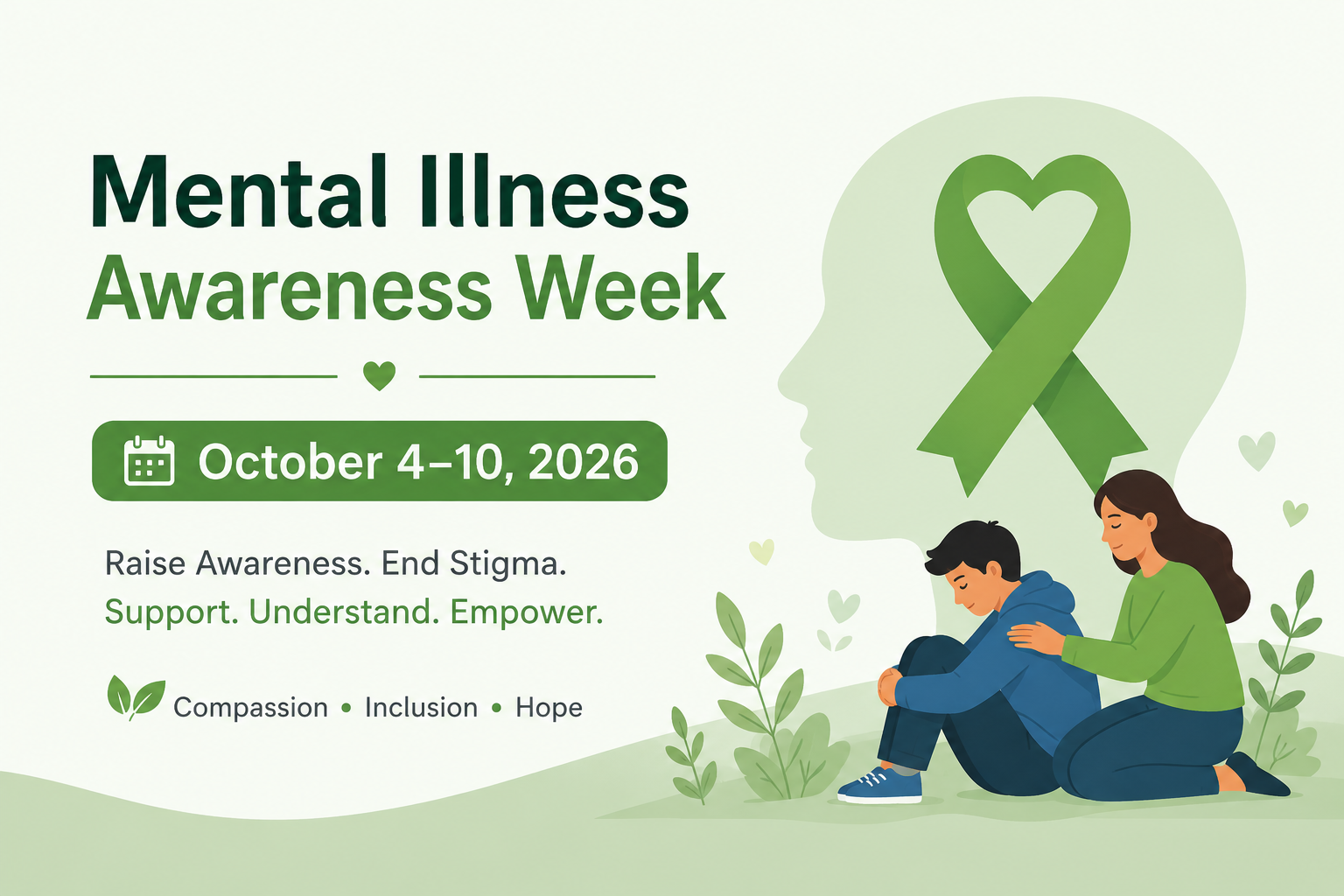
Mental Illness Awareness Week 2026 falls on October 4–10, 2026.
Mark it on your calendar right now. 📅
Here is what typically happens throughout the week:
- Monday–Tuesday: Awareness walks, community outreach, school programs
- Wednesday–Thursday: Free mental health screenings and support group sessions
- Friday: Caregiver and family-focused virtual events
- Saturday–Sunday: Reflection, fundraising, and storytelling campaigns
- October 10 (World Mental Health Day): Global focus — the most powerful day of the week 🌍
🧠 The 5 Mental Illnesses Most Highlighted During Mental Illness Awareness Week
During MIAW, these five conditions take center stage — and all five can affect children with disabilities:
1. 😟 Anxiety Disorders
The most common mental health condition in the world. Anxiety affects over 284 million people globally. It is especially prevalent — and especially underdiagnosed — in children with special needs.
2. 😔 Major Depression
Not just sadness. Depression is a serious clinical condition that affects how a person thinks, feels, and functions every single day. The WHO lists it among the leading causes of disability worldwide.
3. 🔄 Obsessive-Compulsive Disorder (OCD)
OCD affects approximately 2–3% of the population. It frequently co-occurs with autism and Tourette syndrome — and is often misread as “just a behavior issue.”
4. 😰 Post-Traumatic Stress Disorder (PTSD)
Massively overlooked in children with disabilities. Children who experience bullying, medical trauma, or abuse are at significantly higher risk. PTSD changes how a child’s brain develops.
5. 🌀 Bipolar Disorder
Characterized by extreme and cycling mood swings. It is frequently misdiagnosed in individuals with developmental disabilities — leading to years of wrong treatment and unnecessary suffering.
✅ How to Participate in Mental Illness Awareness Week 2026
Whether you are a parent, teacher, therapist, or self-advocate — there are meaningful ways to join this movement.
🟢 For Parents of Special Needs Children:
- Attend NAMI’s free MIAW webinars at nami.org
- Talk openly to your child’s school about mental health support
- Schedule a mental health check-in for both your child and yourself
🔵 For Educators and School Staff:
- Host classroom discussions about emotions, feelings, and mental wellness
- Display mental health posters from Mental Health America
- Train staff to recognize early warning signs of mental illness in students
- Invite a school counselor or child psychologist to speak during MIAW
🟡 For Healthcare Providers:
- Offer free mental health screenings during the awareness week
- Partner with local disability organizations and special needs schools
- Raise awareness about dual diagnoses — mental illness plus developmental disability
🔴 For Everyone:
- 💚 Wear green — the official color of mental health awareness
- 🕯️ Light a candle on World Mental Health Day (October 10)
- ❤️ Donate to NAMI or your local mental health charity
- 📱 Simply check in on a friend or family member who might be struggling in silence
🌿 The Green Ribbon: Symbol of Mental Illness Awareness Week
The green ribbon is the universal symbol of mental health awareness. 💚
Green represents three things that every struggling family needs to hear:
- 🌱 Growth — because recovery is always possible
- 🌿 Hope — even in your darkest moments
- 🍃 Renewal — every single day is a new beginning
Wearing a green ribbon during Mental Illness Awareness Week is a small but profound act. It signals to others: “I see you. You are not alone. You matter.”
For parents raising children with special needs — sometimes just being seen is enough to change everything.
🔎 Early Warning Signs of Mental Illness in Children with Disabilities
Early recognition can genuinely change a child’s entire trajectory. This section is especially critical for special needs families.
Watch carefully for these signs:
| ⚠️ Warning Sign | 👁️ What It May Look Like | ✅ What To Do |
|---|---|---|
| Sudden behavioral changes | Increased aggression, self-injury, withdrawal from activities | Consult a developmental pediatrician immediately |
| Sleep disturbances | Waking up screaming, refusing to sleep, nightmares | Speak with your child’s therapist or neurologist |
| Appetite changes | Refusing all food or dramatic overeating | Rule out medical causes first, then consider anxiety |
| Skill regression | Loss of communication or self-care skills they had mastered | Request a full psychiatric and developmental evaluation |
| Increased repetitive behaviors | Stimming intensity far beyond their personal baseline | Seek a dual-diagnosis specialist |
| Unprovoked emotional outbursts | Intense crying or meltdowns with no clear external trigger | Assess for sensory overload combined with anxiety or OCD |
| Social withdrawal | Refusing activities, people, or places they once loved | Consult a child psychologist experienced in disabilities |
💡 Expert Tip: If your child has both a developmental disability and suspected mental health symptoms, seek a dual-diagnosis specialist or a developmental-behavioral pediatrician. Standard psychiatrists are often not trained in both areas simultaneously.
💡 The Invisible Mental Health Crisis Among Caregivers
Caregivers of children with special needs are among the most mentally vulnerable populations in the world.
And almost nobody talks about it.
Research consistently shows:
- Parents of children with autism experience significantly higher rates of depression and anxiety than parents of neurotypical children
- Caregiver burnout affects an estimated 40–70% of family caregivers of individuals with disabilities
- Many caregivers never seek help because they are too focused — and too exhausted — to consider their own needs
- Caregiver stress has been linked to increased risk of cardiovascular disease, immune dysfunction, and early cognitive decline
During Mental Illness Awareness Week, please hear this clearly:
You cannot pour from an empty cup. 💔
Your mental health is not a luxury. It is a necessity — for you, and for your child.
🛡️ If You Are a Caregiver, Try These Steps This Week:
- Join a free NAMI Family Support Group — no cost, no judgment, just understanding
- Take the NAMI caregiver wellness quiz at nami.org
- Commit to 15 minutes of self-care every day — a walk, a cup of tea, five minutes of silence
- Tell your story to someone safe — you are not weak for struggling. You are human.
- Ask your child’s care team about respite care — you deserve a break
📣 MIAW 2026 Theme: Neurodiversity Meets Mental Health
Mental Illness Awareness Week 2026 is expected to shine a strong spotlight on the intersection of neurodiversity and mental health — the area most special needs families know best and most desperately need support in.

This emerging focus means:
- 🧩 Greater recognition of co-occurring diagnoses (autism + OCD, ADHD + depression, cerebral palsy + anxiety)
- 🎧 More sensory-friendly MIAW events and resources
- 🌐 Expanded outreach to non-English speaking and South Asian communities
- 🏥 A push for culturally adapted mental health care models
- 📱 Integration of AI-powered mental health tools for families without access to specialists
🤝 Trusted Resources to Use During Mental Illness Awareness Week
🏛️ National & International Organizations:
- 🇺🇸 NAMI: www.nami.org — Helpline: 1-800-950-NAMI (6264)
- 🌍 World Health Organization: www.who.int/mental_health
- 🧠 NIMH: www.nimh.nih.gov
- 💚 Mental Health America: www.mhanational.org
- 🧩 Autism Speaks: www.autismspeaks.org
- 🤲 CHADD (for ADHD): www.chadd.org
- 🇮🇳 NIMHANS India: www.nimhans.ac.in
- 🌏 iCall India (Mental Health Support): icallhelpline.org
📞 Crisis Lines — Save These Now:
- 988 Suicide & Crisis Lifeline (U.S.): Call or text 988
- Crisis Text Line: Text HOME to 741741
- Vandrevala Foundation Helpline (India): 1860-2662-345 (24/7)
- iCall India: 9152987821
📱 Mental Health Apps Worth Using:
- Calm — Guided meditation and sleep tools
- Woebot — AI-powered emotional support chatbot
- MindShift CBT — Designed specifically for anxiety management
❓ Frequently Asked Questions About Mental Illness Awareness Week
🔹 Q1: What is the purpose of Mental Illness Awareness Week?
A: The purpose of Mental Illness Awareness Week is to reduce stigma, raise public awareness about mental health conditions, and connect people — especially vulnerable families — with the support they need. It is observed every first full week of October in the United States, led by NAMI.
🔹 Q2: When is Mental Illness Awareness Week 2026?
A: Mental Illness Awareness Week 2026 runs from October 4 to October 10, 2026. October 10 is also World Mental Health Day, which closes the week with a powerful global call to action.
🔹 Q3: Who started Mental Illness Awareness Week?
A: Mental Illness Awareness Week was established by NAMI (National Alliance on Mental Illness) and officially recognized by the U.S. Congress in 1990. NAMI continues to lead MIAW campaigns nationally every year.
🔹 Q4: What color represents Mental Illness Awareness Week?
A: Green is the official color of mental health awareness. 💚 Wearing a green ribbon during Mental Illness Awareness Week symbolizes hope, growth, and solidarity with those living with mental illness.
🔹 Q5: How can parents of special needs children participate in Mental Illness Awareness Week?
A: Parents can attend free NAMI webinars, share their stories on social media using #MentalIllnessAwarenessWeek, speak to their child’s school about mental health resources, and schedule a mental health check-in for both their child and themselves.
🔹 Q6: What are the most common mental illnesses in children with autism or developmental disabilities?
A: Children with autism and developmental disabilities most commonly experience anxiety disorders, major depression, OCD, PTSD, and ADHD as co-occurring mental health conditions. These are frequently underdiagnosed because symptoms often overlap with the primary disability.
🔹 Q7: How can schools support Mental Illness Awareness Week?
A: Schools can host classroom discussions about mental wellness, display awareness posters, train staff to recognize early signs of mental illness, and invite mental health professionals to speak with students and families during MIAW.
🔹 Q8: Is Mental Illness Awareness Week celebrated globally?
A: While MIAW is primarily a U.S.-based observance, World Mental Health Day on October 10 reaches over 150 countries globally. The WHO, UNICEF, and mental health organizations worldwide participate in related awareness events during this week.
🔹 Q9: What is the difference between Mental Illness Awareness Week and World Mental Health Day?
A: Mental Illness Awareness Week is a 7-day U.S. campaign led by NAMI. World Mental Health Day on October 10 is a single global observance organized by the World Federation for Mental Health. The two overlap — World Mental Health Day falls on the final day of MIAW most years.
🔹 Q10: What free resources are available during Mental Illness Awareness Week?
A: During Mental Illness Awareness Week, NAMI offers free virtual mental health screenings, family support groups, crisis helpline services, and downloadable advocacy toolkits. Many community health clinics also offer free consultations. Visit nami.org for the complete list.
🔹 Q11: Can mental illness affect children under age 10?
A: Yes. Mental health conditions can and do begin in early childhood. The WHO confirms that 50% of all lifetime mental health conditions begin by age 14, and many show early warning signs much sooner. Early intervention leads to dramatically better outcomes.
🔹 Q12: How does stigma prevent families from seeking help during Mental Illness Awareness Week?
A: Stigma creates shame, fear of judgment, and a false belief that mental illness means weakness or failure. Over 60% of people with a mental illness do not seek help because of stigma. Mental Illness Awareness Week directly tackles this by normalizing the conversation and celebrating courage.
🌈 Conclusion: One Week. Unlimited Impact.
Mental Illness Awareness Week is not just a campaign. It is a lifeline.
For millions of people — and especially for families raising children with special needs — this week represents something deeply and profoundly important:
The permission to be seen. The courage to ask for help. And the genuine, evidence-backed hope that things can absolutely get better.
Whether your child has autism, ADHD, Down syndrome, cerebral palsy, or any other condition — their mental health matters just as much as any other part of their wellbeing. And so does yours.
In 2026 and beyond, let us commit together to making Mental Illness Awareness Week more inclusive, more accessible, and more impactful than ever before.
Wear your green ribbon. 💚 Share this article with a parent who needs it. Have the conversation that might change someone’s life.
Because awareness does not just raise voices.
Awareness saves lives.
⚕️ Disclaimer: This article is written for informational and awareness purposes only. It does not constitute medical, psychiatric, or therapeutic advice. Always consult a qualified mental health professional for personal mental health concerns.


