

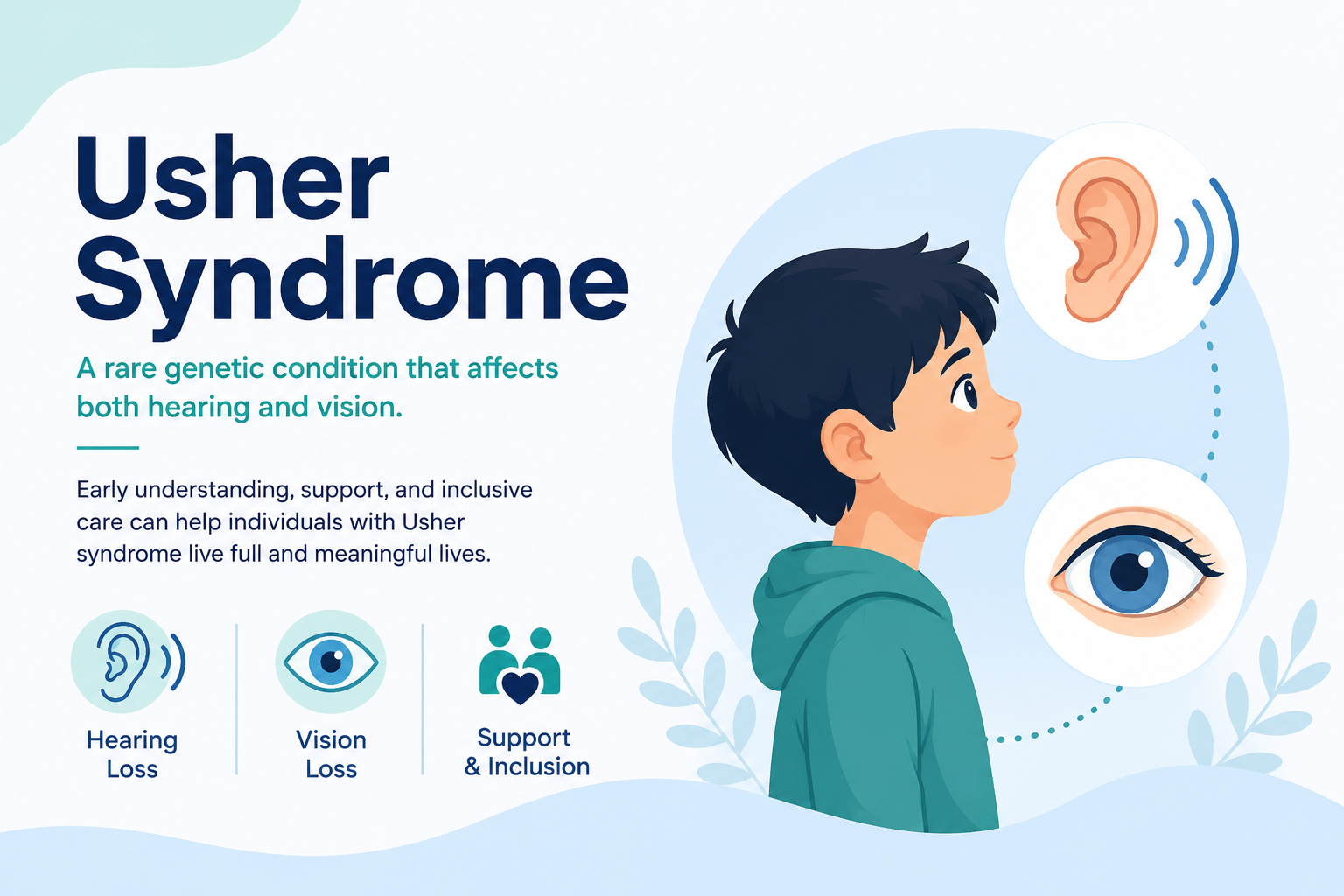
Usher Syndrome 2026: What Every Special Needs Parent Must Know to Protect Their Child’s World 💛
😢 Your deaf child could be losing their sight too — and most families don’t find out until it’s too late. Discover Usher Syndrome warning signs, types, 2026 gene therapy breakthroughs, and school support every parent must know. 💛👇

- 🌟 What Is Usher Syndrome and What Does It Mean for Your Child?
- 🔬 Understanding Usher Syndrome — A Plain-Language Guide
- 📊 Usher Syndrome Statistics 2025–2026 — The Complete Data Picture
- 🧬 The Three Types of Usher Syndrome — A Parent’s Complete Guide
- Usher Syndrome Type 1 (USH1) — The Most Severe 🔴
- Usher Syndrome Type 2 (USH2) — The Most Common 🟡
- Usher Syndrome Type 3 (USH3) — Progressive in Both 🟠
- Side-by-Side Comparison Table
- 💛 Usher Syndrome in Children — What Every Special Needs Parent Must Know First
- Why Usher Syndrome Is So Often Diagnosed Late
- The Single Most Important Action for Parents of Deaf Children
- 🚨 Warning Signs of Usher Syndrome in Children — A Parent’s Checklist
- 🧪 How Is Usher Syndrome Diagnosed? — Tests Explained Simply
- 🔬 Usher Syndrome Treatment in 2025–2026 — The Most Hopeful Moment in History
- Current Management Options
- 🔬 The 2025–2026 Gene Therapy Revolution — Breakthrough by Breakthrough
- The New ICD-10-CM Codes — A Game-Changer for Families
- 🏫 Usher Syndrome at School — IEP, Accommodations, and Advocacy Guide
- Does Usher Syndrome Qualify for an IEP?
- Essential IEP Accommodations for Children with Usher Syndrome
- 💜 The Emotional Reality of Usher Syndrome for Families
- ❓ Frequently Asked Questions — Usher Syndrome 2026
- Q1: What is Usher syndrome in simple terms?
- Q2: What are the three types of Usher syndrome?
- Q3: How common is Usher syndrome in children?
- Q4: Can Usher syndrome be cured?
- Q5: How is Usher syndrome inherited?
- Q6: At what age does vision loss begin in Usher syndrome?
- Q7: My child is deaf — should they be tested for Usher syndrome?
- Q8: What is the new ICD-10-CM code for Usher syndrome?
- Q9: What school support does a child with Usher syndrome need?
- Q10: Where can families find the latest Usher syndrome research news?
- 💛 Final Words: Your Child’s World Is Worth Fighting For
🌟 What Is Usher Syndrome and What Does It Mean for Your Child?
Usher syndrome is the world’s leading genetic cause of combined hearing and vision loss — and it affects far more children than most parents or even healthcare providers realise. In simple terms, it is an inherited condition where gene mutations damage both the sensory cells in the ear and the light-sensitive cells in the retina, causing a child to experience hearing loss from birth or early childhood, followed by progressive vision loss — often beginning in the teenage years. The most critical fact? Early identification changes everything about the outcome.
For families already navigating the complex world of special needs, an Usher syndrome diagnosis can feel like the ground shifting beneath them. A child who is deaf — or hard of hearing — now also faces the prospect of losing their sight. It is a reality that deserves to be named with honesty, met with knowledge, and approached with genuine hope. Because in 2026, hope has never been more scientifically grounded.
🔬 Understanding Usher Syndrome — A Plain-Language Guide
Usher syndrome is a rare inherited disorder that causes vision loss, hearing loss and, sometimes, balance issues. It happens because mutations in specific genes disrupt how hearing and vision develop during fetal development. Usher syndrome symptoms are often congenital or develop during childhood. (Source: Cleveland Clinic)
The condition affects three sensory systems simultaneously — and understanding each one matters.
The Three Sensory Systems Affected
| System | What Happens in Usher Syndrome | How It Shows Up in Children |
|---|---|---|
| Hearing | Sensorineural hearing loss — the inner ear hair cells are damaged from before or at birth | Identified at birth via newborn screening; varies from moderate to profound loss depending on type |
| Vision | Retinitis Pigmentosa (RP) — progressive degeneration of the retina’s rod and cone cells | Begins with night blindness; progresses to tunnel vision; eventually severe vision loss |
| Balance | Vestibular dysfunction — the inner ear’s balance organs are affected | Delayed walking in infants; poor coordination; avoidance of dark environments |
What Causes Usher Syndrome?
All types of Usher syndrome are inherited in an autosomal recessive pattern, meaning both biological parents have the genetic mutations that cause Usher syndrome and pass them on to their child. If a child receives one normal gene from one biological parent and a mutated gene from the other, that child will carry the mutation but probably won’t have symptoms. (Source: Cleveland Clinic)
In plain terms: both parents are typically carriers without symptoms. They each have one working copy and one faulty copy of the relevant gene. When their child inherits both faulty copies, Usher syndrome develops.
Usher syndrome is the most common cause of deaf-blindness in humans, with a prevalence of about 1 in 10,000 — approximately 400,000 people worldwide. (Source: NCBI / Institut Pasteur, 2022)
📊 Usher Syndrome Statistics 2025–2026 — The Complete Data Picture
| Statistic | Data | Source |
|---|---|---|
| Global prevalence | Estimated at 4 to 17 per 100,000 individuals worldwide — the leading cause of combined sight and hearing loss | ScienceDirect |
| Estimated worldwide population affected | Worldwide, more than 400,000 people are affected by Usher syndrome | Hearing Health Foundation |
| 2025 genomic study — worldwide disease prevalence | Worldwide disease prevalence calculated at 721,769 (range 85,107–2,103,592) and a birth rate of 12,090 births/year affected by Usher syndrome | medRxiv, February 2025 |
| US birth rate affected | Usher syndrome affects approximately four babies in every 100,000 births in the United States | Hearing Health Foundation |
| % of all deaf-blindness cases caused by Usher | Approximately 50% of all deaf-blindness worldwide is caused by Usher syndrome | NORD |
| % of bilateral deafness in children | Usher syndrome types 1 and 2 account for approximately 10% of all cases of bilateral moderate to profound deafness in children | NORD |
| % of congenital profound hearing loss with Usher | An estimated 10% of individuals with congenital bilateral sensorineural hearing loss have Usher syndrome | Hearing Health Foundation |
| % of all RP cases caused by Usher | Usher syndrome accounts for about 18% of all patients with retinitis pigmentosa | ScienceDirect |
| Genes linked to Usher syndrome | At least 9 genes conclusively linked — including MYO7A and USH2A | medRxiv, 2025 |
| New ICD-10-CM codes effective | Dedicated ICD-10-CM codes for Usher syndrome took effect October 1, 2025 — improving diagnosis, care, insurance, and research | Usher Syndrome Coalition, 2025 |
🧬 The Three Types of Usher Syndrome — A Parent’s Complete Guide
Understanding which type of Usher syndrome your child has is the most important first step after diagnosis. The type determines the severity of hearing loss at birth, when vision problems begin, whether balance is affected, and which treatments or clinical trials may be relevant.
Usher Syndrome Type 1 (USH1) — The Most Severe 🔴
USH1 is the most severe subtype of Usher syndrome, characterised by profound congenital sensorineural hearing loss with vestibular areflexia. Vestibular dysfunction typically manifests in early childhood as delay in motor development, especially in walking and activities requiring coordination. (Source: ScienceDirect)
Key features of Type 1:
- ✅ Hearing: Profound deafness from birth — child cannot hear without amplification
- ✅ Vision: Retinitis pigmentosa typically begins in early adolescence
- ✅ Balance: Severely affected — children usually do not walk until 18 months or later
- ✅ Speech: Without cochlear implants, children do not typically develop speech
- ✅ Most common genes: MYO7A, USH1C, CDH23, PCDH15, USH1G
- ✅ Global prevalence: 3–6 per 100,000 people
Usher Syndrome Type 2 (USH2) — The Most Common 🟡
USH2 is the most frequent form, characterised by congenital, bilateral sensorineural hearing loss that is mild to moderate in the low frequencies and severe to profound in the higher frequencies, intact vestibular responses, and retinitis pigmentosa that begins in the second to third decade of life. (Source: LSU Health Sciences Center)
Key features of Type 2:
- ✅ Hearing: Moderate to severe hearing loss from birth — hearing aids usually help significantly
- ✅ Vision: RP develops in the teen years or early adulthood
- ✅ Balance: Not typically affected — vestibular function is preserved
- ✅ Speech: Children often develop speech with hearing aids
- ✅ Most common gene: USH2A (most prevalent Usher gene worldwide)
- ✅ Population: Most common Usher type overall
Usher Syndrome Type 3 (USH3) — Progressive in Both 🟠
USH3 is characterised by postlingual, progressive sensorineural hearing loss, late-onset retinitis pigmentosa, and variable impairment of vestibular function. (Source: LSU Health Sciences Center)
Key features of Type 3:
- ✅ Hearing: Normal at birth but deteriorates progressively during childhood and adolescence
- ✅ Vision: RP begins later — often in adulthood
- ✅ Balance: Variable — some patients affected, others not
- ✅ Particularly common in: Finnish and Ashkenazi Jewish populations
- ✅ Key gene: CLRN1
Side-by-Side Comparison Table
| Feature | Type 1 (USH1) | Type 2 (USH2) | Type 3 (USH3) |
|---|---|---|---|
| Hearing at birth | Profound deafness | Moderate–severe loss | Normal |
| Hearing progression | Stable (already profound) | Stable | Progressive loss |
| Vision loss onset | Early adolescence | Second–third decade | Late onset |
| Balance affected | ❌ Severely | ✅ Normal | ⚠️ Variable |
| Speech without implant | Rarely develops | Often develops | Develops normally initially |
| Most common gene | MYO7A | USH2A | CLRN1 |
💛 Usher Syndrome in Children — What Every Special Needs Parent Must Know First
This is the section that is written specifically for parents who are already in the special needs world.
Why Usher Syndrome Is So Often Diagnosed Late
Many families know their child is deaf or hard of hearing from early infancy — thanks to newborn hearing screening programmes. But the second part of the Usher syndrome diagnosis — the retinitis pigmentosa — is often not identified for years.
Why? Several reasons:
- Young children with hearing loss adapt remarkably well — they use peripheral vision, they lip-read, they develop strong visual strategies. The gradual narrowing of peripheral vision from RP can be missed for years.
- Night blindness is the first symptom — but young children are not often out in dark environments alone, so it goes unnoticed.
- Children do not report visual symptoms — they do not know that other people can see differently. What is normal for them has always been their only experience of vision.
- Diagnostic overshadowing — when a child is deaf, all attention focuses on hearing intervention. Vision is sometimes not assessed with appropriate urgency.
💬 A Parent’s Experience
“Radhika was diagnosed with profound deafness at three days old via newborn screening. We spent the next five years entirely focused on her cochlear implant, auditory therapy, speech, and school.
It was a specialist audiologist who first mentioned Usher syndrome at her routine review when she was six. We had never heard the word before.
When she was tested by an ophthalmologist, early-stage RP was already present. I am grateful we found it then. But I wish someone had told us from her very first hearing appointment that Usher syndrome should be ruled out in every profoundly deaf child.” — Sunita K., mother of a child with Usher Syndrome Type 1, Bengaluru, India
The Single Most Important Action for Parents of Deaf Children
Approximately 3–6% of hearing-impaired children have Usher syndrome. An estimated 10% of children born with congenital profound sensorineural hearing loss have Usher syndrome. (Source: LSU Health Sciences Center)
If your child has been diagnosed with any degree of bilateral sensorineural hearing loss, ask for an ophthalmological assessment and genetic testing for Usher syndrome immediately. Do not wait for vision symptoms. By the time RP symptoms are visible, significant retinal degeneration has already occurred.
🚨 Warning Signs of Usher Syndrome in Children — A Parent’s Checklist
🔴 Signs in Infants and Toddlers
- ✅ Profound deafness identified at birth via newborn hearing screening
- ✅ Delayed walking — not walking independently by 18 months (particularly USH1)
- ✅ Poor balance — falls frequently on uneven surfaces, struggles with stairs
- ✅ Clumsiness in low-light conditions — bumps into things when lighting is reduced
- ✅ Does not easily track moving objects at night — parents may notice this during evening outdoor activities
🟡 Signs in School-Age Children
- ✅ Difficulty seeing in dim light or at dusk — requests to leave a dark room or refuses to walk in dimly lit areas
- ✅ Trips over objects at the edges of vision — peripheral vision narrowing
- ✅ Difficulty with crowded or visually complex environments — sports, assemblies, busy playgrounds
- ✅ Squinting or turning the head to look at objects rather than using full field of vision
- ✅ Night blindness that parents notice — reluctance to go out after dark
🟠 Signs in Teenagers
- ✅ Avoiding activities that require clear peripheral vision — driving discussions, sports
- ✅ Difficulty in movie theatres or darkened environments
- ✅ Beginning to bump into objects on the side — classic tunnel vision development
- ✅ Reduced visual field on formal testing — electroretinogram (ERG) shows reduced function
🧪 How Is Usher Syndrome Diagnosed? — Tests Explained Simply
| Test | What It Does | When It Is Used |
|---|---|---|
| Newborn Hearing Screening | Identifies hearing loss in first days of life | At birth — first trigger for Usher investigation |
| Audiological Assessment | Detailed testing of hearing across frequencies | Confirms type and degree of hearing loss |
| Electroretinogram (ERG) | Measures retinal function by recording electrical responses to light | Key test for RP — can detect it before symptoms appear |
| Ophthalmological Visual Field Testing | Maps the full field of vision | Identifies peripheral vision narrowing |
| Vestibular Testing | Tests balance organ function | Differentiates USH1 from USH2/3 |
| Genetic Testing (NGS) | Identifies which specific Usher gene mutation is present | Molecular diagnosis has advanced significantly with the use of targeted next-generation sequencing (NGS), which allows efficient detection of mutations across all known Usher-related genes — (DelveInsight, 2025) |
The most important point: An ERG can detect retinitis pigmentosa before any symptoms are visible. This is why genetic testing and proactive ophthalmological assessment in all deaf children matters so much. Early detection changes what families can plan for, and which clinical trials their child may be eligible for. (Source: NORD)
🔬 Usher Syndrome Treatment in 2025–2026 — The Most Hopeful Moment in History
There is currently no cure for Usher syndrome.

However, 2025 and 2026 have brought more genuine scientific progress than any period in the condition’s history. And the word “cure” — once unthinkable — is now used with increasing confidence by leading researchers.
Current Management Options
| Intervention | What It Does | Who It Helps |
|---|---|---|
| Cochlear implants | Restore functional hearing in profoundly deaf patients | USH1 — transformative for hearing and speech development |
| Hearing aids | Amplify residual hearing | USH2 and USH3 — significant functional improvement |
| Low vision aids and orientation training | Maximise remaining vision; develop navigation skills | All types as RP progresses |
| Tactile Sign Language / DeafBlind communication | Alternative communication system when vision loss is significant | Advanced stages of all types |
| Vitamin A palmitate | Has shown modest slowing of RP progression in some studies | Selected USH2 patients — discuss with ophthalmologist |
| Antioxidant therapy (NACA/NAC) | Aims to slow retinal cell degeneration from oxidative stress | Clinical trials in progress |
🔬 The 2025–2026 Gene Therapy Revolution — Breakthrough by Breakthrough
This is where families deserve the most current, honest information available.
1. PUSH — Pipeline for Usher Syndrome Research (Boston Children’s Hospital, 2025)
The Pipeline for Usher Syndrome Research (PUSH) was launched in January 2025 at Boston Children’s Hospital. This groundbreaking project brings together six world-class scientists in one academic institution, each a leader in their field with complementary expertise, aiming to tackle multiple forms of Usher syndrome in parallel. (Source: Usher Syndrome Society)
2. LUCE-1 Trial — Gene Therapy for USH1B (MYO7A)
AAVantgarde Bio has completed dosing in its Phase 1/2 retinal gene therapy clinical trial for people with Usher syndrome type 1B. Known as LUCE-1, this trial uses AAVB-081 — the first clinical application of a dual-vector gene delivery system for a retinal disease. Initial safety and preliminary efficacy have been reported in the first patients treated. (Source: Foundation Fighting Blindness)
3. MCO-010 — Vision Restoration for Advanced RP (All USH types)
MCO-010 is a gene therapy delivered as a single injection into the eye. It works by activating a different layer of retinal cells to respond to light, bypassing the cells already lost to RP. Because it does not target one specific gene mutation, it may help people regardless of which gene caused their vision loss — including across different Usher syndrome subtypes.
People with advanced RP who received MCO-010 showed meaningful improvements in visual acuity, roughly the equivalent of reading three additional lines on an eye chart. Those gains lasted through three years of follow-up with no treatment-related serious side effects. (Source: Usher Syndrome Coalition — Grounded in Science, March 2026)
4. BF844 for USH3 — First Phase 1 Clinical Trial
Researchers found that the N48K mutation in Clarin 1, which causes Usher syndrome type 3, makes the protein unstable. A drug called BF844 can stabilise this faulty protein and reduced hearing loss in mice. A Phase 1 clinical trial has now begun in Perth, Australia, to test the drug’s safety in people. (Source: Usher Syndrome Coalition — Research News)
5. Ultevursen — RNA Therapy for USH2A
Théa has launched a new business unit, Sepul Bio, to continue clinical development of ultevursen for people with exon 13 mutations in the USH2A gene — an RNA therapy approach targeting the most common Usher gene. (Source: Foundation Fighting Blindness)
The New ICD-10-CM Codes — A Game-Changer for Families
This is a significant 2025 development that most families have not heard about.
Effective October 1, 2025, Usher syndrome now has dedicated ICD-10-CM codes with subcodes for types 1, 2, and 3. Recognition in the US healthcare system means insurance coverage for medical visits, therapies, genetic testing, and assistive devices is now better supported. Coordinated care across hearing, vision, and balance specialists is improved. And patients can be identified more easily in health records, speeding recruitment for clinical trials. (Source: Usher Syndrome Coalition, October 2025)
Action step for parents: Make sure all of your child’s specialists are now using the correct ICD-10-CM code for Usher syndrome at every appointment. This directly affects insurance coverage and research participation eligibility.
🏫 Usher Syndrome at School — IEP, Accommodations, and Advocacy Guide
Children with Usher syndrome face dual sensory challenges in educational settings — and most school staff have never heard of the condition. This makes proactive parent advocacy not optional but essential.
Does Usher Syndrome Qualify for an IEP?
Yes. Usher syndrome qualifies under multiple IDEA categories simultaneously:
- Hearing Impairment — for the sensorineural hearing loss
- Visual Impairment including Blindness — as RP progresses
- DeafBlindness — when both sensory losses become significantly limiting
- Other Health Impairment — if dual sensory needs affect educational performance
Children with Usher syndrome who use cochlear implants or hearing aids may be served primarily under the Hearing Impairment category initially — but the IEP should explicitly acknowledge the anticipated progression of vision loss and plan for it proactively.
Essential IEP Accommodations for Children with Usher Syndrome
For hearing:
- [ ] FM system or Roger device in the classroom — direct signal to cochlear implant or hearing aid
- [ ] Captioning for all video content
- [ ] Preferential seating — front and centre; good lighting on the teacher’s face
- [ ] Note-taker or transcription service for older students
- [ ] Sign language interpreter if the child uses sign language
For vision (especially as RP progresses):
- [ ] Enlarged print or digital materials with adjustable font size
- [ ] High-contrast materials and displays
- [ ] Avoidance of hallway bottlenecks and crowded transitions — safety concern
- [ ] Time and support for transition between rooms — especially during low-light periods
- [ ] Orientation and Mobility (O&M) training — essential and highly practical
- [ ] Access to Braille instruction — beginning early rather than as a last resort
For balance (USH1):
- [ ] Modified PE participation
- [ ] Safe pathways in school — no obstacles in corridors, handrails available
- [ ] Extra time for transitions between classes
For communication:
- [ ] All staff trained in the specific communication system the child uses
- [ ] Tactile sign language training planned for as vision decreases
- [ ] AAC device if dual sensory loss limits other communication
Emotional and social:
- [ ] School counsellor involvement — anticipatory grief and adjustment are real for these children
- [ ] Connection with other children who have Usher syndrome — the Usher Syndrome Coalition facilitates this
💜 The Emotional Reality of Usher Syndrome for Families
No guide on Usher syndrome is complete without naming the emotional dimension honestly. Because this condition is not simply a medical diagnosis. It is a slow-moving dual loss that families live with every day — and that deserves compassionate attention.
When parents learn their deaf child also has retinitis pigmentosa, they often go through a layered grief experience:
- Relief at finally having a name for what they had sometimes half-suspected
- Grief — for the full visual world they hoped their child would have
- Fear of the progressive nature — watching for each symptom of advancing RP
- Guilt — even though inheritance patterns are completely beyond any parent’s control
- And increasingly — hope. Because 2025 and 2026 have brought the most credible, well-funded, and scientifically advanced pipeline of treatments this condition has ever seen.
Practical Emotional Support Resources
- 🌐 Usher Syndrome Society — funding research, supporting families, PUSH programme
- 🌐 Foundation Fighting Blindness — RP and Usher research funding; clinical trial information
- 🌐 NORD — Usher Syndrome Patient Resources — clinical guide in accessible language
- 🌐 ClinicalTrials.gov — search “Usher syndrome” for active trials your child may be eligible for
❓ Frequently Asked Questions — Usher Syndrome 2026
Q1: What is Usher syndrome in simple terms?
Usher syndrome is a rare inherited disorder that causes vision loss, hearing loss, and sometimes balance issues. It happens because mutations in specific genes disrupt how hearing and vision develop during fetal development. It is the leading genetic cause of deaf-blindness worldwide, affecting approximately 400,000 people. (Source: Cleveland Clinic)
Q2: What are the three types of Usher syndrome?
The three types are USH1, USH2, and USH3. USH1 is the most severe, with profound deafness from birth, balance problems, and early-onset RP. USH2 is the most common — moderate hearing loss from birth, normal balance, and later-onset RP. USH3 involves progressive hearing loss beginning after birth, variable balance issues, and late-onset RP.
Q3: How common is Usher syndrome in children?
Usher syndrome affects approximately four babies in every 100,000 births in the United States. An estimated 10% of individuals with congenital bilateral sensorineural hearing loss have Usher syndrome. A 2025 genomic study estimated a worldwide birth rate of approximately 12,090 affected births per year. (Source: Hearing Health Foundation / medRxiv 2025)
Q4: Can Usher syndrome be cured?
Not yet — but 2025 and 2026 have seen the most advanced treatment pipeline in history. Treatments including gene therapy, RNA-based therapies, and pharmacological interventions are all actively in development and entering clinical trials. MCO-010 has demonstrated sustained vision improvements over three years in clinical studies. Multiple Phase 1 and Phase 2 trials are actively recruiting. (Source: Usher Syndrome Coalition)
Q5: How is Usher syndrome inherited?
All types of Usher syndrome are inherited in an autosomal recessive pattern — both biological parents must carry the genetic mutation and pass it on to their child. Both parents are typically healthy, unaffected carriers. When both parents are carriers, each pregnancy has a 25% chance of a child having Usher syndrome. (Source: Cleveland Clinic)
Q6: At what age does vision loss begin in Usher syndrome?
This depends on the type. In USH1, retinitis pigmentosa typically begins in early adolescence. In USH2, RP usually begins in the second to third decade of life. In USH3, RP is late-onset and more variable. The critical point is that vision loss usually begins after childhood — which is why early diagnosis and proactive monitoring matter so much.
Q7: My child is deaf — should they be tested for Usher syndrome?
Yes — absolutely, and as soon as possible. Approximately 3–6% of hearing-impaired children have Usher syndrome. An estimated 10% of children born with congenital profound sensorineural hearing loss have Usher syndrome. Request an electroretinogram (ERG) and genetic testing from your child’s audiologist or ENT specialist at the earliest opportunity. (Source: LSU Health Sciences Center)
Q8: What is the new ICD-10-CM code for Usher syndrome?
Effective October 1, 2025, Usher syndrome now has dedicated ICD-10-CM codes with subcodes for types 1, 2, and 3. These new codes improve diagnosis, insurance coverage for medical visits, therapies, genetic testing and assistive devices, and will speed recruitment for clinical trials. Ask all your child’s specialists to use the correct Usher syndrome ICD-10 code at every appointment. (Source: Usher Syndrome Coalition)
Q9: What school support does a child with Usher syndrome need?
Children with Usher syndrome typically qualify for an IEP under Hearing Impairment, Visual Impairment, or Deaf-Blindness categories. Key accommodations include FM systems for hearing, high-contrast materials and enlarged print for vision, Orientation and Mobility training, modified PE for balance issues, and proactive planning for the progression of RP — even before vision symptoms appear.
Q10: Where can families find the latest Usher syndrome research news?
The most current and reliable sources are the Usher Syndrome Coalition’s Grounded in Science newsletter (updated monthly), the Foundation Fighting Blindness, the Usher Syndrome Society research page, and ClinicalTrials.gov for active trial participation.
💛 Final Words: Your Child’s World Is Worth Fighting For
Usher syndrome is a condition that asks enormous things of children and families. It takes hearing. It gradually takes vision. It takes the easy navigation of spaces that most people never think about.
And yet — in 2026 — it has never been more possible to fight back.
The gene therapies being tested today were science fiction ten years ago. The ICD-10-CM codes that finally give this condition formal recognition in the healthcare system took years of patient advocacy to achieve. The PUSH programme at Boston Children’s Hospital brings six world-class scientists together with one specific purpose: to find treatments for every type of Usher syndrome in parallel.
Your child deserves to know about every clinical trial. Every new treatment. Every technological support. And every family who has walked this path before them.
That is what HopeForSpecial is here for. 💛
This article is written for educational and informational purposes only. It does not constitute medical advice. Always consult a qualified paediatric ophthalmologist, audiologist, and geneticist for the diagnosis and management of Usher syndrome in your child.


