

Respite Care for Special Needs Child India: Every Option, Every Resource & Permission to Rest in 2026 🎗️
⚡ Direct Answer — What You Need to Know First
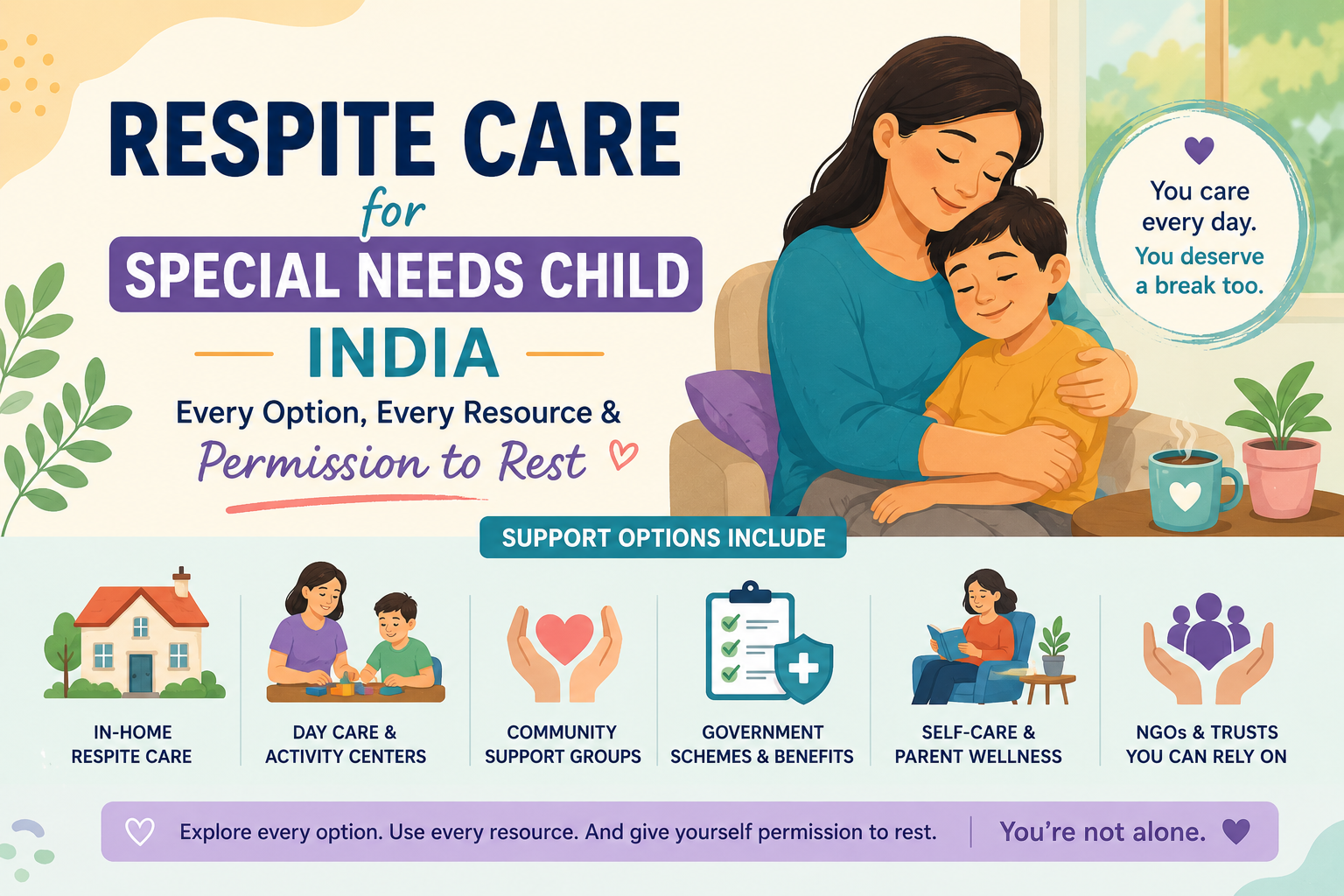
Respite care for special needs child India means temporary, short-term care provided to a child with a disability — giving parents and primary caregivers a planned break. Options include home-based respite workers, day care centers, short-stay residential programs, and NGO-organized relief programs. Government support exists through the National Trust Samarth scheme. Many families access it free or at heavily subsidized rates. 💙
Before anything else — this guide wants to say something directly to you.
You are exhausted. You have been exhausted for a long time. You love your child completely and absolutely. And you are still exhausted.
These two things are not contradictions. They are both true at the same time. And the fact that you are reading this — searching for a way to get some rest — does not make you a bad parent. It makes you a wise one.
Because here is what the research says clearly: caregivers who get regular respite care provide better care to their children. Not worse. Better.
Respite care for special needs child India is not a luxury. It is a medical necessity — for you, and for your child.
This guide tells you every option that exists. Every resource. Every scheme. Every step. Because you deserve to know. And because rest is not a reward you earn after you break. It is a right you have right now.

- ⚡ Direct Answer — What You Need to Know First
- 🌿 What Is Respite Care? — Simply Explained
- 🔬 Why Respite Care Is Not Optional — The Science
- 🏠 Types of Respite Care Available in India
- Type 1 — Home-Based Respite Care
- Type 2 — Day Care Respite
- Type 3 — Short-Stay Residential Respite
- Type 4 — Informal Respite Through Trained Family or Community Members
- Type 5 — Group Respite / Sibling Programs
- 🏛️ National Trust Samarth Scheme — Government Respite Support
- What Is the National Trust Samarth Scheme?
- What Samarth Provides
- How Much Does It Cost?
- How to Access Samarth
- National Trust Gharaunda — For Longer-Term Residential Care
- 💛 NGO-Based Respite Care Programs in India
- 🌆 Day Care Centers — City-by-City Guide
- 👩⚕️ Home-Based Respite Care — How to Find and Train a Carer
- Where to Find Home Respite Carers in India
- What to Look for in a Home Respite Carer
- Training Your Home Carer
- 🏡 Short-Stay Residential Respite — Planning for Longer Breaks
- 🧩 Respite Care for Specific Disabilities
- 🤝 Building Your Own Informal Respite Network
- 📊 Key Statistics — Respite Care and Special Needs Families in India
- 💰 Financial Support for Respite Care in India
- Government-Funded Options
- NGO Subsidized Services
- Income Tax Benefit — Caregiver Deduction
- CSR-Funded Respite Programs
- 💛 A Parent’s Real Story: “I Did Not Know I Was Allowed to Rest.”
- 🔍 What You Must Not Miss About Respite Care in India
- 1. 🧠 Caregiver Mental Health Is a Medical Emergency — Not a Lifestyle Preference
- 2. 👨 Father Caregivers Are Invisible in the Respite Narrative
- 3. 🌾 Rural Families — Respite Is Even More Urgent, Even Less Available
- 4. 💔 Sibling Parentification — The Hidden Cost of No Respite
- 5. 📱 Digital Respite — The Emerging Option
- 6. ⏱️ Micro-Respite — The Power of Small Breaks
- ❓ FAQs — Long-Tail Questions Answered
- What is respite care for special needs children in India?
- Is respite care available for free in India for special needs families?
- How do I access the National Trust Samarth scheme for respite care?
- How do I find a trained home carer for my special needs child in India?
- What is caregiver burnout and how does respite care help?
- Can I get financial help for respite care for my disabled child in India?
- Is respite care safe for children with severe disabilities?
- How do I prepare my autistic child for respite care?
- Where can I find respite care for a child with cerebral palsy in India?
- How often should caregivers of special needs children take respite breaks?
- 🔗 Trusted Resources — Respite Care for Special Needs Families in India
- 🏛️ Government Schemes
- 💛 NGO Respite Providers
- 🧠 Caregiver Mental Health Support
- 🔬 Research and Advocacy
- ✨ Final Thoughts: You Cannot Pour From an Empty Cup — And You Deserve to Be Full
🌿 What Is Respite Care? — Simply Explained
Respite care for special needs child India is one of those terms that sounds complicated but describes something very simple.
Respite means rest. A break. A pause.
Respite care means: someone else looks after your special needs child for a period of time — so that you, the primary caregiver, can rest.
It is not permanent. It is not abandonment. It is not giving up. It is a planned, temporary arrangement that gives you time to breathe, sleep, see a doctor, spend time with your other children, maintain your marriage, or simply sit quietly with a cup of tea — without any of the demands that caregiving carries.
A Simple Way to Explain It
Imagine carrying a very heavy bag every day. Never putting it down. The bag does not get lighter. But you get weaker.
Respite care is putting the bag down for a few hours — or a few days — while someone trustworthy holds it. When you pick it up again, you are stronger. You carry it better. You go further.
That is what respite care does for parents of special needs children. It does not take the responsibility away permanently. It gives you the rest that makes the long journey possible.
Who Needs Respite Care?
Every primary caregiver of a child with a disability.
Not just the caregivers who are “really struggling.” Not just those in crisis. Every single caregiver — because caregiving is demanding by nature, and sustainable caregiving requires regular breaks by design.
💡 Voice Search Answer — What is respite care for special needs children in India?
Respite care for special needs child India is temporary care provided to a disabled child so that their primary caregiver — usually a parent — can take a planned break. It can be provided at home by a trained carer, at a day care center, or through a short residential stay. In India, it is available through government schemes like the National Trust Samarth program, NGOs, and private providers.
🔬 Why Respite Care Is Not Optional — The Science
Respite care for special needs child India is not just a welfare convenience. It is backed by substantial research showing it is clinically necessary for both caregiver and child health.
What the Research Shows About Caregivers Without Respite
1. Physical Health Deteriorates
Primary caregivers of children with disabilities who lack regular breaks show significantly elevated rates of:
- Chronic sleep deprivation
- Immune system suppression
- Cardiovascular stress markers
- Musculoskeletal injury (from lifting and physical care)
- Neglect of their own medical conditions
Source: World Health Organization — Caregiver Health
2. Mental Health Crisis Is Common
Research consistently shows that 30–40% of primary caregivers of children with disabilities meet clinical criteria for depression. Anxiety rates are similarly elevated. Without respite — these numbers worsen over time.
Source: Developmental Medicine & Child Neurology — Caregiver Wellbeing
3. The Child Also Suffers
When a caregiver burns out — the quality of care they provide inevitably declines. Patience decreases. Therapeutic consistency decreases. Emotional attunement decreases. The child with the disability experiences the consequences directly.
Respite care for special needs child India does not just help the parent. It protects the quality of care the child receives.
4. Relationship and Family Breakdown
Studies show significantly elevated rates of marital strain, separation, and sibling neglect in families caring for a child with a disability without adequate respite support.
5. The Positive Evidence
Conversely — research shows that caregivers who receive regular respite care:
- Report significantly lower depression and anxiety scores
- Maintain therapeutic routines more consistently
- Show greater patience and attunement with their child
- Are less likely to reach crisis point requiring emergency intervention
- Report higher satisfaction with their caregiving role
Source: Journal of Intellectual Disability Research — Respite Care Outcomes
The Permission Paragraph
If you have been told — by family, by culture, by your own internal voice — that needing a break means you love your child less: that is not true. It has never been true. And the science confirms it is not true.
Taking respite care for your special needs child in India is an act of love. It is how you ensure you can continue to be the parent your child needs — not just for the next week, but for the next decade.
🏠 Types of Respite Care Available in India
Respite care for special needs child India is available in several different forms. Understanding the options helps you choose what fits your child’s needs, your comfort level, and your practical circumstances.

Type 1 — Home-Based Respite Care
What it is: A trained carer comes to your home and looks after your child for a set number of hours. You stay in the home or leave — your choice.
Best for:
- Children who are most comfortable in their own environment
- Children with severe disabilities who are difficult to transport
- Parents who need just a few hours of relief regularly
- Families in areas without accessible day care
Pros:
- ✅ Minimal disruption to child’s routine
- ✅ Child in familiar environment
- ✅ Flexible timing
- ✅ No transport required
Cons:
- ⚠️ Finding qualified, trustworthy home carers is challenging
- ⚠️ Cost if not subsidized
- ⚠️ Training the carer to your child’s specific needs takes time
Type 2 — Day Care Respite
What it is: Your child attends a structured day program at a center, typically for several hours per day.
Best for:
- Parents who need regular daily or weekly respite
- Families near suitable centers in urban areas
Pros:
- ✅ Structured activities
- ✅ Regular predictable schedule
- ✅ Often NGO-run at low or no cost
Cons:
- ⚠️ Transport required
- ⚠️ Child must be able to manage in a group setting
- ⚠️ Limited availability in smaller cities and rural areas
Type 3 — Short-Stay Residential Respite
What it is: Your child stays at a residential facility — typically 1 to 14 days — with professional care staff.
Best for:
- Parents who need a longer break (illness, major family event, severe burnout)
- Children who can manage overnight separation from parents
- Crisis situations where the family needs immediate relief
Pros:
- ✅ Provides the most substantial rest for caregivers
- ✅ Round-the-clock professional care
- ✅ Allows for family holidays, medical procedures, or crisis recovery
Cons:
- ⚠️ Most limited availability in India
- ⚠️ Some children with separation anxiety struggle with transition
- ⚠️ More expensive without subsidy
Type 4 — Informal Respite Through Trained Family or Community Members
What it is: A trusted family member — grandparent, sibling, aunt/uncle — or community member receives basic training to provide care, giving the primary caregiver breaks.
Best for:
- Families with extended family support networks
- As a complement to more formal respite provision
Pros:
- ✅ Child with familiar, trusted person
- ✅ No cost
- ✅ Culturally comfortable
- ✅ Available even in areas without formal services
Cons:
- ⚠️ Relies on family willingness and availability
- ⚠️ Training is essential for complex care needs
- ⚠️ Potential for caregiver guilt about “burdening” family
Type 5 — Group Respite / Sibling Programs
What it is: Programs that take multiple children with disabilities together for group activities — camps, outings, sessions — providing group respite for multiple families simultaneously.
Best for:
- School-age children with moderate disabilities who enjoy peer interaction
🏛️ National Trust Samarth Scheme — Government Respite Support
The most important government resource for respite care for special needs child India is the National Trust Samarth Scheme — and most families have never heard of it.
What Is the National Trust Samarth Scheme?
The National Trust — a statutory body under the Ministry of Social Justice and Empowerment — runs the Samarth scheme to support caregivers of persons with:
- ✅ Autism Spectrum Disorder
- ✅ Cerebral Palsy
- ✅ Intellectual Disability
- ✅ Multiple Disabilities
The Samarth scheme provides day care and respite services through registered organizations across India.
What Samarth Provides
| Service | Description |
|---|---|
| Day care programs | Structured day programs for the person with disability while caregiver rests |
| Short-term residential care | Short stays at residential facilities under Samarth |
| Caregiver support groups | Facilitated peer support for parents and caregivers |
| Training for caregivers | Skill-building workshops for home caregivers |
| Vocational activities | Meaningful activity for the person with disability during respite |
How Much Does It Cost?
The Samarth scheme is designed to be accessible to all income levels. Registered Samarth organizations offer services on a sliding scale — some completely free for families below the poverty line.
How to Access Samarth
Step 1 — Visit the National Trust website at www.thenationaltrust.gov.in
Step 2 — Find your nearest Samarth-registered organization using the “Organization Search” feature
Step 3 — Contact the organization with your child’s Disability Certificate and UDID Card
Step 4 — Complete the Samarth enrollment form (available on the National Trust website)
Step 5 — Begin accessing day care and respite services
Reference: National Trust — Samarth Scheme
National Trust Gharaunda — For Longer-Term Residential Care
For families in crisis — or for planning long-term residential care — the National Trust Gharaunda scheme provides group home residential services for adults with autism, CP, intellectual disability, and multiple disabilities.
This is not short-term respite — it is longer-term residential provision. But it provides a planned pathway for families thinking about the future.
Reference: National Trust — Gharaunda Scheme
💛 NGO-Based Respite Care Programs in India
Beyond government schemes, a growing number of NGOs across India provide respite care for special needs child India. Here are the most significant.
National NGO Respite Programs
1. ADAPT (Spastics Society of India) — Mumbai ADAPT runs one of India’s most established day care and respite programs for children and adults with cerebral palsy and multiple disabilities. Structured activities, therapy integration, and caregiver support groups.
Contact: www.adaptindia.org
2. Action for Autism India — Delhi Runs structured day programs and parent support groups providing both practical and emotional respite for families of autistic children. Contact: www.autism-india.org
3. Vidya Sagar — Chennai and Bangalore Provides day care integrated with education and therapy. Caregiver support programs run alongside. One of India’s most respected special needs organizations.
Contact: www.vidyasagar.net
4. Ummeed Child Development Centre — Mumbai Offers family support services including caregiver training and planned respite support alongside their clinical programs. Contact: www.ummeed.org
5. Sangath — Goa and pan-India through digital programs Sangath has developed community-based mental health and caregiver support programs that include respite elements, particularly for families in settings with limited formal services.
Contact: www.sangath.in
6. Manzil — Delhi A learning center that provides structured day programs for young people with disabilities — providing meaningful respite for Delhi families.
7. Narayan Seva Sansthan — Udaipur Provides residential and day programs for persons with physical disabilities and multiple disabilities, including respite-oriented services.
Contact: www.narayanseva.org
🌆 Day Care Centers — City-by-City Guide
Finding respite care for special needs child India through day care starts with knowing what exists in your city.
Delhi & NCR
| Organization | Type | Disabilities Served | Contact |
|---|---|---|---|
| Action for Autism | Day program | Autism | autism-india.org |
| AADI | Day care + vocational | CP, multiple disabilities | Delhi |
| Tamana | Day program | Intellectual disability, autism | Delhi |
| Manzil | Day learning program | Multiple disabilities | Delhi |
Mumbai
| Organization | Type | Disabilities Served | Contact |
|---|---|---|---|
| ADAPT | Day care + respite | CP, multiple disabilities | adaptindia.org |
| Ummeed | Family support + day programs | All disabilities | ummeed.org |
| ALERT Centre | Day care | Intellectual disability | Mumbai |
Bangalore
| Organization | Type | Disabilities Served | Contact |
|---|---|---|---|
| Vidya Sagar | Day care + education | Multiple disabilities | vidyasagar.net |
| APD | Day programs | Multiple disabilities | apdindia.org |
| Manovikas | Day care | Intellectual disability | Bangalore |
Chennai
| Organization | Type | Disabilities Served | Contact |
|---|---|---|---|
| Vidya Sagar Chennai | Day care + therapy | CP, multiple disabilities | vidyasagar.net |
| Amar Seva Sangam | Day programs | Physical disabilities | amarseva.org |
Hyderabad
| Organization | Type | Disabilities Served | Contact |
|---|---|---|---|
| NIEPID | Day programs | Intellectual disability | niepid.nic.in |
| Little Star School | Day care | Autism | Hyderabad |
Note: Contact organizations directly to confirm current program availability and timing.
👩⚕️ Home-Based Respite Care — How to Find and Train a Carer
Home-based respite care for special needs child India is the most flexible option — but finding the right person requires care and planning.
Where to Find Home Respite Carers in India
Option 1 — Through Your Child’s Special School or Therapy Center
Ask the school coordinator or therapy center if they know of trained support workers available for home care. Many therapy assistants and special education graduates provide home care in their personal capacity.
Option 2 — Through Parent Networks
Special needs parent WhatsApp groups and Facebook communities often have recommendations for trusted home carers in your city. This peer-to-peer referral is often the most reliable source.
Option 3 — Through National Trust Samarth Organizations
Some Samarth-registered organizations maintain databases of trained home carers and can make referrals.
Option 4 — Through Disability-Focused Job Platforms
Platforms including Indeed India and Naukri.com sometimes list disability support worker positions. Alternatively, post a clear job description on these platforms.
Option 5 — NIEPID and RCI-Trained Graduates
The Rehabilitation Council of India (RCI) trains special educators, rehabilitation workers, and disability support workers. Contact your nearest NIEPID regional center or RCI-certified institution for referrals to trained graduates seeking employment.
Reference: Rehabilitation Council of India
What to Look for in a Home Respite Carer
| Quality | Why It Matters |
|---|---|
| Experience with your child’s disability type | Appropriate care; safety |
| Patience and calm temperament | Essential for complex care |
| Basic first aid knowledge | Safety — particularly for children with seizures |
| Communication skills | Understanding your child’s communication needs |
| Reliability | Respite only works if the carer consistently shows up |
| References from previous families | Verification of trustworthiness |
| Background check | Child protection — essential |
Training Your Home Carer
Even an experienced carer needs training specific to your child. Invest time in this — it makes the respite safer and more effective.
Training Checklist for Home Respite Carers:
- ✅ Your child’s daily routine (morning, meals, rest, evening)
- ✅ Communication methods (verbal, signs, AAC device)
- ✅ Feeding routine and any swallowing precautions
- ✅ Positioning needs and equipment use
- ✅ Seizure management protocol (if applicable)
- ✅ Medication routine and storage
- ✅ Behavioral support — what helps, what triggers difficulties
- ✅ Emergency contacts and procedures
- ✅ What your child loves — favorite activities, toys, music
- ✅ What your child dislikes or finds distressing
Write this information in a simple care guide document. Leave it with the carer every time.
🏡 Short-Stay Residential Respite — Planning for Longer Breaks
Short-stay residential respite care for special needs child India is the most substantial form of respite — and the most scarce. But options exist.
Who Provides Residential Respite in India
National Trust Samarth Residential Component Some Samarth-registered organizations offer short residential stays — typically 3 to 14 days. Contact your nearest Samarth organization to ask about residential availability.
Reference: National Trust
ADAPT Mumbai ADAPT has offered short-stay residential programs for adults with CP and multiple disabilities. Contact directly for current availability.
Contact: www.adaptindia.org
Narayan Seva Sansthan Residential programs for persons with physical disabilities.
Contact: www.narayanseva.org
Private Special Schools With Boarding Facilities Some private special schools offer short boarding stays during school holidays. Ask your child’s school if this is available.
How to Prepare Your Child for Residential Respite
Separation from home is hard for many children with disabilities — particularly those with autism, attachment needs, or sensory sensitivities. Here is how to prepare:
4 weeks before:
- ✅ Visit the facility together — multiple times if possible
- ✅ Meet the staff who will care for your child
- ✅ Show your child photographs of the facility to review at home
2 weeks before:
- ✅ Practice short separations — build confidence
On the day:
- ✅ Pack familiar comfort items — favorite toy, blanket, pillow
- ✅ Leave a recorded message from you for the staff to play
- ✅ Provide the detailed care guide document
- ✅ Keep your goodbye brief and warm — long emotional goodbyes increase distress
🧩 Respite Care for Specific Disabilities
Respite care for special needs child India looks different depending on your child’s disability. Here is what to consider for specific conditions.
Autism Spectrum Disorder
Children with autism often have very specific sensory needs, routines, and communication methods. Respite carers need:
- ✅ Training in autism — ideally with experience of ASD specifically
- ✅ Understanding of AAC if the child is non-verbal
- ✅ Ability to maintain the child’s specific routine precisely
- ✅ Sensory awareness — knowing what overwhelms and what calms
- ✅ Patience for repetitive behaviors without trying to stop them
Best respite format for autism: Home-based respite with a carer trained specifically in autism is often most successful. Familiar environment reduces anxiety.
Cerebral Palsy
Children with CP often have physical care needs alongside communication and cognitive needs.
- ✅ Carer must be trained in safe manual handling and transfer techniques
- ✅ Positioning equipment must be available and used correctly
- ✅ Feeding support — knowing texture requirements and aspiration precautions
- ✅ Communication support — AAC if non-verbal
- ✅ Medication administration if required
Best respite format for CP: Home-based for GMFCS Level IV–V; day care programs for higher-functioning levels.
Intellectual Disability
Children with intellectual disability often do well with day care respite — they enjoy social interaction and structured activities.
- ✅ Staff who communicate at an appropriate level
- ✅ Meaningful activities suited to the child’s interests
- ✅ Behavioral support awareness
- ✅ Consistent routine
Best respite format for ID: Day care programs through Samarth-registered organizations or NGOs; home-based for children who struggle with group settings.
Muscular Dystrophy
Children with MD have progressive physical needs. Carers must understand:
- ✅ Manual handling — safe techniques for a child with weakening muscles
- ✅ Respiratory care awareness — positioning, secretion management
- ✅ Equipment use — ventilators, cough assist devices if prescribed
- ✅ Psychological support — children with MD are often fully cognitively aware and need emotionally sensitive care
🤝 Building Your Own Informal Respite Network
For many Indian families — particularly those in smaller cities and rural areas — formal respite care for special needs child India programs are simply not accessible. In these situations, building an informal respite network is not just helpful — it is essential.
The Practical Guide to Building Your Network
Step 1 — Identify Your Inner Circle
Who in your extended family genuinely wants to help but does not know how? Name them specifically. Identify 2–3 people.
Step 2 — Have an Honest Conversation
Do not ask vaguely for “help sometime.” Be specific: “Would you be willing to spend 3 hours with Meera every other Sunday while I rest? I will train you in exactly what she needs.”
Specific requests are easier to say yes to. Vague requests create anxiety.
Step 3 — Train Them Properly
Spend two or three sessions together with your child and the helper — showing them the routine, the communication system, the feeding method, the behavior support strategies. Confidence removes fear.
Step 4 — Start Small
Begin with short periods — one hour — while you are in the next room. Build up gradually. Let trust develop.
Step 5 — Reciprocate Where You Can
Within your special needs parent community — reciprocal care sharing is powerful. You care for my child on Saturday; I care for yours on Sunday. Even parents with different disability types can swap care duties for simple supervision tasks.
Step 6 — Join or Create a Local Parent Group
A local parent support group does two things simultaneously: it provides emotional respite (being heard and understood) and often leads to practical respite arrangements between families.
📊 Key Statistics — Respite Care and Special Needs Families in India
| Statistic | Figure | Source |
|---|---|---|
| Primary caregivers of disabled children meeting criteria for depression | ~30–40% | Journal of Intellectual Disability Research |
| Percentage of Indian special needs families with formal respite access | Estimated <10% | NCPEDP Caregiver Survey 2022 |
| Children with disabilities in India under age 19 | 78 lakh (7.8 million) | Census of India 2011 |
| National Trust Samarth registered organizations | 200+ across India | National Trust |
| Estimated primary caregivers of disabled persons in India | 5+ crore (50 million+) | WHO India |
| Caregiver burnout rate in CP families (significant symptoms) | ~40–50% | Developmental Medicine & Child Neurology |
| Reduction in caregiver stress with regular respite | Significant reduction in depression scores | WHO Caregiver Study |
| Families where both parents work in Indian special needs households | ~30–35% | NCPEDP Survey |
| Estimated gap in formal respite services vs. need in India | Severe — 90%+ need unmet | National Trust Assessment |
| Annual National Trust budget for caregiver support schemes | ₹100+ crore | National Trust Annual Report |
💰 Financial Support for Respite Care in India
Cost is a genuine barrier for many families seeking respite care for special needs child India. Here is every financial support option available.
Government-Funded Options
National Trust Samarth Scheme Subsidized day care and respite services through registered organizations. Free for BPL families. Sliding scale for others. Apply: thenationaltrust.gov.in
Samagra Shiksha — After-School Programs Some Samagra Shiksha-funded schools provide extended day programs for children with disabilities — effectively providing respite for working parents. Reference: samagra.education.gov.in
State Government Disability Welfare Schemes Several states provide caregiver support allowances or subsidized day care for families of disabled children. Contact your State Social Welfare Department for state-specific provisions.
NGO Subsidized Services
Most NGO-based respite programs in India operate on a sliding scale or completely subsidized model for lower-income families. Always ask about financial assistance — do not assume you cannot afford it without checking.
Key organizations to approach:
- ADAPT Mumbai — sliding scale fees
- Vidya Sagar — subsidized programs
- Action for Autism India — fee waivers available
Income Tax Benefit — Caregiver Deduction
Parents of disabled dependents can claim up to ₹1,25,000 under Section 80DD of the Income Tax Act — covering maintenance and care expenses including respite care costs. Keep receipts for paid respite services.
Reference: Income Tax India — Section 80DD
CSR-Funded Respite Programs
Corporate CSR funds increasingly support caregiver programs. Contact your nearest large employer — particularly IT companies, banks, and manufacturing firms with active disability CSR programs — about support for respite care services.
Find CSR programs: www.csr.gov.in
💛 A Parent’s Real Story: “I Did Not Know I Was Allowed to Rest.”
“My name is Deepa. My son Arjun has severe autism. He is thirteen. He does not speak. He needs support for every activity of daily life — eating, dressing, bathing, toileting. He sleeps poorly. So I sleep poorly.
For ten years, I did not take a single day off. Not one day where someone else was responsible for Arjun and I was responsible for nothing.
My husband works long hours. My parents live in another city. My in-laws were willing to help but they were afraid of Arjun’s meltdowns and did not know how to manage them. My friends — my old friends — slowly disappeared. I understood. Our lives were just too different.
By Arjun’s tenth birthday, I had stopped cooking proper meals. I was forgetting words mid-sentence. I had not seen a doctor for myself in four years. I cried most mornings before Arjun woke up — because I was so tired and because I felt so guilty for being tired.
Then a therapist at Arjun’s school said something that cracked something open in me.
She said: “Deepa, you are running on empty. And you cannot fill Arjun’s life if yours is running on empty.”
She told me about the National Trust Samarth scheme. She helped me find a registered organization near our home in Pune. I applied. Arjun was enrolled in their day care program — three days a week, 9 AM to 3 PM.
The first Monday he went — I sat on my bed and did not know what to do. I had forgotten how to be still. I had forgotten what I liked. I cried again. But differently.
Over the next three months: I saw a doctor. I was diagnosed with anemia and early-stage anxiety disorder — both untreated for years. I started sleeping for six hours straight — something I had not done in five years. I began cooking again. Actually enjoying it. I started calling my friends.
Arjun came home from the day care calmer than I had seen him in years. The staff there understood him. They had taught him a new sign for “more.” He used it at dinner the first week.
Respite did not just help me. It helped him.
I cannot tell you how many years I lost before someone gave me permission to rest. So let me give you that permission right now: You are allowed to rest. You need to rest. And resting makes you a better parent — not a worse one.”
— Deepa R., mother of Arjun (severe autism), Pune, Maharashtra 💙
🔍 What You Must Not Miss About Respite Care in India
1. 🧠 Caregiver Mental Health Is a Medical Emergency — Not a Lifestyle Preference
Most respite care articles in India frame caregiver rest as a quality-of-life improvement. The reality is far more urgent. Untreated caregiver burnout is a medical emergency with measurable physical and psychological consequences including immune collapse, cardiovascular disease, and clinical depression.
When a primary caregiver breaks down — the entire family system breaks down. The disabled child loses their most important person. Respite care is not a lifestyle benefit. It is preventive medicine. It should be prescribed as such — by pediatricians, neurologists, and therapists who work with disabled children.
2. 👨 Father Caregivers Are Invisible in the Respite Narrative
Almost every conversation about respite care for special needs child India assumes the mother is the primary caregiver. Increasingly, fathers are sole or co-primary caregivers — and they face unique barriers: cultural stigma about men seeking help, workplace inflexibility, fewer peer support networks, and a complete absence of father-specific respite or support programs in the Indian context. Father caregivers deserve the same access to respite, the same emotional support, and the same permission to rest.
3. 🌾 Rural Families — Respite Is Even More Urgent, Even Less Available
Urban families in metro cities have more access to formal respite care for special needs child India programs. But caregiving burden is often even heavier in rural India — where there are no NGO day care centers, no Samarth organizations, no peer support groups, no trained home carers, and strong cultural stigma that prevents families from even discussing their exhaustion.
The National Trust’s community-based approaches through CBID (Community Based Inclusive Development) programs are the primary mechanism addressing rural respite gaps — but coverage remains severely limited.
4. 💔 Sibling Parentification — The Hidden Cost of No Respite
When parents of a disabled child have no respite and no support, siblings often become de facto carers — taking on adult responsibilities for their brother or sister with a disability. This “parentification” of siblings is psychologically harmful, educationally disruptive, and socially isolating for the sibling.
Respite care that relieves the primary caregiver also frees siblings from inappropriate care burdens. This dimension of respite benefit is almost never discussed in Indian special needs literature.
5. 📱 Digital Respite — The Emerging Option
With India’s expanding digital infrastructure, online respite support is emerging as a genuine option — particularly for families in areas without formal services. Online support groups (facilitated by therapists or trained peer supporters) provide emotional respite. Remote monitoring tools — basic baby monitors, tablet-based activity apps for the child — allow parents to rest in another room while maintaining oversight.
Digital AAC tools on tablets can occupy and engage children meaningfully for periods, supporting supervised home rest. These digital tools are underused and under-discussed in the Indian respite conversation.
6. ⏱️ Micro-Respite — The Power of Small Breaks
For families where longer breaks feel impossible — financially, logistically, or emotionally — the concept of micro-respite is clinically validated and practically powerful. A 20-minute bath alone while a partner or family member is with the child. Fifteen minutes of sitting in the car in silence.
A 30-minute phone call with another special needs parent. These small breaks, consistently taken, accumulate meaningful restorative benefit. Therapists increasingly prescribe micro-respite formally — giving parents structured permission for brief daily relief within their existing circumstances.
❓ FAQs — Long-Tail Questions Answered
What is respite care for special needs children in India?
Respite care for special needs child India is temporary, short-term care provided to a disabled child so their primary caregiver can rest. It includes home-based carers, day care programs, and short residential stays. Government support is available through the National Trust Samarth scheme. Many programs are free or heavily subsidized.
Is respite care available for free in India for special needs families?
Yes. The National Trust Samarth scheme provides subsidized or free day care and respite services for children with autism, cerebral palsy, intellectual disability, and multiple disabilities. BPL families access services free of charge. NGO-run programs also offer sliding scale fees. Contact your nearest Samarth-registered organization at thenationaltrust.gov.in.
How do I access the National Trust Samarth scheme for respite care?
Visit thenationaltrust.gov.in, find your nearest Samarth-registered organization, contact them with your child’s Disability Certificate and UDID Card, and complete the enrollment form. Services include day care programs, short residential stays, and caregiver support groups.
How do I find a trained home carer for my special needs child in India?
Contact your child’s special school or therapy center for referrals. Ask in special needs parent WhatsApp groups for recommendations. Approach Samarth-registered organizations for carer databases. Contact RCI-certified institutions for trained rehabilitation graduates. Always verify references and conduct a background check before leaving your child with any carer.
What is caregiver burnout and how does respite care help?
Caregiver burnout is physical and psychological exhaustion from sustained caregiving without adequate support. Symptoms include sleep deprivation, depression, anxiety, and physical illness. Regular respite care — even brief breaks — measurably reduces burnout symptoms, improves caregiver mental health, and ultimately improves the quality of care provided to the disabled child.
Can I get financial help for respite care for my disabled child in India?
Yes. The National Trust Samarth scheme provides subsidized services. Section 80DD of the Income Tax Act allows deduction of up to ₹1,25,000 for dependent disability care costs including respite. State social welfare departments provide additional support in some states. Corporate CSR programs fund respite services through NGO partners.
Is respite care safe for children with severe disabilities?
Yes — when provided by trained, experienced carers with proper information about the child’s needs. Safety requires: a detailed written care guide, trained carers familiar with the disability, appropriate equipment, clear emergency protocols, and starting with short trial periods before longer respite. For children with medically complex needs, ensure carers have basic first aid and condition-specific training.
How do I prepare my autistic child for respite care?
Introduce the carer or facility gradually — multiple visits before the first stay or session alone. Use visual social stories and picture schedules to explain the plan. Pack familiar comfort items. Maintain your child’s exact routine during respite. Brief the carer thoroughly on sensory needs, communication methods, and calming strategies. Start with short periods and build up.
Where can I find respite care for a child with cerebral palsy in India?
Contact ADAPT Mumbai adaptindia.org, Vidya Sagar Chennai/Bangalore vidyasagar.net, your local National Trust Samarth-registered organization thenationaltrust.gov.in, or your state’s Social Welfare Department. For home-based respite, ask your child’s physiotherapist for referrals to trained carers with CP experience.
How often should caregivers of special needs children take respite breaks?
There is no fixed prescription — but research suggests that regular, frequent breaks are more beneficial than rare long breaks. Even daily micro-respite (20–30 minutes) combined with weekly half-day breaks produces measurable wellbeing benefits. Monthly longer breaks (full day or overnight) are additionally beneficial. Work with your child’s therapy team to build a realistic, sustainable respite schedule.
🔗 Trusted Resources — Respite Care for Special Needs Families in India
🏛️ Government Schemes
- National Trust — Samarth Scheme — Day care and respite; organization finder
- National Trust — Gharaunda — Residential care planning
- Samagra Shiksha — Extended Programs — School-based support
💛 NGO Respite Providers
- ADAPT India — Mumbai — CP respite and day care
- Action for Autism India — Delhi — Autism day programs
- Vidya Sagar — Chennai and Bangalore — Multiple disabilities
- Ummeed Child Development Centre — Mumbai — Family support
- Sangath — Goa and Digital — Caregiver mental health
- Narayan Seva Sansthan — Udaipur — Physical disability
🧠 Caregiver Mental Health Support
- iCall — iCall Counselling — Mental health helpline for caregivers
- Vandrevala Foundation Helpline — 24/7 mental health support — 1860-2662-345
- NIMHANS — Caregiver Resources — Clinical support and referral
🔬 Research and Advocacy
- NCPEDP — Disability Advocacy — Caregiver rights advocacy
- Journal of Intellectual Disability Research — Research on respite outcomes
- Rehabilitation Council of India — Trained carer directories
✨ Final Thoughts: You Cannot Pour From an Empty Cup — And You Deserve to Be Full
Respite care for special needs child India is not a sign that you have failed. It is not an admission that you cannot cope. It is not giving up.
It is the wisest thing you can do for your child. 💙
Deepa in Pune spent ten years running on empty — and her first three months of respite gave Arjun a new sign, gave her a diagnosis she needed, gave both of them something they could not have found any other way: a sustainable future.
You cannot sustain what is not sustainable. You cannot give what you do not have. You cannot be the parent your child needs if you have nothing left.
So this guide ends with a request — not advice, not instructions, but a simple request:
Please rest.
Not when you have earned it. Not when you have “done enough.” Not when the therapy goals are all met and the IEP is perfect and the house is clean.
Rest now. Because your child needs the version of you that sleeps. That eats. That sees a friend. That has a moment of quiet.
Here is your action plan:
✅ Today: Identify one person in your life who has offered to help. Call them. Be specific. Ask them for 3 hours this week.
✅ This week: Visit thenationaltrust.gov.in and find your nearest Samarth-registered organization.
✅ This month: Contact that organization. Ask about day care enrollment. Take the first step.
✅ Ongoing: Build your informal network. Join a parent group. Give yourself permission — regularly, consistently, without guilt.
You matter. Your health matters. Your rest matters. And the best gift you can give your child is a parent who is still standing — tomorrow, and ten years from now. 🎗️
⚠️ Disclaimer: This article is written for informational purposes only. Program availability, fees, and eligibility change periodically. Always verify current information directly with organizations and government departments before making care arrangements.


