

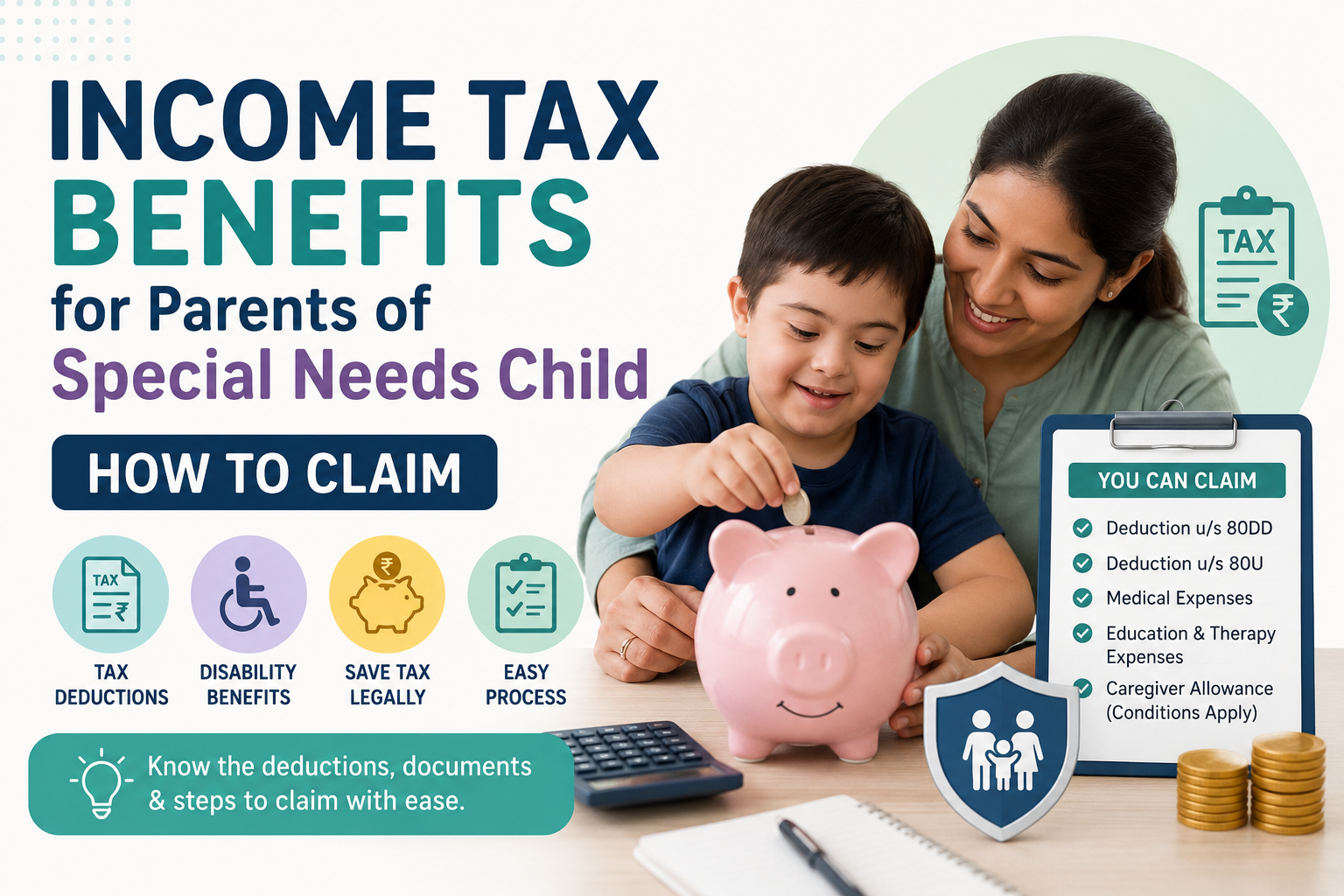
Income Tax Benefits for Parents of Special Needs Child: How to Claim It in 2026 🎗️
⚡ What You Need to Know First
Income tax benefits for parents of special needs child in India include deductions under Section 80DD (up to ₹1,25,000 for severe disability), Section 80U (for the taxpayer themselves if disabled), and Section 80DDB (for medical treatment costs). These deductions directly reduce your taxable income. You do not need to prove actual expenses — flat deductions apply automatically with a valid Disability Certificate. 💙
Think of it this way. Imagine you earn ₹10 lakh a year. The government says: “We know caring for your special child costs extra. So we will pretend you earned less. You pay tax on a smaller amount.”
That is what a tax deduction does. Simple.
And yet — thousands of Indian families caring for children with autism, cerebral palsy, Down syndrome, intellectual disability, and other conditions are paying more tax than they legally should. Simply because nobody explained this clearly.
This guide does exactly that. In plain, simple words. With real numbers. Real examples. And everything you need to act on today.

- ⚡ What You Need to Know First
- 🧾 What Are Income Tax Benefits for Parents of Special Needs Children?
- 📘 Section 80DD — The Most Important Deduction for Special Needs Parents
- What Does Section 80DD Cover?
- How Much Can You Deduct Under Section 80DD?
- The Most Important Thing About Section 80DD
- What Disabilities Qualify Under Section 80DD?
- What You Need to Claim Section 80DD
- 📗 Section 80U — If the Taxpayer Themselves Has a Disability
- 📙 Section 80DDB — Medical Treatment Deduction
- 📕 Section 80C — Insurance and Education Benefits
- Life Insurance Premium Deduction Under 80C
- Specific Insurance Schemes for Disabled Dependents
- Section 80C Overall Limit
- 🛍️ GST Exemptions on Disability Products
- 📊 Complete Comparison Table — All Tax Benefits for Special Needs Parents
- 💰 How Much Tax Can You Actually Save? Real Examples
- Example 1 — Priya, Mother of a Child With Autism (40% Disability)
- Example 2 — Ramesh, Father of a Child With Cerebral Palsy (85% Disability — Severe)
- Example 3 — Sunita, Mother With Own Disability + Disabled Child
- 📈 Key Statistics — Income Tax Benefits for Special Needs Children in India
- 📄 The Disability Certificate — Why It Is Everything
- 🪜 Step-by-Step: How to Claim These Deductions
- Step 1 — Obtain Your Disability Certificate
- Step 2 — Download Form 10-IA
- Step 3 — File Your Income Tax Return (ITR)
- Step 4 — Submit Form 10-IA With Your ITR
- Step 5 — Keep All Documents Safe
- Step 6 — Verify Your ITR
- ⚖️ Old Tax Regime vs. New Tax Regime — Which Is Better for Special Needs Parents?
- 💛 A Parent’s Real Story: “I Was Paying ₹72,000 Extra Tax Every Year Without Knowing”
- 🔍 What You Must Not Miss About Tax Benefits for Special Needs Parents
- 1. 🧾 The Flat Deduction Misunderstanding
- 2. 👶 Disability Certificate for Children — What Makes It Different
- 3. 🏦 The Insurance Gap — LIC Jeevan Aadhar Is Almost Unknown
- 4. 🔄 The Regime Choice Is Permanent for That Year — Choose Carefully
- 5. 📑 Form 10-IA Is Often Not Filed With ITR
- 6. 🌐 NRI Parents — Special Rules Apply
- 7. 💼 HUF (Hindu Undivided Family) Can Also Claim 80DD
- 8. 🏛️ State-Level Tax Benefits — Often Unclaimed
- ❓ FAQs — Long-Tail Questions Answered
- What is Section 80DD in income tax for special needs parents?
- Can I claim 80DD for my autistic child?
- Do I need to show medical bills to claim Section 80DD?
- Can both parents claim 80DD for the same child?
- What is the difference between Section 80DD and Section 80U?
- Can I claim income tax benefits for my special needs child in the new tax regime?
- Is Down syndrome eligible for Section 80DD income tax deduction?
- What form is needed to claim 80DD deduction in ITR?
- Can a non-working mother claim 80DD for a disabled child?
- What happens if the disability certificate has expired when I claim 80DD?
- 🔗 Trusted Resources — Income Tax Benefits for Special Needs Parents
- 🏛️ Government Tax & Legal Resources
- 💛 Disability Support Organizations
- 🔬 Insurance & Financial Planning
- ✨ Final Thoughts: Every Rupee Saved Goes Back to Your Child
🧾 What Are Income Tax Benefits for Parents of Special Needs Children?
Income tax benefits for parents of special needs child are special rules in India’s Income Tax Act that reduce the amount of tax you pay. The government recognizes that raising a child with a disability costs more. So it gives parents a financial break.
These benefits work through something called deductions. A deduction reduces your taxable income. Less taxable income means less tax.
Here is the simple idea:
💡 Imagine this: You earn ₹8 lakh per year. Normally, you pay tax on ₹8 lakh. But with Section 80DD deduction of ₹75,000 — you pay tax on only ₹7,25,000. That saves you real money every single year.
The main tax sections relevant to parents of special needs children are:
- 📘 Section 80DD — Deduction for maintaining a disabled dependent
- 📗 Section 80U — Deduction if the taxpayer themselves is disabled
- 📙 Section 80DDB — Deduction for medical treatment of specified diseases
Let us go through each one. Clearly. Simply. With real numbers.
📘 Section 80DD — The Most Important Deduction for Special Needs Parents
Section 80DD is the single most important income tax benefit for parents of special needs child in India. If you read nothing else in this article — read this section.
What Does Section 80DD Cover?
Section 80DD allows you to claim a deduction if you are:
✅ An Indian resident taxpayer
✅ Caring for a dependent with a disability
✅ Your dependent can be: spouse, children, parents, siblings — or any family member who is wholly or mainly dependent on you
The deduction is for money spent on:
- 🏥 Medical treatment, nursing, and rehabilitation of the disabled dependent
- 🏫 Training and education of the disabled dependent
How Much Can You Deduct Under Section 80DD?
| Disability Level | Disability % Required | Deduction Amount |
|---|---|---|
| Normal Disability | 40% to 79% | ₹75,000 per year |
| Severe Disability | 80% or more | ₹1,25,000 per year |
Source: Income Tax India — Section 80DD
The Most Important Thing About Section 80DD
You do not need to show bills or receipts.
This is what most parents do not know. Section 80DD gives you a flat deduction — a fixed amount — regardless of how much you actually spent. Whether you spent ₹40,000 or ₹4,00,000 on your child’s therapy, the deduction is the same flat amount.
This makes it incredibly easy to claim.
What Disabilities Qualify Under Section 80DD?
All 21 disabilities specified under the Rights of Persons with Disabilities Act 2016 (RPWD Act) qualify. Key ones for children include:
- 🧩 Autism Spectrum Disorder
- 🧠 Intellectual Disability
- 🧬 Cerebral Palsy
- 👁️ Blindness and Low Vision
- 🦻 Hearing Impairment
- 🦽 Locomotor Disability
- 🧬 Down Syndrome (chromosomal condition)
- 🩺 Multiple Disabilities
- 💬 Speech and Language Disability
- 📚 Specific Learning Disabilities (Dyslexia, Dyscalculia)
- 🩸 Thalassemia, Haemophilia, Sickle Cell Disease
- 🧠 Mental Illness
- 🦴 Muscular Dystrophy
Source: RPWD Act 2016 — Ministry of Social Justice
What You Need to Claim Section 80DD
- ✅ Disability Certificate — issued by a government hospital medical board
- ✅ Form 10-IA — Self-declaration form certifying the disability of the dependent
- ✅ Your ITR (Income Tax Return) — where you enter the deduction under Chapter VIA
💡 Voice Search Answer — What is Section 80DD in income tax? Section 80DD is an income tax deduction for Indian residents who care for a disabled dependent family member. It allows a flat deduction of ₹75,000 per year for 40–79% disability and ₹1,25,000 per year for 80% or more disability. No expense receipts are needed — just a valid Disability Certificate and Form 10-IA.
📗 Section 80U — If the Taxpayer Themselves Has a Disability
Section 80U is different from 80DD. Under 80U, the taxpayer themselves has a disability — not a dependent.
Many parents of children with disabilities also have their own health conditions. Some have the same genetic condition as their child. Section 80U covers them.
Section 80U Deduction Amounts
| Disability Level | Disability % Required | Deduction Amount |
|---|---|---|
| Normal Disability | 40% to 79% | ₹75,000 per year |
| Severe Disability | 80% or more | ₹1,25,000 per year |
Source: Income Tax India — Section 80U
Key Difference Between 80DD and 80U
| Feature | Section 80DD | Section 80U |
|---|---|---|
| Who has the disability? | A dependent family member | The taxpayer themselves |
| Who claims the deduction? | The taxpayer (parent/guardian) | The taxpayer themselves |
| Can both be claimed together? | Yes, if both conditions exist | Yes, if both conditions exist |
Important Note
A taxpayer cannot claim both 80DD and 80U for the same disability. But if the parent has their own disability AND has a disabled dependent child — they can claim both 80U for themselves AND 80DD for their child — giving a combined deduction of up to ₹2,50,000.
📙 Section 80DDB — Medical Treatment Deduction
Section 80DDB covers the cost of medical treatment for specified diseases and conditions.
What Does 80DDB Cover?
Section 80DDB covers medical treatment expenses for specific diseases including:
- Neurological diseases where disability is 40% or more (includes dementia, Parkinson’s, motor neuron disease, ataxias, chorea)
- Cancer (malignant cancers)
- Full-blown AIDS
- Chronic Renal Failure
- Haematological disorders (Thalassemia, Haemophilia)
80DDB Deduction Limits
| Taxpayer Category | Maximum Deduction |
|---|---|
| Individual below 60 years | ₹40,000 per year |
| Senior citizen (60+ years) | ₹1,00,000 per year |
Source: Income Tax India — Section 80DDB
Key Point About 80DDB
Unlike 80DD — 80DDB requires a prescription from a registered specialist doctor. You claim the actual amount spent on treatment, up to the ceiling. Keep all medical bills and doctor prescriptions.
Can You Claim Both 80DD and 80DDB?
Yes — for different expenses. If your child’s condition involves both general disability care (claim under 80DD) and specific medical treatment for a listed disease (claim under 80DDB), you can claim both for the same child.
📕 Section 80C — Insurance and Education Benefits
Section 80C is India’s most widely used tax deduction — and it has special provisions relevant to income tax benefits for parents of special needs child.
Life Insurance Premium Deduction Under 80C
Normally, life insurance premiums qualify for 80C up to 10% of the sum assured. But for a person with disability — the limit is 15% of the sum assured.
This means:
- You take a life insurance policy for your disabled child (common for long-term financial planning)
Specific Insurance Schemes for Disabled Dependents
LIC (Life Insurance Corporation of India) operates specific schemes designed for disabled persons:
- LIC Jeevan Aadhar — Designed specifically for parents of children with disabilities. The policy provides for the child’s financial security after the parent’s death.
- LIC Jeevan Vishwas — Another LIC scheme for persons with disabilities
Premiums paid on these policies qualify for 80C deduction under special higher limits.
Reference: LIC India
Section 80C Overall Limit
The overall maximum deduction under Section 80C (combining all eligible investments and premiums) is ₹1,50,000 per year.
🛍️ GST Exemptions on Disability Products
This is an income tax benefit for parents of special needs child that is not about income tax at all — but it saves real money every time you buy essential products for your child.
Under India’s GST (Goods and Services Tax) system, many disability-related products attract 0% or 5% GST — significantly lower than the standard 12% or 18% rates.
Products Attracting 0% GST for Persons with Disabilities
| Product | GST Rate |
|---|---|
| Braille typewriters | 0% |
| Braille paper | 0% |
| Hearing aids | 0% |
| Artificial limbs | 0% |
| Orthotic devices (braces, splints) | 0% |
| Crutches and walking frames | 0% |
| Wheelchairs (manually operated) | 0% |
| Assistive devices for blind persons | 0% |
Products Attracting 5% GST
| Product | GST Rate |
|---|---|
| Motorized wheelchairs | 5% |
| Special vehicles for disabled | 5% |
| Braille watches | 5% |
Source: GST Council — Exemption List
📊 Complete Comparison Table — All Tax Benefits for Special Needs Parents
| Section | What It Covers | Maximum Deduction | Who Claims | Bills Required? |
|---|---|---|---|---|
| 80DD | Dependent with disability — care, treatment, insurance | ₹75,000 / ₹1,25,000 | Parent/guardian | No (flat deduction) |
| 80U | Taxpayer themselves has disability | ₹75,000 / ₹1,25,000 | Disabled taxpayer | No (flat deduction) |
| 80DDB | Specified medical treatment expenses | ₹40,000 / ₹1,00,000 | Parent/guardian | Yes (doctor prescription + bills) |
| 80C | Insurance premiums for disabled dependent | Up to ₹1,50,000 (combined 80C limit) | Parent/guardian | Premium receipts |
| GST Exemption | Disability products and assistive devices | No cap — 0% or 5% GST | Anyone purchasing | Invoice |
Sources: Income Tax India · GST Council
💰 How Much Tax Can You Actually Save? Real Examples
Let us make income tax benefits for parents of special needs child completely real with actual numbers.

Example 1 — Priya, Mother of a Child With Autism (40% Disability)
Priya’s Annual Income: ₹8,00,000
Without Any Disability Deductions:
| Income | ₹8,00,000 |
|---|---|
| Standard Deduction | ₹50,000 |
| Taxable Income | ₹7,50,000 |
| Tax Payable (approx.) | ₹62,500 |
With Section 80DD (Normal Disability — 40%):
| Income | ₹8,00,000 |
|---|---|
| Standard Deduction | ₹50,000 |
| Section 80DD | ₹75,000 |
| Taxable Income | ₹6,75,000 |
| Tax Payable (approx.) | ₹43,750 |
| Tax Saved | ₹18,750 per year |
Example 2 — Ramesh, Father of a Child With Cerebral Palsy (85% Disability — Severe)
Ramesh’s Annual Income: ₹12,00,000
Without Any Disability Deductions:
- Taxable Income: ₹11,50,000
- Tax Payable: approximately ₹1,92,500
With Section 80DD (Severe Disability — 80%+):
| Deduction | Amount |
|---|---|
| Standard Deduction | ₹50,000 |
| Section 80DD (Severe) | ₹1,25,000 |
| Section 80C (LIC Jeevan Aadhar premium) | ₹50,000 |
| Total Deductions | ₹2,25,000 |
| Taxable Income | ₹9,75,000 |
| Tax Payable (approx.) | ₹1,37,500 |
| Tax Saved | ₹55,000 per year |
Example 3 — Sunita, Mother With Own Disability + Disabled Child
Sunita’s Annual Income: ₹10,00,000
Sunita has 45% disability herself AND her child has 85% disability
| Deduction | Amount |
|---|---|
| Standard Deduction | ₹50,000 |
| Section 80U (Sunita’s own disability) | ₹75,000 |
| Section 80DD (Child’s severe disability) | ₹1,25,000 |
| Total Deductions | ₹2,50,000 |
| Taxable Income | ₹7,50,000 |
| Tax Saved vs. no deductions | Approximately ₹60,000–₹75,000 per year |
🎯 Key Insight: For a family with a severely disabled child — claiming all available deductions can save ₹50,000–₹75,000+ annually. Over 10 years, that is ₹5–₹7.5 lakh — enough to fund months of therapy, equipment, or your child’s future security.
📈 Key Statistics — Income Tax Benefits for Special Needs Children in India
| Statistic | Figure | Source |
|---|---|---|
| Section 80DD maximum deduction (severe disability) | ₹1,25,000 | Income Tax India |
| Section 80DD maximum deduction (normal disability) | ₹75,000 | Income Tax India |
| Number of persons with disability in India (Census 2011) | 2.68 crore | Census of India |
| Estimated actual disabled population (WHO-adjusted) | 7–8 crore | WHO India |
| Percentage of eligible families claiming 80DD | Estimated <20% | NCPEDP Report 2022 |
| Children with autism in India (estimated) | 1 in 68 | INCLEN Study — Indian Pediatrics |
| Recognized disabilities under RPWD Act 2016 | 21 conditions | RPWD Act 2016 |
| GST rate on wheelchairs and hearing aids | 0% | GST Council |
| LIC Jeevan Aadhar — designed specifically for | Disabled dependents | LIC India |
| Income tax standard deduction for salaried (2026) | ₹75,000 | Finance Bill 2024–25 |
📄 The Disability Certificate — Why It Is Everything
Every income tax benefit for parents of special needs child described in this article requires one document above all others: the Disability Certificate.
Without this document, you cannot claim 80DD. You cannot claim 80U. You cannot access the higher GST exemptions. You cannot access disability scholarships, pension, or travel concessions.
What Is a Disability Certificate?
It is an official government document issued by a Medical Board at a government hospital that certifies:
- Your child’s type of disability
- The percentage of disability (e.g., 45%, 80%)
- Whether the disability is permanent or temporary
How to Get One
Step 1 — Visit the nearest government district hospital or government medical college
Step 2 — Ask for the Medical Board counter (disability assessment)
Step 3 — Bring: medical reports, Aadhaar, birth certificate, photographs
Step 4 — Medical Board assesses your child
Step 5 — Certificate issued within 7–30 days
Also Apply for UDID Card
Apply simultaneously for the UDID Card (Unique Disability ID) at www.swavlambancard.gov.in. This is a national smart card that works as a single proof of disability for all government benefits — including tax deductions.
⚠️ Critical: A disability certificate from a private doctor or private hospital is NOT valid for income tax deductions. It must be from a government hospital Medical Board.
🪜 Step-by-Step: How to Claim These Deductions
Here is exactly how to claim income tax benefits for parents of special needs child when filing your ITR (Income Tax Return).
Step 1 — Obtain Your Disability Certificate
Already explained above. This is the foundation.
Step 2 — Download Form 10-IA
Form 10-IA is a self-declaration form for claiming 80DD and 80U deductions. Download from: Income Tax e-Filing Portal
Fill in:
- Details of the disabled dependent
- Type and percentage of disability
- Nature of disability condition
- Your relationship to the disabled person
Step 3 — File Your Income Tax Return (ITR)
For salaried individuals: Use ITR-1 or ITR-2
Under the section “Deductions under Chapter VIA”:
- Enter ₹75,000 or ₹1,25,000 under 80DD (as applicable)
- Enter ₹75,000 or ₹1,25,000 under 80U (if applicable)
- Enter actual amount (up to ceiling) under 80DDB (if applicable)
Step 4 — Submit Form 10-IA With Your ITR
Form 10-IA must be submitted along with your ITR. Keep the signed physical copy in your records.
Step 5 — Keep All Documents Safe
Keep these documents for at least 6 years (in case of Income Tax scrutiny):
- ✅ Disability Certificate (original)
- ✅ UDID Card
- ✅ Signed Form 10-IA
- ✅ Medical bills and prescriptions (for 80DDB)
- ✅ Doctor’s certificate (for 80DDB — must be from specified specialist)
Step 6 — Verify Your ITR
After filing, verify your ITR within 30 days using:
- Aadhaar OTP
- Net banking
- Bank ATM
- Sending signed ITR-V to CPC Bangalore
File your ITR at: Income Tax e-Filing Portal
⚖️ Old Tax Regime vs. New Tax Regime — Which Is Better for Special Needs Parents?
This is one of the most important decisions special needs parents face. And it is one of the most commonly misunderstood.
The Key Difference
| Feature | Old Tax Regime | New Tax Regime |
|---|---|---|
| Section 80DD available? | ✅ Yes | ❌ No |
| Section 80U available? | ✅ Yes | ❌ No |
| Section 80DDB available? | ✅ Yes | ❌ No |
| Section 80C available? | ✅ Yes | ❌ No |
| Tax slabs | Higher standard rates | Lower rates |
| Standard deduction (salaried) | ₹50,000 | ₹75,000 |
The Critical Point for Special Needs Parents
The new tax regime does NOT allow Section 80DD, 80U, or 80DDB deductions.
This means that if you choose the new tax regime — you lose all these special needs-related tax benefits.
For most parents with a disabled child claiming significant deductions, the old tax regime typically results in lower overall tax. But this depends on your income level and the total value of deductions you can claim.
How to Decide — Simple Rule of Thumb
Calculate your tax both ways every year:
If (80DD + 80U + 80DDB + 80C deductions × your tax rate) > (tax savings from lower new regime rates) → Choose Old Tax Regime
For parents claiming ₹1,25,000 under 80DD alone — in the 20% tax bracket — that saves ₹25,000 in tax. This typically makes the old regime more beneficial.
💡 Recommendation: Use a tax calculator or consult a CA to run both calculations before choosing your regime at the start of each financial year. Once chosen for the year, the regime generally cannot be changed (except for business income taxpayers who can switch once).
Use the official calculator: Income Tax Calculator — incometax.gov.in
💛 A Parent’s Real Story: “I Was Paying ₹72,000 Extra Tax Every Year Without Knowing”
“My son Aryan has autism. He was diagnosed at age three. He is eleven now. For eight years, my husband Vikram and I were spending between ₹15,000 and ₹25,000 every month on therapy — ABA therapy, speech therapy, occupational therapy, special school fees.
Vikram earns ₹14 lakh a year. He is a software engineer in Pune. Every year, a CA would file his taxes. Every year, they would claim 80C for our insurance and that was it.
Then at a parent support group meeting in 2023, another mother mentioned Section 80DD. I had never heard of it. I went home and searched. I found that because Aryan’s Disability Certificate shows 75% disability — we were eligible for ₹75,000 deduction every year.
We went back to our CA. He ran the numbers. We had been missing ₹75,000 in deduction for eight years. In our tax bracket — that was approximately ₹22,500 in tax saved every year. Times eight years: ₹1,80,000.
We cannot get that back. But from 2023 onwards, we claim it. Every year.
Then our new CA discovered that Aryan’s medical reports also qualify for Section 80DDB — his neurological condition qualifies. We now claim that too.
In our tax return for FY 2024–25, we claimed:
- 80DD: ₹75,000
- 80DDB: ₹38,000 (actual medical expenses)
- 80C: ₹1,50,000 (including LIC Jeevan Aadhar for Aryan)
Total deductions that year: ₹2,63,000. Tax saved: approximately ₹72,800.
₹72,800 that now goes toward Aryan’s therapy.
Please — if you have a child with a disability and you have never claimed 80DD — talk to a CA today. The money is waiting for you.”
— Meera V., mother of Aryan (autism), Pune, Maharashtra 💙
🔍 What You Must Not Miss About Tax Benefits for Special Needs Parents
1. 🧾 The Flat Deduction Misunderstanding
Most articles explain Section 80DD by saying “you can claim expenses up to ₹75,000.” This is misleading. Section 80DD is a flat deduction — fixed at ₹75,000 or ₹1,25,000 regardless of actual expenses. You claim the full amount whether you spent ₹20,000 or ₹2,00,000. No bills needed. Most parents do not realize this and either do not claim or under-claim.
2. 👶 Disability Certificate for Children — What Makes It Different
Getting a Disability Certificate for a child — particularly a young child with autism or intellectual disability — can be more complex than for an adult. Medical boards sometimes require reports from a clinical psychologist, pediatric neurologist, and special educator — not just a single doctor’s note.
Parents are often sent between departments without clear guidance. The solution: approach NIMHANS or NIEPID regional centers for children’s assessments — they have streamlined processes and experienced medical boards familiar with childhood disability conditions.
3. 🏦 The Insurance Gap — LIC Jeevan Aadhar Is Almost Unknown
LIC Jeevan Aadhar — a life insurance plan specifically designed for parents of disabled children — is one of the most relevant financial planning tools available to special needs families. It provides for your child’s financial security after your death, with a lump sum or annuity paid to the child or a trustee. The premiums qualify for 80C deduction under enhanced limits. Yet the vast majority of special needs parents have never heard of it. Your nearest LIC branch or agent can provide details.
4. 🔄 The Regime Choice Is Permanent for That Year — Choose Carefully
Several parents have unknowingly chosen the new tax regime (which excludes 80DD and 80U) — either because their employer defaulted them into it or because they did not understand the choice. Once you choose the new regime for a financial year, you generally cannot switch back for that year. For salaried employees, declare your regime choice to your employer at the beginning of the financial year through Form 12BB to ensure correct TDS deduction.
5. 📑 Form 10-IA Is Often Not Filed With ITR
Even parents who claim 80DD often forget to file Form 10-IA — the supporting declaration. The Income Tax Department has been increasingly scrutinizing 80DD claims without Form 10-IA. Always attach Form 10-IA when claiming 80DD or 80U. Keep the original signed copy in your records.
6. 🌐 NRI Parents — Special Rules Apply
Non-Resident Indian parents caring for a disabled dependent family member in India face different rules. NRIs can claim Section 80DD for a disabled dependent in India only if the NRI themselves is an Indian resident for tax purposes (residential status under Income Tax Act). NRI taxation for disability deductions is a specialized area — consult a CA familiar with NRI taxation.
7. 💼 HUF (Hindu Undivided Family) Can Also Claim 80DD
A fact almost universally missed: if you have a Hindu Undivided Family (HUF) and a disabled family member is a dependent of the HUF — the HUF itself can claim Section 80DD deduction in its HUF tax return. This is separate from the individual taxpayer’s claim and can effectively double your family’s tax savings.
8. 🏛️ State-Level Tax Benefits — Often Unclaimed
Beyond central income tax, several states offer their own disability-related tax concessions — property tax rebates for disability, professional tax exemptions, and stamp duty concessions on property purchases by persons with disabilities. These are administered by state governments and vary widely. Check your State Revenue Department or Municipal Corporation for applicable benefits in your city.
❓ FAQs — Long-Tail Questions Answered
What is Section 80DD in income tax for special needs parents?
Section 80DD allows Indian taxpayers to claim a flat deduction — ₹75,000 for 40–79% disability or ₹1,25,000 for 80%+ disability — for maintaining a disabled dependent. No expense bills are needed. A valid Disability Certificate and Form 10-IA are required.
Can I claim 80DD for my autistic child?
Yes. Autism Spectrum Disorder is a specified disability under the RPWD Act 2016. With a Disability Certificate showing 40%+ disability, you can claim ₹75,000 under Section 80DD. For 80%+ severity, the deduction is ₹1,25,000. No expense receipts are required.
Do I need to show medical bills to claim Section 80DD?
No. Section 80DD is a flat deduction. You do not need to show any bills or receipts. You only need a valid Disability Certificate from a government hospital medical board and a completed Form 10-IA filed with your income tax return.
Can both parents claim 80DD for the same child?
No. Only one parent can claim Section 80DD for the same disabled child in a given financial year. Typically, the parent in the higher tax bracket claims it to maximize tax savings. Coordinate with your spouse before filing.
What is the difference between Section 80DD and Section 80U?
Section 80DD is claimed by a taxpayer whose dependent family member has a disability. Section 80U is claimed by a taxpayer who themselves has a disability. Both offer identical deduction amounts. A person can claim both sections if they personally have a disability AND have a disabled dependent.
Can I claim income tax benefits for my special needs child in the new tax regime?
No. Sections 80DD, 80U, and 80DDB are available only under the old tax regime. The new tax regime does not allow these deductions. Parents of disabled children should carefully compare both regimes annually — the old regime is typically more beneficial when significant disability deductions apply.
Is Down syndrome eligible for Section 80DD income tax deduction?
Yes. Down syndrome (a chromosomal condition) qualifies as an intellectual disability under the RPWD Act 2016. With a government Disability Certificate confirming 40%+ disability, parents can claim Section 80DD deduction of ₹75,000 to ₹1,25,000 annually.
What form is needed to claim 80DD deduction in ITR?
You need Form 10-IA — a self-declaration form certifying the disabled dependent’s condition. Download it from incometax.gov.in. Fill it accurately, sign it, and submit it along with your ITR. Keep the original signed copy for your records for at least 6 years.
Can a non-working mother claim 80DD for a disabled child?
No. Section 80DD is a deduction against taxable income. If the mother has no taxable income, there is no tax to reduce. In that case, the working father should claim the deduction. However, if the mother has any income (freelance, rental, interest income), she may be eligible.
What happens if the disability certificate has expired when I claim 80DD?
Permanent disability certificates do not expire. Temporary disability certificates have validity periods. If your certificate has expired, obtain a fresh one from the government hospital medical board before filing your return. An expired certificate is not valid for claiming Section 80DD deduction.
🔗 Trusted Resources — Income Tax Benefits for Special Needs Parents
🏛️ Government Tax & Legal Resources
- Income Tax India — Official Portal — Section 80DD, 80U, 80DDB details
- Income Tax e-Filing Portal — File ITR, download Form 10-IA
- RPWD Act 2016 — Full Text — 21 specified disabilities
- GST Council — Exemption List — Disability product GST rates
- UDID Portal — Swavlamban Card — Apply for UDID Card
- India Budget — Finance Bill — Latest tax slab changes
💛 Disability Support Organizations
- National Trust — Niramaya, Samarth, Gharaunda schemes
- Action for Autism India — Autism-specific resources
- Disability Affairs Division — MOSJE — All disability schemes
- NCPEDP — National Centre for Promotion of Employment for Disabled — Rights advocacy
🔬 Insurance & Financial Planning
- LIC India — Jeevan Aadhar — Insurance for disabled dependents
- NHFDC — Loans for Disabled — Subsidized financial support
- National Scholarship Portal — Scholarships for students with disabilities
✨ Final Thoughts: Every Rupee Saved Goes Back to Your Child
Income tax benefits for parents of special needs child are not complicated tax strategies reserved for accountants and lawyers. They are straightforward legal entitlements designed by the Indian Parliament specifically for families like yours.
The government designed Section 80DD because raising a child with a disability costs more. 💙
The government created GST exemptions on wheelchairs and hearing aids because these are not luxury products — they are necessities.
The government established LIC Jeevan Aadhar because special needs parents worry about what happens to their child after they are gone.
These laws exist. The benefits exist. The question is whether you know about them — and whether you claim them.
Meera in Pune was losing ₹72,800 per year for eight years. That is ₹5.8 lakh that could have gone toward Aryan’s therapy, his school, his future.
You do not have to lose yours.
Take these three steps today:
✅ Step 1 — Check if your child has a valid Disability Certificate. If not — get one from the nearest government hospital.
✅ Step 2 — Contact a CA (Chartered Accountant) who is familiar with Section 80DD. Show them this article if needed.
✅ Step 3 — File your next ITR under the old tax regime and claim every deduction you are entitled to.
The money is yours by law. Claim it. Use it for your child. 🎗️
⚠️ Disclaimer: This article is written for informational and educational purposes only. Tax laws change regularly. Always consult a qualified Chartered Accountant (CA) for personalized tax advice before filing your income tax return.


