

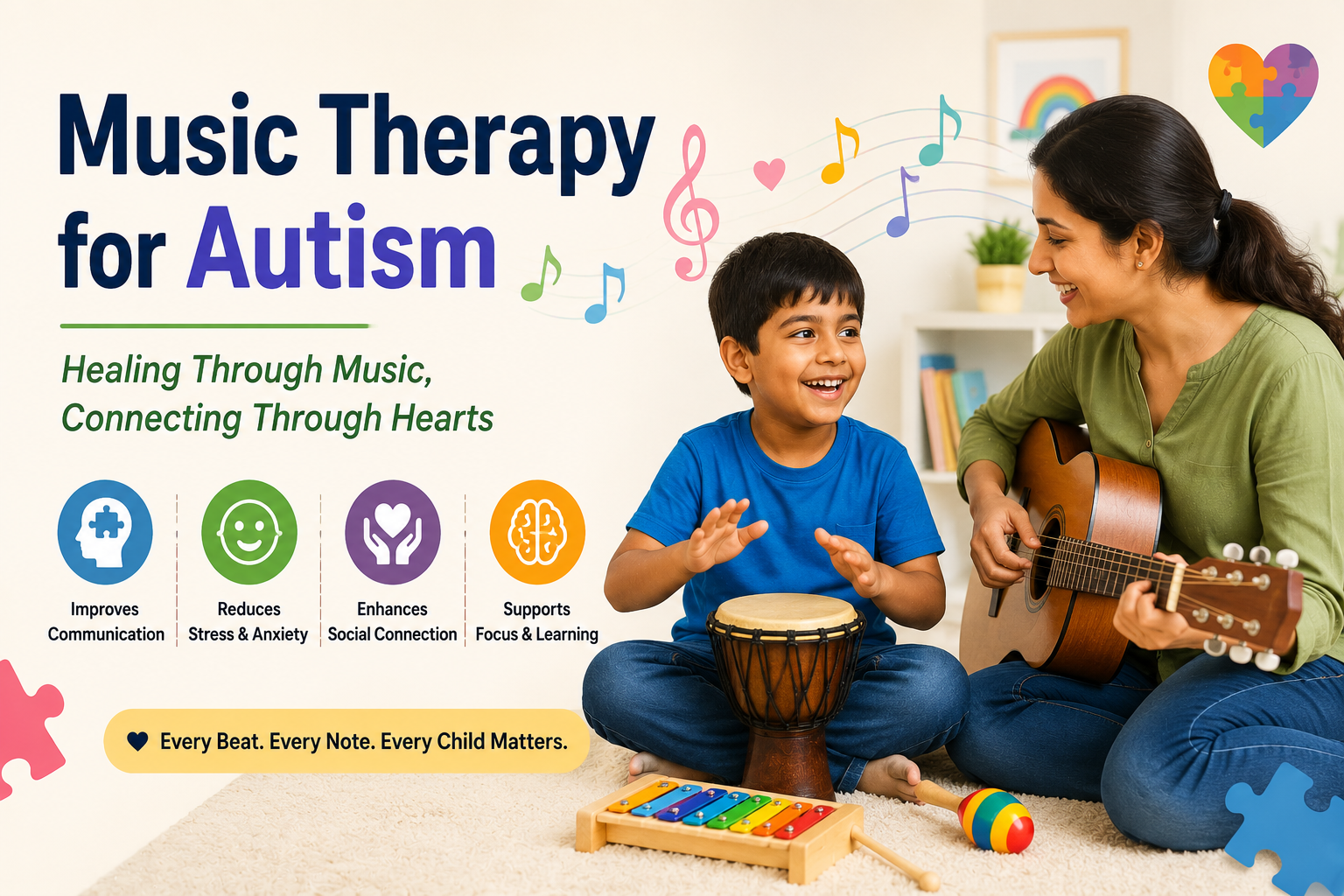
🎵 Music Therapy for Autism: 2026 Evidence-Based Guide to Benefits and What to Expect
Music therapy for autism is a structured, evidence-based clinical intervention — delivered by a trained music therapist — that uses musical experiences to address communication, social, sensory, and behavioural goals in children and adults on the autism spectrum.
In short: the research is strong, the benefits are real across multiple domains, and for many autistic children, music therapy unlocks progress that other interventions have not been able to reach.
This guide gives you the complete, honest picture. 💛

- 🧠 Why Music Reaches the Autistic Brain Differently
- 📊 The Numbers: What the Research Actually Shows in 2026
- 🌟 The Core Benefits of Music Therapy for Autism
- 🗣️ Benefit 1: Language and Communication
- 👥 Benefit 2: Social Skills and Interaction
- 😌 Benefit 3: Behavioural Regulation
- 🎭 Benefit 4: Emotional Expression
- 🏃 Benefit 5: Motor Coordination
- 🧘 Benefit 6: Sensory Processing
- 🎼 What Does a Music Therapy Session Actually Look Like?
- 🎵 Active vs. Receptive Music Therapy: Understanding the Approaches
- 🔄 How Music Therapy Compares to Other Autism Interventions
- 👶 Age-by-Age Guide: What to Expect at Different Stages
- 🔍 How to Find a Qualified Music Therapist
- 🏠 Home Music Activities That Complement Formal Therapy
- 🔍 What You Must Not Miss About This Topic
- 1. 🧬 The Biological Mechanisms Are Now Partially Understood
- 2. 📊 Effect Sizes Matter — and They Are Rarely Translated for Parents
- 3. 🎭 Group Music Therapy Has Different Benefits Than Individual
- 4. 🇮🇳 The Indian Context Is Almost Never Addressed
- 5. 🔄 Honest Limitations Are Almost Never Discussed
- 💙 A Parent’s Story: The Day He Sang His First Word
- ❓ FAQs About Music Therapy for Autism
- Q: What is music therapy for autism?
- Q: Does music therapy actually work for autism?
- Q: How long does it take to see results from music therapy for autism?
- Q: What age should a child start music therapy for autism?
- Q: Is music therapy for autism covered by insurance in India?
- Q: How is music therapy different from simply playing music at home?
- Q: Can non-verbal autistic children benefit from music therapy?
- 🔗 Trusted Resources for Families
- 💙 Final Thoughts: Music Finds What Words Cannot
🧠 Why Music Reaches the Autistic Brain Differently
Before examining the research, it helps to understand why music therapy for autism produces the outcomes it does — because the neuroscience behind this is genuinely compelling.
Music has been identified as a relative strength in many people with autism spectrum disorder. While social interaction, verbal communication, and processing unpredictable sensory input can be profoundly challenging, music — with its predictable structure, its rhythmic repetition, its clear patterns — often engages autistic individuals in ways that conventional verbal instruction cannot.
The considerable heterogeneity in autism itself means that music’s effects vary, but its structural properties consistently offer features that align with autistic cognitive strengths: pattern recognition, rule-governed sequences, and predictable cause-and-effect relationships. (Source: Frontiers in Integrative Neuroscience — Music Interventions in ASD Meta-Analysis, Oct 2025)
Music also engages biological mechanisms that other therapies do not. The most current research suggests that music therapy promotes the secretion of oxytocin — the hormone strongly linked to social bonding and trust — and modulates dopamine and serotonin levels, affecting mood regulation and reward processing. (Source: Frontiers in Psychiatry — Music Therapy for ASD Meta-Analysis and Biological Mechanisms, Jan 2026)
Furthermore, the auditory and motor systems are deeply interconnected in the human brain — a phenomenon called auditory-motor coupling.
When a child taps a drum in rhythm, vocalises with a melody, or matches their movement to a beat, they are simultaneously engaging language, motor planning, attention, and social response systems. Music therapy for autism exploits this neural coupling in ways that directly target the core challenges of the condition.
📊 The Numbers: What the Research Actually Shows in 2026
The evidence base for music therapy for autism has grown substantially in recent years, with several large-scale meta-analyses now providing robust support.
| Study | Sample Size | Key Finding | Source |
|---|---|---|---|
| Shi et al. 2024 meta-analysis (18 RCTs) | 1,457 children with ASD | Music therapy improved language communication (SMD = −1.20, p < 0.001) and social skills (SMD = −1.13, p < 0.001) | PMC — Frontiers in Psychology, May 2024 |
| 2026 Frontiers in Psychiatry meta-analysis (18 studies, up to Aug 2025) | Large combined sample | MT significantly reduced ABC total score (SMD = -0.76, p = 0.01) and CARS total score (SMD = -0.43, p < 0.01) | PMC — Frontiers in Psychiatry, Jan 2026 |
| Frontiers in Integrative Neuroscience (Oct 2025) | 15 RCTs, ages 2–young adult | Multiple positive trends in social interaction and behaviour, particularly within specific subgroups | Frontiers — Music Interventions ASD, Oct 2025 |
| Systematic review of RCTs 2009–2024 | Multiple RCTs reviewed | MT showed promise in improving social interactions and communication skills in individuals with ASD | PMC — Systematic Review RCTs, 2025 |
| PRISMA systematic review (17 studies) | 17 research studies | Positive outcomes in social skills, communication, and stereotypic behaviour; aligned with Hillecke’s Heuristic Working Factor Model | Academia.edu — Music Therapy ASD Meta-Analysis, Nov 2024 |
💡 What these numbers mean for parents: The research foundation for music therapy for autism is now genuinely strong. An SMD (standardised mean difference) of −1.20 for language communication is considered a large effect size in clinical research — meaning the improvement is not just statistically significant but clinically meaningful.
Multiple independent meta-analyses from 2024 to 2026 are converging on the same conclusion: music therapy produces real, measurable improvements across communication, social skills, and behaviour in children with autism.
🌟 The Core Benefits of Music Therapy for Autism
Based on the current research landscape, here are the specific areas where music therapy for autism demonstrates the strongest evidence.

🗣️ Benefit 1: Language and Communication
This is the area with the strongest research support. Music therapy improves language communication with a large effect size (SMD = −1.20) in a meta-analysis of 1,457 children. (Source: PMC — Shi et al. 2024)
Why it works: Songs provide predictable melodic and rhythmic scaffolding for language. A child who cannot produce words spontaneously may sing those same words when embedded in a familiar melodic pattern. This is not a trick — it reflects genuine neurological differences in how music and language are processed and produced.
Music and language share overlapping neural networks, and the melodic-rhythmic framework of song can activate language production pathways more reliably for some autistic individuals than spoken instruction alone.
What this looks like in practice:
- A child who is echolalia-dominant begins using words spontaneously within song contexts first
- Non-verbal children may vocalise and eventually sing before they use functional speech
- Children show improved verbal imitation within musical tasks, which transfers to non-musical communication over time
👥 Benefit 2: Social Skills and Interaction
Music therapy improved social skills (SMD = −1.13) in the same large-scale meta-analysis. (Source: PMC — Shi et al. 2024)
Why it works: Music creates natural, low-threat opportunities for joint attention, turn-taking, and coordinated engagement — the core social skills that are challenging for autistic individuals. Playing music with another person requires watching, listening, responding, and synchronising — all without the overwhelming complexity of unpredictable social conversation.
What this looks like in practice:
- Taking turns with instruments in a simple musical exchange
- Learning to wait and respond to musical cues (the therapist stops playing — the child waits, then plays)
😌 Benefit 3: Behavioural Regulation
The 2026 Frontiers in Psychiatry meta-analysis found that music therapy significantly reduced scores on both the Autism Behavior Checklist (SMD = −0.76) and the Childhood Autism Rating Scale (SMD = −0.43) — both measuring overall autism symptom severity including behavioural features. (Source: PMC — Frontiers in Psychiatry, Jan 2026)
What this means practically: Children show reduction in repetitive or stereotyped behaviours during and following music therapy sessions. Anxiety decreases. Self-regulatory capacity increases as musical experiences give children non-verbal tools for emotional expression and arousal management.
🎭 Benefit 4: Emotional Expression
Many autistic children have genuine difficulty identifying, expressing, and communicating emotional states verbally. Music provides an alternative channel.
Rhythm, melody, tempo, and dynamics carry emotional information that does not require words — and engaging with these elements in therapy directly supports the development of emotional literacy.
🏃 Benefit 5: Motor Coordination
A 2025 study examining music-and-movement-based intervention found positive effects on motor competence, social engagement, and behaviour in children with ASD. (Source: Children, 2025 — via Frontiers in Psychiatry meta-analysis) Rhythmic movement, instrument playing, and movement-to-music activities all engage and develop gross and fine motor planning.
🧘 Benefit 6: Sensory Processing
Music therapy sessions can be specifically designed to address sensory processing differences — beginning at a child’s current sensory tolerance level and gradually expanding. The predictability of musical structure makes sensory experiences during therapy more manageable than in many other therapeutic or school contexts.
🎼 What Does a Music Therapy Session Actually Look Like?
This is one of the most-searched questions about music therapy for autism — and most online resources give a vague answer. Here is what actually happens.
A music therapy session is structured but flexible, led by a trained and credentialled music therapist, and built around your child’s specific therapeutic goals. A typical session for a child with autism might last 30–45 minutes and include:
| Session Element | What Happens | Therapeutic Purpose |
|---|---|---|
| Hello song | A consistent, familiar song sung at every session start | Establishes predictable routine; reduces transition anxiety |
| Instrument exploration | Child is offered instruments (drums, shakers, xylophones, bells) to explore freely | Develops sensory tolerance; builds trust and engagement |
| Turn-taking activities | Therapist and child alternate playing patterns | Teaches reciprocal interaction; models conversational turn-taking |
| Song-based communication | Therapist uses songs with intentional gaps (“Old MacDonald had a farm, E-I-E-I-___”) | Elicits vocalisation and communication within predictable melodic structure |
| Movement to music | Simple rhythmic movement activities | Gross motor coordination; body awareness; arousal regulation |
| Emotion songs | Songs exploring feelings explicitly | Emotional literacy; self-awareness; vocabulary for emotions |
| Choice-making | Child chooses instruments, songs, or activities | Autonomy; decision-making; communication practice |
| Goodbye song | Consistent closing song at every session | Signals predictable transition to end; provides closure |
Key principles across every session:
- The child is never forced to participate — engagement is invited, not demanded
- The therapist follows the child’s lead while gently expanding the interaction
- Success is measured by the child’s engagement, not by conventional performance standards
- All communication modes are valued — movement, vocalisation, eye contact, gesture
🎵 Active vs. Receptive Music Therapy: Understanding the Approaches
Music therapy for autism encompasses two broad delivery approaches. Understanding the difference helps parents know what to expect and what to ask about.
🎹 Active (Participatory) Music Therapy
The child actively participates in making music — playing instruments, singing, moving, improvising. This is the most common approach in music therapy for autism and produces the broadest range of therapeutic outcomes.
Techniques used:
- Musical improvisation: Child and therapist improvise together — no right or wrong notes, just musical conversation
- Songwriting: Creating simple songs about the child’s interests, experiences, or feelings
- Movement and music: Dancing, movement games, or action songs targeting motor and regulatory goals
🎶 Receptive Music Therapy
The child listens to live or recorded music while the therapist guides the experience for specific therapeutic ends — relaxation, arousal regulation, or emotional processing.
Techniques used:
- Guided relaxation with live music
- Music-supported imagery or story
- Rhythmic auditory stimulation for motor coordination (using a consistent beat to guide movement)
Most paediatric music therapy for autism primarily uses active approaches, with receptive techniques woven in for specific regulatory or calming purposes.
🔄 How Music Therapy Compares to Other Autism Interventions
| Intervention | Mechanism | Evidence Strength for Social/Communication Goals | Session Feel for Child | Physical Touch Required? |
|---|---|---|---|---|
| Music therapy | Musical engagement; auditory-motor coupling; oxytocin release | Strong and growing (multiple 2024–2026 meta-analyses) | Low-pressure, joyful, creative | No |
| ABA therapy | Behaviour reinforcement; structured skill drilling | Very strong | Structured, directive | Sometimes |
| Speech therapy | Direct language targeting | Very strong for specific language goals | Clinical, task-focused | No |
| Occupational therapy | Sensory processing; motor and daily living skills | Strong for sensory and motor goals | Activity-based, play-like | Yes — handling and physical support |
| Play therapy | Child-led play exploration | Moderate for social-emotional goals | Child-led, open | No |
The conclusion most experienced practitioners reach: Music therapy for autism is most effective when it forms part of a coordinated, multidisciplinary approach — working alongside speech therapy, occupational therapy, and ABA where indicated — rather than as a standalone replacement for other interventions.
👶 Age-by-Age Guide: What to Expect at Different Stages
🍼 Toddlers (Ages 1–3)
At this age, music therapy for autism focuses primarily on early communication, social responsiveness, and joint attention. Sessions are highly play-based and may involve the parent directly.
What to expect: Sessions are short (20–30 minutes), heavily improvised around the child’s responses, and focus on building turn-taking, eye contact moments, and vocalisation within musical interactions. The therapist will spend significant time matching and responding to the child’s sounds and movements with music.
🧒 Preschoolers (Ages 3–6)
This is often when music therapy for autism produces some of its most striking results in language and communication. Children are old enough to engage in simple musical structures while still being in the optimal window for language development.
What to expect: A clearer session structure emerges. Songs with predictable gaps begin producing first intentional vocalisations or words for some children. Social interaction through music becomes a central focus. Emotional identification through song begins.
👦 School Age (Ages 6–12)
Music therapy at this stage increasingly targets social skills generalisation — using musical interaction as a bridge to real-world social situations. Emotional self-awareness and regulation become more central.
What to expect: Sessions may include more sophisticated instrument work, songwriting, and group components (if group therapy is available). Goals become more aligned with school-based and community functioning.
🧑 Adolescents (12+)
Music therapy for autistic adolescents increasingly focuses on identity, self-expression, emotional processing, and building confidence — in addition to continued communication and social goals.
What to expect: Greater agency in session direction. Music creation, recording, and performance may feature. Processing of social experiences through songwriting. Some adolescents who have participated in music therapy from childhood use it as a long-term emotional wellbeing resource.
🔍 How to Find a Qualified Music Therapist
A music therapist is not the same as a music teacher. Credential verification is essential.
In India
The music therapy profession in India is still emerging as a formally regulated field. Seek practitioners who have:
- A postgraduate degree in music therapy (e.g., from Nada Centre for Music Therapy, Chennai, or similar institutions)
- Training from internationally recognised programmes
- Experience specifically documented with autistic children
- Alignment with or membership of the World Federation of Music Therapy (WFMT)
👉 World Federation of Music Therapy: wfmt.info
In the United States
Look for the MT-BC (Music Therapist-Board Certified) credential — the standard US credential regulated by the Certification Board for Music Therapists (CBMT).
👉 Find a music therapist: musictherapy.org/careers/employment/ 👉 Verify credentials: cbmt.org
In the United Kingdom
The recognised qualification is the membership of the British Association for Music Therapy (BAMT) and registration with the Health and Care Professions Council (HCPC) as a music therapist.
👉 BAMT — Find a Music Therapist: bamt.org
🏠 Home Music Activities That Complement Formal Therapy
Music therapy for autism conducted by a professional produces the best clinical outcomes — but between sessions, supportive musical activities at home can extend the benefits into daily life.
Practical, evidence-informed home activities:
| Activity | Age | Benefit | How to Do It |
|---|---|---|---|
| Singing with gaps | 1–6 | Language elicitation | Sing familiar songs and pause before the last word — wait for your child to fill it |
| Drum conversation | 2–8 | Turn-taking, social reciprocity | Simple alternating patterns on any drum — you play a pattern, they copy or respond |
| Morning routine songs | All ages | Transition support | Create a simple song for each routine step — waking, brushing teeth, getting dressed |
| Emotion playlist | 4+ | Emotional literacy | Build playlists labelled by emotion; discuss how music sounds “happy” or “calm” |
| Instrument exploration | All ages | Sensory exploration, self-expression | Offer a range of instruments freely with no expectation — just musical space |
| Movement to music | All ages | Motor and regulatory | Dance, march, or move freely to music without structure or performance demand |
Important: Home musical activities supplement formal therapy — they do not replace it. Always discuss home activities with your child’s music therapist to ensure consistency with therapeutic goals.
🔍 What You Must Not Miss About This Topic
1. 🧬 The Biological Mechanisms Are Now Partially Understood
Most parent-facing guides on music therapy for autism describe what happens without explaining why. The 2026 Frontiers in Psychiatry meta-analysis explicitly explores the biological mechanisms — oxytocin secretion, dopamine and serotonin modulation, and auditory-motor neural coupling — providing a scientific foundation that moves the field beyond “music just feels good.”
This mechanistic understanding helps parents and practitioners explain why music therapy works and tailor approaches accordingly. (Source: PMC — Frontiers in Psychiatry, Jan 2026)
2. 📊 Effect Sizes Matter — and They Are Rarely Translated for Parents
The SMD of −1.20 for language communication and −1.13 for social skills from the 2024 meta-analysis are considered large effect sizes in clinical research.
Most guides report these numbers without explaining that this means the average child receiving music therapy improved significantly more than the average child in the control group — well beyond what might be expected from random variation. Translating statistical findings into plain language is almost always missing from parent-facing resources.
3. 🎭 Group Music Therapy Has Different Benefits Than Individual
Almost all parent guides describe individual music therapy without distinguishing the specific benefits of group music therapy — which creates real-world social practice with peers in a structured, low-pressure musical context.
Group music therapy has documented positive effects on peer interaction, cooperative behaviour, and social awareness that individual therapy cannot fully replicate. For children working toward social integration goals, group sessions offer a unique bridge between individual therapy and real social environments.
4. 🇮🇳 The Indian Context Is Almost Never Addressed
Music therapy for autism resources in English are almost universally written for UK, US, or Australian audiences. For Indian families — where formal music therapy is less professionalised and more difficult to access — the practical questions are entirely different: where to find qualified practitioners, what qualifications to look for, whether Indian classical music traditions offer valid therapeutic applications, and how to access services in non-metro areas. This guide specifically addresses the Indian context, reflecting the site’s primary audience.
5. 🔄 Honest Limitations Are Almost Never Discussed
The research is genuinely positive — but it is not without caveats. The October 2025 Frontiers in Integrative Neuroscience meta-analysis found considerable heterogeneity across studies — meaning effects vary significantly by child, methodology, and outcome measure.
Statistically significant effects were not consistently observed across all domains. Honest guides acknowledge both the strong evidence for music therapy for autism and the important ongoing research questions. (Source: Frontiers in Integrative Neuroscience, Oct 2025)
💙 A Parent’s Story: The Day He Sang His First Word
Arjun had not spoken a word in four years. His parents, Priya and Vikram, had tried speech therapy, play therapy, and ABA. Progress had been real but slow. His speech therapist suggested adding music therapy to his programme.
“I was sceptical,” Priya admits. “He liked music — he always had. But I thought that was different from it being therapy.”
The music therapist, a postgraduate-trained practitioner with seven years of paediatric experience, began meeting with Arjun weekly. Sessions were short. Forty minutes, no demands, just music.
For six weeks, Arjun mostly listened and occasionally tapped a drum. He rocked to the rhythm. He smiled.
Week seven, the therapist sang: “Old MacDonald had a farm, E-I-E-I-___”
She paused.
Arjun looked up.
“O,” he said.
Not a clear vowel. But a deliberate vocalisation. At exactly the right musical moment.
“I was watching through the one-way mirror,” Priya says. “I burst into tears the moment he made the sound. Not because it was perfect. Because it was intentional. He had done something on purpose for someone else. That was the moment.”
Over the following months, Arjun’s vocalisations expanded. Within a year, he was consistently producing vowel sounds, then consonant-vowel combinations, then five approximated words. All of them were first produced in musical contexts before transferring to spoken communication.
“The music therapist and the speech therapist began meeting regularly,” Priya says. “What started in the music session would be reinforced in speech. What was targeted in speech would be woven into the musical activities. The coordination made everything faster.”
Today Arjun uses approximately 30 functional words. He still loves drumming. He will tap out rhythms on any available surface and look up to see if you are watching — a small social invitation that his parents treasure every single time.
“Music did not cure autism,” Priya reflects. “But it found a door into Arjun’s world that we had been searching for for years. And once that door opened, a lot of other things became possible too.”
❓ FAQs About Music Therapy for Autism
Q: What is music therapy for autism?
Music therapy for autism is a structured, evidence-based clinical intervention delivered by a trained music therapist. It uses musical experiences — instrument playing, singing, rhythmic movement, songwriting, and improvisation — to address therapeutic goals in communication, social skills, behaviour, sensory processing, and emotional regulation. It is different from music education and should be delivered by a credentialled music therapist, not a music teacher.
Q: Does music therapy actually work for autism?
Yes — the current research evidence is genuinely strong. A 2024 meta-analysis of 18 randomised controlled trials including 1,457 children with ASD found large effect sizes for improvements in language communication and social skills. A 2026 Frontiers in Psychiatry meta-analysis confirmed significant reductions in autism symptom severity scores. The research consistently shows music therapy produces real, measurable improvements for many children with autism.
Q: How long does it take to see results from music therapy for autism?
Results vary by child, therapist, and therapeutic goals. Some children show notable changes within weeks — particularly in terms of engagement, vocalisation, and emotional regulation. Communication and social skill improvements typically emerge over months of consistent therapy. Most published studies document meaningful outcomes over 8–24 weeks of weekly or twice-weekly sessions.
Q: What age should a child start music therapy for autism?
Music therapy is appropriate from very early childhood — there are documented programmes working with children as young as 12–18 months. The optimal window for many goals is preschool age, when early language and social development are most malleable. However, music therapy produces benefits across the lifespan — adolescents and adults with autism also benefit, with different therapeutic emphases at different developmental stages.
Q: Is music therapy for autism covered by insurance in India?
Music therapy is not yet consistently covered by Indian health insurance policies, as it remains an emerging profession with variable recognition across states. However, if music therapy forms part of a comprehensive rehabilitation programme recommended by a developmental paediatrician or psychiatrist, some costs may be partially covered under policies that include rehabilitation services.
Niramaya health insurance for autism covers “ongoing therapies to reduce disability impact” — check whether music therapy from a qualified practitioner qualifies under your specific policy terms.
Q: How is music therapy different from simply playing music at home?
Music therapy involves a trained clinician who uses music intentionally and strategically to address specific therapeutic goals — assessing responses, adjusting the musical approach in real time, and working toward measurable outcomes. Home music activities are valuable and can complement therapy, but they lack the clinical expertise, goal-directedness, and real-time therapeutic responsiveness that make formal music therapy effective as an intervention.
Q: Can non-verbal autistic children benefit from music therapy?
Yes — and this is where music therapy for autism shows some of its most striking outcomes. Non-verbal and minimally verbal children often engage with and respond to musical stimuli more readily than verbal instruction. Music provides a non-verbal channel for reciprocal interaction and expression, and vocalisations first produced within musical contexts frequently transfer to functional communication over time.
🔗 Trusted Resources for Families
| Resource | What It Offers | Link |
|---|---|---|
| 🎵 American Music Therapy Association | Professional body; find a music therapist (US) | musictherapy.org |
| 🏅 CBMT — Credential Verification (US) | Verify music therapist credentials | cbmt.org |
| 🇬🇧 BAMT — British Association for Music Therapy | Find a music therapist (UK) | bamt.org |
| 🌍 World Federation of Music Therapy | International professional resources | wfmt.info |
| 🔬 PMC — Music Therapy Meta-Analysis 2024 | Peer-reviewed evidence for music therapy in autism | pmc.ncbi.nlm.nih.gov |
| 📊 Frontiers in Psychiatry — 2026 Meta-Analysis | Biological mechanisms and efficacy evidence | pmc.ncbi.nlm.nih.gov |
| 🌐 Autism Speaks — Complementary Therapies | Overview of evidence-based and complementary approaches | autismspeaks.org |
💙 Final Thoughts: Music Finds What Words Cannot
Music therapy for autism is not about making children musical. It is not about concerts or performances or getting the notes right. It is about something far more fundamental: finding another language for connection, communication, and expression — one that many autistic children respond to more readily than any other.
The research in 2024–2026 has moved this from a promising idea to a well-supported clinical intervention with measurable outcomes across communication, social skills, behaviour, and emotional regulation.
If your child has autism and has not yet had the chance to experience music therapy with a qualified therapist, it is worth pursuing. Not because it will work the same way for every child — the research honestly acknowledges that individual responses vary. But because for a meaningful proportion of autistic children, music opens a door that no other key has been able to turn.
And sometimes that door opens to the first word. 💛
📝 This article is for informational and educational purposes only. Always consult your child’s developmental team before adding any new therapeutic intervention. Music therapy should be delivered by a credentialled music therapist and ideally coordinated with your child’s existing therapeutic and educational programme.


