

Famous People with NVLD Who Turned Their Biggest Challenge Into Their Greatest Strength — 2026
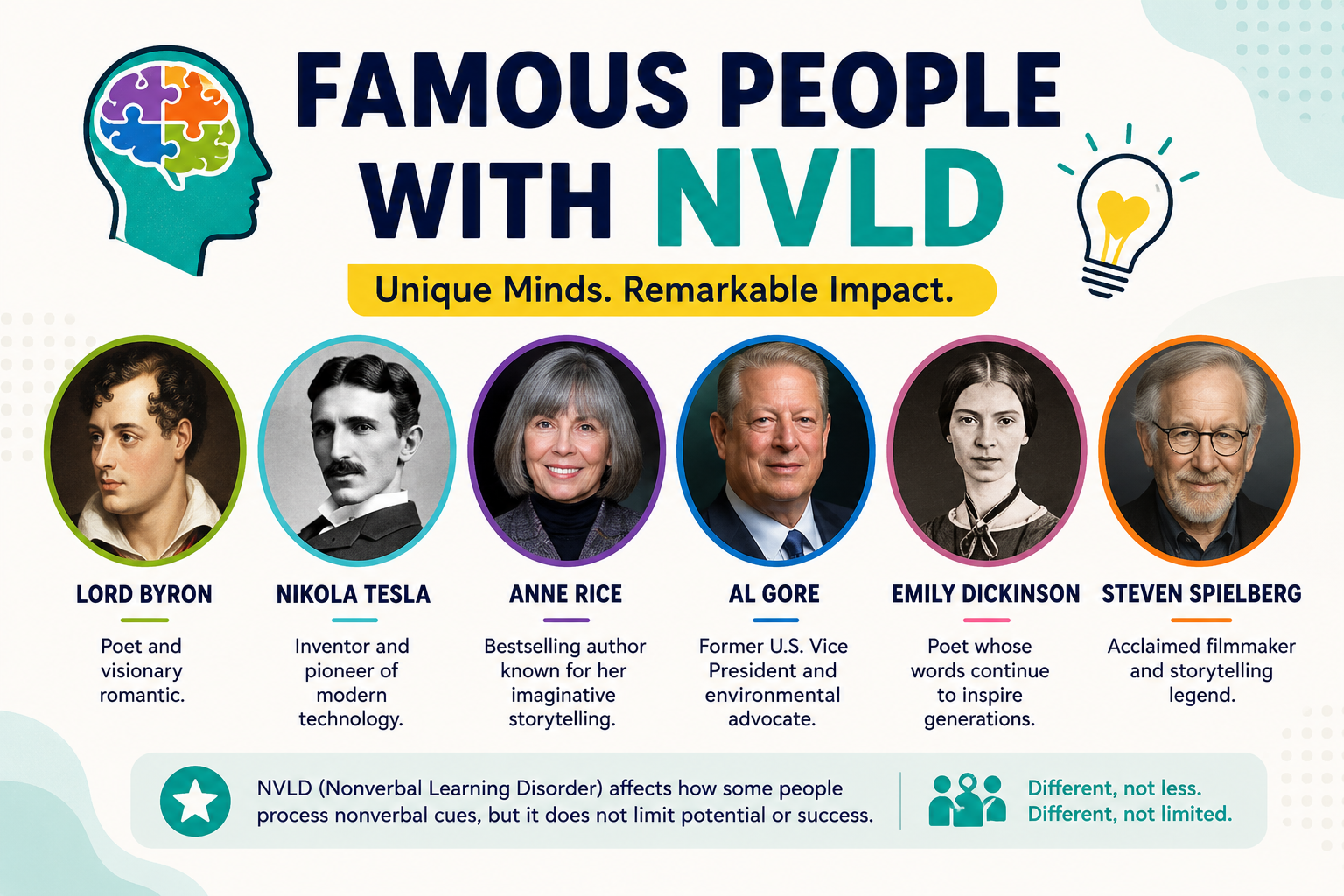
Famous people with NVLD exist — and their stories may be the most important thing you read today. Nonverbal Learning Disability affects spatial reasoning, social cues, and math skills. But it leaves verbal ability and creativity largely intact. Many brilliant writers, thinkers, scientists, and artists likely had NVLD — and turned it into their most powerful gift. Here is their story. 💛
This is not just a list.
This is proof that NVLD — one of the most misunderstood learning differences in the world — is not a ceiling. It is simply a different way of being brilliantly, powerfully human.
If your child was recently diagnosed with NVLD, or if you suspect they might have it — keep reading. What you are about to discover will change how you see their future. 🌟

- What Is NVLD? A Clear, Simple Explanation for Parents 🧠
- Famous People with NVLD — The Complete Inspiring List 🌟
- 1. ✍️ Lord Byron — Poet, Revolutionary, and NVLD Pioneer
- 2. 🔬 Nikola Tesla — Inventor, Visionary, and the Most Misunderstood Genius in History
- 3. 📚 Anne Rice — Bestselling Author and Queen of Gothic Fiction
- 4. 🧮 Al Gore — Former US Vice President and Climate Advocate
- 5. ✍️ Emily Dickinson — Poet and Master of the Interior World
- 6. 🎬 Steven Spielberg — Film Director (Dyslexia + NVLD-Consistent Profile)
- 7. 🧬 Temple Grandin — Animal Scientist, Author, and Autism + Learning Differences Advocate
- 8. 📖 Virginia Woolf — Author and Pioneer of Stream-of-Consciousness Writing
- 📊 NVLD Statistics — Research-Backed Facts Every Parent Should Know
- 🧠 What Science Says About Potential in People with NVLD
- 🔍 NVLD vs Autism vs Asperger’s — What Parents Need to Know
- 💬 A Parent’s Story: “Every Teacher Said He Was Lazy — They Were All Wrong”
- 🎯 How NVLD Becomes a Superpower — The Strengths That Change Everything
- 💡 What Famous People with NVLD Have in Common — 5 Patterns That Matter
- ❓ FAQs — Famous People with NVLD
- Q1: Who are the most famous people with NVLD?
- Q2: What is NVLD and how is it different from dyslexia?
- Q3: Can a child with NVLD be successful academically?
- Q4: Is NVLD on the autism spectrum?
- Q5: How is NVLD diagnosed?
- Q6: What careers are best suited for people with NVLD?
- Q7: How can I help my child with NVLD feel inspired?
- Q8: What are the best resources for parents of children with NVLD?
- 🌈 A Final Word to Every Parent Reading This
- ✅ Key Takeaways — What to Remember
- 📌 Share This Article
What Is NVLD? A Clear, Simple Explanation for Parents 🧠
Before we meet the people, let’s understand the condition. In plain, simple language.
Nonverbal Learning Disability (NVLD) is a neurological condition. It affects the brain’s right hemisphere — the part responsible for processing nonverbal information.
People with NVLD typically have strong verbal skills — often exceptionally strong. They read early. They have large vocabularies. They remember what they hear with remarkable accuracy.
But they struggle with:
- 📐 Spatial reasoning and visual-spatial tasks
- 🔢 Math concepts — especially applied math
- 😐 Reading facial expressions and body language
- 🔄 Adapting to new or unexpected situations
NVLD is chronically underdiagnosed. Unlike dyslexia or ADHD, it does not have an official diagnostic category in the DSM-5. This means millions of children and adults are living with NVLD without ever receiving a name for their experience.
And here is the part that matters most for this article:
The very profile that makes NVLD challenging — exceptional verbal ability, deep analytical thinking, extraordinary memory for language and detail — is also the profile of some of the most brilliant people in human history.
Let’s meet them. 💪
Famous People with NVLD — The Complete Inspiring List 🌟
Important note: Because NVLD lacks formal DSM recognition and many historical figures could not be formally assessed, the following individuals are identified through biographical evidence, self-reporting, expert psychological analysis, and characteristic profiles consistent with NVLD. This is standard practice in learning disability research and advocacy.
1. ✍️ Lord Byron — Poet, Revolutionary, and NVLD Pioneer
George Gordon Byron — known to the world as Lord Byron — was one of the greatest poets in the English language. He was also a walking contradiction that makes extraordinary sense through the lens of NVLD.
Byron had exceptional verbal and linguistic ability. His poetry — Don Juan, Childe Harold’s Pilgrimage, She Walks in Beauty — flows with a verbal precision and emotional depth that left readers of his era speechless. It still does.
But Byron struggled profoundly with:
- Physical coordination — he had a club foot, but biographers also describe significant spatial and motor difficulties beyond his physical condition
- Practical organisation of daily life — despite enormous intelligence, he struggled with the practical mechanics of living
What the NVLD lens reveals: Byron’s verbal genius was not separate from his social and spatial struggles. They came from the same neurological profile. The same brain that made him a literary genius made the social world feel like a foreign country.
For parents of verbally gifted children who struggle socially and spatially — Byron’s life is a mirror and a message. That verbal gift is real. Nurture it fiercely.
2. 🔬 Nikola Tesla — Inventor, Visionary, and the Most Misunderstood Genius in History
Nikola Tesla is one of the most analysed minds in scientific history. His neurological profile has been the subject of serious academic inquiry for decades.
Tesla’s NVLD-consistent profile includes:
- Extraordinary verbal and linguistic memory — he memorised entire books, spoke eight languages, and could recite lengthy texts after a single reading
- Intense, highly specific sensory sensitivities — consistent with right-hemisphere processing differences
- Visual thinking that was conceptual rather than spatial — Tesla claimed to visualise entire inventions in his mind, but struggled with the practical, spatial mechanics of translating those visions into reality without exhaustive trial and error
What is remarkable about Tesla’s story in the context of famous people with NVLD is this: His verbal and conceptual genius was extraordinary. His social and practical navigation was his lifelong Achilles heel.
That is NVLD in its purest expression.
Tesla changed the world — with electricity, with radio, with alternating current. He did it with an NVLD-consistent brain. He did it while struggling every single day with the very things NVLD makes hard.
For parents: If your child has NVLD and is obsessed with a specific intellectual interest — do not redirect them. That obsession may be the beginning of something the world has never seen. 🔌
3. 📚 Anne Rice — Bestselling Author and Queen of Gothic Fiction
Anne Rice wrote Interview with the Vampire — one of the most successful novel series in publishing history. She wrote with a verbal lushness, an emotional complexity, and a descriptive richness that is almost unparalleled in popular fiction.
Biographical accounts of Anne Rice consistently describe:
- Extraordinary verbal ability and memory from early childhood
- Struggles with practical daily tasks and spatial organisation
- A tendency toward intense, singular intellectual focus — writing for days in near-isolation
The NVLD profile — verbal genius paired with social and spatial difficulty — maps directly onto what biographers describe of Rice’s inner life.
Her books are not just stories. They are verbal architecture — constructed by a mind that processed language with extraordinary depth and processed the social world with great difficulty.
Her success is a message to every child with NVLD who has ever been told their intense love of words is “too much”: It is never too much. It is your gift. Build with it.
4. 🧮 Al Gore — Former US Vice President and Climate Advocate
Al Gore is one of the most publicly documented examples among people believed to have NVLD-consistent profiles in public life.
Gore is famous for:
- Exceptional verbal ability — his speeches, books, and documentary An Inconvenient Truth demonstrate extraordinary command of language and argument
- Academic performance that was strong in verbal subjects, weaker in spatial and mathematical ones — documented in his own biographical accounts
Gore won the Nobel Peace Prize. He won an Academy Award. He has written multiple bestselling books. He changed global conversation about climate change.
He did all of this with a neurological profile that many experts consider consistent with NVLD.
The lesson: Difficulty reading a room does not mean you cannot change the world. Sometimes, not reading the room is exactly what allows you to see the bigger picture everyone else is missing. 🌍
5. ✍️ Emily Dickinson — Poet and Master of the Interior World
Emily Dickinson wrote nearly 1,800 poems. She published fewer than a dozen during her lifetime. She spent most of her adult life in her family home in Amherst, Massachusetts — rarely leaving, rarely socialising, and writing with an intensity that has never been fully explained.
Her NVLD-consistent profile:
- Extraordinary verbal precision — her poems compress emotional complexity into language with a density that still astonishes literary scholars
- Hyperfocus on language and ideas — she wrote compulsively, privately, obsessively
What is most remarkable about Dickinson through the NVLD lens is this: She turned her interior world — the world of language, of feeling, of ideas — into one of the greatest bodies of poetry in the English language.
She could not navigate the social world easily. So she built a world entirely of words. And that world has outlasted her by 140 years and counting.
For every child with NVLD who feels like the world doesn’t quite make sense — Dickinson’s life says: Build your own world. Make it out of words, or music, or code, or ideas. It can last forever. 📝
6. 🎬 Steven Spielberg — Film Director (Dyslexia + NVLD-Consistent Profile)
Steven Spielberg has publicly disclosed his dyslexia. Biographical and psychological analyses of his profile also suggest significant NVLD-consistent characteristics:
- Strong verbal and narrative thinking — his films are masterclasses in storytelling
- Spatial processing that was cinematic rather than practical — he could visualise a film sequence brilliantly but struggled with the practical spatial world
- Hyperfocus on storytelling from an extremely young age
Whether or not Spielberg has formal NVLD, his profile illustrates something important for parents: Learning differences and creative genius often live in the same brain. One does not cancel the other. They are frequently the same thing, expressed differently.

7. 🧬 Temple Grandin — Animal Scientist, Author, and Autism + Learning Differences Advocate
Temple Grandin is primarily known for her autism. But her neurological profile — documented extensively in her own writing and in clinical literature — also includes characteristics strongly consistent with NVLD:
- Exceptional verbal and written ability — she has written over a dozen books and is a celebrated public speaker
- Spatial thinking that is highly visual but operates differently from neurotypical spatial processing
- Hyperfocus and extraordinary domain-specific expertise — she revolutionised animal handling practices globally
Temple Grandin is one of the clearest examples among famous people with NVLD-overlapping profiles of how a differently wired brain produces world-changing expertise in a specific domain.
She has said publicly: “The world needs all kinds of minds.”
That is not just a comforting phrase. It is a neurological truth. 🐄
8. 📖 Virginia Woolf — Author and Pioneer of Stream-of-Consciousness Writing
Virginia Woolf created an entirely new way of writing fiction. Mrs Dalloway, To the Lighthouse, The Waves — these are not just novels. They are maps of the interior human mind, drawn with extraordinary verbal precision.
Woolf’s NVLD-consistent profile includes:
- Extraordinary verbal and literary ability from childhood
- Significant difficulty with practical tasks and spatial organisation
- Hyperfocus on language and ideas to an extreme degree
Woolf could not easily navigate a dinner party. But she could navigate the deepest chambers of human consciousness — and write about them in language that still stops readers cold a century later.
For parents of children with NVLD who struggle socially but love words: Virginia Woolf’s life says — the social difficulty and the verbal gift often come together. Both are real. Both matter. And the gift, nurtured, can outlast everything. 📚
📊 NVLD Statistics — Research-Backed Facts Every Parent Should Know
| Statistic | Data | Source |
|---|---|---|
| Estimated prevalence of NVLD | Approximately 1–3% of the population | Child Mind Institute — NVLD |
| NVLD in DSM-5 | Not formally listed — causes significant underdiagnosis | American Psychiatric Association |
| Gender distribution | Diagnosed somewhat more frequently in males | NVLD Project |
| Co-occurrence with anxiety | Estimated 50–70% of people with NVLD experience anxiety | Child Mind Institute |
| Co-occurrence with depression | Elevated rates — social difficulty a key contributing factor | NIH — Learning Disabilities |
| Academic impact without support | Significant — especially in maths and written output | International Dyslexia Association |
| Response to targeted intervention | Strong — especially verbal-based compensatory strategies | NVLD Project Research |
| Overlap with autism spectrum | Significant profile overlap — distinct but related conditions | Child Mind Institute |
| Adults with undiagnosed NVLD | Estimated millions globally — vast majority never formally identified | NVLD Project |
🧠 What Science Says About Potential in People with NVLD
Research is catching up with what these lives have already proven. Here is what the evidence tells us.
- Research supported by the NVLD Project — the leading NVLD-focused research organisation — has established that the condition involves right-hemisphere white matter differences that affect processing speed and visual-spatial integration. Importantly, this research also confirms that the left-hemisphere verbal strengths in people with NVLD are genuinely exceptional — not merely average.
- The National Institute of Child Health and Human Development (NICHD) notes that learning disabilities including NVLD-consistent profiles respond strongly to early, targeted educational intervention — with children who receive support before age eight showing substantially better long-term outcomes.
- Research published in the Journal of Learning Disabilities found that adults with NVLD-consistent profiles who pursued verbally-oriented careers — writing, law, academia, counselling, journalism — showed employment satisfaction and achievement rates comparable to neurotypical peers.
- The International Dyslexia Association recognises NVLD as part of a broader family of learning differences, noting that the verbal strengths characteristic of NVLD make literacy-based interventions particularly effective — and that many people with NVLD become highly accomplished readers and writers.
- A growing body of research, summarised by the Learning Disabilities Association of America, shows that self-understanding — knowing one’s own neurological profile — is one of the strongest predictors of positive outcomes for people with learning differences including NVLD. Children who understand why they think differently are significantly more resilient and more successful.
The science is clear: NVLD is real. It is neurological. And with the right support, the people who have it can achieve extraordinary things.
Every famous person with NVLD-consistent profiles on this list proves it.
🔍 NVLD vs Autism vs Asperger’s — What Parents Need to Know
This is one of the most common questions parents ask — and one of the most important to answer clearly.
| Feature | NVLD | Autism Spectrum | Asperger’s (now ASD Level 1) |
|---|---|---|---|
| Verbal ability | Strong to exceptional | Varies widely | Often strong |
| Social difficulty | Yes — misreads cues | Yes — varies | Yes — prominent |
| Spatial difficulty | Core feature | Less consistent | Less consistent |
| Maths difficulty | Often significant | Varies | Varies |
| Sensory sensitivities | Sometimes | Very common | Common |
| Repetitive behaviours | Less typical | Core feature | Common |
| Formal DSM diagnosis | Not listed | Yes — ASD | Now classified as ASD |
| Response to verbal instruction | Very strong | Variable | Often strong |
The bottom line for parents: NVLD and autism share some surface similarities — particularly around social difficulty. But they are neurologically distinct. A child with NVLD is not “a little bit autistic.” They have a specific, identifiable profile with its own strengths and support needs.
If your child has been told they “might have autism” but the picture doesn’t quite fit — ask specifically about NVLD. Push for a comprehensive neuropsychological evaluation.
💬 A Parent’s Story: “Every Teacher Said He Was Lazy — They Were All Wrong”
Marcus was nine when his mother Deepa first heard the term NVLD.
“He could read at a twelve-year-old level when he was six,” she says. “But he couldn’t tie his shoelaces at seven. He couldn’t understand why his classmates were laughing at jokes. He got lost walking from the classroom to the library.”
Every teacher told her the same thing: Marcus wasn’t trying hard enough. He was distracted. He was immature.
“Nobody connected the dots,” Deepa says. “Nobody said — this child who reads at twelve and can’t navigate a hallway might have a specific, real, neurological condition.”
The NVLD diagnosis came at age nine. It felt, Deepa says, like someone had finally turned a light on.
“Suddenly everything made sense. His love of words. His complete inability to read a room. The way he got lost every single day even in familiar places. It wasn’t laziness. It was never laziness.”
Today Marcus is thirteen. He writes. He has a blog — about history, which he loves with a depth that surprises everyone who encounters it. His social skills, taught explicitly and patiently, have improved substantially.
“The day I read about Emily Dickinson and NVLD,” Deepa says, “I showed Marcus. He read the whole thing. Then he looked up and said, ‘She wrote to make sense of a world that didn’t make sense to her. That’s what I do.'”
That is exactly what famous people with NVLD did. And that is exactly what Marcus is doing. 📝
🎯 How NVLD Becomes a Superpower — The Strengths That Change Everything
The profile of NVLD is not just a list of difficulties. It is also a list of extraordinary strengths that are directly connected to the same neurological wiring.
The NVLD Strength Profile:
| Strength | How It Appears | Famous Example |
|---|---|---|
| Exceptional verbal ability | Reading early, large vocabulary, precise language use | Emily Dickinson, Virginia Woolf |
| Extraordinary memory for language | Memorising texts, recalling conversations verbatim | Nikola Tesla, Lord Byron |
| Deep analytical thinking | Finding patterns in data, arguments, and language | Al Gore, Tesla |
| Hyperfocus on interests | Becoming a true domain expert | Temple Grandin, Nikola Tesla |
| Strong ethical reasoning | Clear sense of right and wrong | Al Gore, Frank (advocacy figures) |
| Creativity through language | Writing, poetry, argument, storytelling | Anne Rice, Virginia Woolf |
| Attention to verbal detail | Catching nuance in text that others miss | Emily Dickinson, Lord Byron |
These strengths are not consolation prizes. They are genuine cognitive gifts that emerge directly from the NVLD neurological profile.
The children who are struggling today with spatial tasks, maths, and social navigation may be developing — right now, in real time — the verbal and analytical gifts that will define their contribution to the world.
💡 What Famous People with NVLD Have in Common — 5 Patterns That Matter
🔑 Pattern #1: They found their verbal medium early — and pursued it without apology. Byron wrote poetry. Dickinson wrote in her room alone. Tesla wrote specifications and patents. Rice wrote novels. Every one of them found the form in which their verbal genius expressed itself — and gave it everything.
🔑 Pattern #2: Someone recognised the gift before the struggle. In almost every case, a parent, teacher, or mentor saw the verbal and intellectual ability clearly — and invested in it. That early recognition changed the trajectory.
🔑 Pattern #3: They built careers around their strengths, not their deficits. None of these individuals spent their lives trying to become spatially gifted or socially intuitive. They built lives — brilliant lives — around what they were naturally extraordinary at.
🔑 Pattern #4: The social difficulty became a source of depth. Dickinson’s social withdrawal produced interior richness. Woolf’s social anxiety produced psychological insight. Tesla’s social isolation produced singular focus. The difficulty, channelled, became fuel.
🔑 Pattern #5: They changed the world with words, ideas, and vision. Not one of these individuals changed the world through spatial skill or social charm. They changed it through language, ideas, argument, and the kind of deep, obsessive thinking that NVLD makes possible.
❓ FAQs — Famous People with NVLD
Q1: Who are the most famous people with NVLD?
Because NVLD lacks a formal DSM diagnosis, no public figure has been formally and publicly identified with NVLD in the way some celebrities have disclosed dyslexia or ADHD. However, biographical analysis and expert psychological profiling consistently identifies figures including Nikola Tesla, Emily Dickinson, Virginia Woolf, Lord Byron, Al Gore, and Anne Rice as having profiles strongly consistent with NVLD. Their combination of extraordinary verbal ability with significant social, spatial, and practical difficulties is the hallmark NVLD profile.
Q2: What is NVLD and how is it different from dyslexia?
NVLD — Nonverbal Learning Disability — affects the right hemisphere of the brain, causing difficulty with spatial reasoning, social cues, and nonverbal information processing. People with NVLD typically have strong verbal and reading skills. Dyslexia, by contrast, is a reading and language processing disorder — it affects verbal ability rather than enhancing it. They are distinct neurological conditions, though they can co-occur.
Q3: Can a child with NVLD be successful academically?
Absolutely — and often remarkably so. Children with NVLD frequently excel in reading, writing, history, science, and any verbally-oriented subject. They may struggle significantly with mathematics, particularly applied or word-problem-based maths, and with spatial tasks. With targeted support — including explicit instruction in maths strategies and social skills — children with NVLD frequently achieve at or above grade level in their areas of strength.
Q4: Is NVLD on the autism spectrum?
No — NVLD is a distinct neurological condition, not part of the autism spectrum. However, they share some surface similarities, particularly around social difficulty, which can lead to misdiagnosis. A comprehensive neuropsychological evaluation by a qualified professional is the most reliable way to distinguish between the two. The Child Mind Institute has an excellent resource on this distinction.
Q5: How is NVLD diagnosed?
NVLD is diagnosed through a comprehensive neuropsychological evaluation — a battery of standardised tests administered by a licensed neuropsychologist. The evaluation measures verbal ability, visual-spatial processing, memory, processing speed, executive function, and academic achievement. Because NVLD is not in the DSM-5, the diagnosis is clinical — based on the overall pattern of strengths and weaknesses rather than a single test result.
Q6: What careers are best suited for people with NVLD?
Verbally-oriented careers tend to be the strongest fit. These include writing, journalism, law, academia, psychology, counselling, history, linguistics, literature, radio, podcasting, teaching, and research. People with NVLD who understand their profile often find that careers built around language, analysis, and verbal communication allow them to thrive completely — while careers requiring strong spatial navigation or complex social reading are more challenging.
Q7: How can I help my child with NVLD feel inspired?
Share the stories of famous people with NVLD-consistent profiles. Show your child that Nikola Tesla — who changed the world with electricity — had the same profile they do. That Emily Dickinson — who wrote poetry that is still read 140 years later — felt out of place socially, just like they do. That Virginia Woolf built entire worlds with words, from the same interior place your child knows well. Representation — even historical representation — is deeply powerful for children with NVLD.
Q8: What are the best resources for parents of children with NVLD?
- The NVLD Project — Leading NVLD research and advocacy organisation
- Child Mind Institute — NVLD — Clear, parent-friendly explanations
- Understood.org — NVLD — Practical strategies for parents and educators
- Learning Disabilities Association of America — Broad LD resources including NVLD
- International Dyslexia Association — Overlapping LD resources
- HopeForSpecial.com — Stories, resources, and support for special needs families globally
🌈 A Final Word to Every Parent Reading This
Your child may be sitting in a classroom right now. Struggling with a maths problem. Getting lost in the hallway again. Missing a social joke that everyone else caught.
And they may also be going home and writing three pages of the most precise, vivid, extraordinary prose their teacher has ever read. Or memorising every fact about ancient civilisations. Or building arguments in their head that could change how a room thinks.
Both things are true at the same time. That is NVLD.
Famous people with NVLD did not succeed by fixing their weaknesses. They succeeded by building their entire world around their extraordinary verbal and intellectual strengths — and finding strategies and support for the rest.
Your child can do the same.
The next Virginia Woolf, the next Nikola Tesla, the next Emily Dickinson — they are out there right now. Feeling out of place. Loving words more than anything. Struggling with a map.
One of them might be your child. 💛
Believe in the gift. Support the struggle. Watch what happens.
✅ Key Takeaways — What to Remember
- Famous people with NVLD-consistent profiles include Tesla, Dickinson, Woolf, Byron, Rice, and Gore.
- NVLD is not in the DSM-5 — causing widespread underdiagnosis.
- Early identification and verbal-based intervention measurably improve outcomes.
- The verbal and analytical gifts of NVLD are genuine, significant, and world-changing.
- Every success story began with someone who saw the gift before the struggle.
📌 Share This Article
If this moved you — please share it. 💛
Another parent is somewhere right now, watching their verbally brilliant child get lost walking to the bathroom, wondering what is wrong.
Send them this article. Let them meet Tesla, Dickinson, and Woolf through the lens of NVLD.
Let them see — there is nothing wrong. There is something extraordinarily right.
And if your child with NVLD is doing something remarkable — tell us in the comments. Because the next famous person with NVLD is writing their story right now. 🌟
At HopeForSpecial.com, we believe every child with special needs deserves stories that look like them. Explore more inspiring articles on autism, ADHD, cerebral palsy, Down syndrome, dyslexia, and rare conditions — written with love, research, and real hope.


