

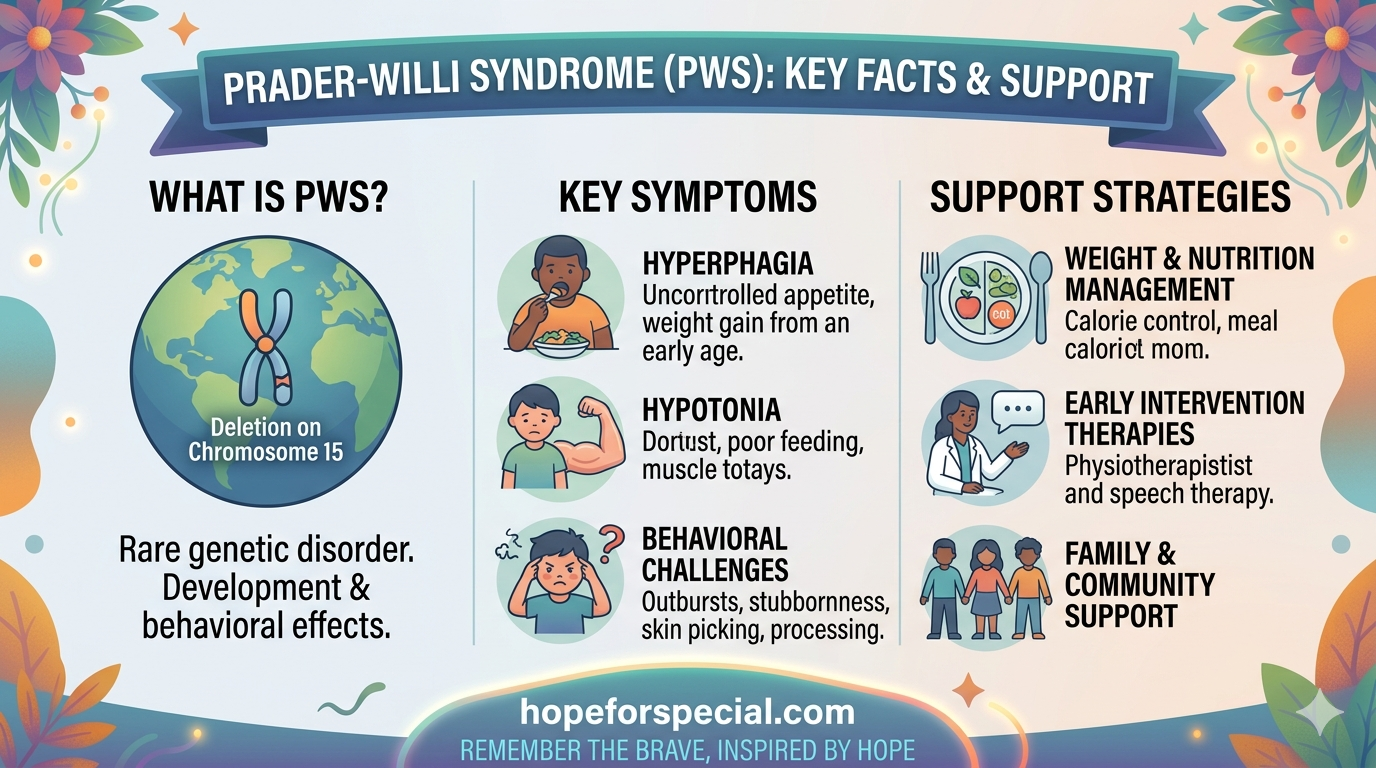
Prader Willi Syndrome: What Every Parent Must Know to Help Their Child Thrive in 2026
Prader Willi Syndrome is a rare, complex genetic disorder that causes an insatiable, life-threatening hunger — alongside intellectual disability, behavioural challenges, and hormonal imbalances — making it one of the most demanding conditions a family can navigate. What is Prader Willi Syndrome exactly? It is a genetic condition caused by the loss of function of specific genes on chromosome 15, affecting the hypothalamus — the brain region controlling hunger, growth, and hormones. There is no off switch for hunger. Ever. 💛
This is not a parenting failure. This is not overfeeding.
This is a brain that sends a constant, urgent, overwhelming signal: I am starving. Even after a full meal. Even after a large meal. Even after a meal that would satisfy any other person on earth.
And managing that signal — safely, compassionately, consistently — is the central challenge of raising a child with Prader Willi Syndrome.
This article gives you everything you need. The science, the strategies, the stories, the resources, and the hope. Because there is genuine, research-backed hope. 💪

- What Is Prader Willi Syndrome? A Clear, Parent-Friendly Explanation 🧬
- 📊 Prader Willi Syndrome — Key Statistics Every Parent and Clinician Should Know
- 🔍 Prader Willi Syndrome Symptoms — The Complete Two-Phase Picture
- 🧩 Prader Willi Syndrome Symptoms — Quick Reference Comparison Table
- 🔬 What Causes Prader Willi Syndrome? The Genetics Explained Simply
- 🏥 How Is Prader Willi Syndrome Diagnosed?
- 💊 Prader Willi Syndrome Treatment in 2026 — What Works
- 🔵 Treatment Overview Table
- 🌟 Growth Hormone Therapy — The Single Most Impactful Treatment
- 🍽️ Managing Hyperphagia — The Central Daily Challenge
- 🌱 Emerging Treatments in 2026
- 🏫 Prader Willi Syndrome and School Life — What Parents and Teachers Need to Know
- 💬 A Parent’s Story: “I Used to Cry Every Night — Now I Know We Are Going to Be Okay”
- 🧠 What Research Says About Prader Willi Syndrome Outcomes
- 🔑 5 Things About Prader Willi Syndrome You Did Not Know
- ❓ FAQs — Prader Willi Syndrome
- Q1: What is Prader Willi Syndrome in simple terms?
- Q2: What are the first signs of Prader Willi Syndrome in a newborn?
- Q3: Is Prader Willi Syndrome hereditary?
- Q4: Can Prader Willi Syndrome be cured?
- Q5: How do you manage hunger in Prader Willi Syndrome?
- Q6: What is the life expectancy of someone with Prader Willi Syndrome?
- Q7: What educational support does a child with Prader Willi Syndrome need?
- Q8: Where can I find support for Prader Willi Syndrome?
- 🌈 A Final Word to Every Parent of a Child with Prader Willi Syndrome
- ✅ Key Takeaways — What to Remember About Prader Willi Syndrome
- 📌 Share This Article
What Is Prader Willi Syndrome? A Clear, Parent-Friendly Explanation 🧬
Prader Willi Syndrome — often abbreviated as PWS — is a rare genetic disorder. It affects approximately 1 in 10,000 to 1 in 30,000 births worldwide.
It was first described in 1956 by Swiss physicians Andrea Prader, Alexis Labhart, and Heinrich Willi — which is how it got its name.
PWS occurs because of a problem with chromosome 15. Specifically:
- In about 70% of cases, a segment of chromosome 15 inherited from the father is deleted or missing
- In about 25% of cases, the child inherits two copies of chromosome 15 from the mother instead of one from each parent — a phenomenon called maternal uniparental disomy (UPD)
- In about 5% of cases, there is an imprinting defect — the genes are present but switched off incorrectly
In all three scenarios, the result is the same: the paternal genes on chromosome 15 are not functioning. And those genes play a critical role in regulating the hypothalamus — the brain’s control centre for hunger, sleep, growth hormones, and body temperature.
Here is what parents need to know right away:
- PWS is not caused by anything a parent did. It is a random genetic event in the vast majority of cases.
- PWS is not contagious.
- Every person with PWS is uniquely affected — no two cases are identical.
- With the right support, structure, and medical management, children with PWS can lead meaningful, fulfilling, and joyful lives.
The key is early diagnosis and consistent, informed management. 🔍
📊 Prader Willi Syndrome — Key Statistics Every Parent and Clinician Should Know
| Statistic | Data | Source |
|---|---|---|
| Global prevalence | Approximately 1 in 10,000–30,000 live births | PWSA USA |
| People living with PWS in the US | Estimated 20,000–25,000 individuals | Foundation for Prader-Willi Research |
| Most common genetic cause of life-threatening obesity in childhood | PWS ranks #1 | NIH — NICHD |
| Chromosome deletion (most common cause) | ~70% of cases | NIH — MedlinePlus Genetics |
| Maternal UPD (second cause) | ~25% of cases | MedlinePlus Genetics |
| Growth hormone deficiency | Present in nearly all PWS cases | MAGIC Foundation |
| Average IQ range in PWS | Typically 60–70 (mild to moderate intellectual disability) | NIH PubMed |
| Life expectancy without management | Significantly reduced due to obesity-related complications | PWSA USA |
| Life expectancy with proper management | Approaching normal lifespan in well-managed cases | Foundation for Prader-Willi Research |
| Growth hormone therapy approval | FDA-approved for PWS since 2000 | FDA |
| Recurrence risk in siblings | Generally less than 1% for deletion cases; higher for imprinting defects | NIH Genetics |
🔍 Prader Willi Syndrome Symptoms — The Complete Two-Phase Picture
One of the most distinctive features of Prader Willi Syndrome is that its symptoms change dramatically with age. Understanding this two-phase presentation is essential for parents and clinicians alike.
📌 Phase 1: Birth to Age 2 — The Hypotonia Phase
In early infancy, PWS presents very differently from what most people expect. The hallmark early symptom is hypotonia — severely reduced muscle tone.
Key symptoms in Phase 1:
- 🔵 Profound hypotonia (floppy baby) — babies with PWS often feel like “rag dolls.” Their muscle tone is so low that they are difficult to position and feed.
- 🔵 Feeding difficulties — the same hypotonia that affects body muscles also affects the muscles used for sucking. Most babies with PWS cannot breastfeed and require nasogastric (tube) feeding in early weeks.
- 🔵 Weak cry — the cry is often described as thin, weak, or high-pitched
- 🔵 Reduced fetal movement — many mothers of children with PWS recall less movement during pregnancy
- 🔵 Failure to thrive — poor weight gain due to feeding difficulties
- 🔵 Undescended testicles (cryptorchidism) in boys
- 🔵 Distinctive facial features — almond-shaped eyes, narrow forehead, thin upper lip, downturned mouth
This phase is deeply alarming for parents. A baby who cannot feed, cannot cry strongly, and lies limply — and yet the diagnosis of PWS may not yet be confirmed.
If you are in this phase: push for genetic testing immediately. Early diagnosis changes everything.
📌 Phase 2: Ages 2–6 Onward — The Hyperphagia Phase
Around ages 2–6, the clinical picture shifts dramatically.
The hypotonia begins to improve — slowly. Muscle tone increases. Children begin to walk. Developmental milestones, though delayed, begin to appear.
And then the hunger begins. 🍽️
Key symptoms in Phase 2:
- 🔴 Hyperphagia — the defining feature of PWS in older children. This is not ordinary appetite. It is a neurologically driven, relentless, physiological drive to eat that never fully resolves. Children with PWS experience hunger as other people experience severe pain — it is consuming, urgent, and impossible to ignore through willpower alone.
- 🔴 Food-seeking behaviour — hoarding food, eating non-food items (pica), waking at night to search for food, extreme distress when food is restricted
- 🔴 Rapid weight gain — without strict dietary management, obesity develops quickly and can become life-threatening
- 🔴 Short stature — growth hormone deficiency means children with PWS are typically significantly shorter than peers without treatment
- 🔴 Intellectual disability — ranging from mild to moderate. Average IQ is typically 60–70, though this varies widely.
- 🔴 Speech and language delays — articulation difficulties are common; speech therapy is essential
- 🔴 Sleep abnormalities — excessive daytime sleepiness, sleep apnea, disrupted sleep architecture
- 🔴 Hypogonadism — incomplete sexual development; most adults with PWS are infertile
- 🔴 Scoliosis — spinal curvature, often requiring monitoring and intervention
- 🔴 Temperature dysregulation — difficulty sensing heat and cold appropriately
- 🔴 High pain threshold — children with PWS may not show or report pain from injuries that would be obviously distressing to other children
🧩 Prader Willi Syndrome Symptoms — Quick Reference Comparison Table
| Symptom | Phase 1 (Birth–Age 2) | Phase 2 (Age 2+) | Severity |
|---|---|---|---|
| Hypotonia (low muscle tone) | ✅ Severe | ✅ Improving | Severe in infancy |
| Feeding difficulties | ✅ Critical | ❌ Resolves | Critical in infancy |
| Hyperphagia (insatiable hunger) | ❌ Absent | ✅ Central feature | Severe and lifelong |
| Obesity risk | ❌ Underweight | ✅ Major risk | Life-threatening without management |
| Intellectual disability | Not yet apparent | ✅ Mild to moderate | Moderate, lifelong |
| Behavioural challenges | ❌ Minimal | ✅ Significant | Moderate to severe |
| Short stature | ❌ Not yet | ✅ Yes | Moderate; treatable with GH |
| Sleep abnormalities | ✅ Some | ✅ Significant | Moderate to severe |
| Skin picking | ❌ | ✅ Common | Moderate |
| Speech delays | Not yet apparent | ✅ Common | Mild to moderate; responsive to therapy |
🔬 What Causes Prader Willi Syndrome? The Genetics Explained Simply
PWS is caused by the absence of functioning paternal genes on chromosome 15 — specifically in a region called 15q11-q13.
Here is why this matters — and why the mechanism is genuinely fascinating:

🧬 Genomic Imprinting
PWS is one of the clearest examples of a phenomenon called genomic imprinting — where certain genes are only active when inherited from a specific parent.
In the 15q11-q13 region:
- Some genes are only active when inherited from the father
- Some genes are only active when inherited from the mother
In PWS, the paternal genes in this region are either deleted or silenced. The maternal copy of these genes exists — but is imprinted (switched off) by default. So the child effectively has no working copy of these critical genes.
The result: the hypothalamus does not function correctly. Hunger signals are never turned off. Growth hormone is not produced adequately. The entire hormonal regulation system is dysregulated.
This is documented clearly by MedlinePlus — NIH Genetics and represents one of the best-understood examples of imprinting disorders in human genetics.
🧬 Why Does It Happen?
In the majority of cases — particularly the deletion type — PWS occurs as a random event during the formation of sperm. It is not inherited from either parent. It is not caused by anything either parent did.
For families dealing with imprinting defects, there is a small recurrence risk. Genetic counselling is strongly recommended for all families after a PWS diagnosis. The Foundation for Prader-Willi Research (FPWR) provides excellent guidance on genetic counselling resources.
🏥 How Is Prader Willi Syndrome Diagnosed?
Early and accurate diagnosis of Prader Willi Syndrome is life-changing. Here is the diagnostic pathway.
Step 1: Clinical Suspicion
Diagnosis often begins with a clinician observing the characteristic features — particularly severe hypotonia in a newborn — and raising suspicion of PWS.
Step 2: Genetic Testing
The gold standard for PWS diagnosis is DNA methylation analysis — a genetic test that identifies the characteristic imprinting pattern in the 15q11-q13 region. This test detects approximately 99% of all PWS cases.
According to NIH MedlinePlus Genetics, additional tests including FISH (fluorescence in situ hybridisation) and chromosomal microarray may be used to identify the specific genetic mechanism — deletion, UPD, or imprinting defect — which matters for recurrence risk counselling.
Step 3: Multidisciplinary Evaluation
Once genetic confirmation is obtained, a comprehensive evaluation should be completed including:
- Endocrinology assessment — growth hormone levels, thyroid function
- Sleep study — to identify sleep apnea and other abnormalities
- Developmental assessment — cognitive, language, motor skills
- Ophthalmology — vision problems are common in PWS
- Orthopaedic assessment — for scoliosis screening
- Nutritional assessment — establishing baseline and dietary plan
The PWSA USA (Prader-Willi Syndrome Association USA) maintains a directory of PWS clinical specialists across the United States — an invaluable resource for newly diagnosed families.
💊 Prader Willi Syndrome Treatment in 2026 — What Works
There is no cure for Prader Willi Syndrome. But treatment has advanced profoundly — and the outcomes for children who receive early, comprehensive management are significantly better than for those who do not.
🔵 Treatment Overview Table
| Treatment | What It Does | Evidence Level | Source |
|---|---|---|---|
| Growth Hormone Therapy (GHT) | Improves height, muscle mass, body composition, cognitive function | FDA-approved; strong evidence | FDA / NIH |
| Caloric restriction (strict dietary management) | Prevents life-threatening obesity | Essential; high evidence | PWSA USA |
| Locked food access (food security management) | Prevents food-seeking and hoarding | Clinical standard | FPWR |
| Sex hormone therapy | Addresses hypogonadism in adolescence | Moderate evidence | NIH PubMed |
| Speech therapy | Addresses articulation and language delays | High evidence | ASHA |
| Occupational therapy | Addresses fine motor, daily living skills | High evidence | AOTA |
| Physical therapy | Builds muscle tone and gross motor skills | High evidence | Clinical standard |
| Behavioural therapy (ABA and CBT adapted) | Addresses food-related behaviours, anxiety, skin picking | Moderate-high evidence | NIH PubMed |
| CPAP therapy | Treats sleep apnea | High evidence | American Academy of Sleep Medicine |
| Psychiatric medication | For anxiety, OCD, psychosis in some cases | Case-by-case basis | NIH PubMed |
| Special education with IEP | Addresses intellectual and learning needs | Legal right (IDEA) | US Dept of Education — IDEA |
🌟 Growth Hormone Therapy — The Single Most Impactful Treatment
Growth hormone therapy for Prader Willi Syndrome is one of the most significant medical advances in rare disease treatment of recent decades.
According to NIH NICHD, growth hormone therapy in PWS:
- Increases height significantly
- Reduces body fat and increases lean muscle mass
- Improves energy levels and reduces excessive sleepiness
- Enhances cognitive function — including language and attention
- Improves physical activity capacity
- Strengthens immune function in some studies
The FDA approved growth hormone therapy for PWS in 2000 — making it one of the few FDA-approved treatments specifically for PWS. The earlier it is started — ideally in infancy — the better the outcomes.
If your child has been diagnosed with PWS and has not yet started growth hormone therapy — discuss this urgently with a paediatric endocrinologist. The MAGIC Foundation provides growth hormone disorder support and specialist referrals.
🍽️ Managing Hyperphagia — The Central Daily Challenge
Food management in Prader Willi Syndrome is not optional. It is medical necessity.
Without strict food management, obesity develops rapidly — leading to Type 2 diabetes, cardiovascular disease, respiratory failure, and premature death.
Here is what effective food management looks like in practice:
Environmental controls (non-negotiable):
- 🔒 Lock all food storage — refrigerators, pantries, and cupboards must be locked or secured
- 🔒 Remove access to money independently — prevents unsupervised food purchases
- 🔒 Inform all caregivers, teachers, and relatives — one well-meaning grandparent offering extra food can undermine weeks of management
- 🔒 Never leave food accessible and unattended — even briefly
Dietary approach:
- Typically 1,000–1,200 calories per day for children — significantly less than typical for age
- High protein, low simple carbohydrate diet to promote satiety and muscle maintenance
- Structured mealtimes — predictable, consistent, emotionally calm
- No “treats” culture — celebrations should never centre on food
Psychological approach:
- Frame food rules as health management — not punishment
- Use visual schedules to help the child anticipate mealtimes
- Never discuss food casually around the child — reduce food cues
- Work with a registered dietitian experienced in PWS — the PWSA USA maintains a specialist directory
This is enormously demanding. It requires consistency across every environment the child inhabits. But it saves lives. Literally.
🌱 Emerging Treatments in 2026
The research landscape for Prader Willi Syndrome is more active than at any point in history. Current areas of investigation include:
- Diazoxide choline controlled-release (DCCR) — investigated for reduction of hyperphagia
- Gene therapy — early-stage research exploring whether the silenced maternal chromosome 15 genes could be reactivated
- Gut microbiome research — emerging evidence suggests the gut-brain axis plays a role in hyperphagia regulation; dietary microbiome interventions are being explored
The Foundation for Prader-Willi Research (FPWR) maintains an up-to-date pipeline of all active PWS research globally — essential reading for families who want to participate in or monitor clinical trials.
🏫 Prader Willi Syndrome and School Life — What Parents and Teachers Need to Know
School is one of the most challenging — and most important — environments for children with Prader Willi Syndrome. Getting it right requires partnership, preparation, and clear communication.
Challenges at school:
- Food access — school environments are full of food cues, celebrations, and opportunities. Birthday cakes, class parties, food rewards, and cafeteria access are all potential crisis points.
- Cognitive and learning needs — most children with PWS benefit from modified curriculum, visual learning supports, and repetition-based teaching
- Fatigue — excessive daytime sleepiness can significantly affect concentration and learning
What every school must have for a child with PWS:
- ✅ An Individualised Education Programme (IEP) addressing academic, behavioural, and physical needs
- ✅ A Health Care Plan specifically addressing food management — signed by the family and the school nurse
- ✅ Locked food storage in classrooms — no food accessible to the child unsupervised
- ✅ No food rewards policy — ever, under any circumstances
- ✅ Advance communication about any school event involving food — with a plan for the child’s participation
The US Department of Education’s IDEA framework guarantees children with PWS the right to a free, appropriate public education with necessary supports. Know your rights. Advocate consistently. 💪
💬 A Parent’s Story: “I Used to Cry Every Night — Now I Know We Are Going to Be Okay”
When Priya’s son Aryan was born, he was immediately transferred to the NICU. He couldn’t suck. He couldn’t cry properly. He lay still in a way that terrified every nurse who cared for him.
“They kept saying they weren’t sure what was wrong,” Priya recalls. “Twelve days in the NICU. Tube feeding. And nobody said the words Prader Willi Syndrome until day fourteen.”
The diagnosis, when it came, felt like a wave crashing over her.
“I went home and searched online. I saw the word ‘hunger’ and ‘obesity’ and ‘behavioural challenges’ and I just sat on the kitchen floor and cried.”
Aryan is now nine years old. He receives growth hormone therapy — started at seven months. His height is close to the normal range for his age. His muscle tone has improved dramatically. He attends a mainstream school with an IEP and a dedicated LSA.
The family keeps their kitchen locked. Every caregiver in Aryan’s life — grandparents, teachers, the school bus driver — has been briefed on his dietary needs. His calorie intake is carefully monitored.
“It is relentless,” Priya says honestly. “There is no day off. There is no party where you can just relax. The locks have to stay on. The rules have to stay consistent.”
But then she says something that stops you:
“And then I look at him. Running in the garden. Laughing at a YouTube video. Telling me about his day at school. And I think — this is the life we built for him. We built it carefully, consistently, with love. And it is a good life.”
She pauses.
“He is happy. That is the whole point. He is happy.” 💛
🧠 What Research Says About Prader Willi Syndrome Outcomes
The research on PWS outcomes has become significantly more optimistic over the past two decades. Here is what the evidence shows:
- Research published through NIH PubMed confirms that early growth hormone therapy — started in infancy — produces significantly better outcomes in height, body composition, cognitive development, and quality of life compared to delayed treatment.
- A landmark study referenced by NIH NICHD found that early diagnosis — before the hyperphagia phase begins — allows families to establish food management protocols before crisis behaviours develop, leading to measurably better long-term outcomes.
- Research published in the Journal of Clinical Endocrinology & Metabolism found that adults with PWS who received comprehensive multidisciplinary care from childhood showed significantly better metabolic health, lower obesity rates, and better quality of life scores than those managed primarily through a single-specialty approach.
- The American Academy of Pediatrics (AAP) recommends that all infants with confirmed PWS be referred immediately to a multidisciplinary team including endocrinology, genetics, dietetics, developmental paediatrics, speech therapy, and physiotherapy — citing significantly better developmental outcomes with coordinated early intervention.
- PWSA USA research summaries document that adults with PWS living in structured supported residential settings — with consistent food management and behavioural support — show dramatically better health and wellbeing outcomes than those living without such structure.
The science is clear and consistent: Early diagnosis + growth hormone therapy + strict food environment management + multidisciplinary support = dramatically better outcomes. Every element matters. None is optional. 💪
🔑 5 Things About Prader Willi Syndrome You Did Not Know
🔑 #1: The hunger in PWS is not psychological — it is neurological.
The most important thing any parent, teacher, or relative needs to understand: children with PWS are not being greedy. They are not manipulating. They are not eating because they are bored or poorly parented. Their brain is sending a signal of severe starvation — constantly. Treating this as a behavioural choice rather than a medical reality causes profound harm.
🔑 #2: The transition from Phase 1 to Phase 2 can happen gradually — and early preparation matters enormously.
The shift from hypotonia-dominated infancy to hyperphagia-dominated childhood is not sudden in most cases. Parents who establish food management structures — locked kitchens, portion-controlled meals, no food rewards — before the hyperphagia phase arrives are significantly better prepared. Don’t wait for the crisis. Build the structure now.
🔑 #3: Skin picking (excoriation) is a medical symptom — not a behavioural choice.
Many children and adults with PWS pick at their skin obsessively — sometimes causing serious wounds. This is a recognised symptom of PWS related to OCD-spectrum features and sensory differences. It should be treated medically and behaviourally — not punished.
🔑 #4: Cognitive ability in PWS is often significantly underestimated.
Many children with PWS have areas of remarkable cognitive strength — particularly in reading, visual puzzles, and long-term memory. The intellectual disability associated with PWS is real but variable. Expectations should be appropriately ambitious — not limited by the diagnosis label.
🔑 #5: Respite care is not a luxury for PWS families — it is medical necessity.
The 24/7 nature of food management in PWS is genuinely exhausting. Parental burnout in PWS families is documented and real. Accessing regular respite care — through disability support services or community organisations — is not giving up. It is sustainable caregiving. Ask for help. Accept help. 💛
❓ FAQs — Prader Willi Syndrome
Q1: What is Prader Willi Syndrome in simple terms?
Prader Willi Syndrome is a rare genetic disorder caused by missing or non-functioning genes on chromosome 15. It affects the hypothalamus — the brain region that controls hunger, growth hormones, and body temperature. The result is an insatiable, lifelong hunger that cannot be controlled through willpower. Without strict food management, life-threatening obesity develops. With early diagnosis and comprehensive treatment, many children with PWS live happy, meaningful lives.
Q2: What are the first signs of Prader Willi Syndrome in a newborn?
The earliest signs of Prader Willi Syndrome in newborns are severe hypotonia (extremely low muscle tone — the baby feels unusually limp), inability to suck properly, feeding difficulties requiring tube feeding, a weak cry, and reduced fetal movement during pregnancy. These symptoms appear from birth. If your newborn shows these signs, request genetic testing immediately — specifically DNA methylation analysis for PWS.
Q3: Is Prader Willi Syndrome hereditary?
In most cases — approximately 70% — Prader Willi Syndrome results from a random deletion on the paternal chromosome 15. It is not inherited and the recurrence risk for siblings is very low (typically less than 1%). However, cases caused by imprinting defects carry a higher recurrence risk. Genetic counselling is strongly recommended for all families after a PWS diagnosis. The NIH Genetics page provides detailed inheritance information.
Q4: Can Prader Willi Syndrome be cured?
Currently, there is no cure for Prader Willi Syndrome. However, treatment — particularly growth hormone therapy, strict food environment management, and multidisciplinary developmental support — can dramatically improve outcomes. Research into new treatments including oxytocin analogues and gene therapy is actively progressing. The Foundation for Prader-Willi Research maintains a full pipeline of current clinical trials.
Q5: How do you manage hunger in Prader Willi Syndrome?
Managing hunger in PWS requires strict environmental controls — not willpower or reasoning. This means locking all food storage, establishing predictable and calorie-controlled mealtimes, educating all caregivers about consistent food rules, and never using food as a reward. Medications are being researched but are not yet approved specifically for hyperphagia management. The hunger cannot be eliminated — but its consequences can be managed with consistent environmental structure.
Q6: What is the life expectancy of someone with Prader Willi Syndrome?
Without proper management, life expectancy is significantly reduced — primarily due to obesity-related complications including Type 2 diabetes, cardiovascular disease, and respiratory failure. With comprehensive management — including strict food control, growth hormone therapy, and multidisciplinary care — life expectancy is approaching that of the general population in well-managed cases. Early diagnosis and consistent management are the most important factors.
Q7: What educational support does a child with Prader Willi Syndrome need?
Children with PWS typically need an Individualised Education Programme (IEP) addressing intellectual and learning needs, speech therapy, occupational therapy, physical education modifications, a strict school food management plan, staff training in PWS, and a no-food-rewards policy. The US Department of Education’s IDEA framework guarantees these rights. Schools must also have locked food storage and a health care plan specific to the child’s PWS needs.
Q8: Where can I find support for Prader Willi Syndrome?
- PWSA USA — Prader-Willi Syndrome Association — specialist directory, family support, educational resources
- Foundation for Prader-Willi Research (FPWR) — research updates, clinical trial information, family resources
- NIH NICHD — Prader-Willi Syndrome — clinical information and research
- MedlinePlus Genetics — PWS — genetic information and inheritance
- MAGIC Foundation — growth hormone disorder support
- HopeForSpecial.com — special needs resources, rare condition guides, and family community
🌈 A Final Word to Every Parent of a Child with Prader Willi Syndrome
If you have read this far — you are already doing something extraordinary.
You are educating yourself. You are refusing to accept confusion or helplessness. You are looking for ways to build the best possible life for your child.
That instinct — that fierce, tireless parental love — is the most powerful tool in your arsenal.
Prader Willi Syndrome is demanding. There is no softer word for it. The locks, the calorie counting, the constant vigilance, the explaining to relatives, the school meetings, the medical appointments — it is relentless.
But here is what the research, and the families who live this every day, consistently show:
Children with Prader Willi Syndrome can be happy. They can learn. They can laugh. They can love. They can participate in their communities, build relationships, develop skills, and experience genuine joy.
The structure you build around them — however exhausting — is the structure that makes that joy possible.
You are not their captor. You are their protector. And your consistency, your love, and your refusal to give up are the greatest gifts you can give them.
Keep going. 💛
✅ Key Takeaways — What to Remember About Prader Willi Syndrome
- PWS is caused by non-functioning paternal genes on chromosome 15 — it is not inherited in most cases
- It presents in two phases: hypotonia in infancy, hyperphagia from ages 2–6 onward
- The hunger in PWS is neurological — not behavioural — and cannot be controlled by willpower
- Growth hormone therapy, started early, dramatically improves outcomes
- Strict food environment management — including locked kitchens — is life-saving
- Early diagnosis and multidisciplinary support produce the best long-term outcomes
- Research into new treatments including oxytocin analogues is actively progressing
- Children with PWS can live happy, meaningful lives with the right structure and support
📌 Share This Article
If this gave you clarity, hope, or practical help — share it. 💛
Share it with a parent who just received a diagnosis and is sitting on the floor trying to understand what comes next. Share it with a teacher who doesn’t understand why food rules are not negotiable. Share it with a grandparent who thinks one extra biscuit won’t hurt.
Knowledge saves lives in Prader Willi Syndrome. Literally.
Bookmark this page. Leave your questions or story in the comments. You are not alone in this. 💛
At HopeForSpecial.com, we believe every child with a rare or complex condition deserves to be deeply understood and powerfully supported. Explore our full library of resources on rare conditions, autism, Down syndrome, cerebral palsy, ADHD, and special needs parenting — written with clinical accuracy, genuine research, and real love.


