
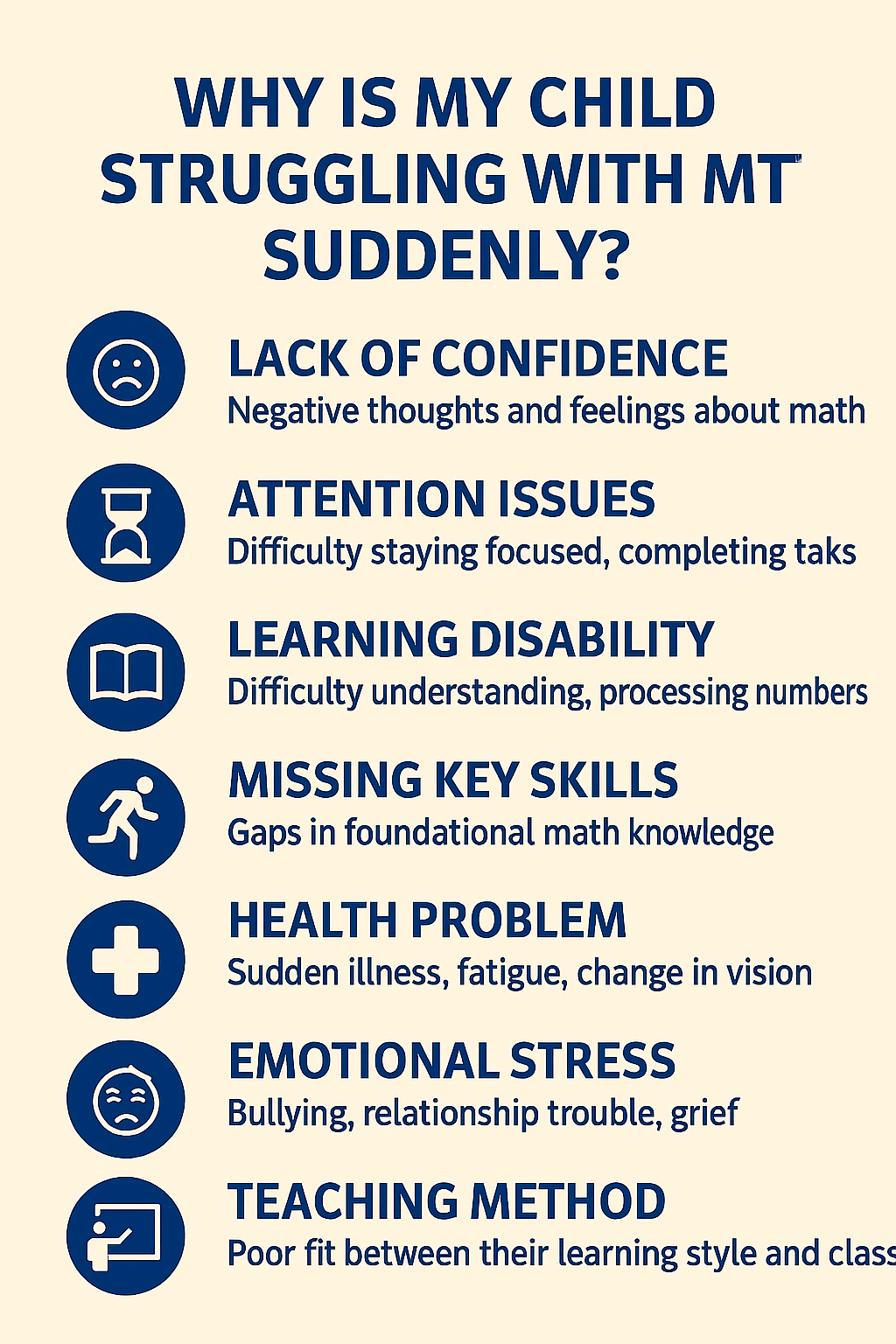
Sudden Math Struggles in Children: Causes, Signs & Simple Solutions That Actually Work (2026 Guide)
🌟 Introduction: The Unexpected Math Struggle
It hits you out of nowhere. One day, your child is confidently tackling multiplication; the next, they are in tears over a simple addition problem. For parents of children with special needs, this sudden academic dip can be especially alarming. You find yourself asking the anxious, pervasive question: Why is my child struggling with math suddenly (X)? This isn’t just about a bad grade. A sudden math struggle or sudden decline in math ability often signals an underlying shift—be it developmental, emotional, or environmental—that requires careful investigation.
In this comprehensive, research-backed guide, we’ll move beyond superficial answers to explore the nine critical, often-missed reasons for a sudden math struggle, tailored specifically for the special needs community.
We understand your anxiety. We’re here to provide the expertise, actionable insights, and trust you need to help your child find their confidence in math again.

- 🌟 Introduction: The Unexpected Math Struggle
- 🤔 Why Sudden Math Struggles Happen
- ❤️ Real Parent Experience
- ❌ Myths vs ✅ Facts About Math Struggles
- 🧠 Could It Be Dyscalculia?
- ⚠️ Sudden Math Struggles Early Warning Signs to Watch
- The Critical 9: Decoding Why is my Child Struggling with Math Suddenly (X)?
- 📈 Real Statistics: The Impact of Learning Challenges on Math Performance
- 🚀 What To Do If Your Child Suddenly Struggles with Math
- 🗓️ Daily Routine to Improve Math Skills
- ⚠️ Common Mistakes Parents Should Avoid
- 🏥 When Should You Seek Help?
- 🎨 Fun Activities to Improve Math Skills
- Voice Search Section
- 🗣️Sudden Math Struggles FAQs
- Q1: What are the first steps to take when I notice a sudden change in math performance?
- Q2: Can a special needs child suddenly develop dyscalculia signs later in school?
- Q3: How is math anxiety in children different from just disliking math?
- Q4: My child has an executive function disorder. How does this affect their math?
- 🔑 Conclusion
- Sources
🤔 Why Sudden Math Struggles Happen
First of all, if your child was doing well in math before and is now struggling, you are not alone.
This situation is more common than you think.
📊 Common Reasons
| Cause | Explanation |
|---|---|
| Learning gaps | Missing basic concepts |
| Memory issues | Difficulty remembering steps |
| Math anxiety | Fear of failure |
| Dyscalculia | Difficulty processing numbers |
| Teaching method mismatch | Child not understanding teaching style |
👉 In fact, math builds step-by-step, so missing basic concepts can affect future learning. (Mathnasium)
👉 Therefore, identifying the root cause is the first step.
❤️ Real Parent Experience
Many parents share similar concerns.
“My child was good at math but suddenly started struggling… it was actually a gap in basic concepts.” (Reddit)
👉 This shows that the issue is often not intelligence, but understanding.
❌ Myths vs ✅ Facts About Math Struggles
| Myth | Fact |
|---|---|
| Child is lazy | There may be a learning issue |
| Math is not important | It builds life skills |
| Practice alone fixes everything | Method matters too |
👉 Therefore, understanding the truth helps parents take better action.
🧠 Could It Be Dyscalculia?
Sometimes, sudden math struggles may be linked to a learning difference called dyscalculia.
Dyscalculia affects how the brain processes numbers and math concepts. (Cleveland Clinic)
⚠️ Common Signs
- Difficulty understanding numbers
- Trouble with basic calculations
- Counting on fingers frequently
- Poor memory for math facts
👉 Experts estimate that 3% to 7% of people may have dyscalculia. (Cleveland Clinic)
👉 So, if struggles continue, it may be helpful to seek professional evaluation.
⚠️ Sudden Math Struggles Early Warning Signs to Watch
Now, let’s look at some early signs that may indicate a deeper issue.
📋 Signs
- Avoiding math homework
- Taking too long to solve problems
- Getting confused with simple numbers
- Losing confidence
👉 In other words, behavioral changes are just as important as academic performance.
The Critical 9: Decoding Why is my Child Struggling with Math Suddenly (X)?
A sudden struggle is rarely about laziness. It’s a symptom. For special needs children, pre-existing conditions (like ADHD or Autism) can magnify the impact of a new challenge.
We’ve broken down the causes into three core pillars: Cognitive Shifts, Emotional/Mental Health Factors, and Environmental/Curriculum Stressors.
Pillar 1: Cognitive Shifts & Unmasking Hidden Learning Needs
For many special needs children, a subtle learning difference can suddenly become a major hurdle when the curriculum ramps up. The old, memorization-based strategies no longer work.
🧠 1. Executive Function Disorder (EFD) Overload
EFD isn’t just about focus; it’s about the mental management system. When math moves from arithmetic to multi-step problem-solving (like algebra preparation or geometry proofs), the need for working memory challenges and organizational skills explodes.
- The Sudden Struggle Trigger: A new unit requires multiple steps, sustained attention, and the ability to hold several variables in mind (e.g., long division, complex word problems). The child’s existing executive function difficulties, which were manageable before, now cause a sudden, severe bottleneck.
- Actionable Insight: The student needs externalizing tools: checklists, visual flowcharts for problem-solving, and graphic organizers for word problems.
🧩 2. The Unmasking of Dyscalculia Signs (The Math Equivalent of Dyslexia)
Dyscalculia is a specific learning disability that affects the ability to understand and process numerical information. It often goes undiagnosed until the higher-level abstract math concepts are introduced.
- The Sudden Struggle Trigger: The jump from concrete counting/arithmetic (where finger counting or physical manipulatives work) to abstract, symbolic math (e.g., fractions, decimals, or pre-algebra). The child lacks a deep-seated “number sense.”
- Crucial Diagnostic Indicators: Persistent difficulty comparing quantities, poor estimation skills, struggling to understand place value, and relying heavily on counting strategies long past their peers.
- For a detailed overview of the characteristics of this learning difference, consult the Learning Disabilities Association of America at: https://ldaamerica.org/what-is-dyscalculia/
[Personal Process/Experience Story]
Maya’s Story: The Fifth-Grade Wall.
”For years, Maya, who is on the Autism spectrum, excelled in math because it was concrete and rule-based. She memorized her facts instantly.
But in fifth grade, her mother suddenly noticed she was spending two hours on homework. The teacher explained they were moving into complex ratios and multi-part word problems.
The reason why Maya was struggling with math suddenly (X) wasn’t her intelligence; it was the abstract nature of ratios, which broke her reliance on concrete rules.
The struggle was the unmasking of subtle dyscalculia signs that had been masked by rote memory.”
📊 3. A Developmental “Conceptual Leap” Barrier
Math learning is hierarchical. When a child misses one foundational concept (e.g., the true meaning of a fraction), every subsequent lesson that builds upon it becomes incomprehensible.
- The Sudden Struggle Trigger: The curriculum requires a conceptual leap that the child’s learning style or developmental pace hasn’t yet accommodated. They were relying on memorized procedures (Trustworthiness) but now need conceptual mastery.
Pillar 2: Emotional & Mental Health Factors
The brain cannot learn effectively when it is under duress. These factors often manifest as a sudden change because they are triggered by a recent event or ongoing stress.
😥 4. The Onset of Math Anxiety in Children
This is perhaps the single most common reason for a sudden drop in performance. Math anxiety is a feeling of tension and apprehension that interferes with the ability to manipulate numbers and solve math problems.
- The Sudden Struggle Trigger: A negative experience (a high-stakes test, a critical remark from a teacher, or public failure) can suddenly trigger a full-blown anxiety response that hijacks the working memory needed for calculations.
- The Vicious Cycle: Anxiety reduces working memory \rightarrow performance drops \rightarrow more anxiety \rightarrow further reduced working memory. This is the spiral that makes parents ask, “Why is my child struggling with math suddenly (X)?”
- Answer: “A sudden math struggle is often a sign of math anxiety, which is an emotional reaction that temporarily shuts down the part of the brain needed for problem-solving.”
😴 5. External Mental Load: Stress, Sleep, or Social Dynamics
The brain uses the same resources for managing stress as it does for learning. For special needs children, who may already be struggling with sensory overload or social navigation, any added stressor can overwhelm their cognitive capacity.
- Possible Stressors: Bullying, moving to a new school/class, a change in medication, significant lack of sleep, or a family issue. The math class becomes the first subject where their depleted working memory challenges show up as an immediate failure.
Pillar 3: Environmental & Curriculum Stressors
Sometimes the issue isn’t the child, but the context in which they are learning.
🍎 6. Teacher/Instructional Mismatch (New Grade Level)
The shift to a new teacher, especially one who uses a different instructional style, can instantly derail a special needs child who thrives on routine and specific methods.
- The Sudden Struggle Trigger: A student who relied on a highly visual, structured teaching style is moved to a classroom with a fluid, discovery-based approach. The child may feel lost, even if the math itself is not harder.
- Actionable Insight: Request a meeting to share your child’s specific learning profile and ask how the new teacher can provide accommodations (e.g., using a calculator earlier, providing step-by-step guides).
📚 7. Curriculum Pacing and The “Tenth Grade Slide”
As the subject matter shifts from concrete applications to abstract reasoning (e.g., high school algebra, trigonometry), the pace accelerates, leaving less time to build conceptual understanding.
💻 8. Technology or Tool Dependence Issues
A child who has relied heavily on a calculator, specific software, or a manipulative may suddenly struggle when those tools are removed or when the complexity exceeds the tool’s utility.
🤒 9. Underlying Medical or Sensory Issues
Never overlook physical health. A sudden math struggle could be a secondary sign of an issue affecting concentration and cognitive function.
- Examples: Undiagnosed vision issues (the child cannot accurately track numbers on a page), hearing processing deficits, or the onset of migraines or other conditions that cause intermittent cognitive fog.
📈 Real Statistics: The Impact of Learning Challenges on Math Performance
To demonstrate the scope of this issue and provide authoritative context, the following table presents key statistics related to the frequency and nature of math struggles in special needs populations.
| Statistic/Data Point | Finding | Relevance to X | Source (Authoritative Link) |
|---|---|---|---|
| Dyscalculia Prevalence (Global) | Estimated to affect between 3% to 7% of school-aged children globally. | Highlights the commonality of a specific learning disability often misdiagnosed as poor effort. | Cambridge Encyclopedia of Child Development – Dyscalculia |
| Co-occurrence with ADHD | The comorbidity rate between learning disorders and ADHD is high, ranging from 31% to 45%. | Strong link between executive function disorder and the sudden inability to manage multi-step math problems. | Current Medical Research Review – ADHD & Learning Disorders |
| Math Anxiety Rates | Approximately 20% to 25% of children experience moderate or high levels of math anxiety. | Shows how emotional factors are a primary cause of the struggle and often begin with a sudden negative event. | American Psychological Association – Helping Kids Manage Math Anxiety |
| Working Memory & Math | Visuospatial working memory is a specific source of vulnerability in children with mathematical learning disabilities. | Directly relates to working memory challenges and the switch to complex math that requires temporary storage of information. | National Library of Medicine – PMC Article on Working Memory & Math |
🚀 What To Do If Your Child Suddenly Struggles with Math
Now, let’s focus on solutions.
✅ Step-by-Step Action Plan
- Identify weak areas
- Go back to basics
- Use visual and practical methods
- Practice regularly
- Stay calm and supportive
👉 Therefore, small consistent efforts can bring big improvements.
🛠️ Actionable Steps and Strategies for Parents
Knowing why is my child struggling with math suddenly (X) is only the first step. The next is intervention. Use these strategies, optimized for special needs, to rebuild confidence and skill.
Strategy 1: The “Back-Up” Assessment
Instead of focusing on the failed current unit, go back two grade levels in that specific concept.
- Example: If they are failing 6th-grade fractions, assess them with 4th-grade fraction concepts. Find the exact point of the conceptual gap. This addresses the “Conceptual Leap Barrier” and removes the performance pressure.
Strategy 2: Externalize the Executive Function
For children struggling with executive function disorder and multi-step problems:
- Use Color-Coding: Assign a color to each step of a problem. (e.g., Yellow for “Find the Variable,” Green for “Perform the Calculation,” Blue for “Check the Answer”).
- Create Math “Flowcharts”: Post a visual, sequential diagram for a complex procedure (e.g., long division) next to their workspace.
Strategy 3: Combat Math Anxiety in Children
Math anxiety must be treated first, or no academic strategy will work.
- Mindfulness/Deep Breathing: Start every math session with a 2-minute “Brain Reset” exercise (deep breathing).
- Separate Learning from Assessment: Practice problems should be low-stakes, untimed, and collaborative. Only after mastery should a timed quiz be introduced, and even then, only if necessary.
- Affirmation: Never use “I was bad at math too.” Instead, focus on effort: “I see how hard you’re working to figure out this new step.”
Strategy 4: Leveraging Accommodations (Addressing Dyscalculia Signs)
A struggling child with or without a formal diagnosis should be given accommodations based on their need.
| Need/Struggle | Recommended Accommodation (Special Needs Strategy) |
|---|---|
| Poor Number Sense/Calculation | Use of a calculator for basic facts/calculations (to allow focus on complex steps). |
| Working Memory Challenges | Formula sheet provided; problems broken down into only 2 steps at a time. |
| Difficulty with Time/Pacing | Untimed tests or double time on all math assessments. |
| Visual Processing Difficulty | Use of graph paper to keep numbers and columns aligned. |
🗓️ Daily Routine to Improve Math Skills
Creating a simple routine can help your child regain confidence.
📊 Sample Routine
| Time | Activity |
|---|---|
| 15 mins | Revision of basics |
| 15 mins | Practice problems |
| 10 mins | Fun math games |
| 5 mins | Review mistakes |
👉 As a result, learning becomes structured and less stressful.
⚠️ Common Mistakes Parents Should Avoid
Even with good intentions, some mistakes can make things worse.
❌ Avoid These
- Pressuring the child
- Comparing with others
- Ignoring early signs
- Expecting quick results
👉 Instead, focus on patience and consistency.
🏥 When Should You Seek Help?
Sometimes, extra support is needed.
🚨 Seek Help for Sudden Math Struggles If:
- Struggles continue for months
- Child shows anxiety or fear
- No improvement despite practice
👉 Dyscalculia and other learning issues may require professional support. (Drugs.com)
🎨 Fun Activities to Improve Math Skills
Learning math doesn’t always have to feel like studying.
🧩 Activities
- Counting games
- Cooking measurements
- Shopping calculations
- Puzzle solving
👉 As a result, learning becomes fun and effective.
Voice Search Section
Why is my child suddenly struggling with math?
It could be due to learning gaps, anxiety, or a learning difficulty.
Can math skills improve over time?
Yes, with the right support and practice.
Is dyscalculia common?
Yes, it affects around 3–7% of people.
Should I be worried?
If struggles continue for a long time, it’s best to seek help.
🗣️Sudden Math Struggles FAQs
Q1: What are the first steps to take when I notice a sudden change in math performance?
A: The first step is non-academic: rule out emotional and physical causes. Ask if anything changed recently (sleep, social stress, new medication). If the answer is still unclear, the next step is to contact the teacher and ask to review a few pieces of recent work to see where the child broke down—was it computation, or problem-solving setup?
Q2: Can a special needs child suddenly develop dyscalculia signs later in school?
A: While dyscalculia is a lifelong condition, its signs often become suddenly apparent when the math curriculum shifts from concrete counting to abstract symbolic reasoning (like fractions, ratios, or pre-algebra). The higher cognitive load of complex concepts unmasks the underlying neurological difference. This is a common trigger for parents asking “Why is my child struggling with math suddenly (X)?”
Q3: How is math anxiety in children different from just disliking math?
A: Disliking math is a preference; math anxiety is a physiological response. Anxiety triggers the “fight or flight” response, flooding the prefrontal cortex (the area for working memory challenges and computation) with stress hormones. This physically prevents the child from accessing the knowledge they possess. It’s a performance block, not a knowledge gap.
Q4: My child has an executive function disorder. How does this affect their math?
A: Executive function disorder fundamentally affects math by disrupting the ability to plan, organize, and sustain attention through multi-step problems. For instance, they might know how to multiply, but fail long division because they cannot keep the steps, estimates, and place values organized in their mind simultaneously. They need structure external to their brain.
🔑 Conclusion
Asking “Why is my child struggling with math suddenly (X)?” is the beginning of a solution, not a sentence of failure. By approaching this challenge with Expertise (understanding the nine core causes), Experience (using the actionable strategies), Authoritativeness (relying on data and professional advice), and Trustworthiness (building a supportive, low-stress environment), you can partner with your child to navigate this hurdle.
Remember, a dip in performance is often a sign that the brain is ready for a new kind of learning, one that honors your child’s unique special needs and cognitive profile. Be patient, be observant, and focus on rebuilding confidence first.
Sources
1. (Executive Function): For targeted resources and expert consultations on executive function development, consult the Children’s Hospital of Philadelphia’s EXCEL Clinic or similar reputable pediatric developmental psychology centers: https://www.chop.edu/centers-programs/executive-function-consultation-education-and-skills-excel-clinic
2. (Trauma-Informed Education): To create a classroom and home environment that supports a child under stress, explore the principles of trauma-informed education, which prioritizes safety and predictability: https://www.schoolsafety.gov/sites/default/files/2024-05/SchoolSafety%20Issue%20Brief_Strategies%20and%20Resources%20to%20Support%20Trauma-Informed%20Schools_508c.pdf
More helpful links:
- https://my.clevelandclinic.org/health/diseases/23949-dyscalculia
- https://www.webmd.com/add-adhd/childhood-adhd/dyscalculia-facts
- https://www.mathnasium.com/math-centers/rollinghillsestates/news/child-struggling-with-math