

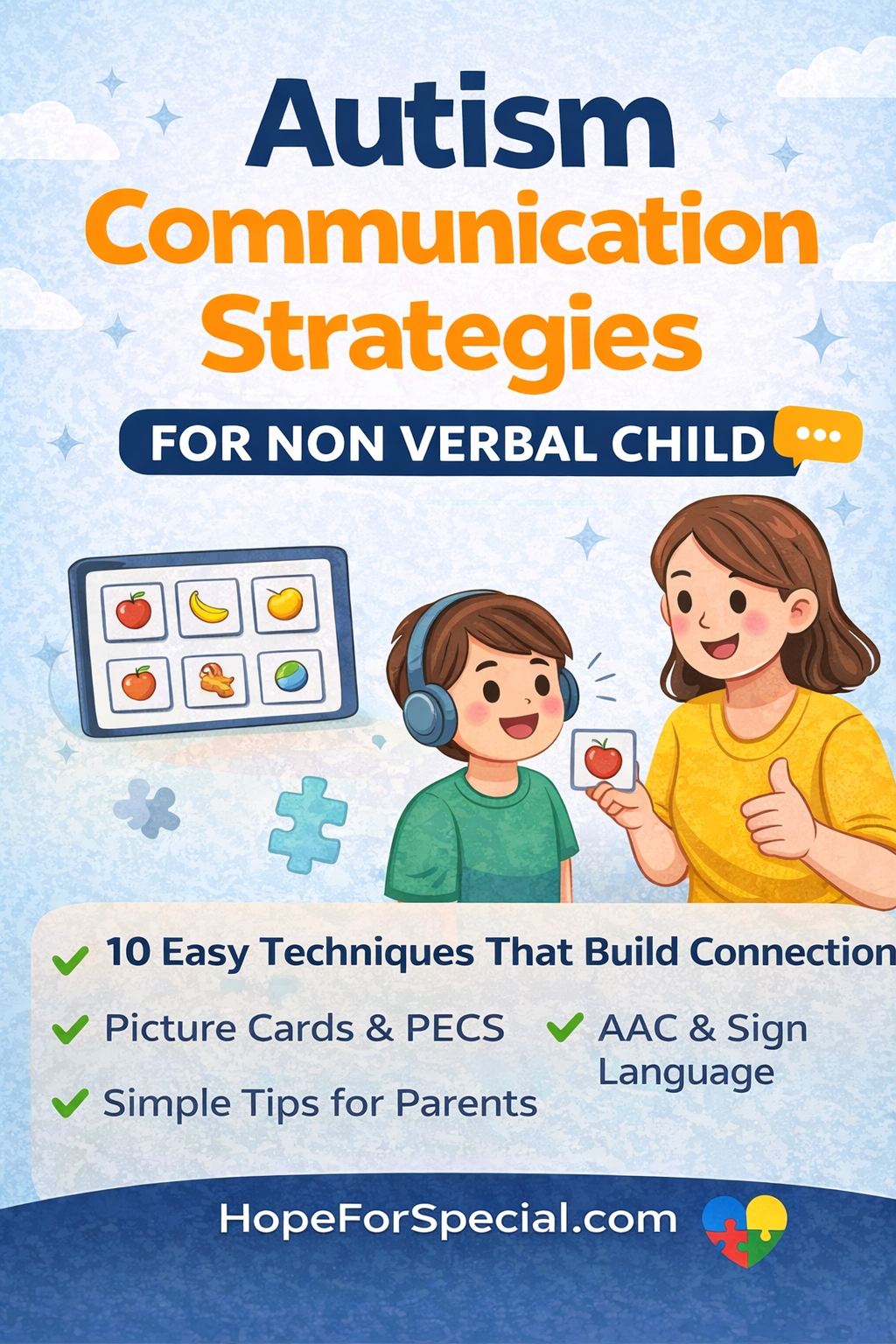
Autism Communication Strategies for Non Verbal Child (2026 Parent Guide)
Communicating with a non-verbal child can feel challenging at first. Many parents wonder how to connect, teach, and understand their child better.
The good news is this:
👉 With the right autism communication strategies for non verbal child, meaningful communication is possible.
This guide will help you with simple, practical, and proven strategies you can start using today.

- What Does Non-Verbal Autism Mean?
- Why Communication Support Is Important
- 1. Use Visual Supports
- 2. Try PECS (Picture Exchange Communication System)
- 3. Use Simple Language
- 4. Encourage Gestures and Signs
- 5. Follow Your Child’s Lead
- 6. Use Repetition
- 7. Give Time to Respond
- 8. Use Technology (AAC Devices)
- 9. Create Communication Opportunities
- 10. Reward Communication Efforts
- 🍽️ During Meals
- 🎮 During Play
- 🛁 During Bath Time
- 📚 During Story Time
- 1. Build a Routine
- 2. Use Visual Schedules
- 3. Stay Calm
- 4. Practice Daily
What Does Non-Verbal Autism Mean?
A non-verbal child with autism may:
- Not speak at all
- Use very few words
- Struggle to express needs
However, this does not mean they cannot communicate.
They may use:
- Gestures
- Sounds
- Facial expressions
According to the CDC, autism affects communication and social interaction, but early support can improve skills.
https://www.cdc.gov/autism/index.html

Why Communication Support Is Important
Communication is more than speech.
It helps a child:
- Express needs
- Build relationships
- Reduce frustration
Research shows that early communication support improves long-term outcomes.
https://www.nichd.nih.gov/health/topics/autism
Best Autism Communication Strategies for Non Verbal Child
Let’s explore simple and effective strategies.
1. Use Visual Supports
Visual tools are very powerful.
Examples:
- Picture cards
- Charts
- Symbols
These help children understand and express ideas.
Experts recommend visual supports as a key strategy for autism communication.
https://www.autismspeaks.org/tool-kit-excerpt/visual-supports-and-autism
2. Try PECS (Picture Exchange Communication System)
PECS allows children to communicate using pictures.
For example:
- The child gives a picture of food to request it
This builds communication step by step.
3. Use Simple Language
Keep your words short and clear.
Instead of:
❌ “Can you please go and sit down now?”
✔ “Sit down”
Short sentences are easier to understand.
4. Encourage Gestures and Signs
Teach simple gestures like:
- Pointing
- Waving
- Nodding
You can also use basic sign language.
5. Follow Your Child’s Lead
Observe what your child likes.
Then:
- Join their activity
- Talk about it
This builds natural communication.
6. Use Repetition
Repeat words and actions often.
Repetition helps children learn faster.
7. Give Time to Respond
Do not rush.
Wait a few seconds after asking something.
This gives your child time to process.
8. Use Technology (AAC Devices)
AAC = Augmentative and Alternative Communication.
Examples:
- Speech apps
- Communication devices
These tools help children express themselves.
Experts highlight AAC as an effective communication support method.
https://www.asha.org/public/speech/disorders/aac/
9. Create Communication Opportunities
Encourage your child to communicate.
Example:
- Place a toy slightly out of reach
- Wait for the child to request it
10. Reward Communication Efforts
Celebrate every attempt.
Even small efforts matter.
This motivates the child.
Table: Autism Communication Strategies for Non Verbal Child
| Strategy | How It Helps | Example |
|---|---|---|
| Visual Supports | Improves understanding | Picture cards |
| PECS | Builds communication | Exchange pictures |
| Simple Language | Reduces confusion | Short sentences |
| Gestures | Encourages expression | Pointing |
| AAC Devices | Supports speech | Communication apps |
| Repetition | Reinforces learning | Repeat words |
| Waiting Time | Improves response | Pause after asking |
Daily Activities to Improve Communication
You can practice communication during daily routines.
🍽️ During Meals
- Show food pictures
- Ask simple choices
🎮 During Play
- Name toys
- Encourage pointing
🛁 During Bath Time
- Use simple words
- Repeat actions
📚 During Story Time
- Use pictures
- Ask simple questions
Common Mistakes to Avoid
Avoid these mistakes:
❌ Talking too fast
❌ Using long sentences
❌ Ignoring non-verbal cues
❌ Not giving enough time
Instead:
✔ Keep it simple
✔ Be patient
How Parents Can Support Communication at Home
1. Build a Routine
Consistency helps learning.
2. Use Visual Schedules
These show what happens next.
3. Stay Calm
Children respond better to calm environments.
4. Practice Daily
Small daily practice leads to big progress.
Real-Life Example
Priya’s son was non-verbal at age 4.
She started:
- Using picture cards
- Speaking in short sentences
- Practicing daily
After a few months:
- He began pointing
- Then using pictures
- Later, simple words
👉 Small steps led to big change.
Expert Insights
Experts agree:
👉 Communication does not always mean speaking.
Children can learn multiple ways to communicate.
Early support is key.
Signs Your Child Is Making Progress
Look for:
✔ More eye contact
✔ Increased gestures
✔ Better response
✔ Use of tools (pictures/apps)
When to Seek Professional Help
Consult a professional if:
- No communication attempts
- Frequent frustration
- No progress over time
You may need:
- Speech therapy
- Behavioral therapy
Benefits of Early Communication Strategies
Early support helps:
- Reduce frustration
- Improve bonding
- Build independence
FAQs: Autism Communication Strategies for Non Verbal Child
1. Can a non-verbal child learn to communicate?
Yes. Many children learn through alternative methods.
2. Is speech therapy necessary?
Often yes. It helps improve communication skills.
3. What is the best method?
There is no single best method. Use a mix of strategies.
4. How long does it take to see progress?
It varies. Consistency is key.
5. Should I use apps or pictures?
Both can be helpful. Choose what suits your child.
Final Thoughts
Using the right autism communication strategies for non verbal child can change your child’s life.
Remember:
👉 Start simple
👉 Stay consistent
👉 Celebrate progress
Every small step matters.
Your child can learn to communicate. And you can help make that happen.


