

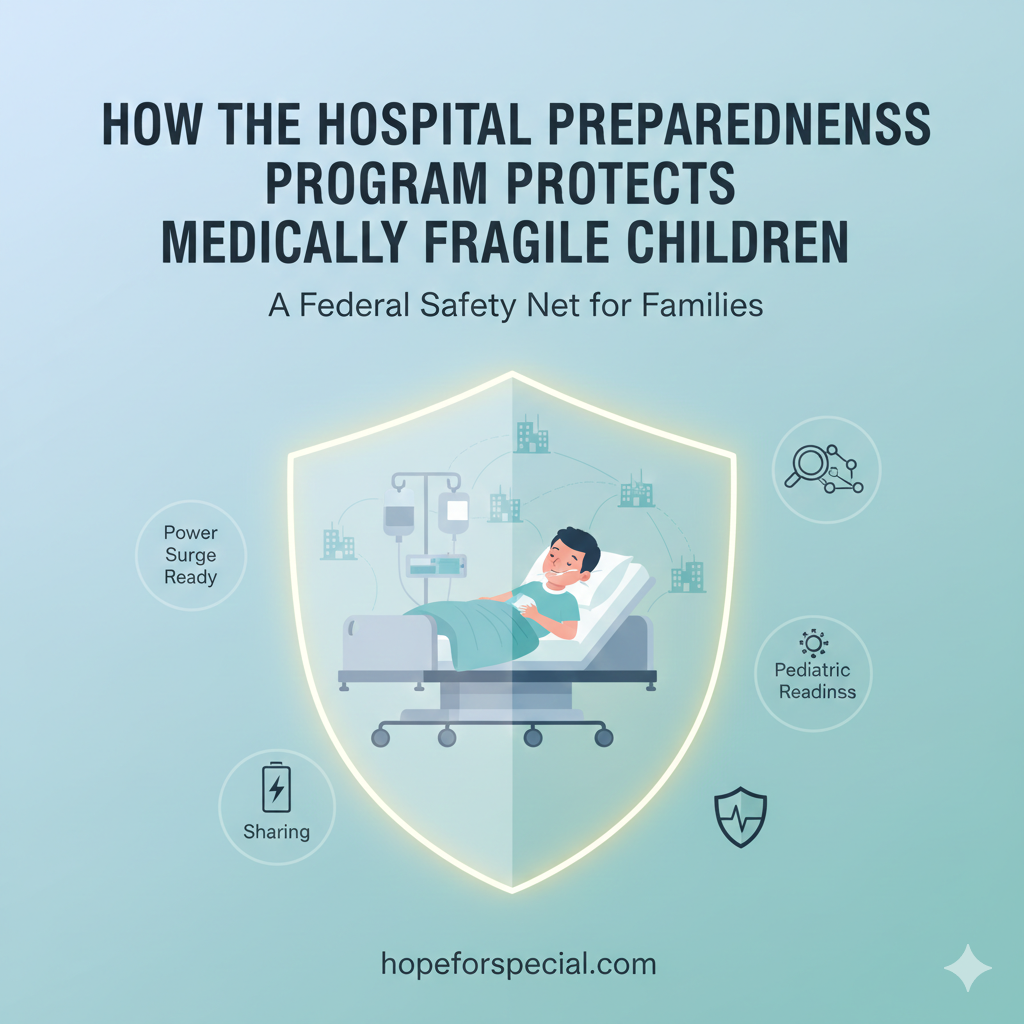
How the Hospital Preparedness Program Protects Medically Fragile Children
In the quiet hours of a typical Tuesday, “emergency” is just a word. But for families with medically fragile children—those dependent on ventilators, feeding pumps, and 24/7 clinical monitoring—a power outage or a natural disaster transforms that word into a life-or-death race. 🏃♂️💨If your child is medically complex, your local ER isn’t just a building; it’s a node in a massive federal safety net called the Hospital Preparedness Program (HPP).
In 2026, this program has evolved into a high-tech, resource-sharing engine designed to ensure that when a “medical surge” happens, your child isn’t just a patient—they are a priority.

- 1. The Invisible Shield: What is the Hospital Preparedness Program? 🌐
- 2. Decoding the Hospital Disaster Plan for Parents 📜🚑
- 3. The Nightmare Scenario: Executing a Hospital Emergency Evacuation Plan 🌪️🚨
- 4. The 2026 “PECC” – Your Child’s Best Friend in the ER 👩⚕️✨
- 5. FAQs: Navigating the Hospital Preparedness Program
- How does the Hospital Preparedness Program affect my local ER?
- What if the local hospital isn’t “Pediatric Ready”?
- Is there a specific evacuation plan for hospital patients in wheelchairs?
- Final Thoughts: Demand the Standard 🕊️💪
1. The Invisible Shield: What is the Hospital Preparedness Program? 🌐
The Hospital Preparedness Program is the primary source of federal funding for healthcare system readiness. Administered by the Administration for Strategic Preparedness and Response (ASPR), it funds 62 recipients across all 50 states to build Healthcare Coalitions (HCCs).
Think of an HCC as a “Emergency Neighborhood Watch” for hospitals. If a local hospital runs out of pediatric ventilators during a flood, the Hospital Preparedness Program ensures they can instantly “pull” equipment from a specialized children’s hospital 100 miles away.
The 2026 Resilience Stats: Why HPP Matters
| Metric | Impact of the Hospital Preparedness Program | Survival Factor | Source |
|---|---|---|---|
| Pediatric Mortality | 76% Lower | High “Pediatric Readiness” scores correlate with drastically lower death rates. | NPRP 2026 |
| Surge Capacity | +5% Bed Minimum | HPP-funded hospitals must be able to increase pediatric beds by 5% instantly. | ASPR TRACIE 2026 |
| Regional Load-Leveling | 90% Interconnectivity | Coalitions now track pediatric vents and NICU beds in real-time across state lines. | HHS.gov 2026 |
| Readiness Relaunch | March 2026 | The next nationwide Pediatric Readiness Assessment launches this month. |
2. Decoding the Hospital Disaster Plan for Parents 📜🚑
Every facility has a hospital disaster plan, but few parents know how to read between the lines. For a medically fragile child, a generic hospital disaster management plan isn’t enough. You need to know about the Pediatric Surge Annex.
What’s inside a 2026 Pediatric Surge Annex?
- Tiered Response: Hospitals are “tiered” based on their ability to handle complex kids. Your Hospital Preparedness Program funding ensures that if a Level 4 (Community) hospital gets a Level 1 (Critical) child, a transfer is triggered immediately.
- Tracking Tech: In 2026, HPP funds are used for AI-driven patient tracking. This prevents “lost” children during a mass hospital emergency evacuation plan execution.
- Family Reunification: The HPP mandates that children are not separated from parents unless it is a life-saving necessity.
3. The Nightmare Scenario: Executing a Hospital Emergency Evacuation Plan 🌪️🚨
Nothing is more terrifying than the words: “We are evacuating the hospital.” For a child on a ventilator, an evacuation plan for hospital movement is a high-stakes clinical operation.
How the Hospital Preparedness Program Powers Evacuations:
- Specialized Transport: HPP funds the “Ambulance Buses” and pediatric transport teams that have the onboard power to run 10+ ventilators simultaneously.
- The “Zero-Fail” Equipment List: Under 2026 HPP standards, every hospital emergency evacuation plan must include a “Go-Bag” for the patient containing 72 hours of meds and specific vent circuits.
- Vertical Evacuation Tech: New stair-descent devices (stair-chairs) are now funded specifically for NICU and PICU units, allowing nurses to move fragile infants safely without elevators.
4. The 2026 “PECC” – Your Child’s Best Friend in the ER 👩⚕️✨
If you take nothing else from this article, remember these four letters: PECC.
The Pediatric Emergency Care Coordinator (PECC) is a dedicated role funded and encouraged by the Hospital Preparedness Program. This person’s sole job is to ensure the ER is “Pediatric Ready.”
- Personal Experience Tip: When you walk into an ER, ask: “Who is your PECC on duty?” This signals to the staff that you understand the hospital emergency preparedness standards and that your child requires specialized triage.
5. FAQs: Navigating the Hospital Preparedness Program
How does the Hospital Preparedness Program affect my local ER?
It provides the money for specialized pediatric equipment (like “Broselow” carts and tiny intubation tubes) that a standard adult ER might not otherwise stock. It also pays for the “Drills” that staff use to practice a hospital disaster plan.
What if the local hospital isn’t “Pediatric Ready”?
The Hospital Preparedness Program creates “Regional Pediatric Disaster Centers.” Even if your local hospital is small, the HPP ensures they have a direct line to experts at a major children’s hospital via Telehealth during a surge.
Is there a specific evacuation plan for hospital patients in wheelchairs?
Yes. Modern hospital emergency evacuation plan standards (2026) mandate “Horizontal Evacuation” (moving to a safe wing) before “Vertical Evacuation” (leaving the building). They are also required to use specialized evacuation mats that can slide down stairs without a wheelchair.
Final Thoughts: Demand the Standard 🕊️💪
The Hospital Preparedness Program is your tax dollars at work, specifically earmarked to protect the most vulnerable. Don’t wait for a disaster to find out if your hospital is part of a coalition. Ask today: “Are you HPP-funded? Do you have a Pediatric Surge Annex?”
Your child’s life depends on the “Invisible Shield” of readiness. Let’s make sure it’s strong.


