

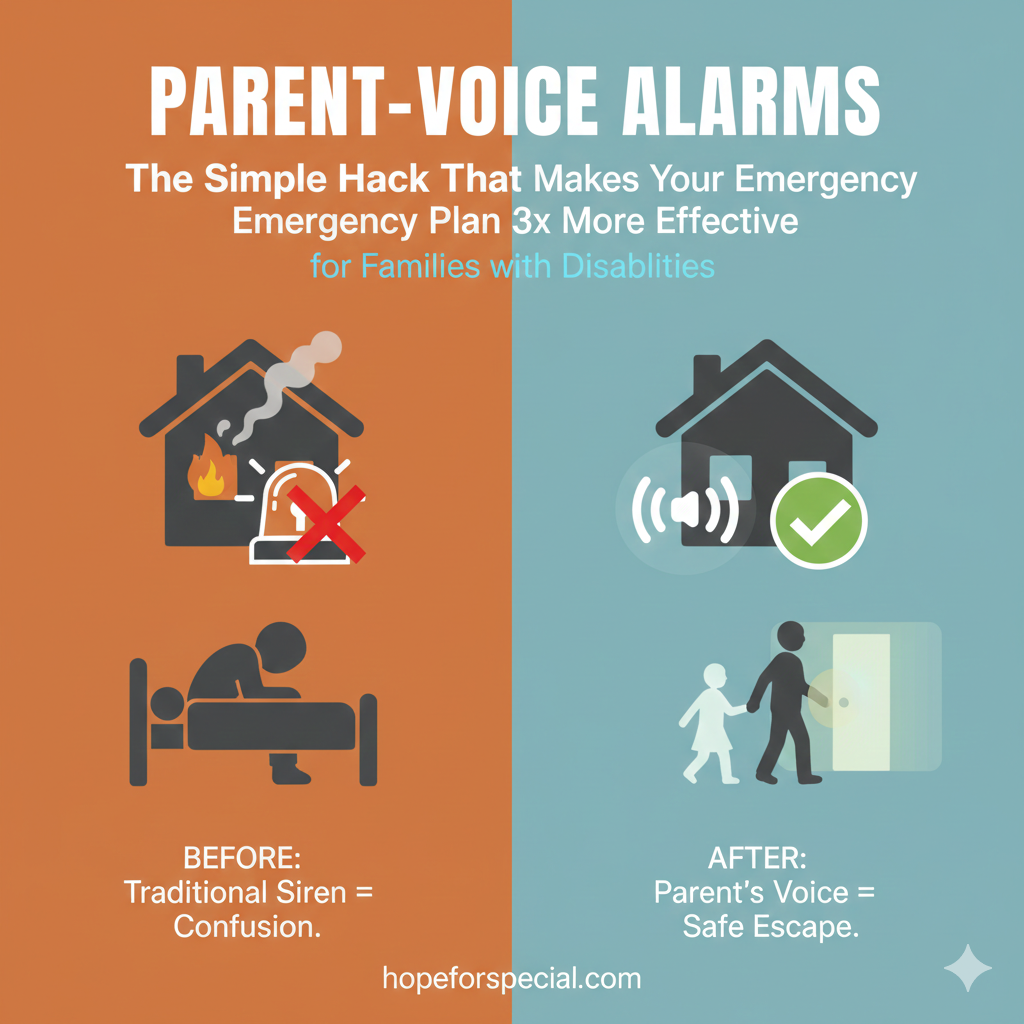
The Simple Hack That Makes Your Emergency Plan 3x More Effective
For parents of neurodivergent children or medically fragile toddlers, the sound of a standard smoke alarm isn’t just loud—it’s a potential barrier to survival. While a traditional high-pitch siren is designed to alert, for a child with autism or sensory processing sensitivities, that same sound can trigger a “freeze” response, a sensory meltdown, or even lead them to hide under a bed—the most dangerous place to be during a fire.
At Hope for Special, we’ve analyzed groundbreaking pediatric sleep research from 2024–2026. The findings are clear: The most powerful tool in your emergency plan isn’t a louder siren; it’s the sound of your own voice.

- 1. The Science of the “Neural Override”: Why Your Voice Wins 🧠⚡
- 2. Integrating Voice Alarms into Your Emergency Plan 🛠️📋
- Step 1: The “Command” Recording
- Step 2: Smart-Home “Routines” (The 2026 Hack)
- Step 3: Sensory Mapping & The “Hiding Spot” Audit
- 3. Real Results: A Sensory-Friendly Save 🦋🤝
- 4. The “Emergency Mesh Network”: Involving Your Neighbors 🏡🛡️
- 5. FAQs: Emergency Plan & Voice Alarm Efficacy
- Does the child need to hear their own name for the alarm to work?
- Are voice alarms legal and code-compliant?
- What if I have a non-verbal child?
- Final Thoughts: The Power of Presence 🕊️💪
- Sources
1. The Science of the “Neural Override”: Why Your Voice Wins 🧠⚡
Traditional smoke alarms emit a high-frequency beep (around 3,000 to 4,000 Hz). Research from the Center for Injury Research and Policy at Nationwide Children’s Hospital has consistently shown that children are “developmentally resistant” to these tones. In fact, many children—especially those in deep “slow-wave” sleep—can sleep through a 120-decibel siren for up to five minutes.
By contrast, a Parent-Voice Alarm uses a low-frequency recording of a familiar voice. This bypasses the auditory “noise filter” of a sleeping child and goes straight to the brain’s behavioral action center.
The “Parent-Voice” vs. Traditional Siren: 2026 Data Comparison
| Metric | Traditional High-Pitch Siren | Parent-Voice Recording | Survival Advantage | Source |
|---|---|---|---|---|
| Wake-Up Rate | ~53% to 56% | ~86% to 91% | 3x More Effective | ScienceDaily/Nationwide Children’s |
| Median Time to Wake | 156+ Seconds | 2 Seconds | Instant Response | CBC News/Pediatrics Study |
| Successful Escape Rate | ~51% | ~85% | Nearly 2x Safer | Journal of Pediatrics |
| Median Time to Escape | 282 Seconds | 18 – 28 Seconds | Saves 4+ Minutes | Nationwide Children’s News |
2. Integrating Voice Alarms into Your Emergency Plan 🛠️📋
Making your emergency plan 3x more effective requires more than just buying a new gadget. It requires a behavioral shift in how your family responds to a crisis.
Step 1: The “Command” Recording
When recording your voice for a talking smoke alarm, the words matter less than the tone. The brain responds best to calm, firm instructions.
- The Script: “Wake up, [Name]! There is a fire. Get out of bed and walk to the front door NOW.”
- Why it Works: It provides a specific Action Command. A siren just says “danger,” but your voice provides the emergency plan instructions.
Step 2: Smart-Home “Routines” (The 2026 Hack)
If you don’t want to replace every smoke detector, you can use your smart home ecosystem (Alexa, Google Home, or HomeKit) to bridge the gap.
- The Routine: Set a trigger where if your smart smoke detector (like Nest Protect) detects smoke, every smart speaker in the house broadcasts your pre-recorded “Action Command” at 80% volume.
- The Benefit: This ensures that your emergency plan is heard in every room, not just the hallway.
Step 3: Sensory Mapping & The “Hiding Spot” Audit
For neurodivergent children, “Sensory Overload” is the enemy of a successful emergency plan.
- Map it Out: Mark “High-Risk Hiding Spots” on your floor plan (closets, under beds, behind toy chests).
3. Real Results: A Sensory-Friendly Save 🦋🤝
“My son, Leo, has severe sensory sensitivities. During a practice drill with a standard siren, he had a complete shutdown and hid in his closet. We switched to a voice-recorded alarm where I told him, ‘Leo, it’s time for our exit game! Go to the big oak tree!’ The change was night and day. He moved instantly. It turned a terrifying noise into a familiar instruction.” — Sarah, Hope for Special Community Member.
4. The “Emergency Mesh Network”: Involving Your Neighbors 🏡🛡️
Your emergency plan shouldn’t exist in a vacuum. In 2026, we advocate for the “Neighborhood Mesh.”
- The Search Angel: Designate one neighbor who has a key to your home and knows your child’s “Hiding Spots.”
- The First Responder Handshake: Register your emergency plan and the existence of your voice-alarm system with your local fire marshal. This prevents responders from being confused when they hear a recording instead of a siren.
5. FAQs: Emergency Plan & Voice Alarm Efficacy
Does the child need to hear their own name for the alarm to work?
Research from the Center for Injury Research and Policy indicates that while a child’s name is helpful, a generic maternal or paternal voice is equally effective at waking them. The familiarity of the voice is the key “hack” for your emergency plan.
Are voice alarms legal and code-compliant?
Yes. Most 2026-compliant talking smoke alarms meet UL standards. However, they should always be used as a supplement to or integrated with your primary, interconnected smoke detection system.
What if I have a non-verbal child?
Your emergency plan should focus on Visual Escape Social Stories and Vibrating Bed Shakers in conjunction with voice alarms. The goal is to provide multiple sensory triggers (Audio, Visual, and Tactile) to ensure response.
Final Thoughts: The Power of Presence 🕊️💪
An emergency plan is only as good as the person’s ability to execute it. For our children, the sound of a parent’s voice provides the safety and clarity needed to move from “frozen” to “functional.” By implementing this simple “Parent-Voice” hack, you aren’t just buying gear—you’re building a neurological bridge to safety.
Sources
Nationwide Children’s – Smoke Alarm Study
The definitive research hub for pediatric response to various smoke alarm types.
Ready.gov – People with Disabilities
Official federal guidance on creating an inclusive emergency plan for families with special needs.
ScienceDaily – Maternal Voice Alarms
A deep dive into the 2018 study that proved parent-voice alarms are 3x more effective than sirens.


