

IEPs vs. 504 Plans: Which Is Right? ⚖️ Expert Guide
🌟 Introduction: The Critical Question for Your Child’s Future
The moment your child is identified as needing support in school, two terms dominate the conversation: the Individualized Education Program (IEP) and the 504 Plan. As a parent of a special needs child, understanding the fundamental differences is the single most important step in advocating for a successful educational future. The question, “IEPs vs 504 plans which is right,” is not about choosing the “better” plan; it’s about choosing the correct legal mechanism that matches your child’s specific needs.
This deep-dive guide, written by an expert in special education law and advocacy, provides the comprehensive, trustworthy, and authoritative comparison you need. We’ll clarify the legal foundations, eligibility gates, and, most importantly, the actual services provided by each document, ensuring you can confidently answer the question: IEPs vs 504 plans which is right for your child.
- 🌟 Introduction: The Critical Question for Your Child’s Future
- 1. The Legal Foundation: IDEA vs. Section 504
- 2. The Core Comparison: Specialized Instruction vs. Equal Access
- 3. The Eligibility Gate: The Key Deciding Factor
- 4. The Critical Role of Services
- 5. Real-World Case Studies: When to Choose Which Plan
- 📚 Case Study A: The Need for Specialized Instruction (Choose IEP)
- ⚕️ Case Study B: The Need for Equal Access (Choose 504 Plan)
- 6. Expert Deep Dive: What Happens After High School? 🎓
- 7. Statistics & Usage Data: How Services are Distributed
- 8. Parent Advocacy Toolkit
- 9. FAQs
- Q1: What is the fastest way to get support—an IEP or a 504 Plan?
- Q2: My child has a severe food allergy. Should they get an IEP or a 504 Plan?
- Q3: What is the main difference in eligibility when considering IEPs vs 504 plans which is right?
- 10. Conclusion: Choosing the Right Legal Tool

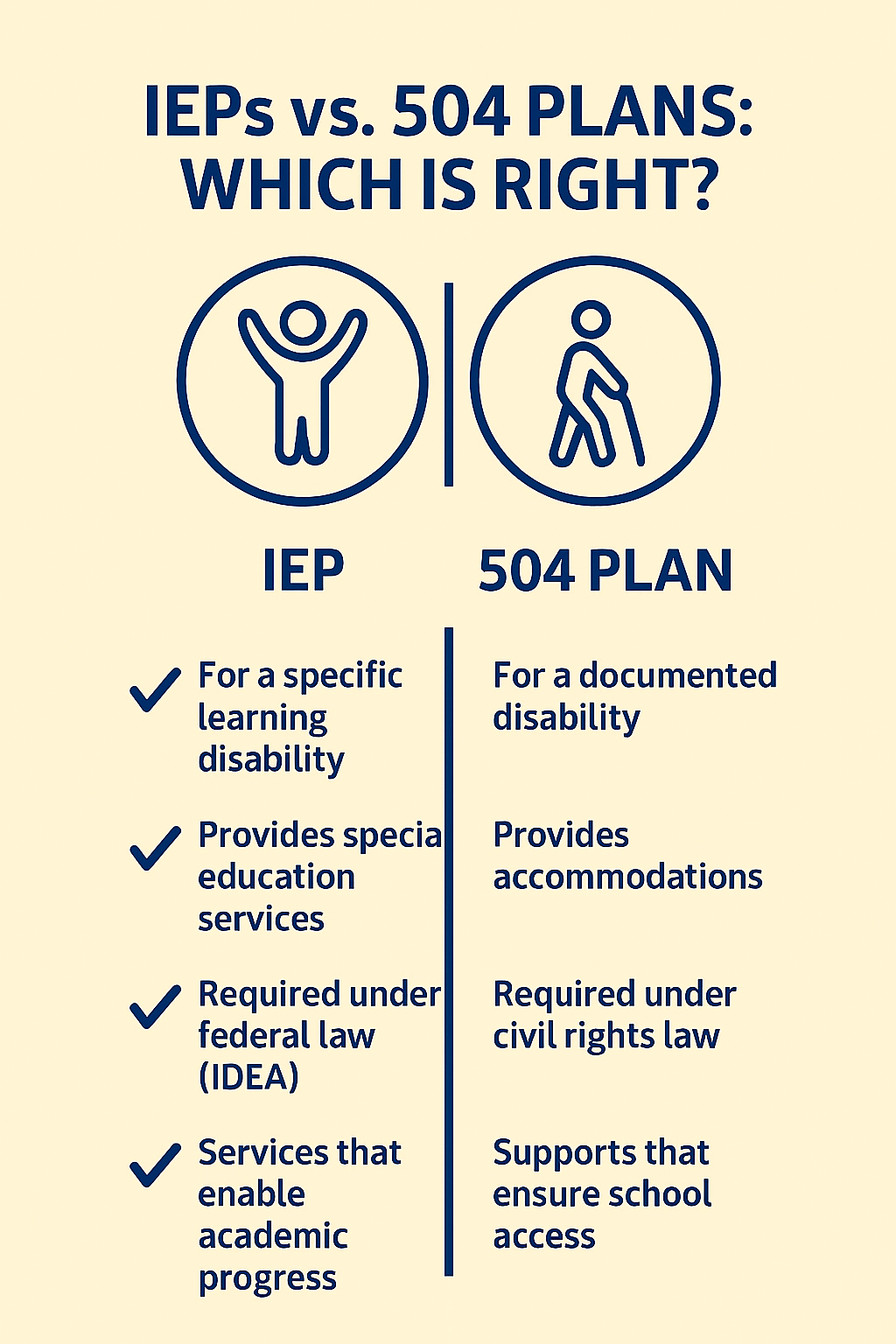
🧩 What the Visual Covers:
A clear side-by-side comparison to help families understand the differences and choose the right support plan:
| Feature | IEP (Individualized Education Program) | 504 Plan |
|---|---|---|
| Legal Basis | IDEA (Individuals with Disabilities Education Act) | Section 504 of the Rehabilitation Act |
| Eligibility | Must qualify for special education | Any documented disability impacting learning |
| Services Provided | Specialized instruction + accommodations | Accommodations only (no special instruction) |
| Evaluation Requirement | Formal evaluation required | No formal evaluation required |
| Goal Tracking | Includes measurable goals and progress reports | No formal goals or progress tracking |
| Team Involvement | Requires IEP team (parents, teachers, specialists) | School staff and parents |
1. The Legal Foundation: IDEA vs. Section 504
The most critical difference between an IEP and a 504 Plan lies in the federal law that governs them. This difference determines everything from eligibility to funding and procedural safeguards.
📜 The IEP: Rooted in IDEA
The IEP is mandated by the Individuals with Disabilities Education Act (IDEA), a federal special education law.
- The Blueprint: The IEP is the blueprint of your child’s entire special education experience, detailing goals, services, progress monitoring, and specially designed instruction.
🏛️ The 504 Plan: Rooted in Civil Rights
The 504 Plan is mandated by Section 504 of the Rehabilitation Act of 1973, a federal civil rights law.
- Core Purpose: Section 504 is an anti-discrimination statute. Its primary goal is to eliminate barriers and ensure that children with disabilities have equal access to the general education curriculum and school activities, just like their non-disabled peers.
- The Leveler: The 504 Plan primarily focuses on accommodations that “level the playing field,” rather than providing specialized teaching.
2. The Core Comparison: Specialized Instruction vs. Equal Access
For a parent trying to decide IEPs vs 504 plans which is right, the primary differentiating factor is whether the child needs Specialized Instruction (IEP) or just Accommodations (504 Plan).
| Feature | Individualized Education Program (IEP) | 504 Plan (Section 504) |
|---|---|---|
| Governing Law | Individuals with Disabilities Education Act (IDEA) | Section 504 of the Rehabilitation Act of 1973 (Civil Rights) |
| Primary Focus | Specialized Instruction (SDI) and related services to change educational outcomes. | Accommodations and supports to ensure equal access to the general curriculum. |
| Document Content | Requires measurable annual goals, present levels of performance, progress monitoring, and service delivery specifics. | Generally includes only the accommodations, the person responsible, and the review date. Goals are not required. |
| Required Team | Highly specific: Parent(s), Special Education Teacher, General Education Teacher, District Rep (authority over SPED), and Specialist (to interpret evaluation results). | Less specific: Persons knowledgeable about the child, the disability, and the placement options. Parents are highly encouraged but not legally required to attend in the same mandatory capacity as an IEP. |
| Review/Reevaluation | Mandated review at least annually; formal reevaluation every three years. | Review typically annually; reevaluation generally every three years, or as needed. |
3. The Eligibility Gate: The Key Deciding Factor
The most frustrating part for parents often comes at the eligibility stage. A child who meets the criteria for a 504 Plan may not meet the stricter requirements for an IEP.
🔑 IEP Eligibility: The Two-Prong Test
To qualify for an IEP under IDEA, the child must meet both of the following requirements:
- Disability Category: The child must have one or more of the 13 specific disability categories defined by IDEA (e.g., Autism, Specific Learning Disability, Emotional Disturbance, Traumatic Brain Injury).
- Need for Specialized Instruction: The disability must adversely affect the child’s educational performance to the degree that they require specially designed instruction (SDI) to access the general education curriculum.
Expert Insight: “If your child has a learning disability like dyslexia (falling under Specific Learning Disability) but is only receiving accommodations (like extended time) and is not receiving direct, tailored reading instruction designed by a special education teacher, they are not meeting the need for SDI and may only qualify for a 504 Plan, even though they have an IDEA-qualifying diagnosis.”
🔑 504 Plan Eligibility: The Broader Civil Rights Test
To qualify for a 504 Plan, the criteria are significantly broader:
- Impairment: The child must have a physical or mental impairment (this includes virtually any diagnosis, visible or invisible).
- Substantial Limitation: This impairment must substantially limit one or more major life activities (which include learning, reading, concentrating, communicating, and eating).
<!– end list –>
- Who Qualifies Here but Not for an IEP? Children with conditions like severe allergies, diabetes, temporary conditions (broken bones/post-concussion syndrome), or ADHD/Anxiety that only require accommodations (e.g., seating preference, blood sugar checks) but do not need specialized instruction.
4. The Critical Role of Services
When parents ask, “IEPs vs 504 plans which is right,” they are often asking about the services their child will receive. The table below clarifies the type of support each plan can legally deliver.
| Service/Support Type | IEP (IDEA) | 504 Plan (Section 504) |
|---|---|---|
| Accommodations (Leveling the field, e.g., extended time) | Yes | Yes (Primary function) |
| Modifications (Changing the curriculum, e.g., simplified assignments) | Yes (Only legally permitted under an IEP) | No |
| Specially Designed Instruction (SDI) (Custom teaching methods) | Yes (Primary function) | No |
| Related Services (e.g., Speech Therapy, Occupational Therapy, Transportation) | Yes (If necessary to benefit from SDI) | Sometimes (If necessary for equal access) |
| Measurable Goals & Progress Reports | Yes (Legally required) |
Answer: “An IEP is right if your child needs specially designed instruction or curriculum modifications, which fundamentally change how or what they are taught. A 504 Plan is right if your child only needs accommodations, like extended time or preferential seating, to access the standard curriculum.”
5. Real-World Case Studies: When to Choose Which Plan
Understanding the laws is abstract; seeing them in action makes the choice clear.
📚 Case Study A: The Need for Specialized Instruction (Choose IEP)
- The Child: Liam, 9 years old. Diagnosed with Dysgraphia (Specific Learning Disability) and ADHD.
- The Challenge: Despite receiving basic classroom accommodations, Liam cannot physically write fast enough to take notes or complete written tests. His written output is far below grade level.
- The Determination: Liam not only needs accommodations (e.g., using a laptop), but he also needs Specially Designed Instruction (SDI)—explicit, direct instruction from an Occupational Therapist or Special Education Teacher focused on handwriting remediation or keyboarding skills. The goal is to improve the underlying skill deficit.
- Verdict: IEP is right. The need for SDI to directly address the academic deficit triggers IDEA.
⚕️ Case Study B: The Need for Equal Access (Choose 504 Plan)
- The Child: Sarah, 12 years old. Diagnosed with Type 1 Diabetes and Generalized Anxiety Disorder (GAD).
- The Challenge: Sarah’s academics are strong, but she needs frequent trips to the nurse for blood sugar checks and needs to carry a snack. Her anxiety causes test-taking panic.
- The Determination: Sarah’s medical and mental health impairments substantially limit major life activities (concentrating, bodily function). She needs accommodations (unlimited restroom breaks, testing in a quiet room, access to a nurse) to prevent discrimination and ensure she can access the general curriculum equally. She does not require specialized teaching methods.
- Verdict: 504 Plan is right. This is a civil rights issue requiring accommodations, not an instructional deficit requiring Special Education.
6. Expert Deep Dive: What Happens After High School? 🎓
This is a critical, often-missed piece of information when parents are comparing IEPs vs 504 plans which is right. The laws change dramatically after a student exits K-12 public school.
- The IEP Sunset: The IDEA (IEP) protections end the moment a student graduates with a standard diploma or turns 22 (whichever comes first). College is covered by Section 504, not IDEA.
- The 504 Continuum: The 504 Plan (Section 504 of the Rehabilitation Act) continues to govern post-secondary education and the workplace. Colleges, universities, and employers receiving federal funds must provide “reasonable accommodations” under Section 504 and the Americans with Disabilities Act (ADA).
- The Transition Gap: When an IEP student transitions to college, they must be given a Summary of Performance (SOP) which helps them apply for accommodations under Section 504 in the college setting. The 504 Plan, therefore, offers a more seamless legal continuum into adult life.
7. Statistics & Usage Data: How Services are Distributed
Understanding national trends provides perspective on where most students fall.
| Statistic/Data Point | Finding | Relevance to \text{X} | Source (Authoritative Link) |
|---|---|---|---|
| Total Students with Disabilities (2020-21) | 17\% of all U.S. students have disabilities: 14\% served under IDEA (IEP) and 3\% served only under Section 504. | Confirms that IEPs are the primary vehicle for support, but the 504 Plan is an essential safety net for millions of students. | https://www2.ed.gov/about/offices/list/ocr/docs/crdc-student-disabilities-snapshot.pdf |
| Disability Most Served by IEP | 32\% of all IDEA students have a Specific Learning Disability (SLD), the largest category. | Highlights the critical need for Specialized Instruction for academic deficits (reading, writing, math). | https://www.pewresearch.org/short-reads/2023/07/24/what-federal-education-data-shows-about-students-with-disabilities-in-the-us/ |
| Eligibility for ADHD Services | Over 51\% of students with a history of ADHD received services, split between IEP and 504. | Illustrates that ADHD can often be accommodated by a 504 Plan unless the symptoms create an adverse effect requiring specialized academic instruction. | https://pmc.ncbi.nlm.nih.gov/articles/PMC4261048/ |
| Racial Disparities in 504 Usage | White students are overrepresented in Section 504-only services (60\% of 504-only students) compared to their overall enrollment (46\%). | Shows that the interpretation of IEP vs 504 plans which is right is not uniform and may be influenced by systemic factors or parental advocacy. | https |
8. Parent Advocacy Toolkit
📢 Parental Rights: The Biggest Difference
If you disagree with the school’s decision regarding IEPs vs 504 plans which is right for your child, your legal recourse is dramatically different:
- IEP (IDEA): You have extensive Procedural Safeguards, including the right to an Independent Educational Evaluation (IEE) at public expense, mediation, and a Due Process Hearing (a formal court-like proceeding).
- 504 Plan (Section 504): Safeguards are less formalized. You generally have the right to an impartial hearing but usually do not have the right to an IEE paid for by the school, and formal Due Process protections are not guaranteed under the same structure.
📝 The ‘Try-First’ Strategy
If your child is on the border (e.g., high-functioning Autism or mild ADHD) and the school suggests a 504 Plan, an expert might suggest a “Try-First” strategy to answer IEPs vs 504 plans which is right:
- Implement the 504 Plan: Document all accommodations (extended time, quiet testing, sensory breaks).
- Monitor Data: Track academic grades, behavioral referrals, and teacher feedback for one full semester.
- If the 504 Plan Fails: If the child is still failing or making inadequate progress despite the accommodations, this data proves the child needs more than equal access—they need Specialized Instruction (SDI). This documentation can be used to compel the school to conduct an IEP evaluation.
9. FAQs
Q1: What is the fastest way to get support—an IEP or a 504 Plan?
A: Generally, obtaining a 504 Plan is faster because the eligibility process is less formal and does not require the extensive testing or the specific team meeting structure mandated by the IEP under the IDEA law.
Q2: My child has a severe food allergy. Should they get an IEP or a 504 Plan?
A: Your child should likely get a 504 Plan. A severe food allergy is a health impairment that substantially limits a major life activity (eating/breathing). This condition requires accommodations (e.g., a special seating chart, a safety plan, access to epinephrine) to ensure equal access to the school environment, but it rarely requires Specialized Instruction, which is the core of an IEP.
Q3: What is the main difference in eligibility when considering IEPs vs 504 plans which is right?
A: The main difference is the severity and type of support needed. To qualify for an IEP, the disability must be one of the 13 IDEA categories and require Specially Designed Instruction. To qualify for a 504 Plan, the disability must simply substantially limit a major life activity (like learning) and only require accommodations for equal access.
10. Conclusion: Choosing the Right Legal Tool
The process of determining IEPs vs 504 plans which is right is a journey of sophisticated advocacy. You must step back from the emotional concern and analyze the issue through a legal lens:
- Does my child need someone to teach them differently (SDI)? \ IEP (IDEA)
- Does my child need environmental supports to access what is already being taught (Accommodations)? \504 Plan (Section 504)
By applying these criteria and leveraging your right to be an equal member of the decision-making team, you can ensure your child receives the precise legal protection—and educational opportunity—they deserve.
Sources
- U.S. Department of Education – IDEA Statute: The primary source for the law governing IEPs and specialized instruction: https://sites.ed.gov/idea/statuteregulations/
- U.S. Department of Education – Office for Civil Rights (OCR): The governing body for Section 504 and the enforcement of non-discrimination: https://www2.ed.gov/about/offices/list/ocr/docs/disabilities.html
- The National Association of Special Education Teachers (NASET): Professional standards and information on the implementation of both plans: https://www.naset.org/
- Wrightslaw – Special Education Law and Advocacy: A leading non-profit resource for detailed procedural safeguards and parental rights under both laws: https://www.wrightslaw.com/


