

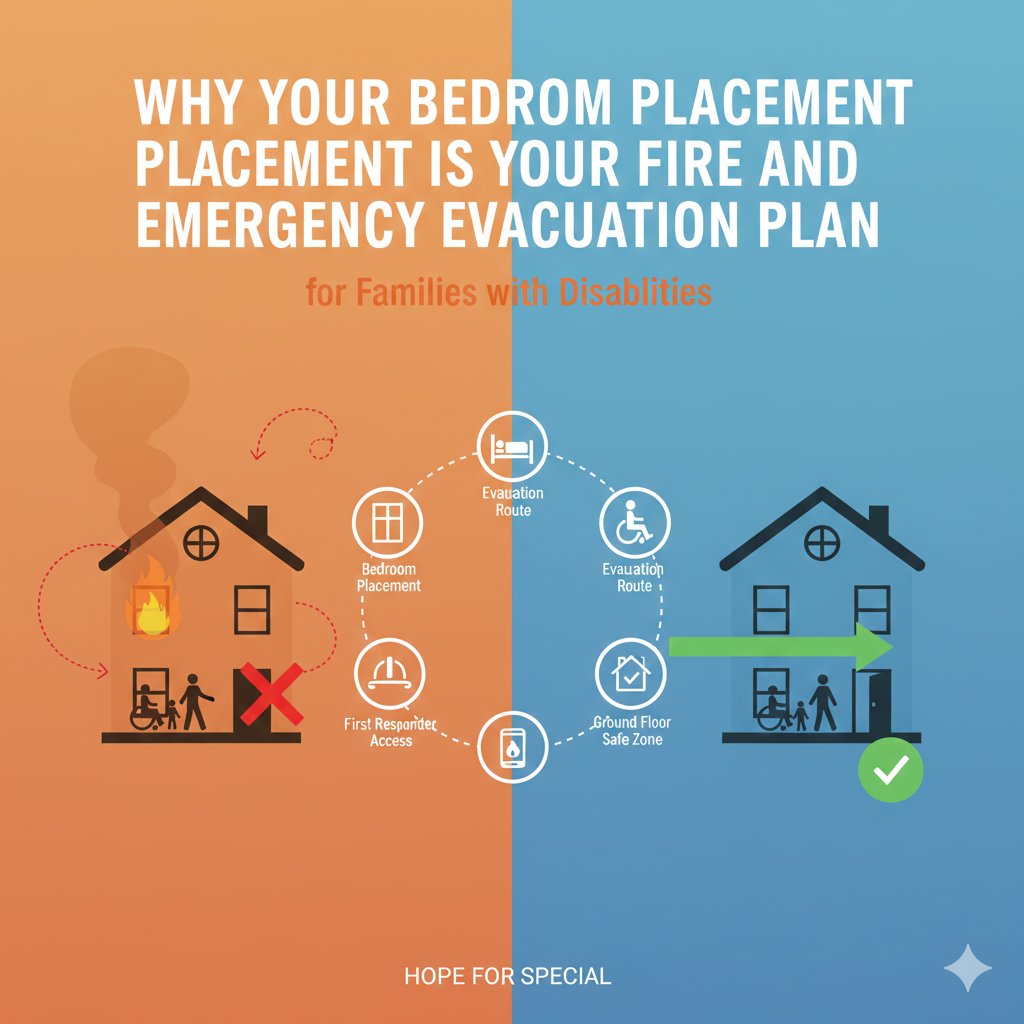
Why Your Bedroom Placement is Your Fire and Emergency Evacuation Plan
When we talk about a fire and emergency evacuation plan, most people think of smoke alarms, fire extinguishers, and meeting at the mailbox. But in 2026, safety experts are pointing to a “passive” survival factor that outweighs almost every other tactical gear: Structural Proximity.
For families with disabilities, the layout of your home isn’t just an architectural choice—it is the foundation of your survival. At Hope for Special, we’ve analyzed the latest 2025-2026 data, and the conclusion is staggering: Bedroom placement is the single most significant predictor of evacuation success for individuals with mobility or sensory challenges.

- 1. The “Seconds-to-Safety” Reality: 2026 Statistics 📊
- 2. The “Ground Floor Law”: Why Proximity Trumps Gear 🚪🏃♂️
- 3. The 4 Pillars of a Structural Fire and Emergency Evacuation Plan 🧱
- Pillar I: The Proximity Audit
- Pillar II: Smart Path-to-Safety Lighting
- Pillar III: The “Quiet Zone” Meeting Spot
- Pillar IV: The Digital First Responder Handshake
- 4. Real Results: The “Ground Floor” Save 🦋🤝
- 5. FAQs: Fire and Emergency Evacuation Plan for 2026
- Why is bedroom placement so critical for a fire and emergency evacuation plan?
- How do I modify my fire and emergency evacuation plan for a non-verbal child?
- What is the best tech to add to my fire and emergency evacuation plan in 2026?
- Final Thoughts: Designing for Survival 🕊️
- Sources
1. The “Seconds-to-Safety” Reality: 2026 Statistics 📊
In a house fire, you have approximately two minutes to escape safely. For a person with a physical disability or a neurodivergent child who may “freeze” or hide, those 120 seconds disappear instantly.
Disability-Inclusive Fire Fatality Data (2025/2026)
| Metric | Impact Statistic | Strategic Necessity | Source |
|---|---|---|---|
| Mortality Rate (Multistory) | 6.3x Higher | Fire death rates are significantly higher in single-family multistory homes compared to modern apartments. | Pew Research 2025 |
| Physical Disability Factor | 30% of Fatalities | Physical disability is the second leading human factor in residential fire deaths. | USFA FEMA 2025 |
| Evacuation Time Reduction | 19% Improvement | Concentrating vulnerable occupants on lower floors reduces total evacuation time by nearly 20%. | ResearchGate 2025 |
| Modern Apartment Safety | 1.2 per Million | Fire death rates in modern (post-2010) multifamily buildings are a fraction of those in older homes. | Smart Cities Dive 2025 |
2. The “Ground Floor Law”: Why Proximity Trumps Gear 🚪🏃♂️
If your fire and emergency evacuation plan relies on an evacuation chair to get a loved one down a flight of stairs, you are already at a disadvantage. While evacuation chairs are effective in high-rises with trained personnel, they can be a bottleneck in a smoke-filled, private residential hallway.
The Passive Extraction Advantage
By relocating the primary bedroom of a disabled family member to the ground floor, near a primary exit, you turn your fire and emergency evacuation plan from an active struggle into a passive extraction.
- Eliminating the Staircase Bottleneck: Every step down is a second lost.
- Direct Responder Access: In 2026, firefighters prioritize “Ground-Level Entry” for search and rescue. If your loved one is on the first floor near a window, they are the first to be reached.
- The “Zero-Lift” Exit: For wheelchair users, being on the ground floor means their fire and emergency evacuation plan is a straight-line exit rather than a vertical rescue.
3. The 4 Pillars of a Structural Fire and Emergency Evacuation Plan 🧱
An effective fire and emergency evacuation plan in 2026 must be integrated into your home’s “Smart Ecosystem.”
Pillar I: The Proximity Audit
Review your floor plan. The most vulnerable person should be in the room with the shortest path to an exterior door.
- The 15-Foot Rule: Try to keep the distance between the bed and the exit under 15 feet.
- Window Egress: Ensure the bedroom has an “extraction-ready” window that opens easily and is wide enough for a firefighter in full gear.
Pillar II: Smart Path-to-Safety Lighting
During a fire, smoke makes it impossible to see. Your fire and emergency evacuation plan should include 2026 IoT lighting.
- Automated Low-Level Strobes: When the alarm sounds, smart floor-level lights should activate, creating a “Visual Runway” to the exit.
- Haptic Guidance: For the visually impaired, vibrating wearables can pulse in the direction of the nearest safe exit.
Pillar III: The “Quiet Zone” Meeting Spot
Standard advice is to meet at a mailbox. For neurodivergent children, the flashing lights of a fire truck at the mailbox can cause them to bolt.
- Strategic Meeting Spots: Your fire and emergency evacuation plan should specify a “Quiet Zone”—perhaps a neighbor’s garage or a fenced backyard—where the child feels safe and won’t elope toward the danger.
Pillar IV: The Digital First Responder Handshake
In 2026, your fire and emergency evacuation plan should be digital.
- Registry Integration: Register your home with local dispatch. When they receive a 911 call from your address, their screen should flash: “Occupant in Room 1 (Ground Floor) has limited mobility. Search Room 1 first.”
4. Real Results: The “Ground Floor” Save 🦋🤝
“We used to have our daughter’s sensory room on the second floor. After reading about the risks, we moved her to the converted den on the first floor. Last October, a lithium-ion battery in the garage caught fire. Because she was on the ground floor, my husband was able to get her out the side door in 35 seconds. If she had been upstairs, the smoke in the hallway would have trapped them both.” — Marcus, Disability Advocate.
5. FAQs: Fire and Emergency Evacuation Plan for 2026
Why is bedroom placement so critical for a fire and emergency evacuation plan?
Bedroom placement determines the “travel distance” to safety. In a fire, heat and toxic smoke rise, making upper floors significantly more dangerous. A ground-floor bedroom allows for immediate exit and easier access for rescue crews.
How do I modify my fire and emergency evacuation plan for a non-verbal child?
Incorporate Parent-Voice Alarms. Studies show children are more likely to wake up and follow instructions from a recorded parent’s voice than a high-pitched siren. Also, ensure your plan includes “Search Angels”—neighbors who know to look in specific “hiding spots” like closets or under beds.
What is the best tech to add to my fire and emergency evacuation plan in 2026?
Look for Interconnected Smoke Alarms with “Path-Finding” smart lights. If the kitchen alarm goes off, the bedroom lights should instantly turn on and change color to guide the way to the safest exit.
Final Thoughts: Designing for Survival 🕊️
Your fire and emergency evacuation plan shouldn’t just be a piece of paper on the fridge. It should be written into the very layout of your home. By prioritizing bedroom placement and structural proximity, you are giving your family the greatest gift possible in a crisis: Time.
Sources
USFA FEMA – Fire Safety for People with Disabilities
The official source for fire prevention strategies tailored to the disability community.
NFPA – Emergency Evacuation Planning Guide
The National Fire Protection Association’s comprehensive guide for inclusive evacuation planning.
Pew Research – Modern Multifamily Fire Safety 2025
A 2025 study highlighting the significant safety advantages of modern building designs for fire survival.


