
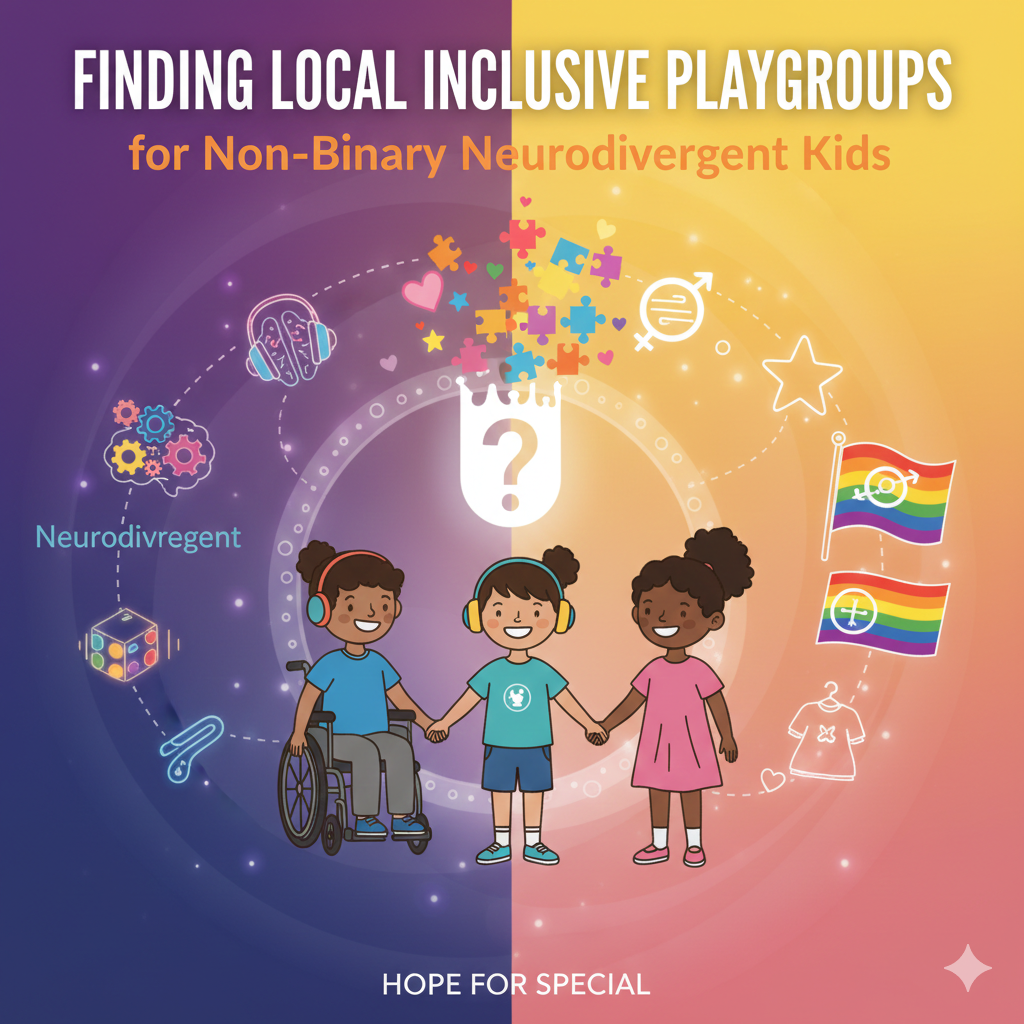
Finding Local Inclusive Playgroups for Non-Binary Neurodivergent Kids
If you are a parent or caregiver searching for finding local inclusive playgroups for non-binary neurodivergent kids, you are likely navigating an intersection that many “mainstream” inclusive spaces don’t quite understand yet.
At Hope for Special, we know that for a child who is “double-divergent”—meaning they inhabit both a neurodivergent brain and a non-binary gender identity—a playgroup isn’t just about social skills. It is about safety. It’s about finding a place where their sensory needs are respected and their pronouns aren’t a debate.
In this 2026 guide, we move past generic advice to help you find, vet, or even build the inclusive village your child deserves.

- 1. The Intersectionality Gap: Why Specificity Matters 📊
- 2. The “Intersectional Vibe-Check”: How to Vet a Playgroup 🕵️♂️
- 3. Top Resources for Finding Your Local Tribe 📍
- 4. When You Can’t Find It: The “Start Your Own” Toolkit 🛠️
- 5. Expert Insights: The Link Between Sensory and Gender 🧠
- FAQs:
- Are there virtual playgroups for non-binary neurodivergent kids?
- How do I explain my child’s gender to a traditional autism playgroup?
- What if my child is “too neurodivergent” for a pride group?
- Final Thoughts
1. The Intersectionality Gap: Why Specificity Matters 📊
Research consistently shows a significant “overlap” between neurodivergence and gender diversity. For many kids, the same brain that processes sensory input differently also views social constructs like gender with a unique, often more fluid, perspective.
2025-2026 Intersectional Data: Neurodiversity & Gender
| Metric | Statistic | Impact on Playgroup Needs | Source |
|---|---|---|---|
| Co-occurrence | 3–6x Likelihood | Trans/non-binary youth are significantly more likely to be autistic/ADHD. | Nature/NIH 2025 |
| Gender Fluidity | 92.3% Stability | Majority of autistic gender-diverse youth remain gender-diverse into adulthood. | PubMed 2025 |
| Social Isolation | 68% “Double-Masking” | Kids often feel they must hide both their “stims” and their gender to fit in. | Neurodiversity Directory |
| Safety Concerns | 1 in 4 Rejection Rate | High risk of rejection in single-focus (only ND or only LGBTQ+) groups. | Frontiers 2025 |
2. The “Intersectional Vibe-Check”: How to Vet a Playgroup 🕵️♂️
When finding local inclusive playgroups for non-binary neurodivergent kids, a “disability-friendly” tag isn’t enough. You need to look for Gender-Affirming Neuro-Inclusion.
Use this 5-point “Vibe-Check” before your first visit:
- Language Check: Does the facilitator say “Hi everyone!” or “Friends!” instead of “Boys and girls”? 🗣️
- Visual Inclusion: Are there pronoun badges available alongside visual schedules or “First/Then” boards? 📛
- Bathroom Policy: Is there a gender-neutral or single-stall restroom accessible without a “key request” drama? 🚻
- Facilitator Training: When you ask, “How do you support non-binary kids with sensory needs?”, do they look confused, or do they have a plan? 📋
3. Top Resources for Finding Your Local Tribe 📍
If a simple Google search isn’t working, try these intersectional-friendly avenues:
- Yellow Ladybugs (International): While focused on girls and gender-diverse youth, their 2026 resources are the gold standard for neuro-affirming support. YellowLadybugs.com.au.
- PFLAG + Local Autism Chapters: Contact your local PFLAG chapter and ask if they have “Neuro-Queer” family meetups. Often, these aren’t advertised on public websites for safety reasons.
- The “Safer Spaces” Network: Look for groups specifically labeled as “Neurodiversity Affirming.” These groups, like the one run by Wyndham City Council, are often the most welcoming to gender-diverse kids.
- Nature Play Programs: Programs like “Turn Back Time” emphasize that nature is the “great equalizer,” where gender and diagnosis matter less than the mud and the trees. ChildrenAndNature.org.
4. When You Can’t Find It: The “Start Your Own” Toolkit 🛠️
In many areas, finding local inclusive playgroups for non-binary neurodivergent kids results in zero hits. If the village doesn’t exist, you may have to build it.
How to host a “Double-Divergent” Meetup:
- The “Soft” Invite: Post in local Facebook groups for “Neurodivergent Parents” using specific language: “Seeking other parents of non-binary/gender-creative ND kids for a sensory-safe park date.”
- The Sensory Kit: Bring a “communal bin” of fidgets, noise-canceling headphones, and sunglasses.
5. Expert Insights: The Link Between Sensory and Gender 🧠
Expert research in 2026 suggests that a child’s interoception (their internal sense of their body) is linked to both neurodivergence and gender identity.
FAQs:
Are there virtual playgroups for non-binary neurodivergent kids?
Yes! If you are in a “resource desert,” look for moderated Discord servers or Zoom-based “Hangouts” through organizations like Yellow Ladybugs or Reframing Autism. These allow for social connection without the physical sensory overwhelm.
How do I explain my child’s gender to a traditional autism playgroup?
You don’t have to explain, but if you want to advocate, use a “bridge script”: “My child, Sam, uses they/them pronouns. They are also very sensitive to loud noises. We’d love to join if your group can accommodate both of those needs.”
What if my child is “too neurodivergent” for a pride group?
Many LGBTQ+ groups aren’t sensory-trained. If a Pride event is too loud, ask the organizers for a “Quiet Hour” or look for “Library-based” pride events, which tend to be more regulated and structured.
Final Thoughts
Finding local inclusive playgroups for non-binary neurodivergent kids is a journey of trial and error. Some days will be hard. But when your child finally finds that one friend who stims with them and uses their correct name without blinking? That is where the magic happens.


