
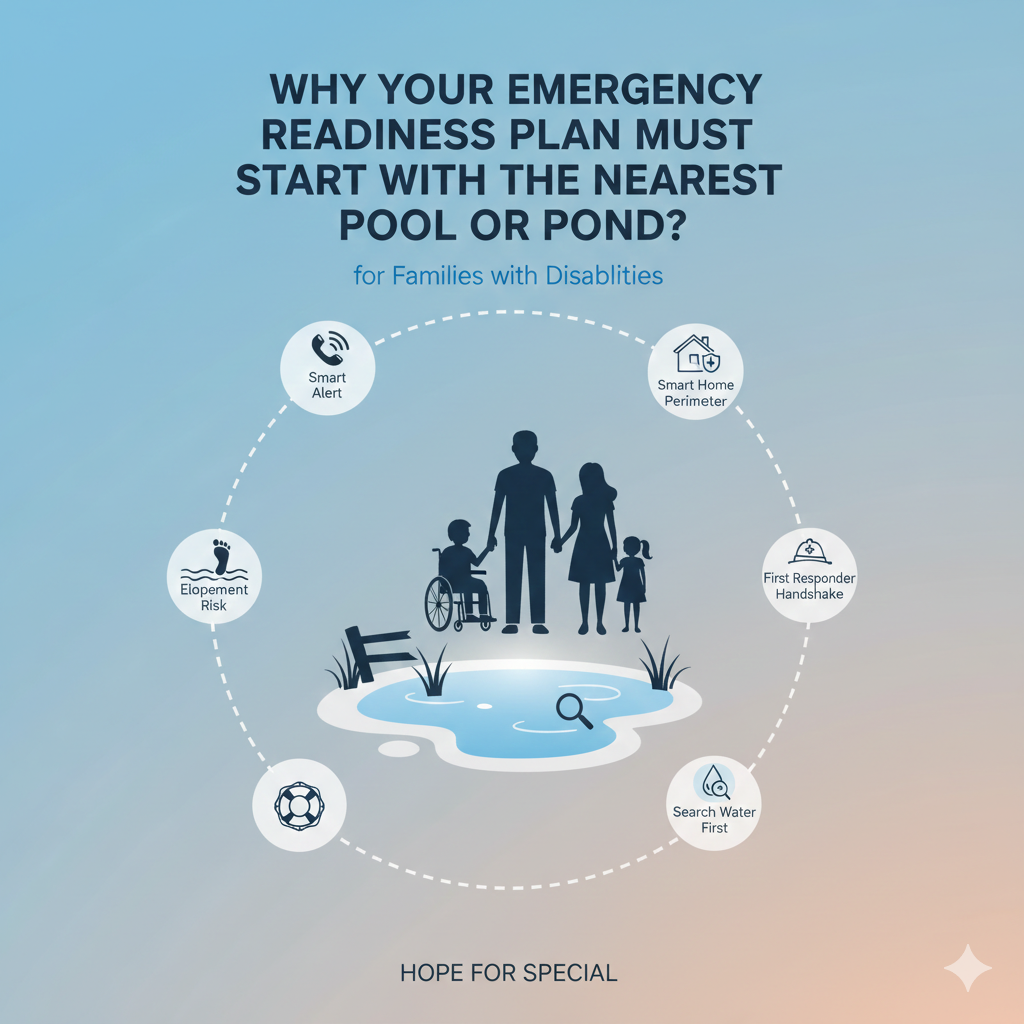
Why Your Emergency Readiness Plan Must Start with the Nearest Pool or Pond?
In the world of disaster preparedness, we are often taught to “stop, drop, and roll” or “head for the basement.” But for families living with neurodivergent children—specifically those on the autism spectrum—the most critical directive in an emergency readiness plan isn’t about fire or wind. It’s about water.
At Hope for Special, we’ve analyzed the heartbreaking trends of 2025 and 2026. The data is clear: in a crisis, the “sensory magnet” of a nearby pool or pond becomes a lethal destination for a wandering child. If your emergency readiness plan doesn’t prioritize a 360-degree water hazard audit, it is missing its most vital component.

- 1. The Lethal Attraction: Why Water? 📊
- 2. The “Search Water First” Annex: A Life-Saving Protocol 🌊⚓
- 3. Five Pillars of a Water-First Emergency Readiness Plan 🧱
- Pillar I: The Visual Water Audit
- Pillar II: 2026 Smart-Home Integration
- Pillar III: The Sensory De-escalation Go-Bag
- Pillar IV: The “Neighbor Handshake” Card
- Pillar V: Adaptive Swim Training
- 4. Case Study: The Retention Pond Save of 2025 🦋🤝
- 5. FAQs: Long-Tail Disaster and Water Insights
- Why are children with autism attracted to water during emergencies?
- How can I automate my emergency readiness plan for water safety?
- What is the “Search Water First” rule?
- Final Thoughts: The Resilience of the Ready 🕊️
- Sources
1. The Lethal Attraction: Why Water? 📊
Disasters are loud, bright, and chaotic. For a child with sensory processing challenges, the high-decibel shriek of a smoke alarm or the flashing lights of an ambulance can trigger an immediate “flight” response.
Where do they run? They run toward sensory regulation. Water—with its calming rhythmic movement, cool pressure, and shimmering surface—acts as a powerful siren call for an overstimulated brain.
Disability-Inclusive Water Risk Statistics (2025/2026)
| Metric | Impact Statistic | Why This Matters for Your Plan | Source |
|---|---|---|---|
| Drowning Fatality Rate | 91% of Deaths | Drowning is the cause of nearly all wandering-related deaths in kids with ASD. | NAA 2025 |
| Comparative Risk | 160x Higher | Children with autism are 160 times more likely to drown than neurotypical peers. | Columbia University 2017/2025 |
| Elopement (Wandering) | 49% Attempted | Nearly half of children with autism wander from safety during a crisis. | Autism Society 2025 |
| Average Missing Time | 41.5 Minutes | The critical window to prevent a water tragedy is less than an hour. | GBH News 2025 |
2. The “Search Water First” Annex: A Life-Saving Protocol 🌊⚓
Standard emergency readiness plan templates suggest searching the house first. For neurodivergent families, we advocate for the Inverse Search Strategy.
If a child goes missing during a fire, flood, or evacuation:
- Direct Search to Water: Someone must immediately sprint to the nearest pool, pond, or retention area.
- Voice-First Search: Use the child’s name coupled with a favorite “reward” word (e.g., “Leo! Let’s go for ice cream!”) rather than “Don’t go in!” which may be ignored.
- Neighbor Beacons: Ensure your emergency readiness plan includes a pre-notified “Water Watcher” neighbor who knows to check their own pool the moment they hear your siren.
3. Five Pillars of a Water-First Emergency Readiness Plan 🧱
A truly resilient emergency readiness plan for 2026 must be layered. Fences fail during storms; locks can be picked during a fire. You need redundant protection.
Pillar I: The Visual Water Audit
Don’t just assume you know where the water is. Map every “sensory magnet” within a 0.5-mile radius of your home.
- Retention Ponds: Often disguised as parks or green spaces.
- Storm Drains: High-velocity water during floods is an elopement trigger.
- Neighboring Pools: Are their gates self-closing? If not, they are part of your risk profile.
Pillar II: 2026 Smart-Home Integration
In 2026, technology is the best “silent” partner in an emergency readiness plan.
- Water-Immersion Sensors: Devices like Safety Turtle or specialized 2026 wearables that alert your phone the second they touch water.
- AI-Camera Geofencing: Program your exterior cameras to trigger a “High-Priority Alert” if a human shape moves toward the backyard pool during an emergency.
- Smart Lock Auto-Release: Ensure your emergency readiness plan includes locks that release only for parents but remain secure for children unless a fire is detected.
Pillar III: The Sensory De-escalation Go-Bag
Chaos triggers wandering. If you can keep the child calm, you prevent the flight to water.
- Noise-Isolation Gear: Professional-grade earmuffs to dampen sirens.
- Weighted Pressure: A portable weighted lap pad to provide the “deep pressure” that water usually provides.
Pillar IV: The “Neighbor Handshake” Card
Your community is your first line of defense.
- The Directive: Give a card to five neighbors. It should include a photo and the bold instruction: “If you see my child alone, PLEASE CHECK THE WATER FIRST and call me at [Number].”
- Key Access: Give a trusted neighbor a key so they can check your “inside hiding spots” while you check the “outside water spots.”
Pillar V: Adaptive Swim Training
The ultimate layer of an emergency readiness plan is water competency.
- Survival Swimming: It’s not about the butterfly stroke; it’s about “float to breathe.”
- The “Face-Wet” Drill: Practice what it feels like to have water splash on the face unexpectedly so the child doesn’t panic and aspirate if they fall in.
4. Case Study: The Retention Pond Save of 2025 🦋🤝
“When the storm hit and our power went out, the smart locks reset. Our son, who is non-verbal, slipped out. My emergency readiness plan had one rule: ‘Search the pond first.’ My husband ran to the backyard while I called 911. He found him standing waist-deep in the retention pond, mesmerized by the rain hitting the surface. If we had searched the closets first, we would have been too late.” — Elena, Hope for Special Member.
5. FAQs: Long-Tail Disaster and Water Insights
Why are children with autism attracted to water during emergencies?
Water offers a “total sensory immersion” that can drown out the overwhelming noise and lights of an emergency. It provides rhythmic visual input and deep physical pressure, acting as a natural (but dangerous) sedative for a panicked brain.
How can I automate my emergency readiness plan for water safety?
Use 2026 IoT (Internet of Things) integration. You can set “triggers” where if your smart smoke alarm goes off, your phone automatically displays the live feed of your pool area and sends a “Perimeter Check” alert to your spouse’s device.
What is the “Search Water First” rule?
It is a directive for first responders and parents: If a child with a known wandering risk is missing during a crisis, all nearby bodies of water (pools, lakes, drains) must be searched before the interior of the home or surrounding streets.
Final Thoughts: The Resilience of the Ready 🕊️
An emergency readiness plan isn’t just about food and flashlights; it’s about understanding the specific vulnerabilities of your loved ones. By placing water safety at the center of your disaster strategy, you are acknowledging the reality of neurodiversity and choosing to fight for every second of safety.
Sources
National Autism Association – Water Safety Resources
The gold standard for understanding the link between autism, elopement, and water risks.
Ready.gov – People with Disabilities
FEMA’s official guide for inclusive emergency readiness plan development.
Columbia University – Autism and Drowning Study
Critical research highlighting the disproportionate risks faced by the neurodivergent community in aquatic environments.


