
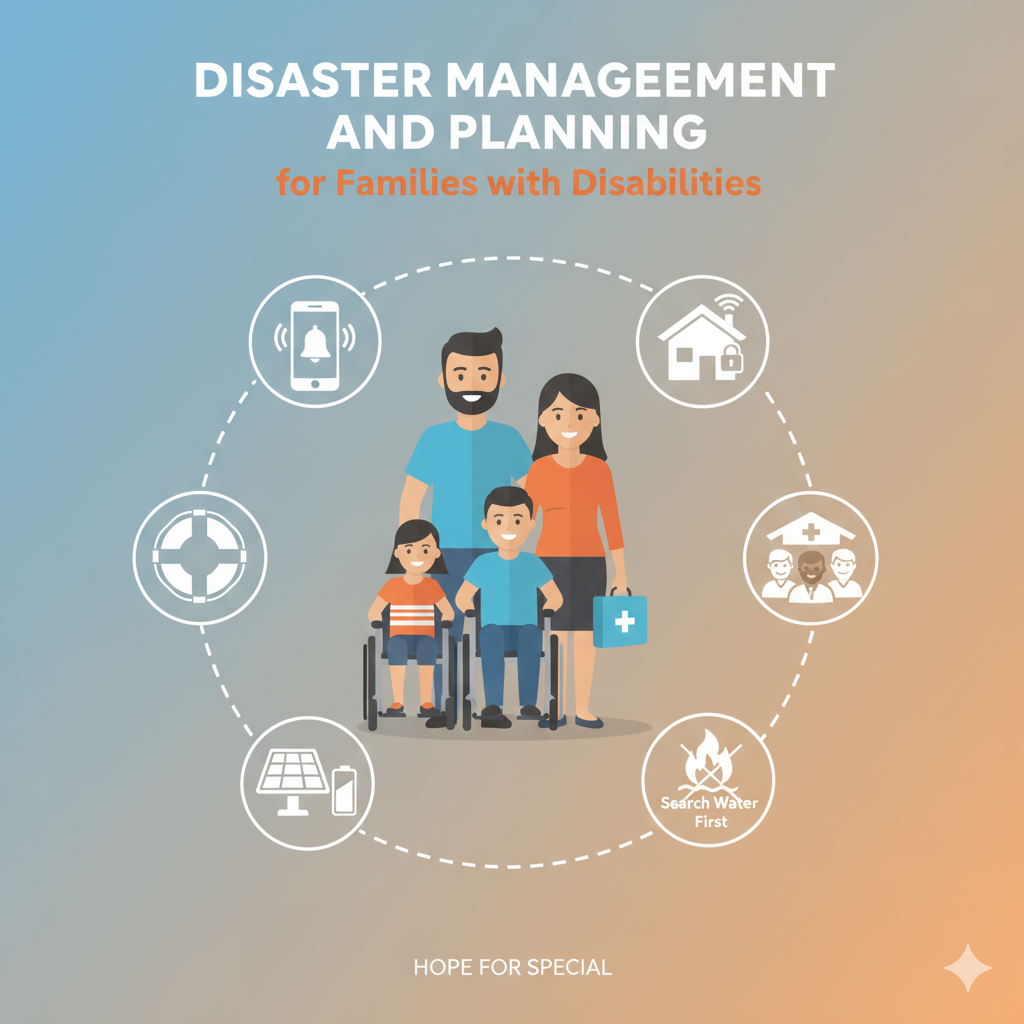
Disaster Management and Planning for Families with Disabilities
In 2026, we are witnessing a shift from “generic readiness” to inclusive resilience. For families living with disabilities, disaster management and planning is not a luxury—it is a life-sustaining necessity. Whether it is a flash flood, a wildfire, or a prolonged power outage, the traditional 72-hour kit often falls short of the complex needs of those with medical dependencies or sensory processing challenges.
At Hope for Special, we understand that a disaster emergency plan must be as unique as the family it protects. This guide explores the “Tactical Field Manual” approach to survival, integrating 2026 tech with the critical—and often ignored—pillar of water safety.

- 1. The Survival Gap: 2026 Inclusive Statistics 📊
- 2. The “Search Water First” Annex: A Critical 2026 Discovery 🌊⚓
- 3. The 5-Pillar Disaster Management Planning Framework 🧱
- Pillar I: The 72-Hour Medical Power Audit
- Pillar II: The Sensory Go-Bag (Behavioral Resilience)
- Pillar III: Workplace Emergency Preparedness
- Pillar IV: The “Neighbor Mesh” (Community Integration)
- Pillar V: The Digital First Responder Handshake
- 4. Case Study: The Flash Flood “Redundancy” Save 🦋
- 5. FAQs: Disaster Management and Planning for 2026
- How does the National Disaster Management Plan 2019 help disabled families?
- What is the best way to handle workplace emergency preparedness for mobility issues?
- How can I prepare for “Water Safety” if a flood occurs?
- Final Thoughts: The Resilience of the Prepared 🕊️
- Sources
1. The Survival Gap: 2026 Inclusive Statistics 📊
Disasters do not affect everyone equally. For the disability community, the “survival gap” is a measurable reality. According to recent 2025-2026 global assessments, the mortality rate for people with disabilities during natural disasters remains significantly higher than the general population.
Disability-Inclusive Disaster Metrics (2025/2026)
| Metric | Impact Statistic | Strategic Necessity | Source |
|---|---|---|---|
| Mortality Rate | 2–4x Higher | Requires a “Person-Centered” disaster emergency plan. | UNDRR 2025 |
| Shelter Accessibility | 57% Hardship | Standard shelters often lack sensory or medical infrastructure. | WID 2025 |
| Water Risk (Autism) | 90% Fatalities | Elopement toward water is the #1 cause of death in chaotic events. | National Autism Association |
| Grid Dependency | 1 in 4 Households | Reliance on electricity for medical gear (vents/oxygen) is rising. | Urban |
2. The “Search Water First” Annex: A Critical 2026 Discovery 🌊⚓
While most disaster preparedness and management guides focus on storing water for consumption, our research highlights water as a primary threat during crisis-induced elopement.
In 2019, the National Disaster Management Plan 2019 began incorporating disability provisions, but it often misses the behavioral “sensory magnet” of water. During the panic of a disaster response planning execution, children with autism often wander toward water to escape the noise of sirens and alarms.
The Tactical Response:
If a family member with wandering tendencies goes missing during a crisis:
- Search Water First: Check pools, retention ponds, and storm drains immediately.
- Designated Water Watcher: Even during evacuation, one person must be assigned as the “Perimeter Lead” to prevent wandering.
- Waterproof GPS: In 2026, ensure your disaster emergency plan includes IP68-rated wearables (like AngelSense) that provide active tracking near water hazards.
3. The 5-Pillar Disaster Management Planning Framework 🧱
Effective disaster planning and preparedness requires more than a backpack; it requires a systemic ecosystem of support.
Pillar I: The 72-Hour Medical Power Audit
If your family uses a ventilator, power chair, or AAC device, your emergency management plans live or die by the grid.
- Solar-Lithium Hubs: Move away from gas generators. 2026 solar stations are silent and can be used inside apartments/shelters.
- Redundant Spares: Always have a 14-day supply of “Critical Spares”—tubing, batteries, and manual override tools.
- Hospital Preparedness Program: Register your home with local utilities and the regional hospital preparedness program to ensure you are on the “Priority Restoration” list.
Pillar II: The Sensory Go-Bag (Behavioral Resilience)
Disaster shelters are sensory minefields. Your disaster management example kit should include:
- Noise-Isolation Gear: Industrial-grade earmuffs.
- Texture-Specific Clothing: For children with tactile defensiveness, losing familiar-feeling clothes can trigger a total breakdown.
- Visual Schedules: Use laminated PECS cards to explain the disaster planning and preparedness steps.
Pillar III: Workplace Emergency Preparedness
Safety doesn’t stop at home. Workplace emergency preparedness for disabled employees must include:
- Evacuation Chairs: Specialized chairs for descending stairs in high-rises.
- Buddy System: A designated peer who knows how to operate medical equipment or provide sensory de-escalation.
Pillar IV: The “Neighbor Mesh” (Community Integration)
You cannot survive a disaster alone.
- The “Key Rule”: Give a trusted neighbor a key and a list of your “Top 3 Life-Sustaining Needs.”
Pillar V: The Digital First Responder Handshake
In 2026, ensure your local dispatch has your “Vulnerability Profile.” Your disaster response planning should be digitally flagged so rescuers know: “Child is non-verbal; likely hiding in a closet.”
4. Case Study: The Flash Flood “Redundancy” Save 🦋
“During the 2025 floods, our disaster planning and preparedness was tested. Our fence was washed away, which meant our ‘Perimeter’ for our son, Leo, was gone. Because our emergency management plans included a waterproof GPS and a ‘Neighbor Alert’ system, our neighbor found Leo at the edge of the rising creek before he even stepped in. The ‘Search Water First’ rule we practiced saved his life.” — Marcus, Hope for Special Parent.
5. FAQs: Disaster Management and Planning for 2026
How does the National Disaster Management Plan 2019 help disabled families?
The National Disaster Management Plan 2019 was a milestone in India and globally, mandating that local authorities include PWDs (Persons with Disabilities) in rescue drills. Families should use this as leverage to ask for disaster planning and preparedness audits from their local city council.
What is the best way to handle workplace emergency preparedness for mobility issues?
Always request a PEEP (Personal Emergency Evacuation Plan). This should include a “Stair Descent” protocol and a designated “Safe Zone” that is smoke-proofed if immediate evacuation is impossible.
How can I prepare for “Water Safety” if a flood occurs?
Identify all “Sensory Magnets” (pools/ponds) within a 0.5-mile radius of your home. Mark these on your disaster emergency plan map as “Primary Search Areas” in case of wandering during the chaos.
Final Thoughts: The Resilience of the Prepared 🕊️
Disaster management and planning is an act of love. By moving beyond the “one-size-fits-all” model and focusing on medical continuity and water safety, you are building a future where your family doesn’t just survive—they thrive through the storm.
Sources
UNDRR – Inclusive Disaster Risk Reduction
Global standards and 2026 frameworks for ensuring that disaster preparedness and management includes the most vulnerable.
Ready.gov – Emergency Planning for People with Disabilities
The official federal repository for disaster planning and preparedness checklists and templates.
National Autism Association – Water Safety & Wandering Resources
The leading resource for integrating water safety into a neurodivergent disaster emergency plan.


