

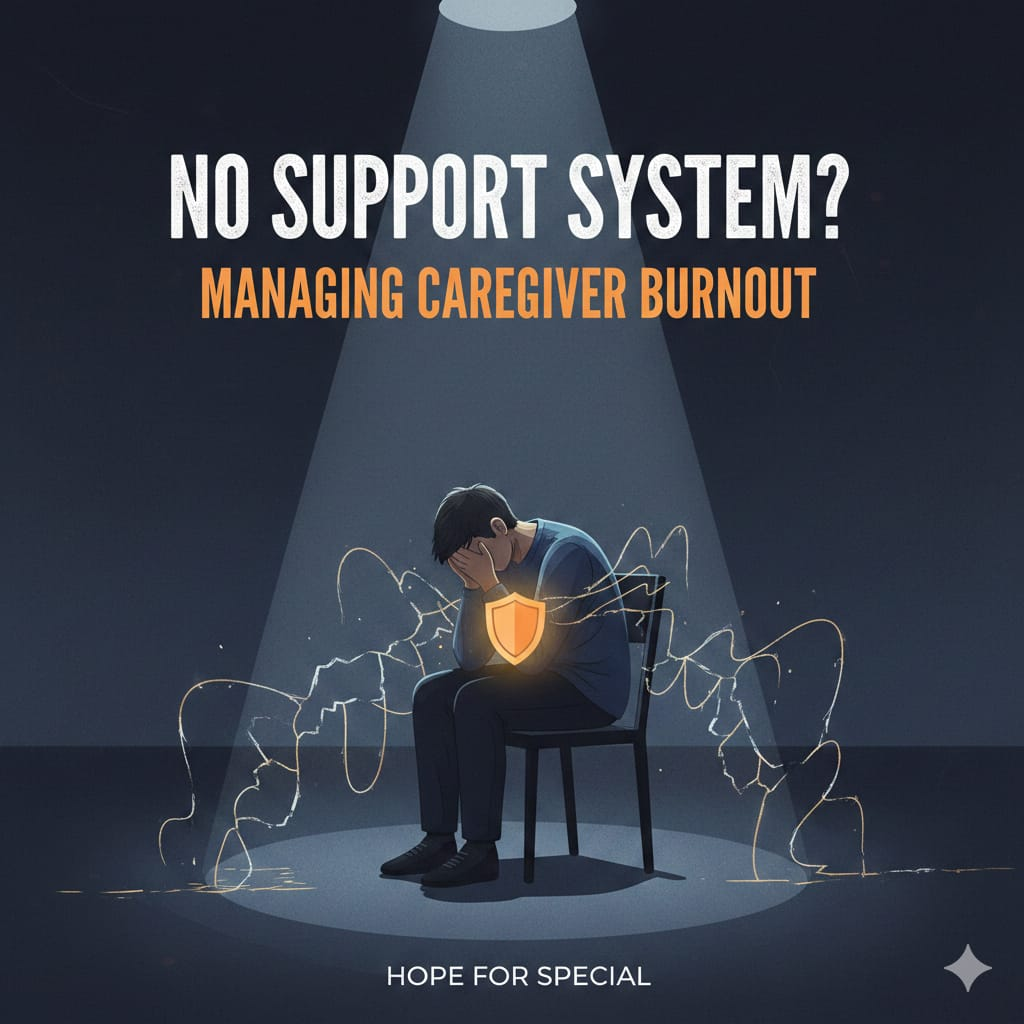
Managing Caregiver Burnout When You Have No Support System
If you are reading this, you are likely exhausted. Not just “need a nap” exhausted, but the kind of soul-deep depletion that comes when you are the only line of defense for a loved one.
At Hope for Special, we know that for many, the advice to “just ask a friend for help” feels like a cruel joke. When you are managing caregiver burnout when you have no support system, you aren’t looking for a spa day; you are looking for a way to survive without breaking.
This guide is designed for the solo warrior. No fluff—just radical strategies for the isolated caregiver.

- 1. The Reality of the “Solo Caregiver” Crisis 📊
- 2. Managing Caregiver Burnout When You Have No Support System: Radical Prioritization ⚡
- 3. Creating a “Digital Support System” (Automating the Help) 🤖
- 4. Professional Resources for the Isolated Caregiver 🏛️
- 5. The Solo Caregiver’s “Emergency Protocol” 🚨
- 6. Micro-Rest for the Mind 🧘
- FAQs: Managing Caregiver Burnout When You Have No Support System
- How do I know if I’m reaching a crisis point?
- Can I get paid to be a caregiver if I have no other income?
- Is it normal to feel resentment when I have no support?
- Final Thoughts: You Are a Hero, But Heroes Need Armor 🛡️
- 1. The Reality of the “Solo Caregiver” Crisis 📊
- 2. Managing Caregiver Burnout When You Have No Support System: Radical Prioritization ⚡
- 3. Creating a “Digital Support System” (Automating the Help) 🤖
- 4. Professional Resources for the Isolated Caregiver 🏛️
- 5. The Solo Caregiver’s “Emergency Protocol” 🚨
- 6. Micro-Rest for the Mind 🧘
- FAQs: Managing Caregiver Burnout When You Have No Support System
- How do I know if I’m reaching a crisis point?
- Can I get paid to be a caregiver if I have no other income?
- Is it normal to feel resentment when I have no support?
- Final Thoughts: You Are a Hero, But Heroes Need Armor 🛡️
1. The Reality of the “Solo Caregiver” Crisis 📊
According to the Caregiving in the U.S. 2025 Report, caregiving has become significantly more intense over the last decade. Isolation isn’t just a feeling; it is a measurable health risk.
Solo Caregiving Impact Statistics (2025-2026 Data)
| Metric | Statistic | Impact on Solo Caregivers | Source |
|---|---|---|---|
| Prevalence | 24% of U.S. Adults | High risk of “Shift-less” care (no relief) | AARP/NAC 2025 |
| Mental Health | 3.72x Stress Multiplier | Solo caregivers without social time face extreme burnout | ResearchGate 2025 |
| Physical Toll | 45% High Physical Strain | Increased risk of chronic illness for the caregiver | CAPC 2026 |
| Unmet Needs | 1 in 5 rate health as “Poor” | Lack of backup leads to neglecting personal medical care | John A. Hartford Foundation |
2. Managing Caregiver Burnout When You Have No Support System: Radical Prioritization ⚡
When you are alone, you cannot do it all. You must implement what we call “The Caregiver’s Triage.” ### Stop Doing These 3 Things Immediately:
- The “Perfect Home” Standard: If the floor is dirty but the meds are administered, you are winning.
- Elaborate Meal Prep: Use paper plates. Buy pre-cut frozen vegetables. Nutrition matters, but “gourmet” is a luxury of time you don’t have.
3. Creating a “Digital Support System” (Automating the Help) 🤖
If you don’t have a brother, sister, or neighbor to lean on, you must use technology as your “surrogate support.”
- Medication Management: Use automated dispensers like Hero or PillPack to remove the mental load of scheduling.
- Remote Monitoring: Install smart cameras (with consent) so you can step into the garden or take a 10-minute shower without the “What if they fall?” anxiety.
- Grocery/Supply Automation: Set everything to “Auto-ship” via Amazon or Walmart. Every minute you aren’t in a store is a minute you are resting.
4. Professional Resources for the Isolated Caregiver 🏛️
If you are managing caregiver burnout when you have no support system, you need to look toward institutional help rather than personal help.
- Area Agencies on Aging (AAA): Even if your loved one isn’t a senior, these agencies often have “Lifespan Respite” grants. Find your local office at Eldercare.acl.gov.
- Respite Vouchers: Many states offer vouchers that pay for a professional to come to your home for 4-8 hours a week, even if you don’t qualify for full Medicaid. Check the ARCH National Respite Network.
- Disease-Specific Grants: Organizations like the National Multiple Sclerosis Society or the Alzheimer’s Association often have crisis funds for caregivers.
5. The Solo Caregiver’s “Emergency Protocol” 🚨
The biggest fear of the solo caregiver is: “What happens if something happens to ME?” This anxiety fuels burnout.
Build your “In Case of Emergency” (ICE) Folder:
- The Red Folder: Keep it on the fridge. It should contain:
- Full medication list and dosages.
- Daily routine (e.g., “Must be fed at 8 AM to avoid seizures”).
- Contact info for the primary doctor.
- Legal documents (POA, Advanced Directives).
- The “ICE” Contact: If you have no local family, list a long-distance friend or even your primary care physician.
6. Micro-Rest for the Mind 🧘
You cannot go to a yoga retreat. You can, however, do “Box Breathing” for 60 seconds while waiting for the kettle to boil.
Try the 5-4-3-2-1 Grounding Method:
- Acknowledge 5 things you see.
- 4 things you can touch.
- 3 things you hear.
- 2 things you can smell.
- 1 thing you can taste. This resets your nervous system when you feel a “meltdown” coming on.
FAQs: Managing Caregiver Burnout When You Have No Support System
How do I know if I’m reaching a crisis point?
Signs include “compassion fatigue” (feeling numb toward your loved one), frequent illness, and thoughts of hopelessness. If you feel you might harm yourself or your loved one, call the 988 Suicide & Crisis Lifeline immediately.
Can I get paid to be a caregiver if I have no other income?
Many states have “Consumer Directed Personal Assistance Programs” (CDPAP) or “Veteran-Directed Care” that allow the care recipient to hire you as their paid caregiver. Check Medicaid.gov for your state’s specific waiver programs.
Is it normal to feel resentment when I have no support?
Yes. It is a natural response to an unfair situation. Managing caregiver burnout when you have no support system involves acknowledging that your anger is a valid reaction to isolation, not a reflection of your love for the person you care for. 🧡
Final Thoughts: You Are a Hero, But Heroes Need Armor 🛡️
You are doing the work of an entire village by yourself. Please remember: You cannot pour from an empty cup. Using technology, lowering your household standards, and fighting for state-funded respite aren’t “extra”—they are your survival tools.


