

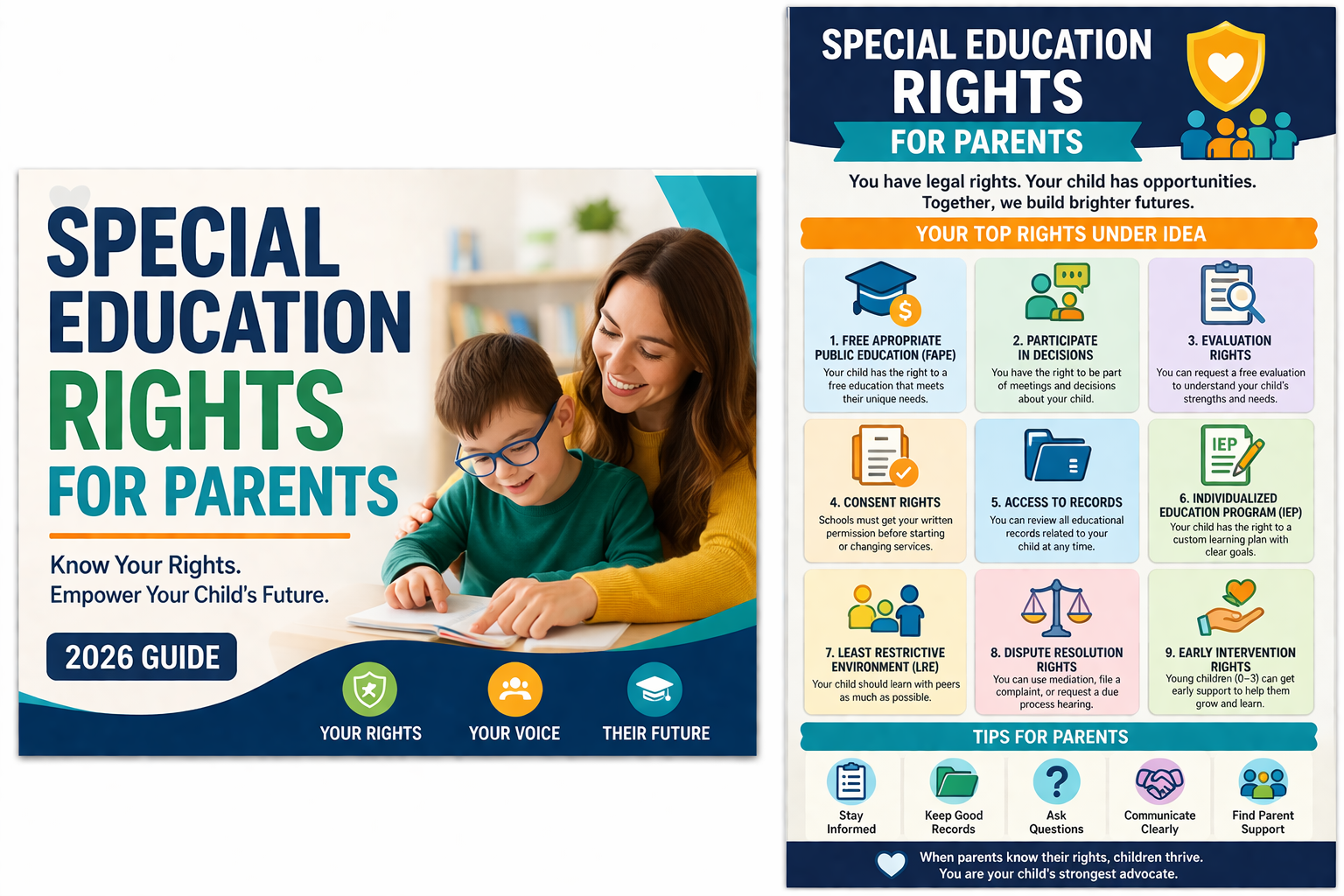
Special Education Rights for Parents: Complete Guide (2026)
🧠 What Are Special Education Rights for Parents?
Special education rights for parents are legal protections. These rights help parents support their child’s education.
In simple words, these rights ensure:
- Your child gets proper education
- You are involved in decisions
- Schools follow fair rules
The most important law behind these rights is the Individuals with Disabilities Education Act (IDEA). It ensures children with disabilities receive the support they need. (EDBlogs)
👉 This law protects both children and parents.
- 🧠 What Are Special Education Rights for Parents?
- 📊 Why Special Education Rights for Parents Matter
- 📜 1. Individuals with Disabilities Education Act (IDEA)
- 📘 2. Section 504 of the Rehabilitation Act
- 🏫 3. Inclusive Education Principles
- 1️⃣ Right to Free Appropriate Public Education (FAPE)
- 2️⃣ Right to Participate in Decisions
- 3️⃣ Right to Evaluation
- 4️⃣ Right to Give Consent
- 5️⃣ Right to Access Records
- 6️⃣ Right to an Individualized Education Program (IEP)
- 7️⃣ Right to Least Restrictive Environment (LRE)
- 8️⃣ Right to Dispute Decisions
- 9️⃣ Right to Early Intervention

📊 Why Special Education Rights for Parents Matter
Understanding special education rights for parents is very important.
It helps you:
- Speak confidently in meetings
- Protect your child’s future
- Get the right services
In the past, many children with disabilities were excluded from schools. Today, laws ensure equal access to education. (LegalClarity)
👉 This is a major progress in education rights.
⚖️ Key Laws That Protect Parents’ Rights
📜 1. Individuals with Disabilities Education Act (IDEA)
IDEA is the main law for special education.
It ensures:
- Free education for children with disabilities
- Special support services
- Parent involvement
According to official sources, IDEA provides services to millions of children and ensures equal opportunity in education. (EDBlogs)
📘 2. Section 504 of the Rehabilitation Act
This law protects children from discrimination.
👉 It ensures children get:
- Equal access to education
- Necessary accommodations
🏫 3. Inclusive Education Principles
Schools must support children in regular classrooms whenever possible.
This is called:
👉 Least Restrictive Environment (LRE)
It helps children:
- Learn with peers
🧩 Top Special Education Rights for Parents
Now, let’s understand the most important special education rights for parents.
1️⃣ Right to Free Appropriate Public Education (FAPE)
Your child has the right to free education.
This includes:
- Special teaching
- Therapy services
- Learning support
👉 Schools must provide these services at no cost.
FAPE is one of the core principles of IDEA. (American Bar Association)
2️⃣ Right to Participate in Decisions
Parents are not just observers. They are active members.
You have the right to:
- Attend meetings
- Help create education plans
👉 Parents are part of the IEP (Individualized Education Program) team. (LegalClarity)
3️⃣ Right to Evaluation
You can request an evaluation if you feel your child needs support.
Important points:
- Evaluation is free
- It checks learning and development
- It helps identify needs
Schools must evaluate children they suspect may have disabilities. (Understood)
4️⃣ Right to Give Consent
Schools cannot take action without your permission.
You must approve:
- Evaluations
- Special education services
👉 This ensures you stay in control.
5️⃣ Right to Access Records
You can see all school records related to your child.
This includes:
- Reports
- Test results
- IEP documents
👉 Transparency helps you make better decisions.
6️⃣ Right to an Individualized Education Program (IEP)
An IEP is a personalized plan for your child.
It includes:
- Learning goals
- Support services
- Progress tracking
👉 This plan is created with your input.
7️⃣ Right to Least Restrictive Environment (LRE)
Your child should learn with other children as much as possible.
👉 Schools must avoid unnecessary separation.
This improves:
- Confidence
8️⃣ Right to Dispute Decisions
If you disagree with the school, you can take action.
Options include:
- Mediation
- Complaint filing
- Due process hearing
👉 These safeguards protect your rights. (EDBlogs)
9️⃣ Right to Early Intervention
For young children (0–3 years), early support is available.
This includes:
- Therapy services
- Development support
👉 Early help improves long-term outcomes.
🧠 How These Rights Help Your Child
These rights are not just legal rules. They directly impact your child’s life.
They help your child:
- Learn better
- Build confidence
- Develop skills
Special education ensures children receive support tailored to their needs. (NCBI)
⚠️ Common Challenges Parents Face
Even with rights, parents may face challenges.
For example:
- Confusing terminology
- Lack of awareness
- Communication gaps with schools
👉 However, understanding your rights makes things easier.
❤️ Practical Tips for Parents
Here are simple tips to use your special education rights for parents effectively:
✔ Stay Informed
Learn basic laws and terms.
✔ Keep Records
Save emails, reports, and documents.
✔ Ask Questions
Do not hesitate to ask teachers.
✔ Stay Calm
Use a polite and professional tone.
✔ Join Support Groups
Learn from other parents.
📖 Real-Life Example
Ravi noticed his child was struggling in school. He requested an evaluation.
After assessment, the school created an IEP. Ravi actively participated in meetings.
Within a year:
- His child improved academically
- Confidence increased
- Communication improved
👉 This shows how special education rights for parents make a real difference.
📊 Key Statistics
- Over 8 million children receive special education services under IDEA (EDBlogs)
- Early intervention improves long-term outcomes
- Parent involvement increases academic success
👉 These numbers highlight the importance of awareness.
❓ FAQs
What are special education rights for parents?
They are legal rights that help parents support their child’s education.
What is the most important right?
The right to FAPE (free education) is the most important.
Can parents refuse special education services?
Yes. Parents must give consent before services begin.
What if I disagree with the school?
You can file a complaint or request mediation.
Are these rights available worldwide?
Many countries have similar laws, but rules may differ.
🌈 Final Thoughts
Understanding special education rights for parents is powerful.
👉 It helps you support your child
👉 It builds confidence
👉 It ensures better outcomes
Remember:
You are your child’s strongest advocate.


