

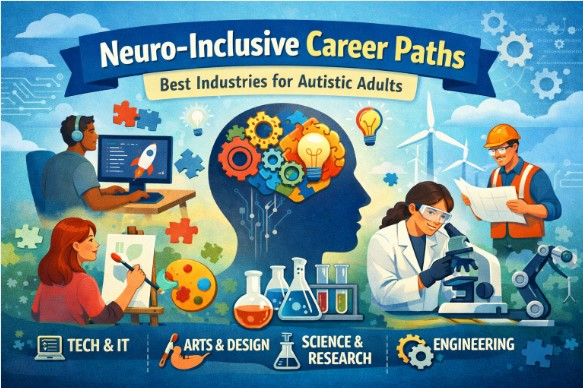
Neuro-Inclusive Career Paths: Best Industries for Autistic Adults 🌱
A 2026 Career Guide for Parents Navigating the “Transition Cliff” (Ages 15–25)
👩👦 Introduction: What Happens After 18?
For many families, turning 18 is not just a birthday—it’s a cliff. Services shrink, school support ends, and suddenly, the focus shifts to employment, independence, and long-term stability.
This guide on neuro-inclusive career paths is designed specifically for parents of autistic teens and young adults. It blends expert insights, lived experiences, and research-backed strategies to help you understand:
- Which autism-friendly industries actually work
- How to identify best careers for autism based on strengths
- What neurodiversity in workplace really looks like in 2026
- How to prepare your child for sustainable autistic adults jobs
- 👩👦 Introduction: What Happens After 18?
- 🧠 What Are Neuro-Inclusive Career Paths?
- 📊 Real Statistics on Autism Employment (2026 Snapshot)
- 🎯 Expert Q&A: Career Planning for Autistic Young Adults
- 👩⚕️ Expert Insight: Occupational Therapist (15+ years experience)
- 👨💼 Hiring Manager (Neurodiversity Program Lead)
- 🏆 Best Industries for Autistic Adults (2026 Updated)
- 💻 1. Technology & IT (Top Choice for Neuro-Inclusive Career Paths)
- 🎨 2. Creative Industries
- 🔬 3. Science & Research
- 📦 4. Logistics & Operations
- 🌐 5. Remote & Freelance Work
- 🧩 Matching Strengths to Careers (Practical Table)
- 🏡 Real-Life Case Example (Parent Perspective)
- 🧠 What Other Guides Miss (2026 Insights)
- 1. Sensory Environment Matters 🎧
- 2. Communication Style is Key 💬
- 3. Burnout is Real ⚠️
- 4. Success ≠ Traditional Jobs
- 🛠️ Autism Workplace Support & Accommodations
- 📈 Chart: Career Growth Potential (2026–2030)
- 📚 Step-by-Step Autism Employment Guide for Parents
- Step 1: Identify Strengths Early
- Step 2: Explore Career Paths (Age 15–18)
- Step 3: Build Skills (18–21)
- Step 4: Transition Gradually
- 💡 Autism Job Tips for Parents & Young Adults
- 🌍 What Defines Inclusive Workplaces in 2026?
- 🔗 Highly Authoritative External Resources
- ❓ FAQs (Voice Search Optimized)
- 1. What are the best careers for autistic adults?
- 2. Are there remote jobs for autistic adults?
- 3. What are neuro-inclusive careers?
- 4. How can parents help with autism employment opportunities?
- 5. What industries are autism-friendly?
- 🧭 Final Thoughts: Redefining Success Beyond 18

🧠 What Are Neuro-Inclusive Career Paths?
Neuro-inclusive career paths are jobs and industries that actively support different ways of thinking, learning, and working. These environments don’t just “accommodate”—they value neurodivergent strengths.
Key Features of Neuro-Inclusive Careers:
- Flexible communication styles
- Clear expectations and structured tasks
- Sensory-friendly environments
- Skill-based hiring instead of traditional interviews
- Strong workplace accommodations for autism
💡 In 2026, companies are shifting from “diversity hiring” to performance-driven neurodiversity hiring, where autistic strengths are seen as competitive advantages.
📊 Real Statistics on Autism Employment (2026 Snapshot)
| Statistic | Data | Source |
|---|---|---|
| Employment rate of autistic adults | ~30–40% globally | https://www.who.int/news-room/fact-sheets/detail/autism-spectrum-disorders |
| Underemployment rate | Over 50% | https://www.autism.org.uk/what-we-do/news/new-data-on-the-autism-employment-gap |
| Employers open to neurodiversity hiring | 75%+ in large firms | https://www2.deloitte.com/global/en/pages/about-deloitte/articles/diversity-and-inclusion.html |
| Autistic individuals preferring structured work | 80% | https://www.ncbi.nlm.nih.gov/pmc/articles/PMC8504047/ |
| Remote work preference among neurodivergent individuals | 65%+ | https://www.microsoft.com/en-us/worklab/work-trend-index |
👉 These numbers highlight a major gap—but also a growing opportunity for neuro-inclusive careers.
🎯 Expert Q&A: Career Planning for Autistic Young Adults
👩⚕️ Expert Insight: Occupational Therapist (15+ years experience)
Q: What’s the biggest mistake parents make?
👉 “Focusing only on academic success instead of functional independence and job readiness.”
Q: What should parents do instead?
✔ Start career exposure early (age 14–16)
✔ Build daily living skills alongside academics
✔ Focus on strengths, not deficits
👨💼 Hiring Manager (Neurodiversity Program Lead)
Q: What makes a candidate stand out?
👉 “Consistency, attention to detail, and reliability—qualities often strong in autistic individuals.”
Q: Are traditional interviews still used?
👉 “Less now. We prefer skill-based assessments and real-world tasks.”
🏆 Best Industries for Autistic Adults (2026 Updated)
Let’s explore the most effective autism-friendly industries based on strengths like pattern recognition, focus, creativity, and logical thinking.
💻 1. Technology & IT (Top Choice for Neuro-Inclusive Career Paths)
Why It Works:
- Structured workflows
- High demand for specialized skills
Roles:
- Software testing
- Data analysis
- Cybersecurity
- AI model training
💡 Tech jobs for autism are among the fastest-growing neurodivergent career options.
🎨 2. Creative Industries
Why It Works:
- Expression-driven
- Flexible work styles
- Often remote-friendly
Roles:
- Graphic design
- Animation
- Content writing
- Video editing
✨ Many individuals thrive in creative careers autism due to strong visual thinking.
🔬 3. Science & Research
Why It Works:
- Deep focus required
- Predictable routines
- Analytical thinking valued
Roles:
- Lab technician
- Research assistant
- Quality control analyst
📦 4. Logistics & Operations
Why It Works:
- Repetitive tasks
- Clear systems
- Minimal ambiguity
Roles:
- Inventory management
- Warehouse operations
- Supply chain tracking
🌐 5. Remote & Freelance Work
Why It Works:
- Controlled environment
- Reduced sensory overload
- Flexible schedules
Roles:
- Virtual assistant
- Freelance coding
- Online tutoring
📌 Remote jobs for autistic adults are becoming a cornerstone of neuro-inclusive careers.
🧩 Matching Strengths to Careers (Practical Table)
| Strength | Suitable Careers | Industry |
|---|---|---|
| Pattern recognition | Data analyst, QA tester | Tech |
| Attention to detail | Accounting, lab work | Finance/Science |
| Creativity | Design, writing | Creative |
| Routine preference | Logistics, admin | Operations |
| Deep focus | Programming, research | Tech/Academia |
🏡 Real-Life Case Example (Parent Perspective)
“My son struggled in school but loved patterns. At 19, he started learning data entry. Today, at 23, he works remotely as a data analyst. The key wasn’t fixing him—it was finding the right environment.”
This reflects the core principle of neuro-inclusive career paths:
👉 Fit the job to the person—not the person to the job.
🧠 What Other Guides Miss (2026 Insights)
Most career guides ignore these critical factors:
1. Sensory Environment Matters 🎧
Lighting, noise, and space impact performance more than skill.
2. Communication Style is Key 💬
Written instructions often outperform verbal ones.
3. Burnout is Real ⚠️
Masking (hiding autistic traits) leads to exhaustion.
4. Success ≠ Traditional Jobs
Freelance, hybrid, and project-based work are equally valid.
🛠️ Autism Workplace Support & Accommodations
Common Workplace Accommodations for Autism:
- Noise-canceling headphones 🎧
- Flexible schedules ⏰
- Written instructions 📄
- Quiet workspaces 🧘
📌 Learn more:
https://askjan.org/disabilities/Autism-Spectrum.cfm
📈 Chart: Career Growth Potential (2026–2030)
Tech Jobs for Autism       ██████████████
Remote Jobs                ████████████
Creative Careers           █████████
Logistics                  ███████
Traditional Office Roles   ████
👉 The future clearly favors neuro-inclusive careers in tech and remote work.
📚 Step-by-Step Autism Employment Guide for Parents
Step 1: Identify Strengths Early
Use observation over testing.
Step 2: Explore Career Paths (Age 15–18)
Internships, volunteering, job shadowing.
Step 3: Build Skills (18–21)
Focus on real-world skills, not just degrees.
Step 4: Transition Gradually
Part-time → freelance → full-time.
💡 Autism Job Tips for Parents & Young Adults
- Start small—confidence builds over time
- Use visual schedules
- Practice interviews differently (role-play tasks)
- Focus on inclusive workplaces, not just job titles
- Encourage self-advocacy
🌍 What Defines Inclusive Workplaces in 2026?
✔ Skills-first hiring
✔ Neurodiversity training for managers
✔ Flexible job roles
✔ Mental health support
🔗 Highly Authoritative External Resources
- WHO Autism Overview: https://www.who.int/news-room/fact-sheets/detail/autism-spectrum-disorders
- National Autistic Society Employment Data: https://www.autism.org.uk/advice-and-guidance/topics/employment
- Deloitte Neurodiversity Report: https://www2.deloitte.com/global/en/pages/about-deloitte/articles/diversity-and-inclusion.html
- Microsoft Work Trend Index: https://www.microsoft.com/en-us/worklab/work-trend-index
❓ FAQs (Voice Search Optimized)
1. What are the best careers for autistic adults?
The best careers for autistic adults include tech roles, creative jobs, research, and logistics—especially those with structure and low social pressure.
2. Are there remote jobs for autistic adults?
Yes, remote jobs are ideal for many autistic individuals due to flexibility and reduced sensory stress.
3. What are neuro-inclusive careers?
Neuro-inclusive careers are jobs designed to support neurodivergent individuals through flexible environments and inclusive hiring practices.
4. How can parents help with autism employment opportunities?
Parents can support by focusing on strengths, exploring careers early, and encouraging skill-based learning.
5. What industries are autism-friendly?
Technology, creative fields, research, logistics, and remote work industries are among the most autism-friendly.
🧭 Final Thoughts: Redefining Success Beyond 18
The future of work is changing—and that’s good news.
Neuro-inclusive career paths are no longer niche. They are becoming the standard in forward-thinking industries.
As a parent, your role is not to force your child into a system that doesn’t fit—but to help them find a system where they thrive.
✨ Because success is not about fitting in—it’s about standing strong in the right environment.


