

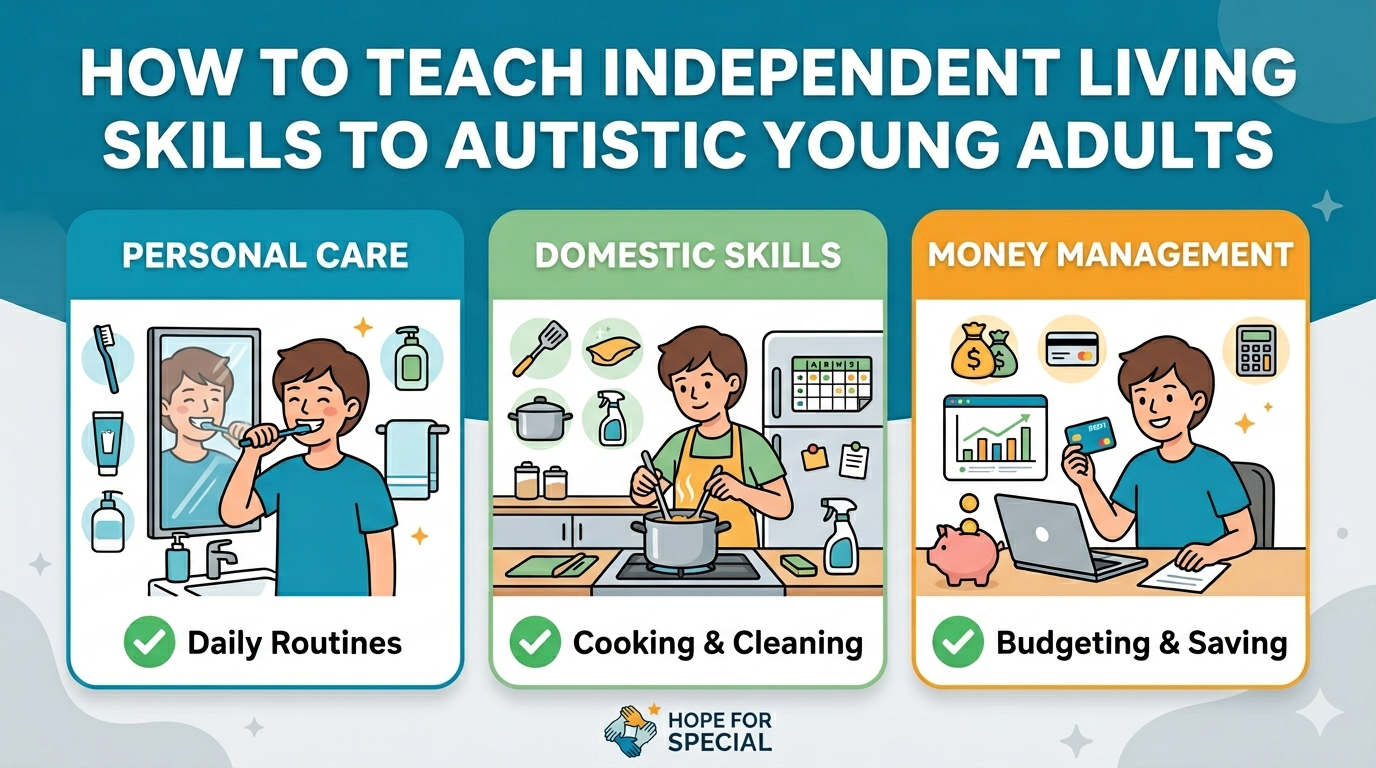
How to Teach Independent Living Skills to Autistic Young Adults
The transition from adolescence to adulthood is often described as a “cliff” for neurodivergent families. When the structure of the school system disappears, the weight of independent living skills falls squarely on the shoulders of young adults and their support systems.
But here is the truth that most clinical guides miss: independent living skills are not about achieving “normalcy.” They are about achieving autonomy. 🧩
Whether it’s managing a sensory-friendly kitchen or mastering the executive function required for a laundry routine, teaching independent living skills for young adults requires a shift from “compliance-based” teaching to a “neuro-affirming” approach.
In this comprehensive guide, we will explore deeply researched strategies, real-world statistics, and a step-by-step roadmap to help autistic young adults thrive.

- I. The Current Landscape: Why “Life Skills” Matter Now 📊
- II. Core Domains of Independent Living Skills 🏠
- III. The “Neuro-Affirming” Teaching Methodology 💡
- IV. A Step-by-Step Task Analysis Example: Doing Laundry 🧺
- V. Overcoming the “Executive Function” Trap 🧠
- VI. Frequently Asked Questions (Long-Tail Keywords) ❓
- VII. The Road Ahead: A Personal Success Story 🌈
- Final Thoughts for Caregivers 💌
I. The Current Landscape: Why “Life Skills” Matter Now 📊
For many autistic individuals, there is a documented “disconnect” between cognitive ability (IQ) and daily living skills. A person may be a brilliant coder but struggle to remember to hydrate or navigate a grocery store.
Statistics on Independent Living (2025-2026 Data)
| Metric | Statistic | Source Link |
|---|---|---|
| Young adults with autism living independently | ~19-20% | Drexel Autism Institute |
| Autistic adults living with parents/caregivers | 87% | National Autism Indicators Report |
| High-income household independence rate | 40% | Milestone Achievements |
| Low-income household independence rate | 6% | Milestone Achievements |
| Autistic youth receiving no transition services | 26% | A.J |
Expert Insight: “Adulthood begins in preschool.” The gap in living skills between autistic and neurotypical peers often widens during the teenage years. Early, intentional instruction using task analysis is the gold standard for closing this gap.
II. Core Domains of Independent Living Skills 🏠
To teach effectively, we must first categorize. Life skills for adults aren’t just about chores; they encompass five critical “Sill Pillars.”
1. Personal Maintenance & Hygiene 🚿
This includes showering, oral care, and dressing. For an autistic young adult, the “barrier” is often sensory.
- The Problem: The “prickly” feeling of water or the smell of mint toothpaste.
- The Neuro-Affirming Fix: Switch to unflavored toothpaste or high-pressure showerheads that feel like “deep pressure” rather than light touch.
2. Domestic Navigation (Kitchen & Cleaning) 🍳
Cooking is a high-level life skill for young adults because it requires massive executive functioning (timing, heat management, following multi-step instructions).
- Example: Use an “Air Fryer First” policy. It is safer, shuts off automatically, and provides consistent results, reducing anxiety about undercooked food.
3. Financial Literacy & Budgeting 💳
Understanding the “invisibility” of digital money is a major hurdle.
- Strategy: Use visual banking apps that show “buckets” of money for rent, food, and fun.
4. Community Access & Transportation 🚌
Whether it’s Uber, a bus, or driving, independent living skills rely on getting from point A to point B safely.
5. Self-Advocacy & Health 💊
This is the “Hidden Pillar.” It’s the ability to say, “I am overwhelmed, I need a break,” or knowing how to call a doctor when sick.
III. The “Neuro-Affirming” Teaching Methodology 💡
Most websites tell you to “just practice.” We recommend a specific, research-backed framework called S.C.A.F.F.O.L.D.
S – Sensory Audit 👂
Before teaching a skill, check the environment. Is the vacuum too loud? Is the dish soap too “slimy”? If the sensory input is painful, the skill will never be mastered.
C – Chaining (Forward & Backward) 🔗
- Forward Chaining: Teach the first step (taking out the bread), and you do the rest.
- Backward Chaining: You do everything except the last step (putting the plate on the table). This allows the learner to feel the “win” of completing the task immediately.
A – Analogies & Visuals 🖼️
Use “Video Modeling.” Record a 30-second clip of the young adult successfully doing the task. Watching themselves succeed is more powerful than watching a stranger.
F – Functional Communication 🗣️
Ensure they have a way to ask for help when a machine breaks or a step is forgotten. This is a core part of independent living skills for young adults.
O – Objectives that Matter 🎯
Don’t teach “making a bed” if they don’t care about it. Teach “ordering a pizza” or “playing a video game” to build the muscle of following steps.
L – Low-Demand Days 🛋️
Respect the “Spoon Theory.” If they had a hard day at work or school, don’t force a complex cooking lesson. Maintenance is better than burnout.
D – Dignity of Risk 🧗
Allow them to make mistakes. If they spend their “fun money” too early in the week, let them experience the consequence (safely) so they learn the value of a budget.
IV. A Step-by-Step Task Analysis Example: Doing Laundry 🧺
Using independent living skills in a practical scenario:
| Step | Instruction | Visual/Tool Needed |
|---|---|---|
| 1. Sort | “Lights vs. Darks” | Color-coded baskets |
| 2. Load | “Halfway full” | A physical “fill line” sticker on the machine |
| 3. Soap | “One Pod” | Use Pods (avoiding the mess of liquid) |
| 4. Start | “Push Green Button” | High-contrast label on the button |
| 5. Timer | “Set Phone Alarm” | Smartwatch or Phone |
V. Overcoming the “Executive Function” Trap 🧠
Many life skills for adults fail because of “Initiation Paralysis”—knowing how to do it but being unable to start.
How to help:
- Body Doubling: Sit in the room while they work. You don’t have to help; your presence helps ground their focus.
- Visual Checklists: Use a “Done” column with Velcro so they can physically move a task over.
- Smart Home Tech: “Alexa, remind me to check the oven in 10 minutes.” Leveraging AI is a game-changer for independent living skills.
VI. Frequently Asked Questions (Long-Tail Keywords) ❓
Q: What are the most important daily living skills for autism?
A: While every individual is different, safety, communication (self-advocacy), and basic nutrition are the “Big Three.” Without these, other living skills cannot be sustained.
Q: How can I find independent living programs for autistic young adults?
A: Look for “Transition to Adulthood” programs via your local school district (IDEA Act) or vocational rehabilitation services. Organizations like College Living Experience (CLE) offer specialized support.
Q: Can a “non-verbal” adult live independently?
A: Absolutely. Independence is about control, not necessarily doing everything physically alone. Using AAC (Augmentative and Alternative Communication) and smart-home automation allows many non-speaking adults to manage their own homes.
Q: What is the “Transitional Cliff”?
A: It refers to the loss of federally mandated support services (IEP/IDEA) once a student turns 21 or 22, making the teaching of independent living skills for young adults vital before this age.
VII. The Road Ahead: A Personal Success Story 🌈
Take the story of “Sam.” At 19, Sam couldn’t boil water because the sound of the boiling bubbles caused a sensory meltdown. Instead of forcing him, his parents bought an electric kettle with a “quiet boil” feature and a “stay-cool” exterior. By removing the sensory barrier, Sam mastered tea, then oatmeal, then pasta.
Today, Sam lives in a supported apartment. He doesn’t do “everything” like a neurotypical person—he uses a cleaning service once a month and orders pre-chopped vegetables—but he is independent.
Success is not doing it “their” way; it’s finding “your” way.
Final Thoughts for Caregivers 💌
Teaching independent living skills is a marathon, not a sprint. Celebrate the small wins. If they remembered to put their shoes away today, that is a victory. If they advocated for themselves at the grocery store, that is a triumph.


