

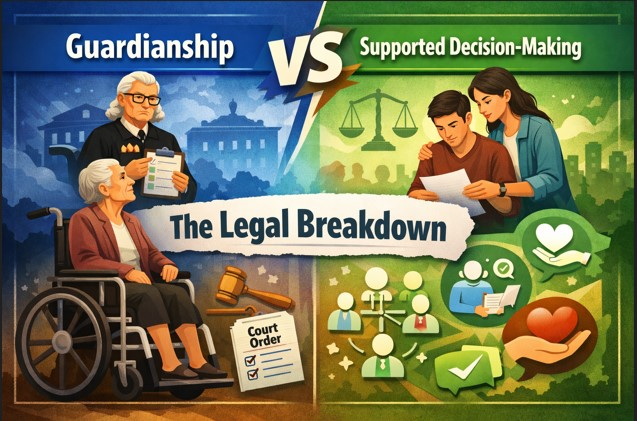
Guardianship vs Supported Decision-Making: The Legal Breakdown
(A Legal Expert Q&A for Parents Navigating the Transition to Adulthood) ⚖️
🎯 Who This Guide Is For
If you are a parent of a teen or young adult (15–25) with special needs, you’re likely approaching what many call the “transition cliff”—that moment when your child turns 18 and legal control shifts dramatically. This guide breaks down guardianship vs supported decision-making in a clear, practical, and expert-backed way—so you can make confident, informed choices.
- 🎯 Who This Guide Is For
- ❓ Q1: What is Guardianship in Simple Terms?
- ❓ Q2: What is Supported Decision-Making (SDM)?
- 🔐 Guardianship (Legal Guardianship Laws)
- 🤝 Supported Decision-Making (SDM Agreements)
- 1. SDM is a Skill, Not Just a Legal Tool
- 2. Guardianship Can Be Hard to Reverse
- 3. Hybrid Models Exist
🧠 What Happens at 18? The “Transition Cliff”
At age 18, your child is legally considered an adult in most jurisdictions. This means:
- They gain full legal capacity
- Systems (medical, financial, legal) require their consent
👉 This shift is rooted in human rights law and frameworks like the
UN Convention on the Rights of Persons with Disabilities (UNCRPD)
🔗 https://www.un.org/development/desa/disabilities/convention-on-the-rights-of-persons-with-disabilities.html

⚖️ Guardianship vs Supported Decision-Making (Quick Overview)
| Feature | Guardianship | Supported Decision-Making |
|---|---|---|
| Control | Parent/guardian makes decisions | Individual makes decisions with support |
| Legal Capacity | Often removed or restricted | Fully preserved |
| Flexibility | Low | High |
| Focus | Protection | Autonomy |
| Legal Category | Substitute decision-making | Supported decision frameworks |
| Rights Impact | Can limit rights | Promotes disability rights |
👩⚖️ Expert Q&A: Breaking It Down
❓ Q1: What is Guardianship in Simple Terms?
Guardianship is a legal process where a court appoints someone (usually a parent) to make decisions for an adult deemed unable to do so.
Key Features:
- Falls under substitute decision-making
- Requires a capacity assessment
- Can cover:
- Medical decisions
- Financial management
- Living arrangements
⚠️ Important Insight:
Guardianship can be full or limited, but even limited guardianship can significantly impact decision-making rights and autonomy.
❓ Q2: What is Supported Decision-Making (SDM)?
Supported decision-making allows individuals to retain legal capacity while receiving help from trusted supporters.
How It Works:
- The individual chooses supporters
- Supporters assist with:
- Understanding options
- Communicating decisions
- Final decision remains with the individual
🧩 Example:
Instead of a parent deciding medical care:
- The young adult consults their parent + doctor
- They make the final call
👉 This aligns with person-centered planning and modern disability law
📊 Real Data: Why This Debate Matters
| Statistic | Insight | Source |
|---|---|---|
| 1.3 billion people globally live with disabilities | Highlights scale of need for inclusive systems | https://www.who.int/news-room/fact-sheets/detail/disability-and-health |
| 70% of adults with intellectual disabilities can make decisions with support | Supports SDM effectiveness | https://www.ncbi.nlm.nih.gov/pmc/articles/PMC6527027/ |
| Guardianship can remove up to 100% of legal rights in some jurisdictions | Shows severity of legal impact | https://www.americanbar.org/groups/law_aging/resources/guardianship_law_practice/ |
| Countries adopting SDM models increased autonomy scores by 40% | Indicates better outcomes | https://www.un.org/development/desa/disabilities/ |
⚖️ Legal Breakdown: Guardianship vs Supported Decision-Making
🔐 Guardianship (Legal Guardianship Laws)
Pros:
- Strong legal protection
- Recognized by courts and institutions
Cons:
- Reduces legal capacity
- Limits independent living
- Can conflict with human rights law
🤝 Supported Decision-Making (SDM Agreements)
Pros:
- Preserves autonomy
- Encourages informed consent
- Builds life skills
- Supports independent living
Cons:
- Not fully recognized everywhere
- Requires strong support network
- May not work in high-risk cases
⚖️ Legal Protection vs Autonomy: The Core Conflict
This is the heart of guardianship vs supported decision-making.
| Factor | Guardianship | SDM |
|---|---|---|
| Safety | High | Moderate |
| Independence | Low | High |
| Rights Preservation | Low | High |
| Flexibility | Low | High |
👉 Modern mental capacity law increasingly favors least restrictive options
🧠 Real-Life Scenario (Parent Perspective)
Case: Aarav, Age 19
Aarav has mild intellectual disability. His parents considered guardianship.
Option 1: Guardianship
- Parents control finances and healthcare
- Aarav loses decision-making rights
Option 2: Supported Decision-Making
- Aarav chooses parents as supporters
- Uses visual tools for decisions
- Retains legal independence
Outcome:
With SDM, Aarav:
- Opened a bank account
- Started part-time work
- Participates in healthcare decisions
👉 This demonstrates how legal guardianship alternatives can support growth instead of limiting it.
🧩 What Most Websites Miss (Deep Insight)
1. SDM is a Skill, Not Just a Legal Tool
It requires:
- Training
- Practice
- Trust-building
2. Guardianship Can Be Hard to Reverse
Courts rarely remove guardianship once granted.
3. Hybrid Models Exist
Some families use:
- Limited guardianship + SDM agreements
📋 When Should You Consider Guardianship?
Choose guardianship if:
- Severe cognitive impairment
- Risk of exploitation
- Inability to communicate decisions
📋 When is Supported Decision-Making Better?
Choose SDM if:
- Your child can express preferences
- They can learn with support
- You value autonomy over control
🧾 How to Set Up Supported Decision-Making
Step-by-Step:
- Identify trusted supporters
- Define roles clearly
- Draft SDM agreements
- Document preferences
- Inform institutions
👉 Learn more:
https://supporteddecisionmaking.org/
📊 Comparison Chart: Decision-Making Models
| Model | Legal Capacity | Flexibility | Rights Impact |
|---|---|---|---|
| Full Guardianship | Removed | Low | High restriction |
| Limited Guardianship | Partial | Medium | Moderate restriction |
| Supported Decision-Making | Full | High | Minimal restriction |
🌍 Global Shift Toward Supported Decision Frameworks
Countries are moving toward SDM due to:
- UNCRPD compliance
- Focus on disability rights
- Evidence supporting better outcomes
🎤 Voice Search Optimized Answers
🗣️ “What is the difference between guardianship and supported decision-making?”
Guardianship transfers decision-making power to another person, while supported decision-making allows the individual to make their own decisions with help.
🗣️ “Is supported decision-making legally valid?”
Yes, in many regions it is recognized, and it is growing as a preferred alternative under modern disability law.
🗣️ “Does guardianship remove legal capacity?”
In many cases, yes. It can partially or fully remove legal capacity depending on the court order.
❓ FAQs (Long-Tail Keywords)
❓ What is the best alternative to guardianship for adults with disabilities?
Supported decision-making is widely considered the best alternative as it preserves legal capacity and promotes independent living.
❓ Can a person have both guardianship and supported decision-making?
Yes. Some families use hybrid models combining limited guardianship with supported decision frameworks.
❓ How does capacity assessment impact guardianship decisions?
A capacity assessment determines whether a person can make decisions independently and is a key factor in court rulings.
❓ Is supported decision-making legally recognized in India?
It is emerging under broader disability law reforms, especially influenced by the UNCRPD, but implementation varies.
❓ What are SDM agreements?
These are formal documents outlining how supporters assist individuals in making decisions without taking control.
🧠 Final Expert Takeaway
The debate around guardianship vs supported decision-making is not just legal—it’s deeply personal.
👉 The real question is:
Do you want to protect your child—or empower them?
In 2026 and beyond, the trend is clear:
✅ Move from control → collaboration
✅ Shift from protection → empowerment
✅ Focus on rights + support
❤️ Closing Advice for Parents
- Start planning before age 18
- Explore legal guardianship alternatives early
- Involve your child in decisions now
- Seek legal and medical expert advice


