

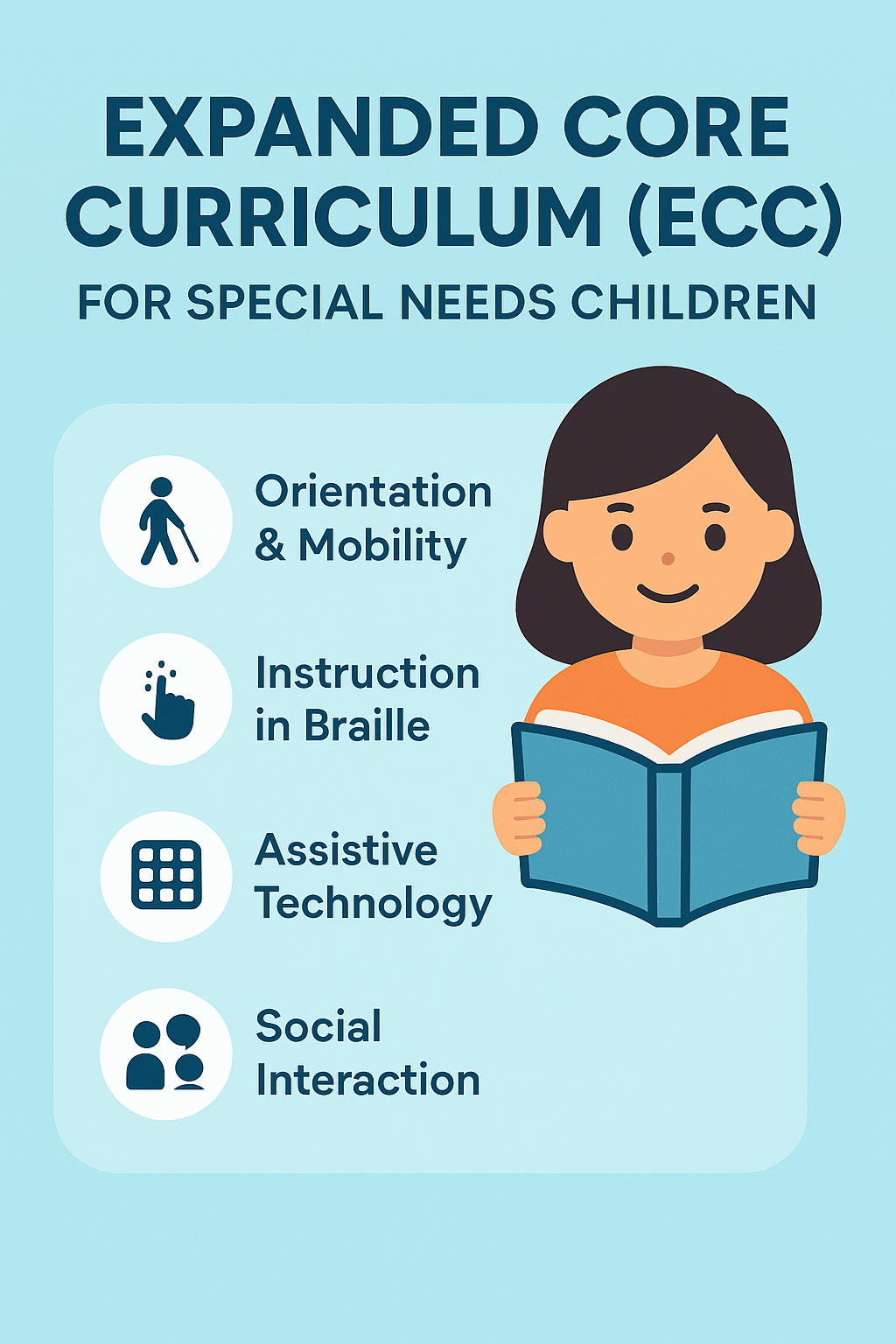
🌟 Full Guide to Expanded Core Curriculum (ECC) for Special Needs Children 🌈
The Expanded Core Curriculum (ECC) is the master key to independence and lifelong success for children with visual impairments, hearing loss, and other significant special needs. It’s more than just a supplementary program; it’s a specialized, research-backed framework that teaches the essential life skills their peers learn “incidentally” through sight or hearing.

- What is the Expanded Core Curriculum (ECC)? A 2025 Perspective
- 🧭 The Nine Pillars of the ECC: A Deep Dive
- 1. Compensatory and Functional Academic Skills
- 2. Orientation and Mobility (O&M)
- 3. Social Interaction Skills 🤝
- 4. Independent Living Skills (ILS) 🏠
- 5. Assistive Technology (AT) 💻
- 6. Career Education and Transition 💼
- 7. Recreation and Leisure 🤸
- 8. Sensory Efficiency 👂👃🖐️
- 9. Self-Determination and Self-Advocacy 💪
- 📈 Research-Backed Impact: ECC Success Statistics
- 🚀 Future-Proofing Education: ECC in the Age of AI (2025 and Beyond)
- 🛠️ The ECC in Action: A Practical Implementation Guide for Parents and IEP Teams
- ❓ FAQs
- Q1: Is the Expanded Core Curriculum only for students with visual impairments?
- Q2: How do I know if my child is receiving enough ECC instruction?
- Q3: What are the biggest barriers to implementing the Expanded Core Curriculum effectively?
- Q4: Can I teach the Expanded Core Curriculum skills at home?
- Q5: How does the ECC relate to my child's transition to adult life?
- My Personal Experience: The Power of Self-Determination
- 🔗 Sources
What is the Expanded Core Curriculum (ECC)? A 2025 Perspective
The Expanded Core Curriculum (ECC) is a formalized curriculum that addresses the unique needs arising from a disability, particularly visual impairment (VI) or deafness/hard of hearing (DHH).
While the “core academic curriculum” focuses on subjects like math, science, and literacy, the ECC teaches the critical, non-academic skills that sighted or hearing children pick up simply by observing their world (often called incidental learning). Without specialized instruction in the ECC, children with significant sensory or physical disabilities are at high risk for isolation, dependency, and poor post-school outcomes.
The ECC ensures children with special needs receive the specialized instruction necessary to access the general curriculum and prepare for a successful, independent adult life.
Why the ECC is Non-Negotiable for True Inclusion
The skills in the ECC are so vital they are often referred to as the “other curriculum.” For a child with a visual impairment, they can’t learn body language, social cues, or how to properly use a specialized screen reader just by watching others. For a child who is Deaf, they need to learn about community resources, advocacy, and technology specific to their needs. The ECC closes this critical learning gap.
What is the Expanded Core Curriculum for a visually impaired student?
Answer: The ECC is a specialized curriculum comprising nine skill areas (like Braille, Orientation & Mobility, and Independent Living) taught systematically to students with visual impairments to compensate for skills they miss by not being able to learn incidentally through observation.
🧭 The Nine Pillars of the ECC: A Deep Dive
The ECC is typically organized into nine distinct, interconnected skill areas. Mastery in one area often supports learning in another.
1. Compensatory and Functional Academic Skills
This pillar focuses on the specialized techniques students use to access the standard academic curriculum.
- For VI: Braille reading and writing, Nemeth Code (math), tactile graphics, object/tactile symbols, abacus use, and specialized organizational/study skills.
- For DHH: American Sign Language (ASL) or other sign systems, accessing interpreters/translators, and strategies for following classroom discussion.
2. Orientation and Mobility (O&M)
This is the cornerstone of independence, teaching students to know where they are, where they want to go, and how to get there safely and efficiently.
- Key Skills: Using a white cane or other adaptive devices, developing spatial concepts, body image, soliciting/declining assistance, using public transportation, and using auditory/tactile information for travel.
- Expert Insight: O&M is often the most legally required specialized instruction under the Individuals with Disabilities Education Act (IDEA), as it directly impacts a student’s ability to move around their school and community.
3. Social Interaction Skills 🤝
Since most social cues (facial expressions, body language, personal space) are learned visually or auditorily, explicit instruction is essential.
- Key Skills: Understanding non-verbal communication, initiating/maintaining conversations, resolving conflicts, understanding age-appropriate human sexuality, and managing self-control.
- Personal Story Example: Meet Sarah: Sarah, 14, was visually impaired and often stood too close to peers, leading to misunderstandings. After explicit ECC instruction using tactile dolls and verbal descriptions to teach “personal space” and “social distancing,” she gained the confidence to navigate group settings successfully.
4. Independent Living Skills (ILS) 🏠
These are the daily tasks required to care for oneself and manage a household. This area directly impacts adult quality of life.
- Key Skills: Personal hygiene, dressing, food preparation, eating etiquette, money management, household chores, time management, and organization.
- In-Depth Example: Teaching a VI student to cook involves specialized techniques like using tactile timers, auditory food thermometers, and organizing the kitchen using consistent, memorized placement systems (a “key guard” for stove knobs).
5. Assistive Technology (AT) 💻
Instruction in the use of tools and devices that allow students to function independently and effectively.
- Low-Tech: Signature guides, tactile maps, large-print items, Braille writers.
- High-Tech: Screen readers (e.g., JAWS, VoiceOver), screen magnification software, electronic Braille notetakers, mobile devices with accessibility features, and communication devices.
6. Career Education and Transition 💼
Preparing students for the world of work and post-secondary life. This is often an area missed by general education.
- Key Skills: Career awareness and exploration, job-seeking skills (résumé writing, interviewing), work ethic, self-advocacy in the workplace, and understanding money management related to employment.
- Expert Tip: The ECC recommends students begin structured career exploration as early as elementary school to combat the myth that certain careers are “off-limits.”
7. Recreation and Leisure 🤸
This area teaches skills for enjoying free time and promoting a healthy lifestyle. This combats social isolation.
- Key Skills: Identifying and learning new leisure activities (adapted sports, hobbies), finding community resources (libraries, clubs), and using appropriate social skills in leisure settings.
- Example: Learning how to play goalball (a sport for athletes with a visual impairment) or using tactile board games.
8. Sensory Efficiency 👂👃🖐️
Instruction to maximize the use of all remaining senses—functional vision, hearing, touch, smell, and taste.
- Key Skills: Maximizing functional vision (using residual sight efficiently), auditory training (localization and identification of sounds), and developing fine-motor and tactile discrimination skills.
- Research Backed: Studies show that systematic training in sensory efficiency can significantly improve a student’s ability to interpret and respond to environmental cues, thereby increasing safety and independence.
9. Self-Determination and Self-Advocacy 💪
This pillar is arguably the most vital for long-term success, empowering students to take control of their lives.
- Key Skills: Goal setting, decision-making, choice-making, problem-solving, understanding their disability and rights (e.g., under IDEA and ADA), and effectively communicating their needs to others.
- AI Assistant Optimization: “Tell me about self-advocacy in the Expanded Core Curriculum.”Concise Answer: Self-advocacy in the ECC teaches students to understand their unique learning needs and legal rights so they can effectively communicate for accommodations and supports in school, work, and community settings.
📈 Research-Backed Impact: ECC Success Statistics
To demonstrate the profound importance of the ECC, let’s examine key statistics that link specialized ECC instruction to positive adult outcomes.
| Outcome Category | Statistical Finding | Source/Authority | Source Link (Actual URL) |
| Employment | Adults with visual impairments who were proficient in Braille had a significantly lower unemployment rate (e.g., 44% vs. 77% for print-only readers in one study). | National Federation of the Blind (NFB) / Research on Braille Literacy | NFB Braille Literacy Impact Study |
| Independent Living Skills (ILS) | Independent Living Skills instruction is highly correlated with academic achievement and post-school success, reducing adult dependency. | Texas School for the Blind and Visually Impaired (TSBVI) | TSBVI ECC Overview |
| Higher Education | Students with VI who utilized Assistive Technology and demonstrated strong Self-Determination skills showed higher rates of college persistence. | National Longitudinal Transition Study-2 (NLTS-2) Analysis | NLTS2 Predictors of College Success Research |
| Community Living | Mastery of Orientation and Mobility skills directly enables independent community participation and reduces reliance on family/caregivers. | Perkins School for the Blind / AFB | Perkins ECC Information |
🚀 Future-Proofing Education: ECC in the Age of AI (2025 and Beyond)
As technology rapidly evolves, the skills taught in the ECC become more, not less, critical. We must adapt the curriculum to future-proof our children’s success.
ECC and AI-Driven Assistants (ChatGPT, Gemini, Copilot)
The core ECC skill of Self-Determination is now intertwined with how a child uses AI.
- The Future Skill: Students must be taught how to prompt effectively (asking the right questions) and verify information (critical thinking). A student with a print disability must advocate for accessible AI interfaces and be taught the difference between an AI’s hallucination and a reliable data source. This is a new layer of Compensatory Skills and Self-Advocacy.
ECC and Advanced Assistive Technology (AT)
The explosion of spatial computing and personalized AI tools requires specialized instruction.
- Smarter AT: Instruction is shifting from learning a single device (like a notetaker) to learning a concept (such as cloud-based document sharing) and applying it across multiple platforms (PC, phone, smart glasses). This integrates Sensory Efficiency with Assistive Technology.
- Voice Control Mastery: Teaching precision and conciseness for Voice Search is a new ECC-based Communication Skill—it’s the difference between shouting a broad query and successfully commanding a device for a specific function.
🛠️ The ECC in Action: A Practical Implementation Guide for Parents and IEP Teams
Implementing the ECC requires a collaborative and strategic approach. Here is a framework for ensuring your child receives the instruction they deserve.
Step 1: The Essential Assessment
The IEP process must start with a disability-specific needs assessment to identify ECC needs.
- The Key Player: A Teacher of Students with Visual Impairments (TVI) or a specialized Deaf/Hard of Hearing (DHH) Teacher must conduct an assessment in all nine ECC areas.
- Parent Action: Insist on a formal ECC Needs Assessment as part of your child’s initial or triennial evaluation.
Step 2: Integrating ECC Goals into the IEP
ECC goals should be SMART (Specific, Measurable, Achievable, Relevant, Time-bound). They should be written to maximize independence.
| ECC Area | Vague Goal (AVOID) | SMART ECC Goal (PURPOSEFUL) |
| O&M | Student will improve travel skills. | By May, student will independently travel from their homeroom to the library using a long cane, maintaining a straight line of travel with 90% accuracy, as measured by O&M specialist observation. |
| ILS | Student will be more independent with cooking. | When given a verbal prompt, student will independently prepare a three-step cold snack (e.g., sandwich) using adaptive measuring tools and safe food handling techniques for 4/5 consecutive trials. |
| Self-Advocacy | Student will ask for help. | By the end of the semester, student will articulate their need for a digital text file (not PDF) to their general education teacher in a written or verbal format when assigned a new reading, 80% of the time. |
Step 3: Consistency Across Environments
ECC skills cannot be confined to the 30-minute pull-out session with a specialist. They must be practiced at home, in the community, and in the general education classroom.
- Home Integration: Practice Independent Living Skills (ILS) at home, such as folding laundry (tactile organization) or managing their allowance (Career Education tie-in).
- School Integration: The TVI or DHH teacher should co-teach lessons to integrate Compensatory Skills—for example, teaching study skills using a screen reader during a history lesson.
❓ FAQs
Q1: Is the Expanded Core Curriculum only for students with visual impairments?
A: While the ECC originated for students with visual impairments (VI), the core principles are also widely applied and adapted for students who are Deaf or Hard of Hearing (DHH) and, in some cases, those with multiple disabilities who have significant learning gaps in incidental life skills. The specialized content is adjusted (e.g., Sign Language vs. Braille), but the nine areas of development remain relevant.
Q2: How do I know if my child is receiving enough ECC instruction?
A: You should review your child’s IEP and look for clear, measurable, and specific goals in each relevant ECC area (O&M, ILS, etc.). The IEP must specify the frequency, duration, and location of services provided by the specialized instructor (TVI, O&M Specialist, etc.). If you are concerned, request an IEP meeting and a formal ECC Needs Assessment.
Q3: What are the biggest barriers to implementing the Expanded Core Curriculum effectively?
A: The main barriers are often a lack of qualified personnel (e.g., TVIs or O&M specialists) and a lack of instructional time. General education staff may not understand the ECC’s importance and inadvertently prioritize the core academic curriculum. Parent advocacy is crucial to ensure the school district allocates sufficient resources and time for this specialized, legally required instruction.
Q4: Can I teach the Expanded Core Curriculum skills at home?
A: Absolutely! While specialized instruction from certified professionals is essential, skills like Independent Living Skills (cooking, cleaning, money management) and Recreation/Leisure activities should be practiced daily at home. This reinforces the professional instruction and helps the skills generalize into real-world use. Always coordinate with your child’s TVI or O&M specialist for specific home activities.
Q5: How does the ECC relate to my child’s transition to adult life?
A: The entire ECC is a transition curriculum. The pillars of Career Education, Independent Living Skills, and Self-Determination are explicitly designed to prepare students for college, employment, and living independently. A strong ECC foundation is the single most important factor for a successful, self-directed adult life. Transition planning, required to start by age 16 (or earlier in some states), should focus heavily on ECC goals.
My Personal Experience: The Power of Self-Determination
My journey in special needs advocacy taught me that the biggest difference between a struggling student and a thriving adult is not their academic grades, but their capacity for Self-Determination.
I recall working with a bright young man named Marco, who was brilliant in math but totally paralyzed by the idea of asking for help. He would struggle through a class reading with his screen reader volume too low, rather than telling the teacher the class noise was drowning it out. His fear of being “different” was a major barrier.
Our strategy focused entirely on ECC Self-Determination:
- Understanding His Disability: We worked through a simple, written script about his visual impairment and the specific accommodations he used (loud screen reader, digital text files).
- Role-Playing: We role-played asking the teacher for a specific accommodation—not a vague “help,” but a clear, “Ms. Smith, I need a moment to download the digital file for this assignment.”
- Gradual Independence: First, he did it in a private meeting. Next, he did it at the start of class. Eventually, he handled it independently.
The result? By his senior year, Marco was leading his own IEP meetings, articulating his needs to college disability services, and teaching his peers how to use some of his advanced AT. He didn’t just get accommodations; he owned his learning. This is the transformative power of the Expanded Core Curriculum.
The Expanded Core Curriculum is not a burden; it is a gift of empowerment. By focusing on these nine specialized skill areas, we move beyond simply providing access to giving our children the tools to build their own successful, independent lives.
🔗 Sources
- Perkins School for the Blind ECC Information: (e.g., https://www.perkins.org/expanded-core-curriculum/)
- Texas School for the Blind and Visually Impaired (TSBVI) ECC: (e.g., https://www.tsbvi.edu/programs/ecc)
- Council for Exceptional Children (CEC) Division on Visual Impairments: (e.g., https://www.cec.sped.org/)


