

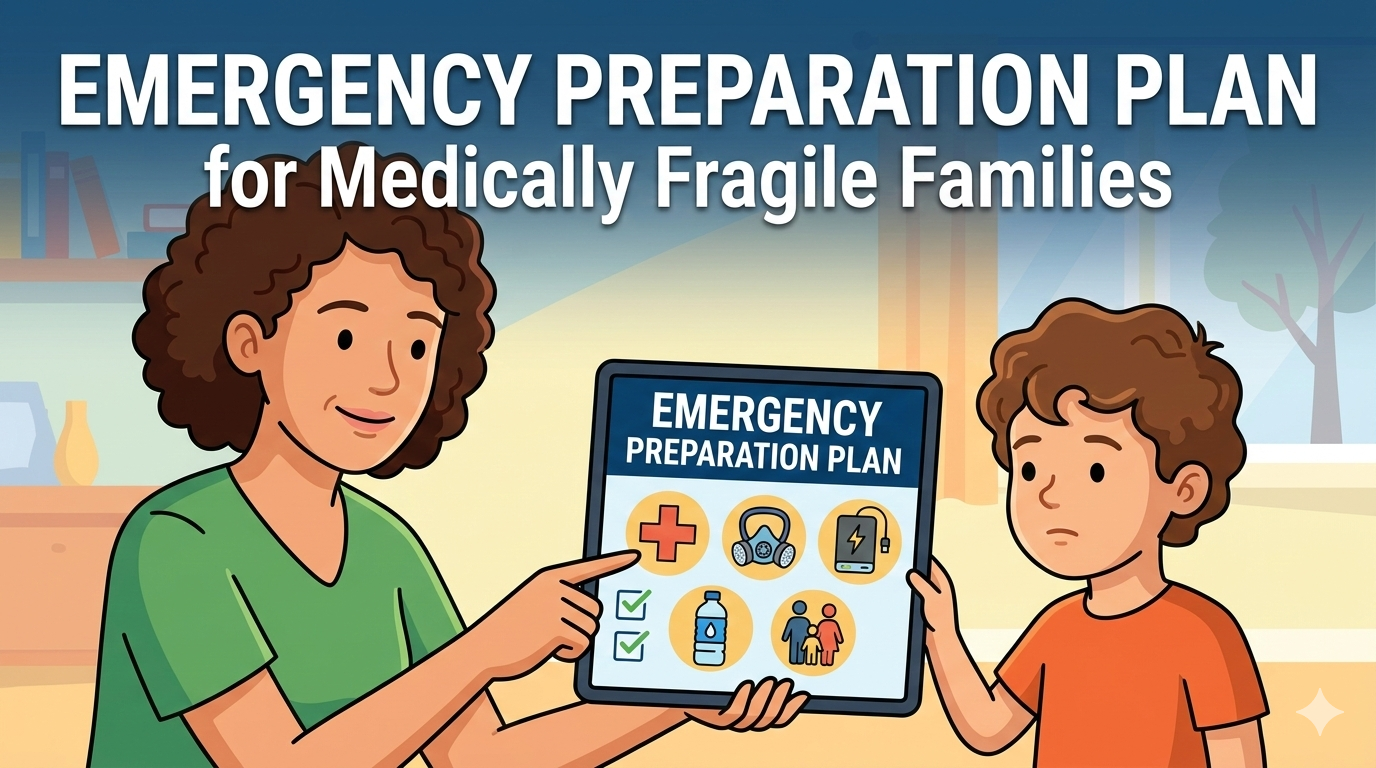
The Ultimate 2026 Emergency Preparation Plan for Medically Fragile Families
In 2026, a “flashlight and a gallon of water” is no longer enough. For families with medically fragile children—those dependent on ventilators, feeding pumps, and 24/7 monitoring—a standard emergency preparation plan is the difference between a controlled situation and a life-threatening crisis.
As the March 2026 National Pediatric Readiness Project (NPRP) assessment kicks off across the country, we are seeing a massive shift in how hospitals and families prepare. It’s time for you to upgrade your home-based emergency preparation plan to meet these 2026 standards. 🏥✨

- 1. The “Priority One” Strategy: Power & Connectivity ⚡📲
- 2. The Digital Safety Net: Cloud-Sync & NFC Tagging ☁️🏷️
- 3. Behavioral Readiness: The “No-Go” Contingency 🏃♂️🛑
- 4. The “Hiding Spot” Audit: A Life-Saving Addition 🚪🕵️♀️
- 5. FAQs: Optimizing Your Emergency Preparation Plan
- What is the “NPRP Score” and why should I care?
- How do I manage refrigerated medications during a power outage?
- Is there a specific emergency preparation plan for non-verbal children?
- Final Thoughts: The “Survival Operating System” 🕊️💪
- Sources:
1. The “Priority One” Strategy: Power & Connectivity ⚡📲
If your child uses a device that plugs into a wall, your emergency preparation plan begins with the “Grid-Down” protocol. In 2026, the rise of home healthcare has made portable medical power supplies a $1.8 billion global industry, reflecting just how many families now rely on off-grid solutions.
The Medical Power Continuity Matrix (2026 Standards)
| Device Type | Average Hourly Wattage | 72-Hour Backup Solution | Priority Action | Source |
|---|---|---|---|---|
| Home Ventilator | 15–30W | Portable Solar Generator (1000Wh+) | Register as “Life-Sustaining” with Utility Co. | ADA Network 2026 |
| Feeding Pump | 5–10W | Large-Capacity Power Bank (USB-C) | Label “Charge Level” on daily chart. | SNS Insider 2026 |
| Suction Machine | 40–60W | 12V DC Vehicle Inverter Adapter | Test suction strength on battery monthly. | HHS.gov 2026 |
| Oxygen Concentrator | 300–500W | Pure Sine Wave Inverter/Gas Generator | Maintain 3 back-up tanks (E-tanks). | ACEP 2026 |
2. The Digital Safety Net: Cloud-Sync & NFC Tagging ☁️🏷️
Gone are the days when a paper medical binder was sufficient. If you are forced to evacuate during a flood or fire, paper can get lost or destroyed. Your emergency preparation plan must be digitized for the mobile era.
The “Care Map” 2.0 Hack
- The NFC Sticker: Attach a small, waterproof NFC (Near Field Communication) tag to your child’s wheelchair or medical go-bag. Use a free app to program it with a link to your Emergency Information Form (EIF).
- The “Cloud Vault”: Store a PDF version of your AAP Emergency Information Form in a secure, offline-accessible folder on your phone (like Google Drive “Available Offline”).
- The Voice Command: Teach Siri or Google Assistant a “Safety Routine.” For example, saying “Hey Siri, Emergency Plan” should immediately text your GPS location to your 3-person support network and pull up your child’s medication schedule.
3. Behavioral Readiness: The “No-Go” Contingency 🏃♂️🛑
A major weakness in most articles is failing to address the child who refuses to leave. If your child has sensory sensitivities or autism, a high-stress evacuation can trigger a “shutdown.”
The 30-Second Crisis Script
In your emergency preparation plan, include a “Social Story” or script specifically for the moment of exit.
- The Goal: Reduce the “demand” on the child’s brain.
- The Phrase: “Leo, it’s ‘Special Exit’ time. You get your Orange Bag and your headphones. We are going to the Blue Safe House now.”
- The Tool: Keep a “Sensory Go-Kit” (weighted lap pad, noise-canceling headphones, and a favorite chewable) right by the door to make the transition less jarring.
4. The “Hiding Spot” Audit: A Life-Saving Addition 🚪🕵️♀️
Most emergency preparation plan guides assume the child will follow the parent. For neurodivergent children, the opposite is often true: they run to their “safest” interior spot.
- Action Item: Identify your child’s top 3 “Hiding Spots.”
- Strategy: Print a simple floor plan of your home, circle these spots in red, and put this map in a “First Responder Tube” (a small magnetic container) on your refrigerator. This allows firefighters to find your child in seconds if you are separated.
5. FAQs: Optimizing Your Emergency Preparation Plan
What is the “NPRP Score” and why should I care?
The National Pediatric Readiness Project (NPRP) scores ERs on their ability to treat children. A high score (above 80) is associated with 76% lower mortality in critically ill children. As part of your emergency preparation plan, check pedsready.org to find the highest-scoring hospital in your regional healthcare coalition.
How do I manage refrigerated medications during a power outage?
Your emergency preparation plan should include a high-performance cooler (like a Yeti or Pelican) and a “Medical Cooling Wallet” (like Frio bags) which stay cool for 45 hours using only water.
Is there a specific emergency preparation plan for non-verbal children?
Yes. You must use “Visual Schedule” cards for evacuations. Use a “First/Then” board: First (Car) -> Then (Safe House). This reduces the cognitive load during the panic of an evacuation.
Final Thoughts: The “Survival Operating System” 🕊️💪
An emergency preparation plan isn’t a static document you file away; it’s a living system. In 2026, we have the technology to make our children safer than ever before. Don’t wait for the storm—rehearse your plan, tag your gear, and register your “Priority” status today.
Sources:
- EIIC – 2026 NPRP Nationwide Assessment – Official benchmarking for pediatric emergency standards.
- ACEP – Emergency Information Form (EIF) – The gold standard for medical record transfer.
- ADA National Network – Emergency Power Planning – Critical guidance for battery-dependent medical devices.
- UNICEF – 2024/2025 Child Mortality Trends – Understanding global and local safety risks.
- HHS ASPR TRACIE – Pediatric Surge Annex – How healthcare coalitions support fragile children during disasters.


