
2026 Guide to Water Safety for Children with Wandering Tendencies
For parents of neurodivergent children, “water” is often a word that inspires both fascination and fear. In 2026, the data remains startling: drowning is the leading cause of death for children with autism who wander, with nearly 91% of elopement-related fatalities involving water (National Autism Association).
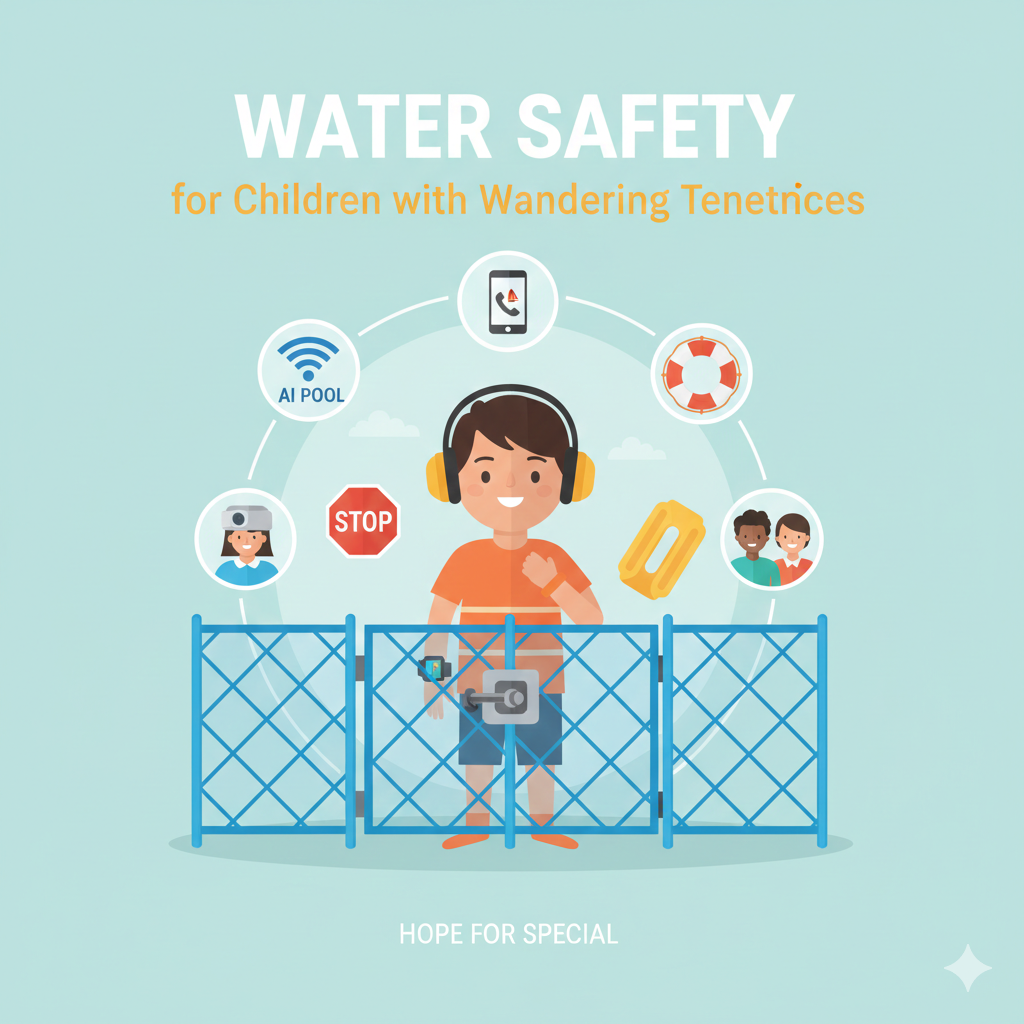
At Hope for Special, we know that “watching them closely” isn’t a strategy—it’s a baseline. True water safety for a child with wandering tendencies requires a high-tech, multi-layered “Command Center” approach that accounts for human error and sensory attraction.

- 1. The “Water Lure”: Why They Wander Toward Danger 🧠
- 2. The 5 Layers of Protection (2026 Updated) 🧱
- I. Secure the Home (Physical Barriers)
- II. Secure the Pool (Mechanical Barriers)
- III. 2026 Safety Tech (Digital Barriers)
- 4. Specialized Learning: Survival Over Strokes 🏊♂️
- 5. The “Neighbor Alert” System: Community as a Safety Net 🏘️
- 6. Personal Story: The Day the Alarm Saved Us 🦋
- FAQs: Long-Tail Water Safety Insights
- What is the best waterproof GPS for wandering children in 2026?
- How do I teach a non-verbal child “Water Safety”?
- Are “Puddle Jumpers” or “Floaties” safe for kids who wander?
- What should I do if my child is attracted to the neighbor’s pond?
- Sources
1. The “Water Lure”: Why They Wander Toward Danger 🧠
Why are children with wandering tendencies (elopement) so drawn to water? It’s rarely about wanting to swim; it’s about sensory input.
- Visual Stimulation: The way light reflects on a pool or pond.
- Repetitive Movement: The rhythmic sound of waves or a fountain.
- Proprioceptive Input: The weightlessness of water provides deep pressure that calms a dysregulated nervous system.
The Crisis Protocol: If your child is missing, search water first. Check your pool, then the neighbor’s pool, then the nearest storm drain or retention pond. Seconds save lives.
2. The 5 Layers of Protection (2026 Updated) 🧱
In 2026, water safety has evolved from simple fences to “Smart Perimeters.” Here is the hierarchy of protection every household must implement:
I. Secure the Home (Physical Barriers)
Don’t just lock the door; secure the exit points.
- High Latches: Install deadbolts at the very top of exterior doors.
- Smart Alarms: Use chimes that alert your smartphone the second a door or window is opened.
- Stop Signs: Many children with autism are rule-driven. A visual “STOP” sign on the exit door can act as a cognitive speed bump.
II. Secure the Pool (Mechanical Barriers)
If you have a pool, it must be an island.
- Four-Sided Fencing: The fence should separate the pool from the house, not just the yard.
- Self-Latching Gates: Ensure the gate opens outward so a child can’t push it open if it doesn’t latch.
III. 2026 Safety Tech (Digital Barriers)
Standard pool alarms are prone to false positives. The 2026 standard is AI-Driven Detection.
| Technology Type | 2026 Recommended Brands | Key Safety Feature |
|---|---|---|
| AI Pool Cameras | CamerEye / SwamCam | Differentiates between a ball and a child; alerts your phone instantly. |
| Wearable Water Sensors | Safety Turtle 2.0 | A wristband that triggers a base station alarm if submerged in water. |
| Waterproof GPS | AngelSense / Jiobit Gen 3 | Provides “Proactive Alerts” if your child leaves a “Safe Zone” near water. |
4. Specialized Learning: Survival Over Strokes 🏊♂️
Traditional swim lessons often fail children with wandering tendencies because they focus on “form.” For our kids, water safety means survival swimming.
ISR (Infant Swimming Resource) vs. Adaptive Lessons
- ISR/Self-Rescue: Teaches the “Roll-to-Float” method. Even if a child falls in fully clothed, they are trained to flip onto their back and breathe until help arrives.
- Adaptive Aquatics: These instructors understand sensory aversions (like goggles) and use visual schedules to teach water boundaries.
Expert Insight: According to 2025 studies, formal swim lessons can reduce the risk of drowning by 88% in young children. However, for neurodivergent kids, these lessons must be consistent and year-round to maintain “muscle memory.”
5. The “Neighbor Alert” System: Community as a Safety Net 🏘️
You cannot be awake 24/7. Your neighbors are your extended eyes. In 2026, “Community Water Safety” is about proactive disclosure.
The neighbor Alert Template
Download and text this to your neighbors:
“Hi, I’m [Name] from [Address]. My child, [Child’s Name], is autistic and prone to wandering. They are very attracted to water and don’t understand the danger. If you ever see them alone, please call 911 immediately and then call me at [Phone Number]. If you have a pool, please double-check your gates today. Thank you for keeping them safe!”
6. Personal Story: The Day the Alarm Saved Us 🦋
“Last summer, my son Leo slipped out of the doggy door while I was unloading groceries. Because we had a water safety sensor on his wrist and an AI camera on the pool, my phone started screaming before he even reached the water’s edge. I caught him three feet from the deep end. The technology didn’t just help; it replaced my eyes when they were elsewhere for thirty seconds.” — Marcus, Hope for Special Parent.
FAQs: Long-Tail Water Safety Insights
What is the best waterproof GPS for wandering children in 2026?
The AngelSense Guardian and Jiobit Gen 3 are the top picks for 2026. They are rugged, waterproof (IP68 rated), and offer “continuous tracking,” which is vital if a child wanders near a fast-moving creek or large lake.
How do I teach a non-verbal child “Water Safety”?
Use Social Stories and Visual Cues. Show them a picture of a pool followed by a “No” symbol unless a parent is holding their hand. Practice “Wait” and “Stop” routines daily, using high-value rewards for compliance.
Are “Puddle Jumpers” or “Floaties” safe for kids who wander?
No. In fact, they can be dangerous. They create a “false sense of buoyancy,” making a child believe they will always float. If they wander into water without the device later, they may jump in expecting to stay above water. Always prioritize USCG-approved Life Jackets for boating, but avoid “swim aids” for daily safety.
What should I do if my child is attracted to the neighbor’s pond?
Visit the neighbor. Explain the elopement risk and ask if you can help them install a simple motion-sensor alarm or a temporary perimeter fence. Most neighbors are happy to help once they understand the water safety implications.
Sources
National Drowning Prevention Alliance (NDPA) – 5 Layers of Protection
This authoritative resource outlines the essential layers of protection required to prevent drowning incidents in residential settings.
AngelSense – Autism Water Safety Guide 2026
A specialized guide on how GPS and wearable technology integrate into an autism-specific safety plan.
ISR – Self-Rescue® Instruction
The official site for Infant Swimming Resource, detailing the survival skills taught to children to prevent drowning.


