

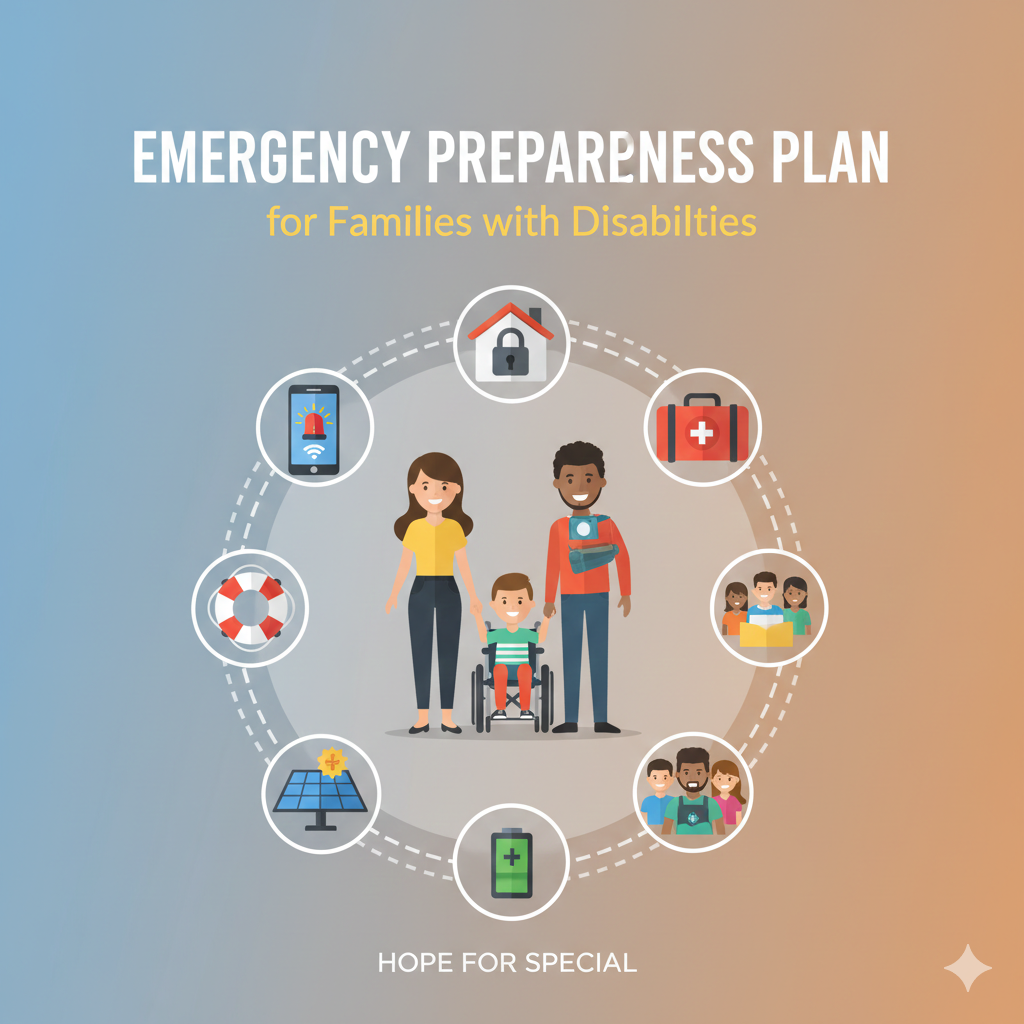
Zero-Failure Emergency Preparedness Plan for Families with Disabilities
Disaster doesn’t discriminate, but its impact does. For families living with disabilities, a “standard” survival guide is often dangerously insufficient. Whether it’s a sudden flood, a prolonged power outage, or a fire evac plan, the stakes are exponentially higher when medical equipment, sensory needs, and mobility challenges are in play.
At Hope for Special, we believe that preparedness in disaster management is the ultimate form of advocacy. In 2026, with climate events becoming more frequent, your emergency preparedness plan must be more than a backpack—it must be a resilient, tech-forward ecosystem.

- 1. The Survival Gap: Why Traditional Plans Fail 📉
- 2. The Critical Pillar: Water Safety During Disasters 🌊⚓
- 3. Creating Your 5-Phase Emergency Preparedness Plan 🧱
- Phase I: The 72-Hour Medical Power Audit
- Phase II: The Sensory Go-Bag
- Phase III: The “Fire Evac Plan” & Mobility Mapping
- 4. The 2026 Tech Advantage: Digital Disaster Management 📱🚀
- 5. Personal Story: The Power of the “Neighbor Mesh” 🏘️🤝
- 6. FAQs: Long-Tail Disaster Management Insights
- What is a “Hospital Preparedness Program” for families?
- How do I create a fire evac plan for a non-verbal child?
- What should be in a disability-inclusive Go-Bag?
- Final Thoughts: The Resilience of the Ready 🕊️
- Sources
1. The Survival Gap: Why Traditional Plans Fail 📉
Statistics show a harrowing reality for the neurodivergent and disabled communities. Traditional disaster management and planning often overlooks the “invisible” barriers of disability.
Disability Disaster Impact Statistics (2025-2026 Data)
| Metric | Impact Statistic | Why It Matters | Source |
|---|---|---|---|
| Mortality Risk | 2–4x Higher | People with disabilities are significantly more likely to perish in disasters. | WID 2025 |
| Plan Awareness | 84% Lack Personal Plans | Most families don’t have a vetted emergency readiness plan. | PrepareCenter 2025 |
| Medical Disruption | 7x Difficulty | Disabled adults are 7x more likely to lose access to meds in a storm. | Urban Institute 2025 |
| Evacuation Difficulty | 57% Report Hardship | Over half of the disabled population cannot evacuate without specialized help. | UNDRR 2024 |
2. The Critical Pillar: Water Safety During Disasters 🌊⚓
While most preparedness for disaster guides focus on storing water, for families with “wandering tendencies” (elopement), water is often the primary threat. During the chaos of a fire evac plan or a flash flood, a child may be drawn to rising waters due to sensory attraction.
The “Search Water First” Protocol
If a child goes missing during an evacuation, the rule is absolute: Search any body of water first.
- Retention Ponds: Often fill rapidly during storms.
- Storm Drains: High-velocity water is a major risk.
- Neighboring Pools: Gates may have been left open during the neighbor’s own flight.
3. Creating Your 5-Phase Emergency Preparedness Plan 🧱
A truly inclusive emergency preparation plan must be tiered. It’s not about the kit; it’s about the flow.
Phase I: The 72-Hour Medical Power Audit
If your family relies on ventilators, CPAP machines, or electric wheelchairs, your emergency plan lives or dies by its power source.
- Solar Generators: In 2026, portable solar units (like Jackery or EcoFlow) are the gold standard for quiet, indoor-safe power.
- The “Manual” Backup: Always keep manual versions of equipment (e.g., a manual resuscitator bag for ventilators).
- Priority Restoration: Ensure you are registered with your utility company’s hospital preparedness program or medical priority list.
Phase II: The Sensory Go-Bag
Disaster shelters are loud, bright, and crowded—a nightmare for sensory-sensitive individuals. Your family emergency plan must include:
- Noise-Canceling Gear: Heavy-duty earmuffs or active ANC headphones.
- Low-Tech Communication: Laminated “Picture Exchange” (PECS) boards for when tablets die.
- Weighted Items: Laminated lap pads to provide deep pressure during the stress of a disaster plan.
Phase III: The “Fire Evac Plan” & Mobility Mapping
An emergency evac plan for a wheelchair user requires pre-vetted routes.
- The “Downstairs” Rule: If possible, sleeping quarters for those with mobility issues should be on the ground floor.
- Evacuation Chairs: For multi-story homes, specialized “stair chairs” can allow one person to safely transport a non-ambulatory family member down stairs.
4. The 2026 Tech Advantage: Digital Disaster Management 📱🚀
Modern emergency readiness plan strategies leverage AI and Smart City tech.
- AI Weather Beacons: Systems that alert you based on your specific geolocation, giving you 15 minutes of “Lead Time” to secure medical devices.
- Water-Activated Beacons: Wearable tech (like Safety Turtle) that alerts you if a child with wandering tendencies touches water during a flood.
- Digital “First Responder” Handshake: Many 2026 apps allow you to pre-upload your family’s “Vulnerability Profile” to local 911 dispatchers.
5. Personal Story: The Power of the “Neighbor Mesh” 🏘️🤝
“When the 2025 flash floods hit our town, our emergency plan wasn’t just about our Go-Bag. It was about our neighbor, Mike. Mike had a key to our house and knew exactly where my daughter’s oxygen tanks were kept. While I was stuck at work, Mike was able to get her and the equipment to a high-ground shelter. Community is the ultimate layer of preparedness in disaster management.” — Elena, Hope for Special Member.
6. FAQs: Long-Tail Disaster Management Insights
What is a “Hospital Preparedness Program” for families?
A hospital preparedness program (HPP) usually refers to regional healthcare coalitions. For a family, it means knowing which local hospitals have the infrastructure (back-up power and specialized staff) to handle your specific disability during a city-wide crisis.
How do I create a fire evac plan for a non-verbal child?
Focus on muscle memory. Use visual “Social Stories” to explain the sound of the alarm. Practice the emergency evac plan with a high-value reward at the end. In 2026, you can also install smart smoke detectors that play a parent’s recorded voice instead of a siren, which is proven to be less triggering.
What should be in a disability-inclusive Go-Bag?
Beyond water and food, you need a 14-day supply of medications, copies of all medical scripts, spare batteries for AAC devices, a laminated “Crisis Communication Card,” and a small “Sensory De-escalation Kit” (fidgets, weighted blanket).
Final Thoughts: The Resilience of the Ready 🕊️
An emergency preparedness plan is a living document. It changes as your child grows, as technology advances, and as medical needs shift. By integrating water safety and disaster management and planning, you aren’t just preparing for the worst—you are ensuring your family’s right to a safe, inclusive future.
Sources
Ready.gov – Emergency Planning for People with Disabilities
The premier federal resource for creating an inclusive emergency readiness plan.
National Autism Association – Big Red Safety Box
A vital resource for families managing wandering tendencies and water safety risks during crises.
CDC – Disability Inclusion in Emergency Preparedness
Comprehensive guidelines on preparedness for disaster for diverse functional needs.


